Data Integration, Sharing, and Management for Transportation Planning and Traffic Operations (2025)
Chapter: 12 Shared Mobility Data: A Resource Guide
CHAPTER 12
Shared Mobility Data: A Resource Guide
Introduction
This chapter provides readers with an overview of the public-sector applications of shared mobility data and directs them to information sources where additional detailed information can be found on specific topics of interest. It includes summaries of relevant literature and online documents; sample documents and agreements relating to provision, management, and sharing of shared mobility data; relevant data standards and open-source software related to these standards; organizations that are active in these topic areas; and examples of public datasets and dashboards provided by public agencies across the country.
Background
Shared mobility is “the shared use of a vehicle, motorcycle, scooter, bicycle, or other travel mode; it provides users with short-term access to a travel mode on an as-needed basis” (SAE J3163_201809). Its scope includes micromobility services such as bikesharing and electric scooter services, as well as car sharing, microtransit, paratransit, transportation network companies (TNCs), and traditional ride-hailing (taxi) services.
Shared mobility services have grown rapidly within just a few years. They help solve the last mile problem by providing links to and from mass transit stations and can replace car trips. They also may substitute for walking and transit trips. Some shared services can address longer trips, such as the use of microtransit, where there is insufficient demand for efficient use of fixed route transit, or car-sharing services, for occasional or periodic trips where a car is desirable.
When available, public agencies use the data from these providers for operations, planning and analysis, and enforcement. Operations applications include evaluating performance and deal with subjects such as vehicle utilization, vehicle caps, prohibited zones for operations or parking, and identifying areas that may be under- or overserved. Planning and analysis applications examine how the service fits into the larger transportation ecosystem and include using data to understand demand patterns for shared mobility, what physical infrastructure is being used (e.g., for parking), what routes are being taken (and, hence, where new bicycle infrastructure might be suitable), what the right price for curb space is, and the relationship with transit stations. Enforcement activities involve monitoring and auditing provider operations to ensure that both mobility providers and their customers are complying with established regulations. Specific activities may include determining whether service providers are accurately reflecting the status of their fleets, how well providers are rebalancing and maintaining their fleets, and when and where people are riding scooters in prohibited areas. In addition, there are topics of interest that cut across these application areas. Crosscutting topics include data sharing policies and practices (including privacy protection), the use of third parties for data management and analysis, and topics closely related to shared mobility, such as curb management.
Just as some cities were taken by surprise by TNCs and struggled to put in place regulatory frameworks, many localities have had the same experience with dockless bikes and scooters. There is a clear need for public agencies to have data to better understand how all these services fit into the overall transportation network. However, there is tension between public agencies and service providers over the sharing of data. Shared mobility providers possess proprietary data as well as personally identifiable information (PII) relating to their customers. They understandably wish to protect these data. At the same time, the public sector needs some of the data in sufficient detail and with sufficient timeliness to fulfill its operations, planning, and enforcement functions. This has created tension and a lack of trust. There is a need for model data governance agreements, adequate protection of proprietary and personal data, and a better understanding of needs and issues between the public and private sectors to increase trust.
There is also a variation in the amount of standardization and data sharing across the many shared mobility modes. For example, the General Bikeshare Feed Specification (GBFS) (NABSA n.d.) and the Mobility Data Specification (MDS) (OMF n.d.-d) provide a fairly comprehensive, widely used standard for micromobility data, but no similar standards yet exist for TNCs or other shared mobility services. State and local data-reporting laws are often also very different for micromobility and TNC operators.
Purpose and Intended Audience
The purpose of this chapter is to provide public-sector agencies with a curated guide to resources to help them plan for, manage, and utilize shared mobility data. The guide is intended not to be a comprehensive encyclopedia, but rather to provide an overview on the data management needs related to each topic and provide readers with summaries of resources where more detailed guidance and reference information can be found. The content of each resource is categorized and summarized to enable readers to determine those that best address their specific issues.
The primary intended audience includes management and staff of public agencies responsible for shared mobility, including those that use data for regulating shared mobility operations and those who use this type of data for broader planning purposes, such as implementing bike lanes or integrating shared mobility with transit operations. Both agencies that are taking on the challenge of internally managing shared mobility data and those looking to contract these services out to a third party will find material to assist them.
Scope and Organization
The organization of this chapter is intended to help readers easily locate the specific sections relevant to their topics of interest. More than 40 resources on data management are summarized in this chapter. Some of the summaries also list additional related resources. The bulk of the resources deal with micromobility; however, many of these have information or recommendations that are equally applicable to other shared mobility services, such as TNCs, ride hailing, and microtransit. The following topic areas are covered:
- Applications:
- Operations,
- Planning and analysis, and
- Enforcement.
- Crosscutting practices:
- Data sharing policies and practices,
- Use of third parties for data management,
- Communicating with the public, and
- Curb management.
The next section of the chapter discusses each of the seven topic areas, and the discussion of each topic area is accompanied by a table that lists all the resources for that topic by type of resource. The section on topic areas is followed by the catalog of resources, the primary section of the guide. The resources are organized according to type, as follows:
- Literature or online resource,
- Sample document or agreement,
- Standards effort or software tool (grouped together because standards efforts almost always include software tools that support their implementation and use),
- Organization, or
- Dataset.
For each resource, the following information is given: title, author (if applicable), type of resource, where to obtain it, topic areas covered, a short summary of the content, and a more detailed description. In some cases, links to additional closely related resources are also provided.
The references cited are listed at the end of the chapter.
Topics
This section provides a summary of each topic and a cross-reference to the resources that contain information on each topic. The two broad topic categories are applications, which are the primary reason the data are needed and why they are analyzed, and crosscutting practices.
Applications
Applications can be further divided into operations, planning and analysis, and enforcement.
Operations
This application topic deals with the day-to-day operations of shared mobility services, which include monitoring and managing the total number of vehicles in operation and vehicle utilization and identifying under- or overserved areas. Operational questions that an agency might seek to answer include the following:
- How does the driver pay rate change on the basis of trip type, location, and time of day?
- Where/when are there clusters of vehicles? (Vehicles, particularly micromobility vehicles, are sometimes referred to as “devices” in the literature. The term “vehicle” is used throughout this guide to refer to all types of shared mobility vehicles and devices, both powered and unpowered, ranging from bicycles and e-scooters to shared automobiles and microtransit vehicles.)
- When/where are there not enough vehicles in an area? When/where are there too many?
- How many vehicles are on the street but unavailable because of a maintenance issue or low battery?
- Which parts of the city are served by ride-hail services and micromobility?
- Were dockless micromobility or ride-hail vehicles involved in crashes?
The data that are needed include
- The total number of vehicles deployed as well as in-use by each operator,
- The distribution of vehicles by geographic area and by time,
- The number of trips taken per vehicle per day and their origins and destinations,
- Accident reports, and
- Surveys of user satisfaction.
In addition to collecting data from service providers, public agencies also need to provide data to service providers. Especially with regard to dynamic information, there is a benefit to standardizing and automating this information flow, and the MDS is one standard that addresses this need. The types of information that may flow from agencies to service providers include
- Areas where usage is forbidden,
- No-parking areas,
- Areas with reduced speed regulations,
- Preferred parking locations, and
- Temporary rules to address both planned and unplanned events, as well as emergencies.
However, apart from MDS, there is little other material addressing the information flows from public agencies, and most of the references in this guide deal only with information coming from service providers.
Resources for the topic of operations are indexed by type in Table 12-1.
Planning and Analysis
This topic deals with issues that are more long term than daily operations as well as broader topics, such as transportation planning, overall impact on the streets or city, or the impact of micromobility on street design. Following are some questions that public agencies may seek to answer:
- What are the impacts on street and sidewalk safety?
- What is the impact on economic development?
- How do ride-hail services and micromobility trips relate to existing transit services?
- Which routes/streets are most used by people on shared micromobility vehicles?
Table 12-1. Resources on the topic of operations, by type of resource.
| Literature and Online Resources | Sample Documents and Agreements | Standards Efforts and Software Tools | Organizations | Datasets |
|---|---|---|---|---|
|
None specific to this topic |
|
|
None specific to this topic, though some may contain data elements useful for analyzing operations |
- How efficiently are ride-hail services using the streets?
- What share of total transportation emissions and local air pollution is coming from ride-hail services?
- How do vehicle utilization and pooling relate to congestion by geography?
- How many nonrevenue vehicle miles traveled occur on the street (e.g., Lyft/Uber deadheading or rebalancing dockless micromobility vehicles)?
- What is the right price for curb space?
Data on usage, demand, and trip-level can be used to determine the location of new bike/scooter lanes and vehicle parking areas and to allocate curb usage, all of which provide value to the service providers as well as the general community. Another area of interest for most localities is the interrelationships and interactions between various shared mobility modes and public transit operations, such as the use of shared mobility to address last mile issues or the extent to which shared mobility services compete with transit for usage and ridership. These types of analyses can help service providers demonstrate the value that they are providing to the community.
Along with other data sources, the specific types of data from mobility providers that might be needed include time-dependent origin–destination data, routes taken, trip duration, number of vehicles by service type and status within specified geographic and time boundaries, number of trips taken per vehicle per day, and parking area usage.
Resources for planning and analysis are indexed by type in Table 12-2.
Enforcement
These types of applications include enforcing both service provider and user compliance with regulations. The two are interrelated, as enforcement policies may hold the service provider
Table 12-2. Resources on the topic of planning and analysis, by type of resource.
| Literature and Online Resources | Sample Documents and Agreements | Standards Efforts and Software Tools | Organizations | Datasets |
|---|---|---|---|---|
|
None specific to this topic |
|
|
None specific to this topic |
responsible for the actions of its users. These policies may include regulations related to operations in restricted areas, speed violations, parking or riding on sidewalks, and restricted hours of operation.
This topic also includes information needed to calculate any fees due from operators, which may be based on the number of vehicles deployed, the number in use per day, or other criteria.
Another important aspect of enforcement and fee collection is verifying the accuracy of provider data with independently measured ground truth data to identify and resolve discrepancies. This can include using check rides, independent observations, and data auditing tools.
Resources for enforcement are indexed by type in Table 12-3.
Crosscutting Practices
Crosscutting practices discussed in this section include the following:
- Data sharing policies and practices,
- Use of third parties for data management,
- Communicating with the public, and
- Curb management.
Data Sharing Policies and Practices
This topic deals with data sharing agreements and policies that public agencies put in place for getting data from shared mobility providers and storing and using that data as well as how private and proprietary data will be protected. In some cases, the requirements are included in operating agreements, permits, or licenses, while in other cases they are separate documents incorporated by reference. They may cover items such as what data must be reported, how frequently, and in what format(s); allowed uses for the data; who owns the data; and requirements for privacy protection.
Most of the material available in this area addresses micromobility services rather than other forms of shared mobility such as TNCs. This came about for a combination of reasons. First, micromobility services came later, and, by that time, cities were better prepared and had a better understanding of what information they needed as well as the legal structures to insist that it be provided. In addition, at the urging of TNCs, several states preempted the ability of local
Table 12-3. Resources for the topic of enforcement, by type of resource.
| Literature and Online Resources | Sample Documents and Agreements | Standards Efforts and Software Tools | Organizations | Datasets |
|---|---|---|---|---|
|
None specific to this topic |
|
|
None specific to this topic, though some may contain data elements useful for enforcement |
governments to collect data from TNCs. Despite this, TNCs and traditional ride-hailing (taxi) operators may have similar data sharing requirements. For example, Seattle specifies the data that must be collected by taxicab associations, for-hire vehicle companies, and TNCs. The regulations cover what data must be collected, the data retention requirements (2 years), and the reporting requirements (quarterly) (City of Seattle, WA n.d.). Similarly, the California Public Utilities Commission lays out annual reporting requirements for TNCs (California Public Utilities Commission n.d.) and the New York City Taxi and Limousine Commission (TLC) requires regular reporting by both TNCs and ride-hailing companies (New York City TLC n.d.).
Resources for data sharing policies and practices are indexed by type in Table 12-4.
Use of Third Parties for Data Management
This topic is closely related to and overlaps with data sharing policies and practices but is distinct enough to warrant being called out into a separate topic. Third parties are hired by the public agency. They have experience working in multiple cities and with multiple service providers, which enables them to often have a better understanding of the issues relating to data than a public agency. These third parties can audit data provided by operators and ensure that consistent definitions are used for reporting. The use of third parties to obtain, store, and analyze shared mobility data is also one method for resolving the tensions between providing information that is adequate for public agencies to perform their functions while ensuring adequate protection of private and proprietary information.
Public agencies have a legitimate need for data to effectively plan their transportation systems, to develop regulations for the best use of shared mobility, and to enforce those regulations. Some of this analysis requires the use of the type of trip-specific information that raises privacy concerns. At the same time, the collection, storage, and use of such data by public agencies raises multiple legitimate concerns. Some agencies, especially smaller ones, may simply lack the specific skills and resources needed to effectively manage and analyze the large volumes of data. In addition, some datasets, such as trip-specific data, raise privacy concerns that require special handling, for which requirements sometimes come into conflict with existing state freedom-of-information laws. This occurs because, although location-specific data are not considered (PII), such data can often be combined with other public data to enable re-identification and, thereby, reveal sensitive information about individual activities. Some existing state laws do not adequately protect such data from Freedom-of-Information Act (FOIA) requests or other types of disclosure. Finally, the mobility providers themselves are rightfully protective of their proprietary data as well as their customers’ privacy and see risks with sharing data with public-sector agencies, since disclosure to competitors could harm their business. Care must be taken even with aggregate data to ensure that they cannot be disaggregated (e.g., if there are only two providers for a given service type).
One approach for dealing with these issues is for an agency to contract with a trusted third party to manage and analyze the data. These third parties receive raw data from mobility providers but do not provide the raw data to government agencies or to any other organizations. They securely store whatever data need to be kept and conduct the analyses that public agencies need to manage mobility providers. The public agencies receive the results of the analyses along with anonymous aggregated data. There are currently nonprofit universities and private for-profit corporations providing these services.
Resources for the use of third parties for data management are indexed by type in Table 12-5.
Communicating with the Public
This topic covers the use of information to communicate with the public as well as elected government officials, community groups, and researchers. This communication may include
Table 12-4. Resources for the topic of data sharing policies and practices, by type of resource.
| Literature and Online Resources | Sample Documents and Agreements | Standards Efforts and Software Tools | Organizations | Datasets |
|---|---|---|---|---|
|
|
|
|
|
Table 12-5. Resources for the topic of use of third parties for data management, by type of resource.
| Literature and Online Resources | Sample Documents and Agreements | Standards Efforts and Software Tools | Organizations | Datasets |
|---|---|---|---|---|
|
None | While standards and tools may be used by public and private agencies, none that relate specifically to the interface between public agencies and third parties providing data management as a service |
|
None that relate specifically to the exchange of data between public agencies and third parties providing data management as a service |
publishing real-time availability data for various services as well as providing aggregated data, dashboards, and reports that show how shared mobility services are being used throughout the jurisdiction. This topic also includes collecting, investigating, and resolving resident complaints related to operations, parking, speeding, and so forth and may include the use of user surveys to collect information from the public.
Resources for communicating with the public are indexed by type in Table 12-6.
Curb Management
Curb management and the geotagged digitization of curb usage and regulations is a topic of growing importance for towns and cities. Its applications are far broader than shared mobility, but, because of its important role within shared mobility, it has been included as a topic.
Table 12-6. Resources for the topic of communicating with the public, by type of resource.
| Literature and Online Resources | Sample Documents and Agreements | Standards Efforts and Software Tools | Organizations | Datasets |
|---|---|---|---|---|
|
None specific to this topic |
|
|
|
Table 12-7. Resources for the topic of curb management, by type of resource.
| Literature and Online Resources | Sample Documents and Agreements | Standards Efforts and Software Tools | Organizations | Datasets |
|---|---|---|---|---|
|
None specific to this topic |
|
|
None specific to this topic |
Curb space is a limited resource with increasing demands for use as pick-up and drop-off space for both people and goods, scooter corrals, and other uses. Multiple communities are digitizing the data associated with curb rules as well as fees that some communities are beginning to charge for curb access. The data include the georeferenced rules and regulations applying to various sections of curb in a municipality, as well as to pricing of curb access, whether for parking, pick-up and drop-off, or the delivery of freight.
One example is Los Angeles’ Code the Curb initiative, which was launched in 2016 (LADOT n.d.). Code the Curb provides a digital, geocoded reference for all the city’s traffic signs, painted curbs, and other regulatory tools. Private-sector and nonprofit entities are also working in this area. SharedStreets, for example, has created CurbLR, a proposed standard for describing curb regulations such as those in the Code the Curb initiative (SharedStreets n.d.-a). Safari AI works with public agencies and delivery operators to better manage, coordinate, and schedule curb access (Safari AI 2024). The Open Mobility Foundation has also begun to look at developing a common specification as part of the MDS for digitized curb data and is coordinating with SharedStreets (OMF 2020a), among numerous other public agency and private-sector stakeholders.
Resources for curb management are indexed by type in Table 12-7.
Resources
This section provides a short description of each resource, including its title and author, the type of resource, where to obtain it, and the topic areas covered, and a short summary of the content. In some cases, information on additional related resources is also provided.
Literature and Online Resources
This section catalogs articles and websites on shared mobility data management. The resources, which range from short articles or summaries to extensive guides, are as follows:
- A Practical City Guide to Mobility Data Licensing
- Mobility Brief #2: Micromobility Data Policies: A Survey of City Needs
- Data Sharing Glossary and Metrics for Shared Micromobility
- Guidelines for Mobility Data Sharing Governance and Contracting
- Privacy Guide for Cities
- Mobility Data State of Practice
- Leveraging Data to Achieve Policy Outcomes
- Urgent Privacy Concerns with City’s Decision to Collect Traveler Mobility Location Information
- Civic Analytics Network Dockless Mobility Open Letter
- Brief for Justin Sanchez and Eric Alejo v. Los Angeles Department of Transportation and the City of Los Angeles
- Objective-Driven Data Sharing for Transit Agencies in Mobility Partnerships
- Mobility Data Methodology and Analysis
- Dockless Open Data
- Managing Mobility Data
- Shared Mobility Data: A Primer for Oregon Communities
- Shared Mobility Data Sharing: Opportunities for Public–Private Partnerships
- Protecting Rider Privacy in Micromobility Data
- Prioritizing Privacy When Using Location in Apps
- Using Micro-Mobility Data to Drive Transportation Policy Investments in Greater Boston
- Effectively Managing Connected Mobility Marketplaces
- CDS-M Use Case: From Policy Needs to Use Cases
- Charlotte Takes E-Scooter Data for a Test Ride
Resource: A Practical City Guide to Mobility Data Licensing
Author: Jascha Franklin-Hodge
Date: 2019
URL: https://medium.com/remixtemp/city-guide-to-mobility-data-licensing-71025741ae2c
Description: Short online article.
Summary: The article provides guidance, from a public agency’s perspective, on drafting data sharing agreements. Topics covered include types of licenses, considerations regarding the right to further share data, and integration with data from other sources. The author is the former chief information officer for the City of Boston and is currently the executive director of the Open Mobility Foundation.
Topic Area(s):
Data Sharing Policies and Practices
Use of Third Parties for Data Management
Resource Type:
Literature or Online Resource
The article does not provide specific language for agreements; rather, it provides specific recommendations on what should be considered for inclusion in any agreement as well as what should be avoided. The information is presented on a topic-by-topic basis.
This article is an excellent resource for understanding the importance of data sharing agreements and identifying what public agencies should and should not include when drafting, reviewing, or entering into any sort of data sharing agreement with private-sector mobility providers regarding sharing mobility data.
Additional Details: The recommendations are divided into three major parts, each of which includes several focus areas. The article discusses the various types of licenses and recommends that data sharing agreements be either embedded in permit agreements or incorporated by reference. It also recommends the use of a standard agreement with all providers rather than negotiating different agreements with each provider. Other topics discussed include but are not limited to the following:
- Rights of use;
- Access to raw versus preaggregated data—ability to share data with other public agencies, third-party data management organizations, and the public;
- Integration with other datasets;
- Requirements on the public agency to adequately protect the data;
- Privacy protection;
- Relations of the data to state-level freedom-of-information laws; and
- Liability issues.
Additional Resources: An Updated Practical City Guide to Mobility Data Licensing (Zack 2019).
Resource: Mobility Brief #2: Micromobility Data Policies: A Survey of City Needs
Author: Michael Migurski
Date: 2018
URL: https://medium.com/remixtemp/micromobility-data-policy-survey-7adda2c6024d
Description: Ten-page survey of data sharing policies across multiple U.S. cities.
Summary: The author surveyed the data sharing policies of more than a dozen U.S. cities, including Nashville, TN; Chicago, IL; Santa Monica, CA; San Francisco, CA; Pittsburgh, PA; Austin, TX; and Dallas, TX. Some of these cities had pilot programs, some had postpilot operational programs, and one had an emergency data sharing rule in place.
Topic Area(s):
Data Sharing Policies and Practices
Resource Type:
Literature or Online Resource
On the basis of the survey results, the author identified four major findings:
- Universal agreement on the need for trip data and fleet availability data,
- A wide range of requirements regarding the frequency of data reporting,
- Multiple approaches for handling customer feedback information, and
- The need for formal data sharing agreements.
Note that at the time the survey was conducted, the MDS was a newly emerging standard being developed by the Los Angeles Department of Transportation (LADOT). The subsequent widespread adoption of the MDS may change some of the findings.
Additional Details: The report includes a comprehensive table of 12 cities and the types of data collected by each city (trips, fleet, customer survey, parking, maintenance, safety/incidents, and data validation). All 12 cities required trip data, and 11 of the 12 required fleet data. Only two specifically addressed data validation.
For trip and fleet data, the report provides details, walking through an overview of the findings, why the data type is important, and how it is being collected across the surveyed cities. The results for the other data types are covered more briefly. In addition, there is a good discussion on reporting frequency and the use of application programming interfaces (APIs) versus static, periodic reports. Since the report was published, the widespread adoption of the MDS makes the case for APIs even stronger than what is included in the report.
Additional Resources: None.
Resource: Data Sharing Glossary and Metrics for Shared Micromobility
Author: Mobility Data Collaborative
Date: 2020
URL: https://www.sae.org/standards/content/mdc00002202004/
Description: Glossary that “provides a consensus-based set of definitions for terms and metrics that are commonly used. It outlines key vehicle, trip, and geospatial definitions and metrics to reduce discrepancies in the terminology used across jurisdictions and sectors and allow public agencies to clarify policies related to shared micromobility.”
Topic Area(s):
Data Sharing Policies and Practices
Operations
Policy and Analysis
Resource Type:
Literature or Online Resource
Summary: The 19-page glossary focuses on vehicle and trip-level data. It provides standardized, often hierarchical, definitions of terms as well as vehicle-based and trip-based performance metrics and standardized methods for calculating these metrics.
Additional Details: The definitions are short textual descriptions in English. For example, vehicle is “a motorized or human-powered vehicle [that] could include an automobile, motorcycle, (e-)bike, e-scooter, or moped that is used for transportation.” At the highest level, a vehicle may be in “Deployed,” “Removed,” or “Unknown” status. Deployed vehicles may be “Operational” or “Non-Operational.” Operational Vehicles may be “In-Use” or “Available.” Both “Available” and “Non-Operational” vehicles are in the “Idle” state.
To fully define vehicle and trip terms, several geographic terms (e.g., “service area,” “waypoint”) and time-related terms (e.g., “available time,” “operational time”) are also defined.
The glossary then defines many vehicle and two trip-based performance metrics and presents mathematical formulas for how they should be calculated. For example, the average number of vehicles of a specified status in a specified geographic area over a specified time is given as
where
avgveh = average number of vehicles of a specified status,
vehi = number of vehicles of a specified status at i,
i = sampling frequency (e.g., time units in minutes), and
T = time of interest (i.e., total number of i samples).
Additional Resources: None.
Resource: Guidelines for Mobility Data Sharing Governance and Contracting
Author: Mobility Data Collaborative
Date: 2020
URL: https://www.sae.org/standards/content/mdc00001202004/
Description: Recommended guidelines for data sharing.
Summary: Presents recommended guidelines for data sharing that consider the goals of both public agencies and mobility service providers as well as the need to protect consumer privacy.
Topic Area(s):
Data Sharing Policies and Practices
Use of Third Parties for Data Management
Resource Type:
Literature or Online Resource
This resource is a short (10-page) document intended to be used as discussion input when specific agency policies and agreements are being formulated across disciplines (e.g., planning, legal, policy, data, and information system professionals).
Additional Details: The document lays out 10 guidelines, defines each guideline’s objective, and provides actionable recommendations to which all parties should commit. The discussion, however, is at a rather high level as opposed to including specifics. The 10 guidelines are as follows:
- Address benefits and challenges associated with mobility data sharing.
- Evaluate consumer-facing risks through standard impact assessments.
- Consider anonymization and de-identification techniques for mobility data sharing.
- Engage consumer groups in conversations about privacy and mobility data.
- Establish data governance frameworks to support mobility data sharing.
- Determine and incorporate appropriate role of third parties around management and analysis of mobility data.
- Develop a consistent approach to open records requests.
- Develop policies for compliance with law enforcement requests.
- Allocate resources for training on applicable laws and best practices for safeguarding data.
- Develop workable liability frameworks to mitigate risks.
Additional Resources: None.
Resource: Privacy Guide for Cities
Author: Open Mobility Foundation
Date: 2020
Description: Fourteen-page guide to aid cities in developing policies and procedures for managing sensitive mobility data, particularly data collected using the MDS.
Summary: While MDS data, as well as most shared mobility data collected by public agencies, contain information about vehicles rather than individuals, there are risks that these data could, in combination with other data, be used to re-identify individual users and violate their privacy. This publication provides specific recommendations on factors, policies, and techniques to consider for protecting privacy.
Topic Area(s):
Data Sharing Policies and Practices
Use of Third Parties for Data Management
Communicating with the Public
Resource Type:
Literature or Online Resource
Additional Details: After explaining why MDS and similar shared mobility data should be considered sensitive, the guide addresses five major topics, most of which are further broken down into subtopics:
- Planning Your Implementation:
- Identify Your Use Cases,
- Review Applicable Laws and Regulations,
- Assess Your Readiness,
- Consider a Mobility Data Solution Provider (MDSP), and
- Provide for Transparency;
- Managing Risk:
- Minimization,
- Retention,
- Access Controls, and
- Obfuscation and Aggregation;
- Working with Mobility Service Providers;
- Sharing MDS Data:
- Sharing Through Open Data Portals,
- Sharing with MDSPs,
- Sharing with Academic Institutions or Researchers, and
- Sharing with Other Agencies; and
- Disclosure Based on Public Records Requests.
Additional Resources: None.
Resource: Mobility Data State of Practice
Author: Open Mobility Foundation
Date Accessed: January 26, 2021
Description: Set of links to policy and technical resources relating to the handling and protection of shared mobility data.
Topic Area(s):
Data Sharing Policies and Practices
Use of Third Parties for Data Management
Communicating with the Public
Resource Type:
Literature or Online Resource
Summary: This document provides a collection of links to diverse resources organized by topic. These include samples of data licensing and policy documents from various localities, guidance and methodology guides, open-source software, risk assessment documents, open mobility datasets, guides for publishing mobility data, and data visualizations.
Additional Details: The document provides a wide-ranging categorized list of resources, some of which are included in this chapter, but many of which are not. The content ranges from sample policies [e.g., the LADOT Data Protection Principles (City of Los Angeles, CA 2019)], to sample permit requirements [e.g., Louisville, KY’s, Dockless Vehicle Policy (City of Louisville, KY n.d.-a)] to data protection methodologies [ranging from Minneapolis, MN’s mobility-specific Mobility Data Methodology and Analysis (City of Minneapolis, MN n.d.) to the National Institute of Standards and Technology’s general De-Identification of Personal Information (Garfinkle 2015)], to open source code (e.g., interface for retrieving anonymized and aggregated dockless mobility trip data, deployable reference implementation for working with MDS data, front-end for ingestion and analysis of MDS data), and more, including a half dozen open mobility datasets, guides for publishing mobility data, and examples of data visualizations. Unlike this chapter, only the source and title are identified, without any descriptions. The categories of resources are as follows:
- Privacy principles, policies, and guidelines;
- Permit and licensing requirements;
- Data sharing;
- Data processing, aggregation, and anonymization;
- Risk assessment;
- Open data;
- Data visualization; and
- Outreach and education.
Additional Resources: None.
Resource: Leveraging Data to Achieve Policy Outcomes
Author: New Urban Mobility alliance (NUMO)
Date Accessed: March 2, 2021
URL: https://policydata.numo.global/
Description: Interactive web-based tool for cities to use in evaluating micromobility services against policy goals that foster safe, sustainable, and equitable communities.
Topic Area(s):
Planning and Analysis
Operations
Enforcement
Communicating with the Public
Resource Type:
Literature or Online Resource
Summary: This document is a tool for identifying metrics addressing equity, safety, environment, and usage. It defines outcomes, metrics for each outcome, the data required for each metric, and the data source.
Additional Details: The guide covers metrics for a dozen outcomes:
- Access to necessities,
- Infrastructure,
- Operations,
- Access to platforms,
- Observation and enforcement,
- Lifespan,
- Access to vehicles,
- Vehicle condition,
- General usage,
- Safety,
- Environment, and
- Education.
For each outcome, the following is provided: a short definition; one or more questions to answer to assess the outcome measure; and evaluation, policy, and equity metrics that relate to each question. The data required for each specific metric are then identified. For example, one question under access to vehicles is “How far does the average user have to travel to find a vehicle?” A policy metric associated with that question is the “percentage distribution coverage” (total area covered by a quarter-mile radius around each vehicle divided by the total service area). A goal might be “50% coverage 75% of the time.” The data required would be
- device_id,
- event_type,
- event_location,
- service area spatial file,
- event_time,
- event_type_reason, and
- neighborhood spatial file.
All but the two spatial files are data that are specified in the MDS. The spatial data are expected to be found in a locality’s open data.
Additional Resources: Micromobility & Your City Webinar: Leveraging Data to Achieve Policy Outcomes (NUMO 2020).
Resource: Urgent Privacy Concerns with City’s Decision to Collect Traveler Mobility Location Information
Author: Center for Democracy and Technology
Date: 2020
Description: Two letters from the Center for Democracy and Technology—one to the District (Washington, DC) Department of Transportation (DDOT) and the other to the LADOT—raising privacy issues and concerns with data provided by using the MDS.
Topic Area(s):
Data Sharing Policies and Practices
Resource Type:
Literature or Online Resource
Summary: The first letter expresses concerns over DDOT’s decision to require trip reporting via MDS and to require the data to be reported in near real time. The letter references the second letter to LADOT, which goes into much more detail, with references, over the privacy concerns raised by the collection of detailed trip-level data and makes specific policy recommendations.
Additional Details: The first letter cites the U.S. Supreme Court’s finding that time-stamped location data “provides an intimate window into a person’s life, revealing not only his particular movements, but through them his ‘familial, political, professional, religious, and sexual associations.’ ” It urges DDOT to use aggregated data to meet its needs for planning data.
The second letter acknowledges LADOT’s recognition that data collected via the MDS should be classified as “confidential” data under the city’s information handling guidelines but calls on LADOT to be more specific as to how the data will be safeguarded, including data retention policies; the uses to which the data will be put; and how access will be controlled. The letter cites specific examples, with references, on how confidential location-specific data can and have been misused and explains why trip data raise serious privacy concerns. The letter then lays out specific privacy policy recommendations for the city to consider.
Additional Resources: None.
Resource: Civic Analytics Network Dockless Mobility Open Letter
Author: Civic Analytics Network
Date Accessed: December 2018
URL: https://datasmart.hks.harvard.edu/news/article/civic-analytics-network-dockless-mobility-open-letter
Description: Short letter authored by chief data officers from 13 urban municipalities laying out recommendations both on dockless mobility policies in general and data policies in particular.
Topic Area(s):
Data Sharing Policies and Practices
Use of Third Parties for Data Management.
Communicating with the Public
Resource Type:
Literature or Online Resource
Summary: The letter provides a set of recommendations for communities that are embarking on micromobility programs. It discusses the types of reporting that should be required; what types of data should be made available to the public; how privacy should be maintained through data aggregation before publishing data; and more general recommendations, such as recommendations related to equity, compliance tracking, and the use of surveys. The guidance is specific but not comprehensive.
Additional Details: Interestingly, this letter recommends against the use of third parties for data management and lists a variety of reasons for this recommendation. This recommendation runs counter to all other references included in this chapter that address the topic. All the other references recommend that this option at least be given consideration, depending upon the circumstances of the locality.
The letter includes a link to a public spreadsheet showing the various fees that cities charge providers of dockless mobility services, including per-vehicle fees, annual fees, application fees, and bonding requirements. As of February 2021, 20 communities were listed. It is not clear how up to date the spreadsheet is, but many of the rows include online links to the original sources.
The letter also recommends considering that service providers be required to distribute a city-designed survey to their users to provide insight into behavior patterns, preferences, and customer satisfaction. The survey used by Portland, OR, is linked to and recommended as a good model.
Additional Resources:
- Dockless Vehicle Fees, a spreadsheet of vehicle fees by community (Civic Analytics Network n.d.).
- 2018 E-Scooter Findings Report (City of Portland, OR 2018).
Resource: Brief for Justin Sanchez and Eric Alejo v. Los Angeles Department of Transportation and the City of Los Angeles
Authors: M. Tajsar, J. Snow, J. Lynch, D. E. Mirell, and T. J. Toohey
Date: 2020
URL: https://www.eff.org/document/sanchez-v-ladot-complaint
Description: Legal brief challenging the legality of LADOT requiring the provision of detailed, location-specific trip data from dockless mobility providers.
Topic Area(s):
Data Sharing Policies and Practices
Resource Type:
Literature or Online Resource
Summary: The brief challenges the legality of the collection of these data under the Fourth Amendment to the U.S. Constitution, the California state constitution, and the California Electronic Communication Privacy Act (CalECPA).
The brief is included in this chapter because it provides an excellent, detailed discussion of the privacy concerns raised by the collection of detailed, location-specific trip data, including numerous references that further demonstrate or discuss these concerns. It is included for its comprehensive discussion of legitimate privacy issues rather than the legal arguments.
Additional Details: The legal brief explains how location-specific individual trip data can be combined with other, publicly accessible data (such as who lives at a given address or what business is at an address) to reveal both the individual who took the trip and why the trip was taken (e.g., to visit a reproductive health clinic). The brief explains that these data are sensitive regardless of whether they are collected in real time or provided after the fact.
The brief also provides examples of how such de-anonymized data can harm an individual and examples of how location information has been abused in the past, as when automatic license plate reader information was used by stalkers and domestic abusers. Citations to research and reports with additional detail are provided.
Additional Resources: In February 2021, this case was dismissed on legal grounds by the judge, who ruled that collecting MDS data did not constitute a search in legal terms and that, even if it did, it was not an unreasonable one. As of June 2021, that ruling was being appealed. See Justin Sanchez et al. v. Los Angeles Department of Transportation, et al. (Gee 2021).
Resource: Objective-Driven Data Sharing for Transit Agencies in Mobility Partnerships
Author: Shared Use Mobility Center
Date: 2019
Description: Twenty-five-page white paper intended to support the decision-making of
Topic Area(s):
Data Sharing Policies and Practices
Use of Third Parties for Data Management
Operations
Analysis
Resource Type:
Literature or Online Resource
transit agencies that are considering implementing mobility on demand (MOD) or a similar integration with private mobility service providers, with a focus on data exchange requirements.
Summary: The paper outlines the types of information transit agencies might need, depending upon the type of project and its objectives. The paper then discusses the challenges that agencies have faced in attempting to obtain the data, including concerns over privacy, proprietary data, security, level of aggregation, data needed for the National Transit Database and to support federal funding, and the limitations of the agencies’ capabilities.
The paper then presents project-level, regulatory, and legislative options for overcoming these challenges. It includes a decision tree to aid agencies with sequential decision-making to determine the best approaches based on project type, project objectives, and constraints.
Additional Details: The paper states that reaching data sharing agreements between the public and private partners was one of the primary challenges of projects under FTA’s MOD Sandbox Program (FTA n.d.). Throughout the paper, specific MOD Sandbox projects are discussed as examples of data needs, challenges, and solutions. Much of the content is based on lessons learned from the MOD Sandbox Program.
The decision tree at the end of the paper addresses two types of projects: MOD service projects and Multimodal Trip Planning App (Smart Columbus n.d.) projects. Project- and policy-level decisions are identified in the tree, and the advantages and disadvantages of each decision are presented in a table. Decisions include whether to pursue modernizing public record laws, whether to manage data in-house versus by using a third party, and whether to establish a common API or pursue individual API agreements with each service provider.
Additional Resources: Webinar: Objective-Driven Data Sharing for Transit Agencies in Mobility Partnerships (Shared-Use Mobility Center 2019).
Resource: Mobility Data Methodology and Analysis
Author: City of Minneapolis, MN
Date Accessed: October 2018
URL: https://www2.minneapolismn.gov/media/content-assets/www2-documents/departments/wcmsp-218311.pdf
Description: Short (seven pages) but detailed description of the methodology followed by Minnesota to manage and analyze data collected as part of a motorized scooter pilot program that ran from July through November 2018.
Topic Area(s):
Data Sharing Policies and Practices
Resource Type:
Literature or Online Resource
Summary: The focus is on how the state protected privacy and minimized any potential use or release of sensitive information through anonymization and aggregation. The license agreements between the city and scooter operators prohibited the city from obtaining any PII and required service providers to put good security practices in place to protect any PII that they collected as part of their operations. The agreements also laid out the city’s purpose in collecting the data, how the data were to be provided, what data the city would make publicly available, and what data each provider had to make available to the public.
Although no PII data were collected by the city, location-specific trip-level data were collected, and these data are potentially re-identifiable. The report describes the methods used by the city to minimize this possibility.
The methodology was developed to be consistent with the Minnesota Government Data Practices Act (Gehring 2010).
Additional Details: The city used a Python front end and a Microsoft SQL server to consume and store the data. Server access was restricted, as was access to the API authorization tokens. Python, R, and Tableau were used for analysis and visualizations.
The paper describes seven techniques that were used to anonymize the data, including the following:
- Python was used to process all incoming API data in memory. Only anonymized data, no raw data, were stored.
- The trip IDs sent from the MDS, while already hashed into a unique value intended for anonymization, were discarded, and a new ID was generated to make it more difficult to link back to the providers’ data.
- Trip times and locations were binned and the original trip times and locations discarded.
The report describes several specific issues that arose, such as differing interpretations of standards, the absence of historical data in the GBFS (the project did not initially use the MDS), and bad data. The project used only GBFS data in the beginning. The MDS standard became available midway through the project, and this was incorporated into the data-reporting requirements. The specific MDS and GBFS data fields used in the pilot are provided and discussed in the two appendices to the document.
Additional Resources: None.
Resource: Dockless Open Data
Author: City of Louisville, KY
Date Accessed: February 3, 2021
URL: https://github.com/louisvillemetro-innovation/dockless-open-data
Description: Short technical guide covering “how and why cities can convert MDS trip data to anonymized open data, while respecting rider privacy.”
Topic Area(s):
Data Sharing Policies and Practices
Communicating with the Public
Resource Type:
Literature or Online Resource
Summary: The MDS standard does not support collecting PII; however, it does support collecting detailed trip data that could potentially be combined with other data to re-identify individuals. This guide describes a method for ensuring data collected using the MDS is sufficiently anonymized so that it cannot be used for this purpose. The resulting datasets can be published or released via open data requests without fear that individuals can be identified from the data.
Additional Details: Trip start and end time data are binned into 15-minute increments. The geographic location data are both binned and fuzzed. The data are first binned by truncating the latitude and longitude data to three decimal places. The data are then fuzzed using a k-anonymity generalization function that groups multiple similar trips together and replaces their individual origins and destinations with the prototypical origin and destination for that group. This fuzzing is only done for trips for which fewer than five trips were made between the origin and destination bin pair. The entire process is described in detail, with SQL and other sample code provided and described. The processed data can be seen on Louisville’s public dashboard (City of Louisville, KY n.d.-b). The guide also provides links to open data from six other localities and a general description of how each anonymizes its published data.
Additional Resources:
- Louisville Dockless Trips Dashboard (City of Louisville, KY n.d.-b).
- How Chicago Protects Privacy in TNP and Taxi Open Data (City of Chicago, IL 2019).
Resource: Managing Mobility Data
Author: National Association of City Transportation Officials (NACTO) and the International Municipal Lawyers Association (IMLA)
Date: 2019
URL: https://nacto.org/wp-content/uploads/2019/05/NACTO_IMLA_Managing-Mobility-Data.pdf
Description: Fourteen-page document that sets out “principles and best practices for city agencies and private-sector partners to share, protect, and manage data to meet transportation planning and regulatory goals in a secure and appropriate manner. While this document focuses mainly on the data generated by ride-hail and shared micromobility services, the data management principles can apply more broadly.”
Topic Area(s):
Data Sharing Policies and Practices
Operations
Planning
Enforcement
Resource Type:
Literature or Online Resource
Summary: The document discusses the challenges of balancing the need for information with providing adequate privacy protection. It has an excellent discussion on how geospecific trip data can become PII—the reason such data need to be treated as sensitive information.
The document defines and discusses four principles for managing mobility data: public good, protected, purposeful, and portable. Specific, actionable best practices for public agencies are provided to put each principle into practice. Additional, more detailed best practices for data governance and data management are also provided. The document concludes with examples of the types of questions that public agencies wish to address through the collection of mobility data, broken out into planning, oversight, analysis, and enforcement topics.
Additional Details: As an example, the “purposeful” principle is defined as the need for clear definition of the types of questions the organization is seeking to answer and to map data requests to those needs. Four high-level recommendations are discussed, including developing an internal capacity to audit the data to ensure their accuracy.
Specific, bulleted examples of best practices, such as “aggregate all geospatial data before committing it to permanent storage” are provided for seven areas: storage, sharing, access, oversight, expanding staff capacity, data aggregation, and common data queries.
Additional Resources: Guidelines for Regulating Shared Micromobility (NACTO 2019, Chapter 5, Mobility & User Privacy).
Resource: Shared Mobility Data: A Primer for Oregon Communities
Author: Trillium Solutions, Inc.
Date: 2020
URL: https://www.oregon.gov/odot/RPTD/RPTD%20Document%20Library/Shared-Use-Mobility-Data-Primer.pdf
Topic Area(s):
Data Sharing Policies and Practices
Resource Type:
Literature or Online Resource
Description: Thirty-seven-page primer on data policies and practices for shared mobility systems.
Summary: While written for Oregon communities, the content is applicable to any locality, the guide is easy to read and provides an excellent introduction to the topic while giving specific, actionable advice.
Additional Details: The guide consists of an executive summary, a glossary of terms, five chapters (“Understanding Shared Mobility Data,” “Policy Development,” “Collection of Recommended Mobility Data Practices,” “Summary of Third-Party Data Analysis Tools,” and “Information Resources”), and an appendix that provides sample licensing terms for various types of shared mobility services across the country. The first chapter provides an explanation of open data specifications and open data that is very easy to read and understand and then describes the roles and capabilities of the GBFS and MDS. The second chapter draws on the decision tree in Objective-Driven Data Sharing for Transit Agencies in Mobility Partnerships (Shared Use Mobility Center 2019a) to lay out and define a four-step process for developing data sharing policies: (1) lay the groundwork, (2) establish the purposes for shared mobility data, (3) clearly define the data scope and data protection policies, and (4) draft the data policies. Guidance is provided on each of these steps. The third chapter goes into some detail on seven recommended practices:
- Strategic requests for proposals,
- Pilot programs,
- Codified data requirements,
- Using open data specifications,
- User surveys,
- Privacy risk assessments, and
- Using shared mobility data to manage sidewalk space.
The fourth chapter contains a unique table of six shared mobility data management dashboard products. The table includes the distinguishing features of each product, the cost for some of the products, and examples of locations that are using each product. The final chapter briefly describes eight references to investigate for additional information, many of which are also described in this chapter.
Additional Resources: None.
Resource: Shared Mobility Data Sharing: Opportunities for Public–Private Partnerships
Author: Rainer Lempert
Date: 2019
Description: Twenty-nine-page report written for TransLink, the Vancouver, Canada, area’s transportation authority, to help the agency plan a path forward with respect to developing a data sharing policy and data sharing agreement.
Topic Area(s):
Data Sharing Policies and Practices
Use of Third Parties for Data Management.
Resource Type:
Literature or Online Resource
Summary: The report discusses issues associated with data sharing in some detail and includes good examples of each. It also presents overviews of the GBFS and MDS standards and the rationale and state of the practice at the time for third-party data management. The report concludes with a set of specific recommendations and options for TransLink to consider.
The shared mobility data sharing environment is evolving rapidly. Although this study is only a few years old, its somewhat negative view of the MDS reflects the then-new and not yet widely adopted status of the standard. This had changed over the 2 years between the publishing of Lempert’s report and the writing of this chapter; however, the concerns expressed on the viability of some of the third-party data providers remained accurate as of early 2021.
Additional Details: The report discusses two major sets of issues with data sharing: the private sector’s concerns with sharing its proprietary data and privacy concerns. The report includes several instructive real-world examples of how location data can be re-identified and why location data may reveal sensitive personal information. It describes how bike- and scooter-sharing services have generally been more willing to share data than TNCs.
The report then introduces the GBFS and MDS standards, their relationship to one another, and their uses as well as their benefits and challenges. The MDS has evolved somewhat since the summary provided in the report. The discussion and examples of the challenges with implementing MDS are good but also dated. For example, it cites Washington, DC’s, initial decision that MDS was too complex to implement; however, this decision was changed in 2020, with a new requirement that service providers implement an MDS API for obtaining data.
The report’s discussion of SharedStreets provides a good introduction to the SharedStreets Referencing System in addition to discussing SharedStreets’ roles as a data aggregator and analytics provider.
Additional Resources: None.
Resource: Protecting Rider Privacy in Micromobility Data
Author: Tarani Duncan
Date: 2019
URL: https://blog.mapbox.com/protecting-rider-privacy-in-micromobility-data-81f6c93c868e
Description: Brief article describing privacy concerns with detailed trip-level data and examples of how aggregated trip data can be used for operations, planning and analysis, and enforcement.
Topic Area(s):
Data Sharing Policies and Practices
Operations
Planning and Analysis
Enforcement
Resource Type:
Literature or Online Resource
Summary: After a brief description of the privacy concerns raised by location-specific trip data, the article talks about how aggregated data can be used to demonstrate the usage and value of bike lanes, identify popular areas for trip origins and destinations for planning micromobility parking and mobility hubs, and monitor compliance.
Additional Details: The compliance discussion is further broken out to discuss monitoring of out-of-service vehicles and inspection data, tracking fleet size, identifying vehicles in prohibited areas in real time, and ensuring equitable distribution across their jurisdiction.
Additional Resources: Dockless Open Data (City of Louisville, KY n.d.-a), Ride Report, April 8, 2020, is a very good introductory webinar to the value of data sharing between providers and public agencies as well as the need for security. It consists of approximately 30 minutes of presentation, including seven best practices, and 30 minutes of questions and answers.
Resource: Prioritizing Privacy When Using Location in Apps
Author: Tom Lee
Date: 2019
URL: https://blog.mapbox.com/prioritizing-privacy-when-using-location-in-apps-f31cdec85fc9
Description: Short article that provides five specific recommendations for preserving privacy when dealing with location data, such as that associated with shared mobility trips.
Topic Area(s):
Data Sharing Policies and Practices
Resource Type:
Literature or Online Resource
Summary: The article discusses five specific recommendations for any use of location data:
- De-identification and anonymization. Specific suggestions are to remove any obvious identifiers (vehicle ID may be a linkable identifier in the MDS), break trip data down into shorter segments (useful for traffic data but likely not a viable strategy for many applications of shared mobility data), and discard the origins and destination end points for trips (again, not a viable strategy for many of the use cases for shared mobility data).
- Fuzzing and aggregation. Aggregation groups individual trips with some similarity together into larger groups of trips. Fuzzing can shift trip origins or destinations (perhaps by simply truncating the latitude and longitude data) while still maintaining the level of fidelity needed for a specific use case. Both practices are relevant to shared mobility data and are being used today.
- Encryption of data, both at rest and in transit. Location data should be routinely encrypted, and the process should use widely adopted and vetted libraries. While not discussed in this article, New York taxi data that had been released under a Freedom of Information Act (FOIA) request were deanonymized because a poorly chosen hashing algorithm was used to encrypt the medallion IDs (Hern 2014).
- Access control. Data access should be limited to those who need it, and procedures should be put in place for onboarding and offboarding staff who require access.
- Providing user choice. This recommendation is partially relevant for shared mobility. It is likely that neither individual users nor service providers will be given a choice about providing data to the public agency; however, agencies should make clear and transparent what data will be collected and how the data will be used.
Additional Details: None.
Additional Resources: Dockless Open Data (City of Louisville, KY n.d.-a) goes into detail on how Louisville fuzzes and aggregates the shared mobility data it collects, down to the level of code examples. That document is summarized in this report.
Resource: Using Micro-Mobility Data to Drive Transportation Policy Investments in Greater Boston
Author: Stephen Goldsmith and Matthew Leger
Date: 2020
Topic Area(s):
Data Sharing Policies and Practices
Planning and Analysis
Resource Type:
Literature or Online Resource
Description: Short article describing the dockless bikeshare program run by the Boston area Metropolitan Area Planning Council (MAPC) as well as MAPC’s approach to data sharing with Lime, the bikeshare service provider.
Summary: The goal for data sharing was to better understand how dockless bikesharing was being used and then to use the results to inform policy and investment decisions. After 18 months, MAPC analyzed 300,000 trips covering 380,000 miles.
Additional Details: The analysis showed that about 20% of trips were on “very high stress roadways” with high traffic volumes, multiple lanes in each direction, and no protected bike lane infrastructure. In many cases, there were few or no alternate routes for these portions of a trip. These results are being used to prioritize infrastructure investments.
More than half of the riders were not primarily bike riders, that is, they either had not ridden their own bike in more than 30 days or did not own a bicycle. Fifteen percent of trips began or ended at a transit station, which indicates that while last mile trips were a significant minority, they were not the primary reason for choosing a bikeshare. One-third of trips began and ended in different localities, which shows the importance of coordination across jurisdictions. The full report on the analyses is listed under “Additional Resources.”
Additional Resources: First Miles: Examining 18 Months of Dockless Bikeshare in Metro Boston (MAPC 2019).
Resource: Effectively Managing Connected Mobility Marketplaces
Author: Stephen Goldsmith and Matthew Leger
Date: 2020
URL: https://dash.harvard.edu/handle/1/42556710
Description: Twenty-three-page white paper recommending the implementation of data-driven investment and regulatory policies for mobility.
Topic Area(s):
Operations
Planning and Analysis
Enforcement
Curb Management
Resource Type:
Literature or Online Resource
Summary: The paper addresses the policies and regulations that government agencies can put in place to ensure equity, enforce regulations, make investment decisions, plan zoning and land use, and protect sensitive data. The scope of the paper is broader than shared mobility, encompassing transit and freight movement as well.
Additional Details: The paper is written at a high level, with broad recommendations on the types of policies that should be put in place and on the role of data in informing and enforcing these policy decisions. The paper includes the following sections:
- Investments in Physical and Digital Infrastructure,
- Regulating and Licensing,
- Public Safety,
- Zoning and Land Use Planning,
- Regulating the Digital Realm (specifically, dealing with private apps routing vehicles onto low-volume residential streets),
- Advancing Equitable Access, and
- Public-Private Mobility Partnerships.
Additional Resources: “Moving Beyond Mobility as a Service: Interview with Seleta Reynolds” (Gardner 2019).
Resource: CDS-MUseCase:FromPolicyNeeds to Use Cases
Author: POLIS Network
Date Accessed: April 14, 2021
URL: https://www.polisnetwork.eu/wp-content/uploads/2021/03/Use-cases-G-52.pdf
Description: Fifteen-page paper that begins to describe the application data needs for the City Data Specification for Mobility (CDS-M) under development in the Netherlands.
Topic Area(s):
Operations
Planning and Analysis
Enforcement
Resource Type:
Literature or Online Resource
Summary: The CDS-M is a proposed alternative or modification to the MDS that is under development in the Netherlands. It is intended to address specific European needs, including use of standardized European vehicle classification systems and compliance with the General Data Protection Regulation (GDPR).
The paper describes needs for quantitative data from each of five Dutch cities, so that these can be turned into requirements that the CDS-M standard must address. The use cases are divided into policy, planning, and enforcement. For each sufficiently defined policy question, the paper then provides the purpose of the need, the type of analysis (at an extremely high level), and the specific data that the standard would require to be provided. The paper dives deeper into a specific use case in Utrecht, which is interested in the extent to which shared electric carrier bikes will save on short car trips. The relevant need definitions are mapped to this use case.
Additional Details: The needs are formatted in the form of policy questions. Examples of the included use cases include the following:
- How are the existing parking areas being used, and which parking areas need to be enlarged/reduced/removed or made more visible?
- At what places is shared mobility creating nuisance/unsafe situations in the public space?
- Do the vehicles have the correct speed limits built in?
Additional Resources: Dutch Cities Develop New Mobility Data Standard (POLIS n.d.-b).
Resource: Charlotte Takes E-Scooter Data for a Test Ride
Author: Stephanie Kanowitz
Date: 2020
Description: Short article describing Charlotte, NC’s, e-scooter pilot program and how data are used to make decisions on how to move forward.
Summary: In 2018, the city of Charlotte, NC, began an e-scooter pilot program. The City used a private third party, Passport (https://www.passportinc.com/), to manage and analyze the data. In addition to investigating how much the system was used and how it was being used,
Topic Area(s):
Operations
Planning and Analysis
Use of Third Parties for Data Management
Resource Type:
Literature or Online Resource
Charlotte implemented a 6-month trial period of a dynamic pricing system for service providers rather than a flat per-vehicle charge.
Additional Details: For the dynamic pricing pilot, the city was divided into different zones with different prices to incentivize access to transit and discourage overconcentration in congested areas. In addition, the fee varied by how long each vehicle was parked. Hot spot visualizations of the data helped the city determine where scooter corrals should be located.
Additional Resources: None.
Sample Documents or Agreements
This section includes examples of permitting or license agreement terms that public agencies are using to regulate the exchange of information between shared mobility service providers and public agencies. Some localities include the terms within the general permit or license document, while others use separate agreements related specifically to data sharing that are incorporated by reference. The examples included in this section cover requirements for TNCs and taxi operators as well as micromobility service providers. In addition, this section also includes the LADOT Data Protection Principles, which are the principles that LADOT has placed upon itself to securely handle the data it collects.
The section contains the following resources:
- Transportation Network Companies: Data Reporting,
- Required Reports for Transportation Network Companies,
- LADOT Data Protection Principles,
- 2019 E-Scooter Pilot Program Permit Application and Administrative Rules for Shared Electric Scooters,
- Director Rules for Deployment and Operation of Shared Small Vehicle Mobility Systems,
- Shared Mobility Data Sharing Specifications Policy, and
- Data Sharing Section of Minneapolis, MN, Licensing Agreement.
Resource: Transportation Network Companies: Data Reporting
Author: City of Seattle, WA
Date Accessed: January 2021
Description: City regulations.
Topic Area(s):
Data Sharing Policies and Practices
Resource Type:
Sample Document or Agreement
Summary: City regulations specifying the data collection, maintenance, and reporting requirements for taxicab associations, for-hire vehicle companies, and TNCs.
Additional Details: The document lays out the following requirements:
Taxicab associations, for-hire vehicle companies and transportation network companies must compile accurate and complete operational records and keep these records for two years. The records must include:
- The total number of rides provided by each taxi, for-hire vehicle license holder or transportation network company.
- The type of dispatch for each ride (hail, phone, online app, etc.).
- The percentage or number of rides picked up in each ZIP code.
- The pickup and drop off ZIP codes of each ride.
- The percentage by ZIP code of rides that are requested by telephone or applications but do not happen.
- The number of collisions, including the name and number of the affiliated driver, collision fault, injuries, and estimated damage.
- The number of rides when an accessible vehicle was requested.
- Reports of crimes against drivers.
- Records of passenger complaints.
- Any other data identified by the director of the Department of Finance and Administrative Services to ensure compliance.
Records may be maintained electronically.
Data must be reported quarterly to the director of the Department of Finance and Administrative Services. Reports are to be made electronically on forms provided by the director.
Additional Resources: None.
Resource: Required Reports for Transportation Network Companies
Author: California Public Utilities Commission
Date Accessed: March 3, 2021
Description: State regulation.
Topic Area(s):
Data Sharing Policies and Practices
Resource Type:
Sample Document or Agreement
Summary: This regulation defines the annual data-reporting requirements for TNCs. It provides a data dictionary reference and Excel templates for reporting. Numerical reports must be filed in Excel or CSV format, while narrative reports must be provided in PDF format.
Additional Details: The reporting requirements are extensive, with the following 20 report types listed:
- Driver Names & IDs,
- Accessibility Report (Confidential),
- Accessibility Report (Public),
- Accessibility Complaints (Confidential),
- Accessibility Complaints (Public),
- Accident & Incidents,
- Assaults & Harassments,
- 50,000+ Miles,
- Number of Hours,
- Number of Miles,
- Driver Training,
- Law Enforcement Citations,
- Off-platform Solicitation,
- Aggregated Requests Accepted,
- Requests Accepted,
- Aggregated Requests Not Accepted,
- Requests Not Accepted,
- Suspended Drivers,
- Total Violations & Incidents, and
- Zero Tolerance.
Additional Resources: None.
Resource: LADOT Data Protection Principles
Author: City of Los Angeles, CA
Date: 2019
URL: https://ladot.lacity.gov/sites/default/files/documents/2019-04-12_data-protection-principles.pdf.pdf
Description: LADOT policies for protecting data collected from providers of dockless mobility services.
Topic Area(s):
Data Sharing Policies and Practices
Resource Type:
Sample Document or Agreement
Summary: Specifies that providers of dockless mobility service are required to use the MDS standard to provide data and lays out how LADOT will protect the data as well as user privacy.
Additional Details: The principles statement lays out five standards LADOT will use when collecting, storing, analyzing, and publishing data:
- Data minimization. LADOT specifies that it will only collect data to meet specific operational and safety needs. Except where required to meet a specific need, data will be aggregated, obfuscated, de-identified, and/or destroyed, as appropriate.
- Access limitation. Raw trip data will be limited to what is needed to meet operational needs. No raw data will be provided to any other local, state, or federal agency, including law enforcement agencies, unless required by law, such as through a court order or subpoena. Third parties will only be allowed access to raw data under contracts that limit their uses to those directed by LADOT. After the pilot dockless program ends, the agency will produce a transparency report that documents the requests for data received from third parties and how LADOT responded.
- Data categorization. Raw trip data are designated as confidential information under the city’s data-handling guidelines and handled accordingly. One consequence of this designation is that data are exempt from release under the California Public Records Act.
- Security. LADOT will follow existing city data security policies and will conduct ongoing security tests.
- Transparency for the public. LADOT will publish the types of data collected through MDS and how long the data are retained. De-identified data may be published through the city’s Open Data Portal.
In addition to this document, LADOT also has the LADOT Guidelines for Handling of Data from Mobility Service Providers (City of Los Angeles, CA 2018). That document refers back to the data protection principles, but, unlike several other public agencies and recommended practices, states that “To the extent that Confidential data is used for transportation policymaking, it will be stored unobfuscated for no less than two years and in accordance with the City of Los Angeles Information Handling Guidelines.”
Additional Resources: None.
Resource: 2019 E-Scooter Pilot Program Permit Application and Administrative Rules for Shared Electric Scooters
Author: Portland Bureau of Transportation
Date Accessed: October 7, 2024 (permit application) and June 14, 2021 (administrative rules)
URLs:
- Permit application: https://www.portland.gov/transportation/escooterpdx/documents/2019-e-scooter-pilot-program-permit-application
- Administrative rules: https://www.portland.gov/policies/transportation/new-mobility/trn-1501-new-mobility-shared-electric-scooters
Description: Permit application for the city of Portland, OR. Appendix C is the incorporated Data Sharing Agreement, and the administrative rules for shared electric scooters establish the policies, regulations, and permit requirements.
Topic Area(s):
Data Sharing Policies and Practices
Resource Type:
Sample Document or Agreement
Summary: The data sharing agreement requires permit applicants to agree to provide certain information, in specified formats, to either the city of Portland or a city-identified third-party researcher. In addition, applicants must agree to distributed user, employee, and contractor surveys developed by the city. The administrative rules cover the pilot program that was in effect at the time this chapter was written, running from April 26, 2019, through June 30, 2021. Section 4 describes the metrics terminology used for reporting, and Section 7 of the administrative rules covers the data requirements.
Additional Details: The data sharing agreement requires permit holders to provide MDS data as well as a publicly available API for accessing data in the GBFS format. This is an update from Portland’s 2018 pilot permit application, which defined the API in an appendix to the permit application instead of referring to the MDS. The 2018 pilot program also did not have the requirement for a public GBFS feed.
However, the permit application references the Portland version of the entire MDS, which, as of January 18, 2021, appeared to be a copy of an earlier version of the Open Mobility Foundation version. It does not specify specific portions, which may imply that all portions relating to data originating from the mobility service provider are required. Similarly, while a public API to files “consistent with GBFS standards” is required, the elements that are or are not required are not called out in the permit application.
The agreement includes language stating that if the city receives a public records request or is sued to release confidential information, or if a court determines certain information is not confidential or a trade secret, the city will notify the mobility service provider so that it can take steps to prevent disclosure. The agreement states that “city-identified third-party researchers” will be working with the city to help evaluate the pilot program.
In the section on data requirements in the administrative rules, the specific metrics discussed in Section 4 and the API requirements in Section 7 are incorporated by reference to a GitHub site maintained by the city (https://github.com/CityofPortland/mobility-data-specification).
This gives the city the flexibility to make changes without needing to redefine its rules at the elected official level, thus streamlining the process. Many other cities are taking a similar approach.
Additional Resources: None.
Resource: Director Rules for Deployment and Operation of Shared Small Vehicle Mobility Systems
Author: City of Austin, TX, Transportation Department
Date Accessed: March 3, 2021
Description: Set of rules for dockless shared mobility service providers.
Topic Area(s):
Data Sharing Policies and Practices
Resource Type:
Sample Document or Agreement
Summary: The document presents rules for city licensees operating dockless shared small vehicle systems such as scooters, bikes, and e-bikes. Section 7 covers the rules for privacy, data reporting, and sharing. These rules include provisions for limiting the data that service providers can collect from users, which is a subject not addressed in many other communities’ requirements.
Additional Details: All operators must implement and submit a privacy policy that safeguards users’ information. It also limits the types of data that licenses can require customers to provide:
- Monthly complaints and crash history reports are required. The formats are not specified but may be set by the city.
- Other real-time and historical information must be provided through an API to either the city or a city-specified third party. The format is not specified in the rules but will be specified by the city.
- Incomplete or inaccurate information may result in license revocation.
Additional Resources: None.
Resource: Shared Mobility Data Sharing Specifications Policy
Author: City of Indianapolis, IN
Date: 2020
URL: https://citybase-cms-prod.s3.amazonaws.com/f6a12e18ac654afa8fdad85c4923de25.pdf
Description: Presents the data sharing policies and requirements of the city of Indianapolis, IN.
Topic Area(s):
Data Sharing Policies and Practices
Resource Type:
Sample Document or Agreement
Summary: This document lays out the data-reporting requirements that must be followed by shared mobility operators in Indianapolis, IN. It lays out the requirements for real-time and quarterly reporting to support “compliance, long range planning, and real-time device availability.” The real-time reporting must use an API, and the MDS standards are used as the format for the data. There is also a requirement to make GBFS feeds publicly available. Quarterly reporting uses a mix of PDF, CSV, and Excel file formats with the detailed reporting format specified in the policy document.
Additional Details: For real-time reporting, anonymized trip-level data must be provided in the format specified in the MDS. Real-time GBFS feeds must be provided to the public, and the policy document lays out 12 specific GBFS files that must be included.
Quarterly reports are used to support planning, compliance, and other reporting. Four reports are required:
- Summary Report of Data: a summary of device ridership,
- Trip Report: anonymized details for individual trips,
- Customer Complaint and Violation Report: a list of customer-reported issues, and
- Maintenance Report: details on device maintenance.
The specific fields for each report, along with the data type and a description of each field, are included in the policy document.
Additional Resources: None.
Resource: Data Sharing Section of Minneapolis, MN, Licensing Agreement
Author: Minneapolis, MN
Date: Provided June 2021
URL: Not available online. See Appendix to this chapter: Data Sharing Section of Minneapolis, MN’s Licensing Agreement
Description: Presents the data collection and sharing requirements contained in the licensing agreement for micromobility service providers in Minneapolis.
Topic Area(s):
Data Sharing Policies and Practices
Resource Type:
Sample Document or Agreement
Summary: This document lays out the data-reporting requirements that must be followed by shared micromobility operators in Minneapolis’ pilot program. It lays out the requirements for operators to provide APIs for MDS and GBFS data feeds and for the operator to conduct two customer surveys using questions provided by the city. The city reserves the right to require that the operator provide an API that may be shared with a third party to facilitate the city’s mobility-as-a-service (MaaS) program.
Additional Details: The agreement lays out specific data that must be provided. In addition to the APIs and surveys, operators must also provide either a dashboard or a report that includes the following summary data: “number of Fleet Scooters distributed; total number of trips; trips per Fleet Scooter per day; number of new customers; total number of customers; total number of low-income program customers; average miles per trip; and average minutes per trip.” Falsified data or deliberately inaccurate reporting may be grounds for termination of the operator’s license.
The city may share any public data collected with other government entities for common public purpose objectives but will not share or disclose nonpublic data as defined under Minnesota law. The city agrees to abide by its Mobility Data Methodology and to inform operators of any substantive changes in advance of their implementation.
Additional Resources: None.
Standards Efforts and Software Tools
This section covers resources related to standards for data formats and data exchange as well as open-source software tools that have been written to support the implementation and use of these standards. The two primary standards are the MDS and the GBFS, but there are others that relate to shared mobility, such as efforts to standardize the digitization of georeferenced curb use regulations. The section contains the following resources:
- MDS,
- GBFS,
- Mobility Metrics,
- CurbLR, and
- SharedStreets Referencing System.
Resource: Mobility Data Specification
Author: Open Mobility Foundation
Date Accessed: June 4, 2020
URL: https://github.com/openmobilityfoundation/mobility-data-specification
Description: Widely used, open, standardized API for exchanging data between micromobility operators and public-sector agencies.
Topic Area(s):
Data Sharing Policies and Practices
Operations
Planning and Analysis
Enforcement
Resource Type:
Standards Effort or Software Tool
Summary: The MDS is a set of open, standardized APIs for two-way, automated exchange of information between micromobility service providers and public agencies. It has been adopted by more than 90 agencies across the world and by most major mobility providers. The inclusion of detailed, trip-specific data has been controversial, due to privacy concerns; however, agencies can choose which portions to implement, and providers support the use of a single reporting standard across cities.
Additional Details: The MDS currently has three sets of APIs:
- Provider: Implemented by mobility providers and used by public agencies. It is how providers report historical data to these agencies.
- Agency: Implemented by public agencies and used by mobility providers. It is generally accessed at the start of each vehicle trip and is how providers send real-time updates, such as new vehicle registrations and location data.
- Policy: Implemented by public agencies and used by mobility providers. Allows providers to query for information about rules and regulations affecting their operations.
Various open-source software tools have been developed to support the use of the MDS.
Additional Resources: There is a wealth of resources available for learning more about the MDS:
- About MDS (OMF n.d.-a).
- Understanding MDS APIs (OMF n.d.-d).
- Understanding the Relationship Between GBFS and MDS (OMF n.d.-e).
Resource: General Bikeshare Feed Specification
Author: MobilityData
Date: 2018
URL: https://github.com/NABSA/gbfs
Description: Widely used standard for public dissemination of real-time micromobility data.
Topic Area(s):
Data Sharing Policies and Practices
Operations
Planning and Analysis
Communicating with the Public
Resource Type:
Standards Effort or Software Tool
Summary: The GBFS is, by design, an open standard for providing public, real-time, read-only data on bikeshare and shared e-scooter systems. It does not provide trip-level data or historical data. The GBFS was originally developed as a stand-alone standard for providing real-time information to consumers via an open, standard data feed. It can be used on its own for this purpose. The MDS is intended for private data exchange between providers and public agencies, contains historical data, and unlike the GBFS, may contain sensitive information. The data exchanged using the two standards complement one another, and, in fact, the MDS requires that providers also have a GBFS data feed.
Additional Details: The GBFS was originally developed by a volunteer at the North American Bikeshare & Scootershare Association (NABSA), working in collaboration with many public- and private-sector organizations (NABSA n.d.). In 2019, NABSA selected MobilityData to become the technical steward for the standard. NABSA and MobilityData continue to partner on the effort, improving the specification and its governance to meet evolving industry needs.
GBFS provides information on stations where vehicles may be located, available vehicles, operating locations, dates, hours, pricing, alerts, and more. A significant number of software tools have been developed to support the implementation and use of the GBFS.
Additional Resources:
- MDS, GBFS, and How Cities Can Ask for Data from Micromobility Providers (Bailey 2018).
- GBFS: A Common Language for Shared Mobility (GBFS n.d.).
- Understanding the Relationship Between GBFS and MDS (OMF n.d.-e).
Resource: Mobility Metrics
Author: SharedStreets
Date Accessed: March 3, 2021
URL: https://github.com/sharedstreets/mobility-metrics
Description: Open source software package.
Topic Area(s):
Data Sharing Policies and Practices
Operations
Planning and Analysis
Resource Type:
Standards Effort or Software Tool
Summary: SharedStreets is an open-source software package for ingesting MDS data feeds and aggregating the data in such a way that it is useful for analysis while also protecting privacy.
Additional Details: The software runs on either OSX or Linux (Windows users can either use a Docker image or Windows Subsystem for Linux). It is open-source software licensed under the MIT License. Raw data, which, per the MDS, may include detailed individual trip-level data (thereby raising privacy concerns) are aggregated and analyzed to produce multiple metrics. These include summary metrics and fleet-level snapshot metrics as well as geographic and time-filtered data. Summary metrics include the total number of vehicles on the street for a given day, the number of active vehicles for the day, average trips per vehicle, and average trip distance.
Mobility Metrics produces three fleet-level snapshot metrics: the number of vehicles deployed and available for use, the number of vehicles deployed but unavailable (e.g., a vehicle with a dead battery or awaiting maintenance), and the number of vehicles actively engaged in a trip. Filtered data can be produced by using a variety of different geographic and time filters and includes metrics such as trip volume, the number of vehicles available, and the number of pickups within the specified area and time frame.
Additional Resources: “Announcing SharedStreets’ Trusted Data Exchange” (McArdle 2019).
Resource: CurbLR
Author: SharedStreets
Date Accessed: January 28, 2021
URL: https://curblr.org/
Description: Open standard for curb data as well as an open, publicly accessible repository for curb data.
Topic Area(s):
Curb Management
Data Sharing Policies and Practices
Operations
Planning and Analysis
Resource Type:
Standards Effort or Software Tool
Summary: SharedStreets, a nonprofit organization, developed and uses CurbLR, an open standard for digitized, georeferenced curb information. In addition to regulatory information, CurbLR maps curb-related assets such as wheelchair cuts, bus stops, fire hydrants, signage, crosswalks, bike racks, and other physical assets. CurbLR makes use of the SharedStreets Referencing System for location data.
Additional Details: The data exchange format for CurbLR is GeoJSON. An example of a curb feature coded in CurbLR format (in this case, a motorcycle-only paid parking space) is shown in Figure 12-1.
SharedStreets is working with the Open Mobility Foundation’s Curb Management Working Group to develop a uniform agreed standard for curb data, with CurbLR as an input to the process.
Additional Resources: Curbside Data Management (SharedStreets n.d.-b).
Resource: SharedStreets Referencing System
Author: SharedStreets
Date Accessed: January 28, 2021
URL: https://github.com/sharedstreets/sharedstreets-ref-system
Description: Nonproprietary system for describing streets and locations to allow porting of data between differing base maps, such as a commercial geographic information system (GIS), a city-managed GIS, and OpenStreetMap.
Topic Area(s):
Data Sharing Policies and Practices
Operations
Planning and Analysis
Curb Management
Resource Type:
Standards Effort or Software Tool
Summary: As shown in Figure 12-2, differing base maps often do not align, which makes it difficult to combine data from different sources. The SharedStreets Referencing System provides a common framework to solve this problem.
Additional Details: Organizations using the SharedStreets Referencing System maintain their own base maps and can share the nonproprietary information in their GIS. The system provides a stable, nonproprietary, base map and independent identifiers for identifying street segments, intersections, and geometries. Data are exchanged using these common identifiers. The types of data that might be exchanged or combined include traffic data, street and curb inventories (CurbLR makes use of the SharedStreets Referencing System), incident reporting, and road closure reporting.
Additional Resources:
- Getting Started with the SharedStreets Referencing System: Matching a City’s GIS Data (Eros 2019).
- A Powerful Map Promises to Help Cities Keep Streets Free (Bliss 2018).
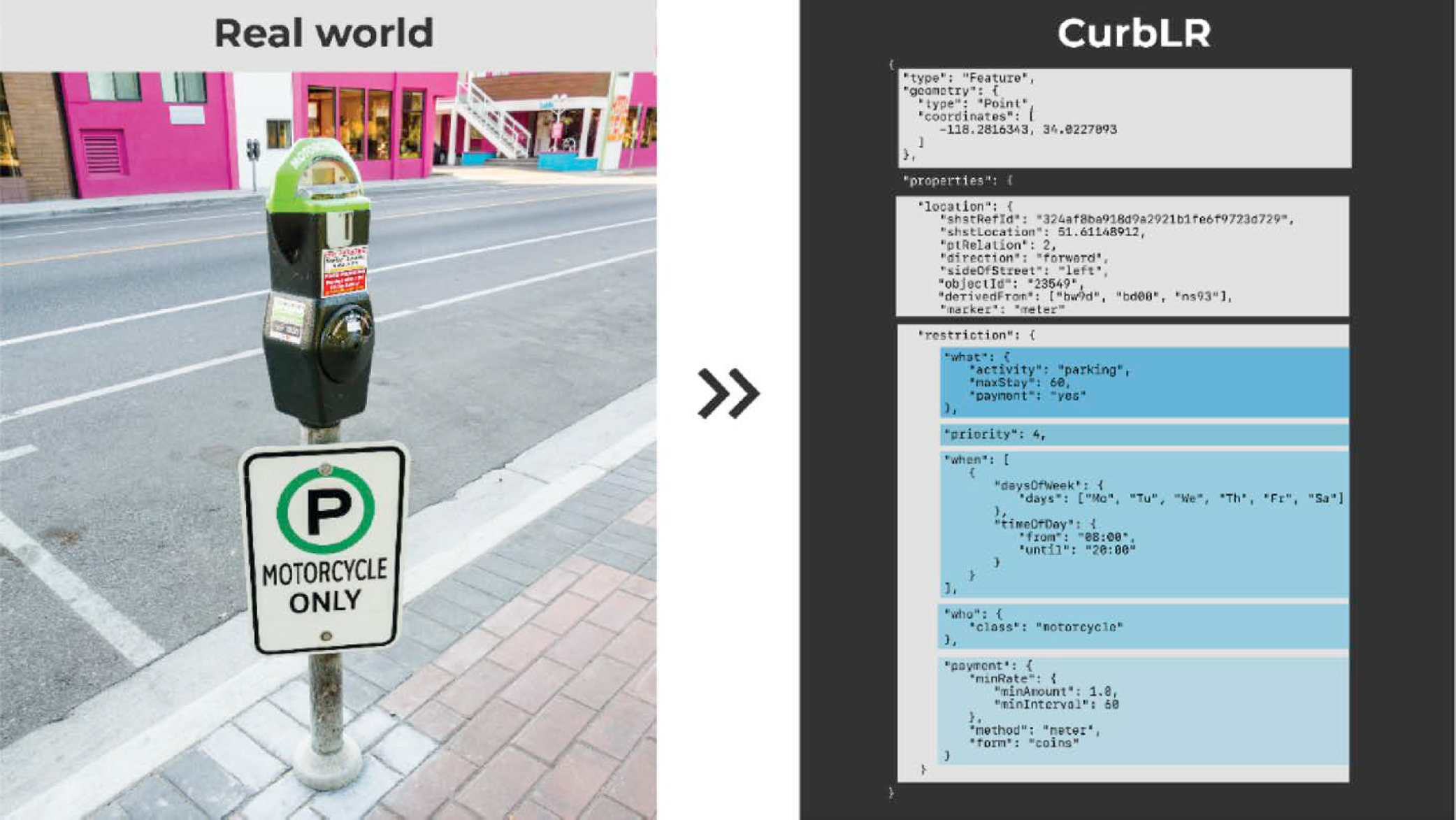
Source: SharedStreets, https://github.com/curblr/curblr-spec, licensed under Creative Commons 0 (CC0).
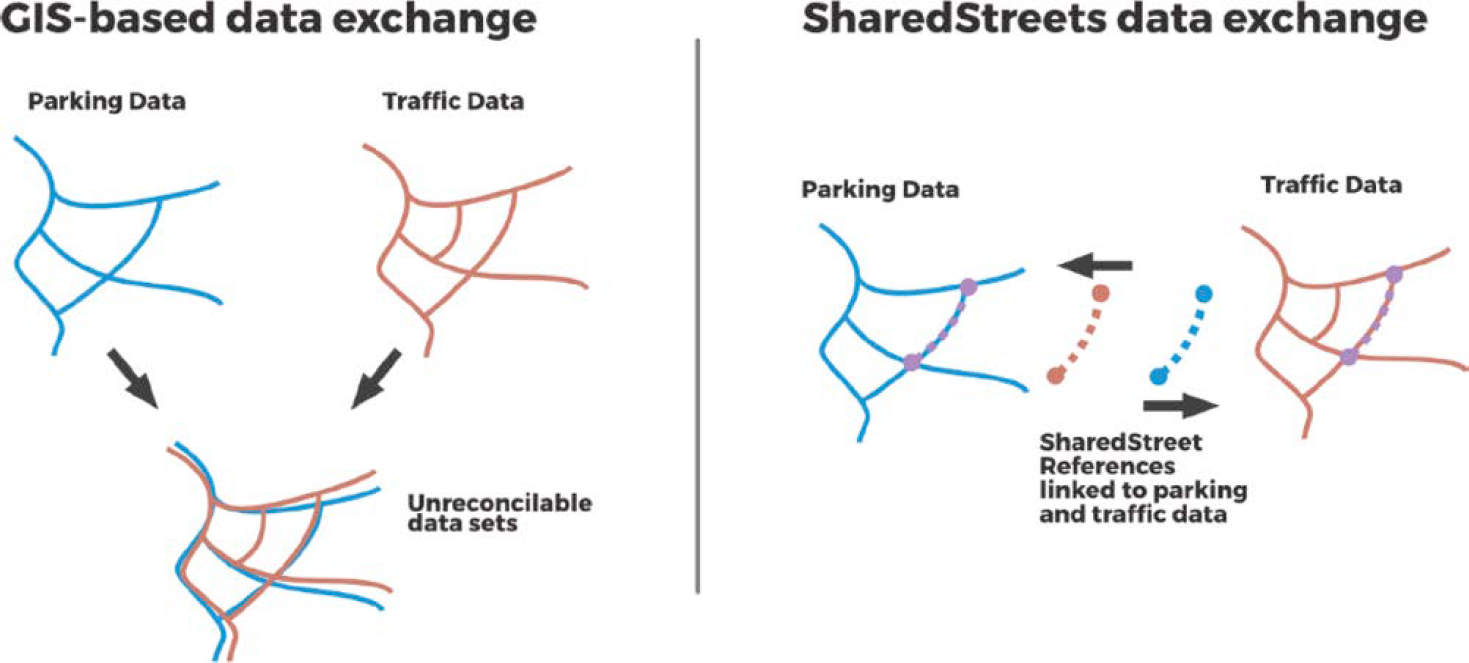
Source: SharedStreets (n.d.-e), copyright © 2017. Used with permission.
Organizations
This section provides information on five organizations that are active in providing resources related to shared mobility data. Three of these are membership organizations that public agencies may also wish to consider joining or in whose work they might wish to participate:
- Mobility Data Collaborative (MDC),
- New Urban Mobility alliance (NUMO), and
- Open Mobility Foundation.
The other organizations are those that, in addition to other activities, serve as third parties for data management and analysis. SharedStreets is a nonprofit initiative, while the Transportation Data Collaborative (TDC) is an initiative of the University of Washington. There are also commercial third-party providers that offer similar data management and analysis services for shared mobility.
Resource: Mobility Data Collaborative
Date Accessed: March 3, 2021
Description: Forum established by SAE ITC for public- and private-sector participants to develop frameworks for mobility data sharing.
Topic Area(s):
Data Sharing Policies and Practices
Use of Third Parties for Data Management
Operations
Policy and Analysis
Resource Type:
Organization
Summary: The MDC is comprised of public-sector agencies such as Miami-Dade County and Bellevue, WA; TNCs such as Uber and Lyft; micromobility providers such as Spin and Bird; data analysis companies such as Populus and StreetLight Data; and membership organizations such as NABSA and the NUMO. MDC defines its initial focus as protecting data privacy and defining performance metrics.
Additional Details: As of January 2021, the collaborative had developed two products:
- Data Sharing Glossary and Metrics for Shared Micromobility (MDC 2020a): Provides standardized definitions for terms used in micromobility and common, formal definitions and formulas for calculating several key metrics.
- Guidelines for Mobility Data Sharing Governance and Contracting (MDC 2020-b): Provides 10 recommended guidelines intended to be used as discussion input when specific agency policies and agreements are being formulated and to be used across disciplines (e.g., planning, legal, policy, data, and information system professionals).
Additional Resources: None.
Resource: New Urban Mobility alliance
Date Accessed: March 2021
Description: Global organization of cities, nongovernmental organizations, companies, mobility service providers, and community advocates that work together to implement the Shared Mobility Principles for Livable Cities (https://www.sharedmobilityprinciples.org/).
Topic Area(s):
Planning and Analysis
Operations
Enforcement
Communicating with the Public
Resource Type:
Organization
Summary: NUMO is a global alliance focused on urban transportation policies that benefit all residents. One focus area for NUMO is micromobility. NUMO has three major initiatives in this area: the Micromobility Policy Atlas (NUMO n.d.-b), the Shared Micromobility Playbook (Transportation for America n.d.), and “Micromobility & Your City: Leveraging Data to Achieve Policy Outcomes” (NUMO 2020).
Additional Details: The NUMO Micromobility Policy Atlas tracks micromobility programs around the world. As of January 2021, it tracked dockless scooter, bicycle, and moped deployments across 626 cities in 53 countries, which includes 127 mobility service providers. The data are all open-source and available for download.
The Shared Micromobility Playbook (Transportation for America n.d.) is a policy guide for communities and addresses eight topics:
- General provisions,
- Operations,
- Equipment and safety,
- Parking and street design,
- Equity,
- Communications and community engagement,
- Data, and
- Metrics.
The Micromobility & Your City project has produced Leveraging Data to Achieve Policy Outcomes, an interactive, web-based tool for selecting outcome measures of interest, defining specific metrics for each outcome, and identifying the data needed for the metric (NUMO n.d.-a). The focus is on safe, sustainable, and equitable services.
Additional Resources: None.
Resource: Open Mobility Foundation
Date Accessed: March 2021
URL: https://www.openmobilityfoundation.org/
Description: City-led open-source software foundation that governs the MDS standard and addresses other technical issues related to shared mobility, including curb management.
Topic Area(s):
Data Sharing Policies and Practices
Curb Management
Resource Type:
Organization
Summary: The Open Mobility Foundation intends to “create and manage a set of model policies, privacy and data security, procurement, and technical guidelines.” It was founded to take over the governance of the MDS, which was originally developed by LADOT. The MDS is a specification for APIs to allow for mobility service providers to provide information to government agencies and for government agencies to provide both static and dynamic information (e.g., temporary street closures) to service providers.
While the MDS was originally written to cover shared scooters, it can be used in its current form for other micromobility services as well. One of the Open Mobility Foundation’s goals is to explore either expanding the scope of the MDS or developing related APIs to cover other shared mobility modes such as TNCs.
Additional Details: In addition to multiple working groups focused on various aspects of the MDS, the Open Mobility Foundation created a Curb Management Working Group to work on developing common data definitions and API specifications for digital, geocoded curb assets, regulations, and occupancy (OMF 2020a). In addition, the Open Mobility Foundation has a Privacy, Security, and Transparency committee, which published Mobility Data State of Practice, an extensive inventory on the state of the practice of location data privacy and anonymization (OMF n.d.-c) and Privacy Guide for Cities (OMF 2020b). The organization is developing a set of privacy principles to guide future work by the foundation.
The Open Mobility Foundation has both public- and private-sector members; however, board members must come from the public sector. As of January 2021, its website listed 31 public-sector members, most from the United States, but also non-U.S. members such as Ulm, Germany, and Bogota, Colombia. Nine private-sector members are listed, including service providers (e.g., Bird), data management organizations (e.g., Ride Report) and others (e.g., Ford Autonomous Vehicles LLC).
Additional Resources: None.
Resource: SharedStreets
Date Accessed: March 3, 2021
URL: https://sharedstreets.io/
Description: Nonprofit organization working on open-source software, digital infrastructure, and governance for urban transportation data.
Topic Area(s):
Data Sharing Policies and Practices
Curb Management
Use of Third Parties for Data Management
Resource Type:
Organization
Summary: SharedStreets has a number of different projects and programs, including the
SharedStreets Referencing System for allowing data to be transferred between different base maps; CurbLR, an open data standard for georeferenced curb data; Mobility Metrics; and open-source software supporting these initiatives. In addition, SharedStreets functions as an independent third party for managing and analyzing data.
Additional Details: The SharedStreets Referencing System provides an open, common referencing system that can be used to convert data from one base map to another, so that data from different geographic reference systems can be effectively combined and analyzed. CurbLR is one of several initiatives for standardizing digital, georeferenced curb locations, rules, regulations, and usage.
One example of SharedStreets’ function as an independent third party for managing and analyzing mobility data was the Washington, DC, Data Sharing Partnership. The District Department of Transportation and the Washington, DC, Department of For-Hire Vehicles teamed with SharedStreets and Uber to launch a data sharing and data analysis partnership under which Uber agreed to share data that might be privacy sensitive or proprietary with SharedStreets, who agreed to use the data only for specific, agreed-to purposes and not redistribute it. SharedStreets then used the data to provide both aggregate data and analysis results to the city government (Marshall, 2018).
This model—using a trusted third party—holds promise for helping to allow localities to receive the data analysis that they require while protecting the data from, for example, state FOIA requests or other concerns with government possession of the data (e.g., its use for law enforcement).
While SharedStreets is a nonprofit organization, there are also for-profit companies and university programs, such as the University of Washington TDC, working to establish themselves as trusted third-party data managers and analysts.
Additional Resources: Announcing SharedStreets’ Trusted Data Exchange (McArdle 2019).
Resource: University of Washington Transportation Data Collaborative
Date Accessed: March 3, 2021
Description: Data repository for shared mobility data.
Topic Area(s):
Data Sharing Policies and Practices
Use of Third Parties for Data Management
Resource Type:
Organization
Summary: The goal of the collaborative is to provide a common protected and linked repository for both public- and private-sector data. The concept is that data can be managed, protected, analyzed, and, where appropriate, shared more efficiently and effectively by a single collaborative organization with a common set of policies and procedures.
The TDC identifies the following barriers to data sharing that third-party management can help overcome:
- The need for policies to govern data sharing, ownership, access, security, and privacy.
- A shortfall of capacity (both human and computational) in the public sector for data analytics, visualization, privacy, and cybersecurity.
- Interoperability challenges between information systems, including schema, format, and structure.
- The potential for nonuniform coverage and biases in individual datasets that can lead to misinterpretation or misuse of shared results.
- Laws and regulations that place transportation data at risk of disclosure to any interested party.
Additional Details: TDC currently provides services to the city of Seattle, WA. Seattle planners want access to census block-level data on shared mobility to better understand impacts such as curb usage but recognize the need to protect privacy and that Washington state’s open records laws currently do not fully protect location-specific trip data that might have to be disclosed should they be stored by city agencies. TDC is looking to expand its services to other major metropolitan areas.
In addition to TDC, which is operated by a university, there are other nonprofit organizations, such as SharedStreets, and for-profit organizations that provide third-party shared mobility data management and analysis services.
Additional Resources: Cities & Data Sharing—Part 2: Seattle (Aapti Institute 2020).
Resource: Commercial Third-Party Providers of Data Management for Software as a Service
URLs of Example Providers:
- Passport (https://www.passportinc.com/)
- Populus (https://www.populus.ai/)
- Remix (https://www.remix.com/)
- Ride Report (https://www.ridereport.com/)
Description: Commercial third-party companies that provide data management and analysis services related to shared mobility on a software-as-a-service basis.
Topic Area(s):
Data Sharing Policies and Practices
Use of Third Parties for Data Management
Resource Type:
Organization
Summary: These types of organizations are typically hired by a public agency. Operators are required to provide their data to the third party, which processes, stores, and analyzes the data. The third-party provides metrics, analysis, and visualizations as well as public and private dashboards for the public agencies that hire it.
The third-party providers have experience dealing with multiple operators across multiple jurisdictions and can provide public agencies with data collection, standards, data management, security, and analytic expertise that they may not have in-house. In addition, this model holds promise for helping to allow localities to receive the data analysis that they require while protecting the data from, for example, state FOIA requests or other concerns regarding government possession of the data (e.g., its use for law enforcement). Mobility operators may be more comfortable working with a third-party provider that they have worked with in other communities than dealing with a new (to them) provider and municipality.
Additional Details: The scope of services provided varies with the provider. Some only cover micromobility services, while others also cover additional forms of shared mobility, such as car sharing, and even transit systems. Some provide digital geographic tools for curb and street management and for communicating regulations and changes to outside parties. Some of the companies support the collection of operating fees that localities may place on mobility operators, and some also support parking enforcement. In addition, these companies will audit the reports provided by mobility operators, checking that they are accurately reporting ground truth.
Additional Resources: None.
Public Dashboards and Datasets
This section provides links to eight representative public datasets, visualizations, and dashboards available on the Internet. It includes examples of micromobility, TNCs, and taxi datasets.
An important consideration is that there is a clear understanding and agreement between agencies, operators, and third-party data managers (if any) as to what data and which metrics are publicly shareable versus what needs to be kept as internal data available only to the agency. Metrics that may be appropriate to share publicly may include (M. Schwartz, personal communication, June 2021):
- Total trips aggregated across operators, rounded to the nearest 1,000;
- Trips/vehicle/day aggregated across operators, rounded to the nearest whole number;
- Total vehicles aggregated across operators, rounded to the nearest 100;
- Total number and percentage of trips with origins and destinations from a particular geographic area (e.g., neighborhood), aggregated across operators, rounded to the nearest 1,000 (minimum 1,000 trips);
- Heat maps aggregated across operators that do not show specific numbers (i.e., screenshots or reconstituted maps, not downloaded GeoJSON files);
- Origin/destination maps from dashboard aggregated across operators that do not show specific numbers (i.e., screenshots or reconstituted maps; not downloaded GeoJSON files);
- Parking clustering data (e.g., heat maps) aggregated across operators; and
- The following specific statistics related to compliance:
- Number of days meeting geographic requirements;
- Number of days meeting minimum and maximum deployment levels;
- Fines;
- Number and percentage of days with trips (or other behavior) above or below benchmarks for increasing or decreasing caps; this does not include the specific number but, rather, an estimate of frequency of meeting the criteria.
Topic Area(s):
Data Sharing Policies and Practices
Communicating with the Public
Resource Type:
Dataset
There may still be issues with aggregated data, however, and care must be taken. For example, if there are only two providers of a type of service, aggregated data will provide insight into each other’s operations, as each provider can simply subtract out its own data.
Examples:
- LA Metro Bike Share (https://bikeshare.metro.net/about/data/). Provides quarterly trip data and station reports. Since this is a docked system, the origins and destinations are established bike dock locations, which reduces the sensitivity associated with precise location data.
- City of Austin, TX (https://data.austintexas.gov/Transportation-and-Mobility/Shared-Micromobility-Vehicle-Trips/7d8e-dm7r). Austin provides open, downloadable data for either bulk downloads or via the Socrata Open Data (SODA) API, which allows the ability to filter, query and aggregate data. The data are aggregated into census tracts to preserve anonymity. The software used to implement the API is open-source and available on GitHub (https://github.com/cityofaustin/atd-micromobility-api). Austin Transportation also has open data and reporting tools on shared mobility available for public use and analysis (Austin, TX n.d.). The Open Data Portal (https://public.ridereport.com/austin) provides quarterly summaries for statistics, including total trips, total miles traveled, average trips per day, median distance
- traveled, and median trip duration. The portal also includes a heat map that shows the number of trips across different areas of the city.
- Open Data Minneapolis (https://opendata.minneapolismn.gov/search?q=Scooters). Minneapolis, MN, scooter data by year and pilot program applications by service provider.
- New York City TLC Trip Record Data (https://www1.nyc.gov/site/tlc/about/tlc-trip-recorddata.page). The New York City TLC publishes geographic, temporal, financial, and service data for trips made by both traditional ride-hailing (taxi) companies and TNCs. Individual medallion (driver) information is stripped from the dataset before it is published to assist in protecting privacy; however, some trips can still be linked to individual homes. Excellent examples of how these data can be analyzed and used can be found in the blog post Analyzing 1.1 Billion NYC Taxi and Uber Trips, with a Vengeance (Schneider n.d.).
- Portland Guide to E-Scooter Trips Dashboard (https://www.portland.gov/transportation/escooterpdx/trips-dashboard). The dashboard provides visualizations of aggregated trip data as well as the ability to download the actual data. Statistics can be viewed by year and type of day (weekday or weekend), by time and distance, by census block group, or as a heat map of trip start times.
- Louisville Dockless Trips Dashboard (https://cdolabs-admin.carto.com/builder/f57ee92e09c3-4efd-b7c0-3d561cc9e951/embed). Louisville, KY, provides a map view of aggregated trip origins and destinations, which can be selected by data and time. The methodology used for aggregation is documented in Dockless Open Data (City of Louisville, KY n.d.-a).
- Bay Wheels System Data (https://www.lyft.com/bikes/bay-wheels/system-data). Lyft provides trip-level data to the public for the San Francisco Bay Area bikeshare service, as required by the service’s license agreement. It also provides a GBFS feed of real-time system data.
Appendix: Data Sharing Section of Minneapolis, MN’s, Licensing Agreement
This section of the City of Minneapolis, MN, licensing agreement is provided as an appendix because, although it is a public document, it is not available online.
Data Collection/Sharing
- The City and Licensee each understand and agree that the City is not requesting or requiring the collection or creation of any new data with this Agreement, unless expressly provided and stated herein. Any new data collected, created, or stored by Licensee shall be considered Licensee’s private data, and not government data, unless a provision of this Agreement expressly requires its collection or creation, and/or the City requests and receives such data from Licensee.
- The City and Licensee each understand and agree that the City is not requesting or requiring sharing of user data deemed to be Personally Identifiable Information as defined by the US Department of Commerce, with the exception of data as specified herein.
- Licensee agrees to administer two customer surveys during the Program term, including survey questions submitted by the City. The surveys must address travel behavior and basic socioeconomic indicators to aid the city in evaluating whether and how Licensee’s Operation supports City goals for transportation. The surveys shall not include, and Licensee shall not collect, any personally identifiable data related to or in furtherance [of] this provision.
- Licensee shall provide an API that meets the requirements of the Mobility Data Specification (“MDS”) as published online at https://github.com/openmobilityfoundation/mobility-data-specification. Licensee may not change the API URL without notifying at least 30 days in advance of change. The City shall only require compliance with the “Provider” component of MDS and shall not require compliance with the “Agency” component of MDS without
- explicit agreement from Licensee.
- Licensee shall provide an API that meets the requirements of the General Bikeshare Feed Specification (https://github.com/NABSA/gbfs). Licensee may not change the API URL without notifying at least 30 days in advance of change. Licensee is required to make the API endpoint available for public consumption.
- The City may request that the Licensee provide an API that may be shared with a third party, which allows for fleet vehicle location, as well as user access and payment, to facilitate the City’s Mobility as a Service program.
- Licensee shall keep a record of maintenance activities, including but not limited to Fleet Scooter identification number and maintenance performed. Licensee will provide a complete copy of the same to the City upon request.
- Licensee shall deliver to the City, upon request, all specified real-time and archival information for each device in its Scooter Fleet. Information covered by this provision includes real-time location, event, and status information gathered by on-board GPS tools, data for each trip record, historic/archival data, and key system information. All requested data will be shared via the documented MDS and GBFS APIs. Except as otherwise provided in this Agreement, Licensee will not be asked to share any new data sharing specifications, nor personally identifiable information with the City. At a minimum, Licensee will supply the City with the following upon request:
- Daily drop-off locations or aggregation sites/zones
- Real-time location, event, and status information
- Trip-level details including start/end location/time, duration, and distance traveled
- Trip-level breadcrumb trails listing all GPS readings for each scooter
This provision is intended to and applies to only such data collected by Licensee pursuant to Licensee’s own initiative. The City is not requiring Licensee to generate or collect any of the above-described data with this Agreement. To the extent that Licensee does generate and/or collect such data, the Parties each understand and agree that the City may seek, and Licensee must then provide, a copy of any such City-requested data.
- Licensee shall create a dashboard and/or reports illustrating the following: number of Fleet Scooters distributed; total number of trips; trips per Fleet Scooter per day; number of new customers; total number of customers; total number of low-income program customers; average miles per trip; and average minutes per trip. The foregoing summaries shall be delivered to City upon request at mutually agreed upon intervals.
- Licensee shall deliver to the City, upon request, a reporting of total vehicle miles traveled resulting from all of Licensee’s employee or contractor operations in support of participation in the Program.
- Licensee is directly responsible for providing the API key, and all other required information and data covered by this Agreement to the City. The City will be permitted to publicly utilize Licensee’s API and display real-time GBFS data.
- If any data requested by City and covered by this Agreement is falsified, or the City suspects dishonest reporting, the City reserves the right to either sanction or perform an audit of vehicle availability and/or trip data at any time during the Program term. If a third-party audit finds that falsified or dishonest reporting exists, the City reserves the right to terminate the Agreement and debar Licensee from future agreements with the City.
- Unless otherwise required by law, Licensee agrees that it will not retain any raw trip data related to this Agreement for a period longer than set forth in Licensee’s adopted, City-approved records retention policy.
- In addition to responding to valid requests for public data under the Minnesota Government Data Practices Act, Licensee understands that the City may share, without notice to Licensee, any public data related to this Agreement with separate government entities for purposes of
- collaborating or furthering common public purpose objectives. The City will not unlawfully share or disclose any data that is classified as nonpublic due to the existence of trade secrets or other qualifying reasons under Minnesota law. Licensee agrees that it will, to the extent practicably feasible, notify the City of any data in the City’s possession that Licensee believes to be a trade secret or protected proprietary information implicated by this provision. This duty to notify shall not operate to relieve the City of its responsibilities stated herein, and this Section 7.l. shall not operate so as to modify, override, or negate the legal responsibilities, duties or definitions set forth by the Minnesota Government Data Practices Act or other applicable law.
The City shall abide by its “Mobility Data Methodology” as outlined in Appendix D [of the Minnesota agreement] and shall inform Licensee of substantive changes to methodology in advance of implementation of changes.
References
Aapti Institute. (2020). Cities & Data Sharing—Part 2: Seattle. Retrieved from https://aapti.medium.com/part-2-global-mobility-data-sharing-seattle-8e07bf73e543.
Austin, TX. (n.d.). Shared Mobility Services, Open Data and Reporting Tools. Retrieved 10/23/2024 from https://www.austintexas.gov/sharedmobility.
Bailey, C. (2018). MDS, GBFS, and How Cities Can Ask for Data from Micromobility Providers. Retrieved from https://medium.com/remixtemp/mds-gbfs-and-how-cities-can-ask-for-data-from-micromobility-providers-7957ca639f16.
Bliss, L. (2018). A Powerful Map Promises to Help Cities Keep Streets Free. Bloomberg CityLab. Retrieved from https://www.bloomberg.com/news/articles/2018-02-22/a-powerful-map-to-share-city-streets-with-uber-and-lyft.
California Public Utilities Commission. (n.d.). Required Reports for Transportation Network Companies. https://www.cpuc.ca.gov/regulatory-services/licensing/transportation-licensing-and-analysis-branch/transportation-network-companies/required-reports-for-transportation-network-companies#:.
Center for Democracy and Technology. (2020). Urgent Privacy Concerns with City’s Decision to Collect Traveler Mobility Location Information. Retrieved from https://cdt.org/wp-content/uploads/2020/03/2020-03-20-CDT-Letters-to-DDOT-LADOT-regarding-mobility-data.pdf.
City of Austin, TX, Transportation Department. (n.d.). Director Rules for Deployment and Operation of Shared Small Vehicle Mobility Systems. Retrieved March 3, 2021, from http://austintexas.gov/sites/default/files/files/Transportation/Dockless_Final_Accepted_Searchable.pdf.
City of Chicago, IL. (2019). How Chicago Protects Privacy in TNP and Taxi Open Data. Chicago Data Portal. https://data.cityofchicago.org/stories/s/How-Chicago-Protects-Privacy-in-TNP-and-Taxi-Open-/82d7-i4i2/.
City of Indianapolis, IN. (2020). Shared Mobility Data Sharing Specifications Policy. Retrieved from https://citybase-cms-prod.s3.amazonaws.com/f6a12e18ac654afa8fdad85c4923de25.pdf.
City of Los Angeles, CA. (2018). LADOT Guidelines for Handling of Data from Mobility Service Providers. https://ladot.lacity.org/sites/default/files/documents/ladotguidelinesforhandlingofdatafrommsps2018-10-25.pdf.
City of Los Angeles, CA. (2019). LADOT Data Protection Principles. Retrieved from LADOT: https://ladot.lacity.gov/sites/default/files/documents/2019-04-12_data-protection-principles.pdf.pdf.
City of Louisville, KY. (n.d.-a). Dockless Open Data. Retrieved Feb. 3, 2021, from https://github.com/louisvillemetro-innovation/dockless-open-data.
City of Louisville, KY. (n.d.-b). Louisville Dockless Trips Dashboard. Retrieved Feb. 11, 2021, from https://cdolabs-admin.carto.com/builder/f57ee92e-09c3-4efd-b7c0-3d561cc9e951/embed.
City of Minneapolis, MN. (n.d.). Mobility Data Methodology and Analysis. https://www2.minneapolismn.gov/media/content-assets/www2-documents/departments/wcmsp-218311.pdf.
City of Portland, OR. (2018). 2018 E-Scooter Findings Report. https://www.portland.gov/transportation/escooterpdx/2018-e-scooter-findings-report.
City of Seattle, WA. (n.d.). Transportation Network Companies: Data Reporting. City of Seattle Official Website, Business Regulations. http://www.seattle.gov/business-regulations/taxis-for-hires-and-tncs/transportation-network-companies/tnc-companies#datareporting.
Civic Analytics Network. (2018). Civic Analytics Network Dockless Mobility Open Letter. Data-Smart City Solutions. https://datasmart.hks.harvard.edu/news/article/civic-analytics-network-dockless-mobility-open-letter.
Civic Analytics Network. (n.d.). Dockless Vehicle Fees. Retrieved Feb. 10, 2021, from https://docs.google.com/spreadsheets/d/17ftRB4q2gzqMNrIdP6ZiP84fpMxI0Zb3XbcsQVSqs-0/edit#gid=0.
Duncan, T. (2019). Protecting Rider Privacy in Micromobility Data. Retrieved from https://blog.mapbox.com/protecting-rider-privacy-in-micromobility-data-81f6c93c868e.
Eros, E. (2019). Getting Started with the SharedStreets Referencing System: Matching a City’s GIS Data. Retrieved from https://sharedstreets.io/getting-started-with-the-sharedstreets-referencing-system/.
Franklin-Hodge, J. (2019). A Practical City Guide to Mobility Data Licensing. Medium. https://medium.com/remixtemp/city-guide-to-mobility-data-licensing-71025741ae2c.
FTA. (n.d.). Mobility on Demand Sandbox Program. Washington, DC: U.S. Department of Justice. https://www.transit.dot.gov/research-innovation/mobility-demand-mod-sandbox-program.
Gardner, B. (2019). Moving Beyond Mobility as a Service: Interview with Seleta Reynolds. Data-Smart City Solutions. https://datasmart.hks.harvard.edu/news/article/moving-beyond-mobility-service-interview-seleta-reynolds-0.
Garfinkle, S. L. (2015). De-Identification of Personal Information. Gaithersburg, MD: National Institute of Standards and Technology, U.S. Department of Commerce. https://nvlpubs.nist.gov/nistpubs/ir/2015/nist.ir.8053.pdf.
GBFS (General Bikeshare Feed Specification). (n.d.). GBFS: A Common Language for Shared Mobility. Retrieved Jan. 29, 2021, from https://gbfs.mobilitydata.org/.
Gee, D. M. (2021). Justin Sanchez, et al. v. Los Angeles Department of Transportation, et al., Case 2:20-cv-05044 -DMG-AFM document 27. Filed 02/23/21. Retrieved from https://drive.google.com/file/d/1YJhqVBzxzpOSBy2Z5qgRRphG8_sD9fVT/view.
Gehring, M. (2010). Minnesota Government Data Practices Act: An Overview. Saint Paul, MN: Research Department, Minnesota House of Representatives. https://www.house.mn.gov/hrd/pubs/dataprac.pdf.
Goldsmith, S., and Leger, M. (2020a). Effectively Managing Connected Mobility Marketplaces. Retrieved from Government Innovators Network: https://dash.harvard.edu/handle/1/42556710.
Goldsmith, S., and Leger, M. (2020b). Using Micro-Mobility Data to Drive Transportation Policy Investments in Greater Boston. Data-Smart City Solutions. https://datasmart.hks.harvard.edu/news/article/using-micro-mobility-data-drive-transportation-policy-and-investments-greater-boston.
Hern, A. (2014). New York Taxi Details Can Be Extracted from Anonymized Data, Researchers Say. The Guardian, June 27, 2014. https://www.theguardian.com/technology/2014/jun/27/new-york-taxi-details-anonymised-data-researchers-warn.
Kanowitz, S. (2020). Charlotte Takes E-Scooter Data for a Test Ride. Route Fifty. https://www.route-fifty.com/digital-government/2020/02/charlotte-takes-e-scooter-data-for-a-test-ride/291168/.
LADOT (Los Angeles Department of Transportation. (n.d.). Code the Curb. https://ladot.lacity.org/projects/transportation-technology#code-the-curb.
Lee, T. (2019). Prioritizing Privacy When Using Location in Apps. Retrieved from https://blog.mapbox.com/prioritizing-privacy-when-using-location-in-apps-f31cdec85fc9.
Lempert, R. (2019). Shared Mobility Data Sharing: Opportunities for Public–Private Partnerships. TransLink New Mobility Lab. https://sustain.ubc.ca/sites/default/files/2018-70%20Shared%20Mobility%20Data%20Sharing%20Opportunities_Lempert.pdf.
MAPC (Metropolitan Area Planning Council). (2019). First Miles: Examining 18 Months of Dockless Bikeshare in Metro Boston. https://storymaps.arcgis.com/stories/f9c8e9cddc444dd7a47a678158fd3580?utm_source=Ash+Center+for+Democratic+Governance+and+Innovation.
Marshall, A. (2018). Uber Makes Peace with Cities by Spilling Its Secrets. Wired. https://www.wired.com/story/uber-nacto-data-sharing/.
McArdle, M. P. (2019). Announcing SharedStreets’ Trusted Data Exchange. Medium. Retrieved from https://medium.com/sharedstreets/announcing-sharedstreets-trusted-data-exchange-51a0c0e25a53.
MDC (Mobility Data Collaborative). (2020a). Data Sharing Glossary and Metrics for Shared Micromobility. https://www.sae.org/standards/content/mdc00002202004/.
MDC. (2020b). Guidelines for Mobility Data Sharing Governance and Contracting. https://www.sae.org/standards/content/mdc00001202004/.
MDC. (n.d.). Mobility Data Collaborative. SAE-Industry Technologies Consortia. Retrieved March 3, 2021, from https://mdc.sae-itc.com/.
Migurski, M. (2018). Mobility Brief #2: Micromobility Data Policies: A Survey of City Needs. https://medium.com/remixtemp/micromobility-data-policy-survey-7adda2c6024d.
MobilityData. (2018). General Bikeshare Feed Specification. Retrieved from https://github.com/NABSA/gbfs.
NABSA (North American Bikeshare and Scootershare Association). (n.d.). GBFS & Open Data. Retrieved June 4, 2020, from https://nabsa.net/resources/gbfs/.
NACTO (National Association of City Transportation Officials). (2019). Guidelines for Regulating Shared Micromobility, v. 2. New York: NACTO. https://nacto.org/wp-content/uploads/2019/09/NACTO_Shared_Micromobility_Guidelines_Web.pdf.
NACTO (National Association of City Transportation Officials) and IMLA (International Municipal Lawyers Association). (2019). Managing Mobility Data. Retrieved June 4, 2020, from https://nacto.org/wp-content/uploads/2019/05/NACTO_IMLA_Managing-Mobility-Data.pdf.
New York City TLC (New York City Taxi and Limousine Commission). (n.d.). TLC Trip Record Data. https://www1.nyc.gov/site/tlc/about/tlc-trip-record-data.page.
NUMO (New Urban Mobility alliance). (2020). Micromobility & Your City: Leveraging Data to Achieve Policy Outcomes. Webinar. Retrieved from https://www.numo.global/resources/micromobility-your-city-leveraging-mobility-data-achieve-policy-outcomes-webinar.
NUMO (n.d.-a). Leveraging Data to Achieve Policy Outcomes. Retrieved March 2, 2021, from https://policydata.numo.global/.
NUMO (n.d.-b). Micromobility Policy Atlas. https://www.numo.global/our-work/micromobility/micromobility-policy-atlas.
NUMO. (n.d.-c). New Urban Mobility alliance. https://www.numo.global/.
OMF (Open Mobility Foundation). (2020a). Announcing the Open Mobility Foundation’s Curb Management Working Group. https://www.openmobilityfoundation.org/announcing-the-open-mobility-foundations-curb-management-working-group/.
OMF. (2020b). Privacy Guide for Cities. https://github.com/openmobilityfoundation/governance/blob/main/documents/OMF-MDS-Privacy-Guide-for-Cities.pdf.
OMF. (n.d.-a). About MDS. Retrieved January 26, 2021, https://www.openmobilityfoundation.org/about-mds/.
OMF. (n.d.-b). Mobility Data Specification. Retrieved June 4, 2020, from https://github.com/openmobilityfoundation/mobility-data-specification.
OMF. (n.d.-c). Mobility Data State of Practice. https://github.com/openmobilityfoundation/privacy-committee/blob/main/products/state-of-the-practice.md.
OMF. (n.d.-d). Understanding MDS APIs. Retrieved Feb. 11, 2021, from https://github.com/openmobilityfoundation/governance/blob/main/technical/Understanding-MDS-APIs.md.
OMF. (n.d.-e). Understanding the Relationship Between GBFS and MDS. Retrieved Feb. 11, 2021, from https://github.com/openmobilityfoundation/governance/blob/main/technical/GBFS_and_MDS.md.
POLIS Network. (n.d.-a). CDS-M Use Case: From Policy Needs to Use Cases. Retrieved April 14, 2021, from https://www.polisnetwork.eu/wp-content/uploads/2021/03/Use-cases-G-52.pdf.
POLIS Network. (n.d.-b). Dutch Cities Develop New Mobility Data Standard. Retrieved April 14, 2021, from https://www.polisnetwork.eu/news/dutch-cities-develop-new-mobility-data-standard.
Portland Bureau of Transportation. (n.d.-a). 2019 E-Scooter Pilot Program Permit Application. https://www.portland.gov/transportation/escooterpdx/documents/2019-e-scooter-pilot-program-permit-application.
Portland Bureau of Transportation. (n.d.-b). TRN-15.01—New Mobility—Shared Electric Scooters. Retrieved June 14, 2021, from https://www.portland.gov/policies/transportation/new-mobility/trn-1501-new-mobility-shared-electric-scooters.
Safari AI. (2024). Brightline Manages the Curbsides at Its Busy Train Stations. https://getsafari.ai/casestudies/brightline-manages-the-curbsides-at-its-busy-train-stations-2/.
Schneider, T. W. (n.d.). Analyzing 1.1 Billion NYC Taxi and Uber Trips, with a Vengeance. Retrieved Feb. 9, 2021 from https://toddwschneider.com/posts/analyzing-1-1-billion-nyc-taxi-and-uber-trips-with-a-vengeance/.
Shared Mobility Principles for Livable Cities. (n.d.). https://www.sharedmobilityprinciples.org/.
Shared Use Mobility Center. (2019a). Objective-Driven Data Sharing for Transit Agencies in Mobility Partnerships. Retrieved from https://sharedusemobilitycenter.org/wp-content/uploads/2020/04/SUMC_IKA_DataSharingforTransitAgencies.pdf.
Shared Use Mobility Center. (2019b). Webinar: Objective-Driven Data Sharing for Transit Agencies in Mobility Partnerships, 2019. Retrieved from https://learn.sharedusemobilitycenter.org/multimedia/webinar-objective-driven-data-sharing-for-transit-agencies-in-mobility-partnerships/.
SharedStreets. (n.d.-a). CurbLR. Retrieved January 28, 2021, from https://curblr.org/.
SharedStreets. (n.d.-b). Curbside Data Management. https://sharedstreets.io/curbside-management/.
SharedStreets. (n.d.-c). Mobility Metrics. Retrieved March 3, 2021, from https://github.com/sharedstreets/mobility-metrics.
SharedStreets. (n.d.-d). Retrieved March 3, 2021, from https://sharedstreets.io/.
SharedStreets. (n.d.-e). SharedStreets Referencing System. (MIT License) Retrieved Jan. 28, 2021, from https://github.com/sharedstreets/sharedstreets-ref-system.
Smart Columbus. (n.d.). Multimodal Trip Planning Application. Columbus, OH. https://smartcolumbus.com/projects/multi-modal-trip-planning-application.
Tajsar, M., Snow, J., Lynch, J., Mirell, D. E., and Toohey, T. J. (2020). Brief for Justin Sanchez and Eric Alejo v. Los Angeles Department of Transportation and the City of Los Angeles. Retrieved from https://www.eff.org/document/sanchez-v-ladot-complaint.
Transportation for America. (n.d.). Shared Micromobility Playbook. https://playbook.t4america.org/.
Trillium Solutions, Inc. (2020). Shared Mobility Data: A Primer for Oregon Communities. Retrieved from https://www.oregon.gov/odot/RPTD/RPTD%20Document%20Library/Shared-Use-Mobility-Data-Primer.pdf.
University of Washington Transportation Data Collaborative. (n.d.). Retrieved March 3, 2021, from https://www.uwtdc.org/.
Zack, T. C. (2019). An Updated Practical City Guide to Mobility Data Licensing. https://medium.com/remixtemp/tagged/transportation.


