Safeguarding the Food Supply: Integrating Diverse Risks, Connecting with Consumers, and Protecting Vulnerable Populations: Proceedings of a Workshop (2025)
Chapter: 3 Considerations and Perspectives in Food Safety Communication
3
Considerations and Perspectives in Food Safety Communication
The next two sessions, moderated by Emily Dimiero, Cargill, and Francisco Diez-Gonzalez, University of Georgia, respectively, featured a discussion on various consumer considerations in risk communication, as well as regulatory and producer perspectives on communications in food safety. Several speakers discussed that identifying the hazards that threaten food safety is an important first step, but successfully communicating them to the public in ways that safely convey risks while still compelling appropriate actions is also an important step to protecting the health of populations.
CONSUMER CONSIDERATIONS IN RISK COMMUNICATION
Navigating the Consumer Information Landscape
Kris Sollid, International Food Information Council (IFIC), presented findings from the council’s consumer research initiatives on food safety perceptions and behaviors (IFIC, 2024). Regarding “healthy” food perceptions, he noted that consumers have often been using three primary characteristics to define healthy foods: freshness, good protein content, and low sugar levels. Lately, there has been a growing trend of consumers associating healthiness with limited or no artificial ingredients, minimal processing, and fewer ingredients. He also reported on dietary trends, with more than half of survey respondents reporting they tried a specific eating style in the past year. Most popular diet patterns included high protein, mindful eating, or intermittent fasting. But there was a significant drop in consumer confidence in the safety of the U.S. food supply in 2024, said Sollid, with the decline
most notable among millennials and Hispanic Americans. Conversely, there is increased confidence among Gen Z age respondents, and he hypothesized a possible correlation between the concerns of millennials and infant formula shortages among other issues in recent years.
Regarding food safety concerns, Sollid reported carcinogens, foodborne illness from bacteria, and pesticides as top issues for American consumers. Those who report carcinogens or cancer-causing chemicals in food as an important food safety issue are more likely to live in higher-income households, have a college degree, and not receive government food assistance. Shifting to perspectives of individuals while grocery shopping, Sollid noted that consumers primarily rely on labels such as natural, organic, and healthy as indicators of food safety. People also look for labels indicating no artificial ingredients or colors, and sometimes use price as a proxy for safety. While most consumers consider both health benefits and risks, said Sollid, nearly 25 percent do not consider either of those factors in their food choices. Lastly, he focused on trust in information, reporting that soon-to-be-published IFIC consumer research consistently showed people have the highest trust in medical professionals and registered dietitians, moderate trust in government agencies, and low levels of trust in food companies and social media influencers. He emphasized the importance of personal interaction in building trust, and suggested providing consumers with practical, fact-based information focused on family safety rather than focusing on scientific details.
Consumer Risk Perception and Food Safety Practices
Benjamin Chapman, North Carolina State University, presented research on consumer food safety behaviors, emphasizing the discrepancy between what consumers report doing and their actual practices. Describing the university’s controlled facility in North Carolina, he explained his team’s use of research and teaching kitchens where they can observe people’s cooking, cleaning, and food handling behaviors. The facility includes three home-style kitchens equipped with multiple camera angles, which they have used to conduct more than 11,200 observations and 25,000 minutes of recorded interviews.
Through extensive observational studies, Chapman found that only about 30 percent of consumers attempt to wash their hands after handling raw meat or poultry, despite most participants reporting regular handwashing as important. Only 1.2 percent of observed handwashing events met Centers for Disease Control and Prevention (CDC) guidelines. From this work they are finding that handwashing recommendations may be too complicated, and there may be benefits to just saying “wash your hands” and not telling them how to do so in detailed steps, as they were unable to
find differences in microbial movement between those who followed handwashing guidelines successfully versus those who did not.
Regarding food thermometers, Chapman said participants were more likely to use them when recently prompted, but without prompting the use was rare and often incorrect. They also studied poultry washing, and Chapman reported that among 300 self-declared poultry washers, only 4 percent successfully cleaned and sanitized the sinks afterwards, with 26 percent of the observations resulting in transfer of bacteria from raw poultry to ready-to-eat salads (Shumaker et al., 2022). Cross contamination emerged as an understudied risk factor, he noted.
In terms of public education to address these issues, Chapman discussed two major approaches to behavior change. In the first, they looked at celebrity chef influence, but this was found to be ineffective at changing behavior. He also shared a public service announcement campaign study they conducted that only marginally increased thermometer use for cooking hamburgers from 14 percent to 16 percent (Cope et al., 2020), despite high cost for a campaign designed to reach an entire city population. Food safety behaviors are complex, said Chapman, and can be influenced by the environment, family history, and social media. He emphasized the need for more in-depth, observational research on consumer behaviors, including the integration of mixed-methods research, developing artificial intelligence (AI) and machine learning tools, and expanded funding for observational research. Effective food safety education requires understanding the gap between perceived and actual behaviors, he concluded, and that will require targeted messaging, not a one-size fits all approach.
The Case for Integrating Food Safety and Nutrition Security
Barbara Kowalcyk, George Washington University, discussed the integration of food safety and nutrition security using a communication lens. Foodborne disease is also associated with many long-term health outcomes, she said, including autoimmune, digestive, and neurological disorders, and remains a significant global health challenge. Estimates on foodborne disease worldwide include 600 million illnesses each year, resulting in 420,000 deaths, and 33 million healthy life years lost. This can lead to significant economic impacts including medical costs, lost productivity, loss of consumer confidence, and increased food waste. Bringing in the role of water, she noted that water, sanitation, and hygiene (WASH) are a big problem globally, affecting food safety and nutrition. Nearly 70 percent of the diarrheal disease burden stems from unsafe WASH conditions. She outlined the complex relationship between food safety and nutrition (see Figure 3-1).
Presenting on the concept of nutrition security, she defined this as consistent and equitable access to nutritious, safe, and affordable foods
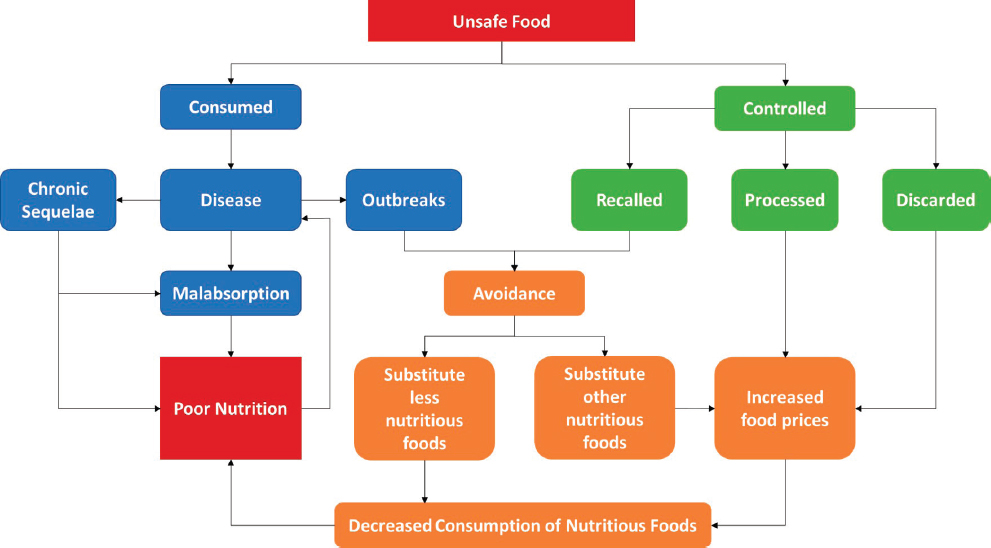
SOURCES: Presented by Barbara Kowalcyk on September 4, 2024, adapted from Grace, 2016.
essential to health and well-being. Kowalcyk noted a significant challenge in that many nutritious foods, such as fresh produce and animal-sourced foods, are also at elevated risk from a food safety perspective. In the United States, fresh produce accounts for half of foodborne illness. Managing these risks is a very complex effort as the system relies on food grown, processed, and distributed from all over the world, she explained, even just for a single salad. No intervention(s) will be 100 percent effective, so there is a need for multiple interventions along the continuum to try and prevent foodborne disease.
Adding to the challenge of food safety is that consumers have limited information and knowledge about what they or others can do to prevent illness. For instance, many foods are labeled with use by and sell by dates, she said, but even food professionals struggle with what the different meanings mean relative to safety versus quality, let alone the public. The global food supply chains are also incredibly complex, and she argued that consumers need actionable information. Kowalcyk used the ongoing Boar’s Head Listeria monocytogenes outbreak across 18 states, linked to deli meats, to illustrate systemic failures in food safety. This outbreak has been associated with nine deaths and 57 hospitalizations, with seven million pounds of food recalled. The plant responsible for the recall had more than 100 food inspection violations over the past year, yet it was never shut down, she noted.
To really move the needle on food safety, Kowalcyk said there needs to be a culture change in the food industry, and for regulatory agencies and society to prioritize proactive food safety measures. Consumers have a right to expect safe food, she said, as well as informative labeling, an ability to verify the system’s effectiveness, and a right to information access. She cautioned that increasing consumption of fresh foods without improving food safety measures could amplify the burden of foodborne disease, potentially offsetting nutritional benefits. She called for increased awareness of food safety and nutrition interlinkages, integration of food safety and nutrition in interventions, and effective collaboration among stakeholders.
Discussion
The panel discussion centered on consumer perceptions, communicating risks, and ways to make food safer while still maintaining trust with consumers. Peter Lurie, Center for Science in the Public Interest, highlighted the potential for changing consumer perceptions, citing the evolution of car safety marketing as an example of a successful cultural shift. Chapman agreed but noted that current food safety messaging often focuses on perceived rather than actual risks. Kristin Reimers from Conagra Brands raised concerns about potentially demonizing nutrient-dense foods that also carry higher food safety risks. Instead of thinking about trade-offs, Kowalcyk emphasized the need to make safer foods instead of just accepting the existing safety–nutrition trade-offs. Chapman emphasized the importance of acknowledging that all foods carry some level of risk though—there is no “risk-free food.” He suggested the food industry should be more transparent about communicating those risks and sharing relevant information.
Francisco J. Zagmutt from EpiX Analytics brought up the topic of food irradiation as a highly effective risk-reduction strategy that is still not widely adopted, potentially because of perceived low consumer acceptance. Chapman noted that irradiation cost is a significant factor, presenting a barrier to adoption. Kowalcyk suggested a need for education, and possibly rebranding, since many people are not aware that irradiation is already being used on foods like spices and flour. Sollid added that consumers are generally more fearful of technology in food compared to other areas but noted consumer interest in using AI to help make safe and nutritious food decisions, which may signal a shift in thinking.
REGULATORY AND PRODUCER PERSPECTIVES ON FOOD SAFETY COMMUNICATION
Shifting to a Risk-Based Approach to Food Safety
De Ann Davis, Western Growers Association, presented the challenges for the field of food safety and the need to shift from a hazard-based to a risk-based approach. Western Growers is a nonprofit trade association representing approximately 2,200 members, primarily in western states. “To strengthen food safety, we should not be focused on avoiding the next outbreak but on avoiding the next illness,” she said. The agricultural industry faces several challenges, including climate change affecting water availability, labor shortages, invasive species, increasing competition from imports, and others. Davis highlighted the complexities of California’s agricultural industry, with an annual market value of $60 billion. California produces more than 400 commodities and accounts for a significant portion of the country’s fruits and vegetables. For example, California and Arizona account for 85 percent of the domestically harvested leafy greens, and leafy green food safety continues to be a priority for public health.
Despite significant research and industry investment, she noted that foodborne illness attribution data show limited improvement in safety outcomes across leafy greens production for contaminants like pathogenic E. coli, Salmonella, and Listeria monocytogenes. Davis also introduced the multifaceted nature of adjacent land use challenges in leafy green production, which can include environmental factors like irrigation channels running alongside animal feeding operations, trucks driving by leafy green fields, or nearby hobby farms—all affecting food safety. She emphasized the limitations of current hazard-based approaches that identify agents capable of causing harm, but do not help the user prioritize or manage the risks. Current approaches, relying heavily on checklists and distance-based standards, also fail to account for regional variations and provide insufficient feedback on program effectiveness.
Collectively, Davis said, we need to start thinking differently about field food safety. She called for a national agenda focused on prevention, drawing parallels to the Federal Aviation Administration collaboration with the aviation industry. A new agenda would include increased resources for state-level support, as well as improved education, comprehensive industry-led commodity best practices, public–private data-sharing collaborations, and better risk-informed research. Lastly, Davis also pointed out the gap in the scientific workforce supporting fresh produce, highlighting public–private collaborations as examples to guide future expansion to improve food safety. She emphasized the need for a shared, prevention-focused agenda to secure domestic production while still improving public health
outcomes, and she emphasized that the current traditional approaches are insufficient to achieve this.
Food Safety Consumer Education
Sharmi Das, U.S. Food and Drug Administration (FDA), discussed the agency’s approach to consumer education on food safety. She outlined the upcoming reorganization of all food safety activities at FDA into the unified Human Foods Program, with a goal of better positioning the agency to uphold the safety of the nation’s food supply, respond to food-related emergencies, and elevate the importance of nutrition, strengthen partnerships, and regulate innovative products more effectively. Das highlighted FDA’s multipronged approach to prevention, including the use of various communication tactics and the need for creativity and strategic planning to work within limited resources. She emphasized the importance of research that informs the development of consumer education resources and outreach tactics, using appropriate terminology that resonates with consumers, balancing messages that provide facts without promoting specific products, and integrating food safety and nutrition information.
Das shared examples of successful initiatives, such as the Feed Your Mind program focused on genetically engineered foods. This project’s success stemmed from the recognition of the need to use consumer-familiar language instead of strictly scientific terminology, she noted. The ongoing Closer to Zero initiative, is another example of the challenge that exists in addressing heavy metal exposure while still ensuring children have access to nutritious foods. It demonstrates the balance between communicating about environmental contaminants in healthy foods like fruits, vegetables, and seafood. This initiative employs extensive focus group research to develop effective messaging strategies.
In summary, Das highlighted the importance of using terminology that consumers know and are comfortable with, balancing the message by providing facts and data to inform decisions, and the interconnections between food safety and nutrition. The agency has learned it is important to avoid regulatory jargon and ensure an early establishment of relevance to the audience, she explained. Das emphasized the integration of food safety and nutrition messaging, saying that FDA recognizes the inherent interconnection and the need to consider unintended consequences of certain communications. Food can be a vehicle for wellness, she concluded, and consumer education can play a crucial role in promoting informed decision-making. Well-informed consumers are more likely to make better choices for themselves and their families, while also advocating for safer measures and helping to combat misinformation in today’s communication environment.
Discussion
Speakers in the discussion focused on key areas of communication, including terminology differences between regulatory agencies and consumers. Das acknowledged the importance of the disconnection between consumer understanding of terms like contaminants and heavy metals and scientific definitions. She highlighted ongoing research through focus groups to better understand consumer interpretation and perceptions of these terms. In response to a question on data sharing, Davis elaborated on the GreenLink platform initiative from Western Growers, which allows farmers to confidentially share food safety data. The system features approximately 20 operations participating in leafy greens safety data sharing, she noted, as well as a test-and-learn program for the California Leafy Green Marketing Agreement where 45 handlers are sharing pathogen testing data, with the capability of integrating with other datasets on weather or pathogens associated with migratory birds.
Similarly, Kimberly L. Cook, U.S. Department of Agriculture, raised a question about overcoming barriers in public health messaging, particularly when initial “do not” messages may have long-lasting effects. Das used the example of raw cookie dough consumption to illustrate the complexities of effective risk communication. When FDA posted strict “do not eat raw cookie dough” messages on social media, Das said it received some backlash from the public, which demonstrated that sometimes agencies should consider alternative messaging approaches leaning toward harm-reduction messages versus absolute prohibition. Overall, she discussed the need for nuanced messaging in certain behavior change campaigns, but using direct, clear communication for others like recalls, and considering equity and access issues in recommendations.


