1
Introduction
With the changing landscape of threats to food safety, as well as evolving approaches and technology to inform academic, businesses, and government stakeholders, maintaining a heightened level of awareness can play a key role in protecting the public. On September 4–5, 2024, the National Academies of Sciences, Engineering, and Medicine’s Food Forum hosted a workshop, titled Safeguarding the Food Supply: Integrating Diverse Risks, Connecting with Consumers, and Protecting Vulnerable Populations,1,2 to explore the state of the science around hazard- and risk-based approaches to safeguarding both domestic and global food systems.
Opening the workshop, Keeve E. Nachman, Johns Hopkins Bloomberg School of Public Health, reviewed the diverse risks to food safety that challenge the field, and the recent food safety issues in the news. He highlighted the Listeria monocytogenes outbreak in deli meat, a recall of apple juice for elevated arsenic levels, California’s bill to address artificial food dyes, and a
___________________
1 The workshop agenda, presentations, and other materials are available at https://www.nationalacademies.org/event/43353_09-2024_safeguarding-the-food-supply-integrating-diverse-risks-connecting-with-consumers-and-protecting-vulnerable-populations-a-workshop (accessed September 5, 2024).
2 The planning committee’s role was limited to planning the workshop, and the Proceedings of a Workshop has been prepared by the workshop rapporteur as a factual summary of what occurred at the workshop. Statements, recommendations, and opinions expressed are those of individual presenters and participants, and are not necessarily endorsed or verified by the National Academies of Sciences, Engineering, and Medicine, and they should not be construed as reflecting any group consensus.
new pathogenic E. coli outbreak under investigation by the U.S. Food and Drug Administration.
The World Health Organization concluded that, globally, unsafe food causes 1 in 10 people to fall ill each year, said Nachman, with children uniquely susceptible and accounting for 1 in 3 deaths from foodborne illness. In the United States each year, the Centers for Disease Control and Prevention estimate that 1 in 7 people get sick from foodborne illness, nearly 128,000 people are hospitalized, and more than 3,000 people die, he added. The burden of foodborne illness is also not equitably distributed, with some areas of the world and some populations more affected than others. There are many places along the food supply chain to intervene, though, and those interventions hinge on successful collaboration across all sectors and stakeholders, he explained (see Figure 1-1).
The first workshop session focused on nutrition, economic, and equity implications in food safety, followed by consumer considerations in risk communication. The third session concluded the first day discussing regulatory and producer perspectives on food safety communication. Day 2 opened with session 4, sharing national and international perspectives on risk assessment and tools to mitigate risk, and closed with a discussion exploring opportunities for the future of food safety. This Proceedings of a Workshop summarizes the presentations and discussions expressed during the workshop and should not be seen as a consensus of the workshop participants, the committee, or the National Academies. See Box 1-1 for a full statement of task. The workshop agenda and biographical sketches of the workshop speakers and planning committee members can be found in Appendixes A and B, respectively.
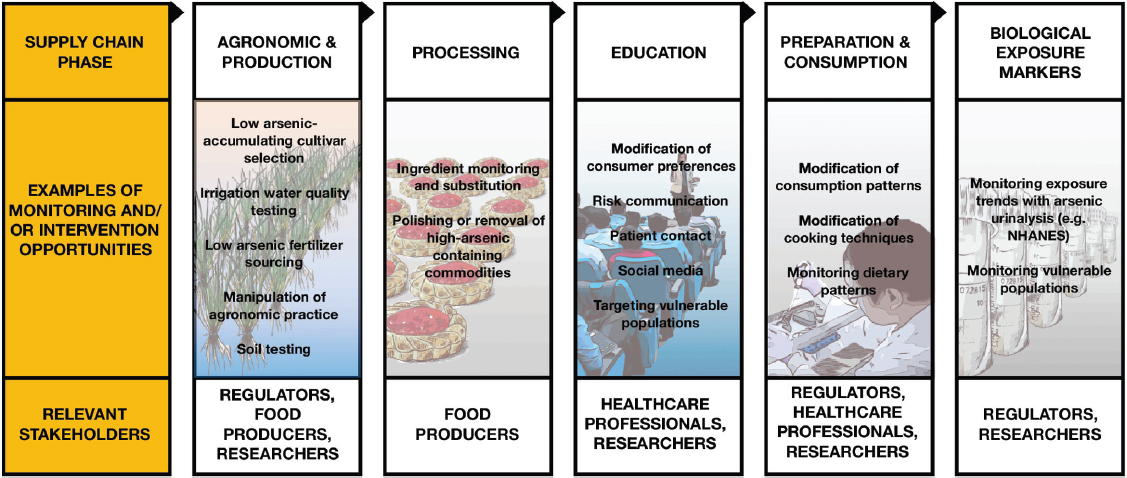
NOTE: NHANES = National Health and Nutrition Examination Survey.
SOURCES: Presented by Keeve E. Nachman on September 4, 2024, from Nachman et al., 2018. Reproduced from Environmental Health Perspectives with permission from the author.


