Addressing the Needs of an Aging Population Through Health Professions Education: Proceedings of a Workshop (2023)
Chapter: 2 Exploring What Matters Most in Working with Older Adults
2
Exploring What Matters Most in Working with Older Adults
Key Messages Made by Presenters
- The first step of the process [in the course] is for students to get to know older adults and to understand what matters to them. (Lynch)
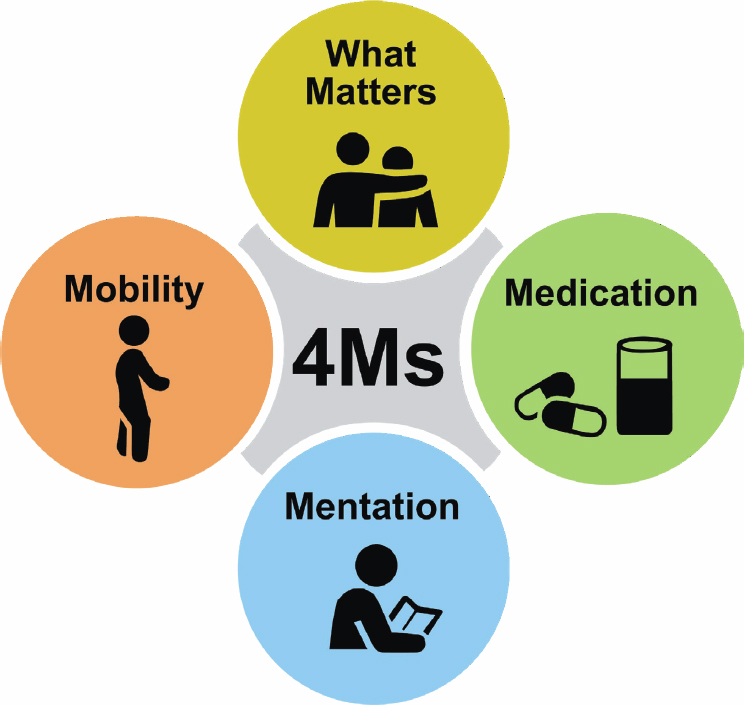
- The four Ms in the program stand for what matters, medication, mentation (mental activity and stimulation), and mobility. Students should be taught early about the four Ms and how they will be expected to deliver 4Ms care both during and after their education. (Pohnert, Dolansky)
Multiple individual speakers at the workshop emphasized the importance of focusing on what matters most to older adults. In the two sessions described in this chapter, presenters discussed programs that seek to do so. The first presentation described a course in which students work closely with older adults in the community to address some of their challenges. The second presentation described the 4Ms approach for age-friendly health systems and explains how it was implemented at CVS MinuteClinics.
ENGINEERING FOR HUMANITY
People are at the center of everything, said Caitrin Lynch, the dean of faculty and a professor of anthropology at Olin College of Engineering. When innovating or trying to make change, it is critical to “hold on to what really matters to people” and create things that are relevant and
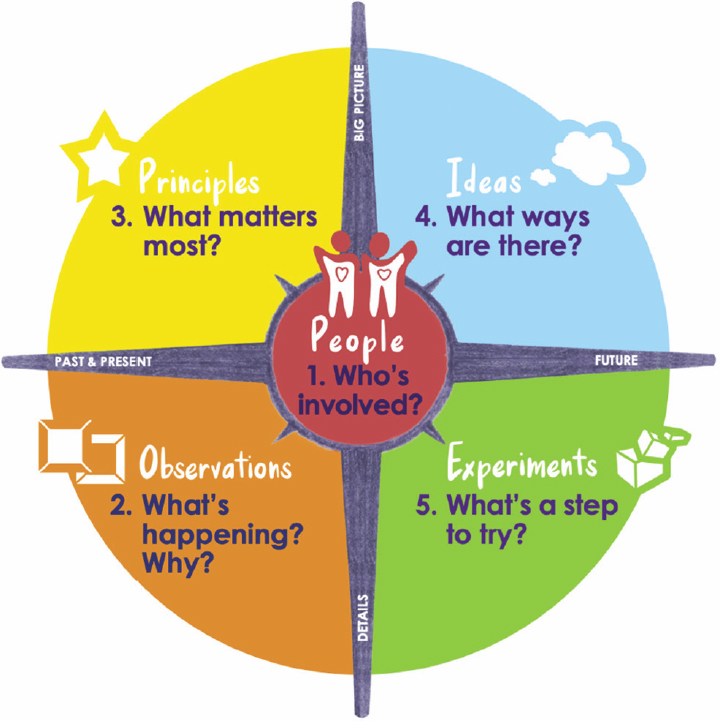
useful. This people-first principle is the heart of a class that Lynch teaches called Engineering for Humanity. The course is based on the innovator’s compass (Figure 2-1), which was created by Lynch’s colleague Ela Ben-Ur. The course is interdisciplinary, Lynch said, and students receive half their credits in anthropology and half in engineering. Students come from three different colleges—Olin College of Engineering, Wellesley College, and Babson College—and are placed in teams with an older adult community partner. These partnerships are facilitated through a longstanding relationship with the Council on Aging, she said.
The course was first developed with a grant from a local health care foundation with the aim of creating an opportunity for engineering students to work with older people to design tools that would help people stay in
SOURCES: Lynch presentation, December 8, 2022; Ben-Ur, 2020.
their homes and live independently. The first step of the process, Lynch said, is for students to get to know the older adults and to understand what matters to them. Using the iterative innovator’s compass, the students immerse themselves in the lives of their senior partners and come up with ideas to help people achieve their goals. For example, students may go to movies with their partners, go shopping, or play chair volleyball in a senior center. Lynch offered the example of one student team that went grocery shopping with an older adult named Terry who uses a wheelchair and has hearing loss. In the second step of the compass, the students observed that Terry had issues with reaching and carrying groceries at the store as well as challenges in her home. In the third step, the students identified the principles that were important to Terry, namely, independence, social engagement, and positivity. The students brainstormed multiple potential ideas, including a tool to help Terry reach groceries, a way for her to use her oven, and multi-modal alarms in her home. Many plans and prototypes were produced, and the students ultimately focused on helping Terry get her groceries from the store. One approach that could have been taken, Lynch said, would be to stack four bags of groceries on the back of the wheelchair to maximize convenience and efficiency. However, going to the store was an important activity for Terry, given her desire for social engagement. Thus, instead of maximizing efficiency, the students maximized social engagement by producing a system that would help Terry carry two bags of groceries on the back of her chair. Students used a “prototype, pilot, produce” iterative process to develop the final product. The product included communication symbols and served as a point of conversation at the store, which meant that Terry was able to do what mattered most to her and spend her time engaging with those around her.
Lynch shared several other examples of designs that students created during the course, including a tool to help a man with diabetic neuropathy massage his own feet instead of waking his wife to massage them, a device that magnified photos for a woman with macular degeneration who liked to tell stories about her photos, and a cutting board with physical guides for a woman with vision problems who loved to cook. Lynch emphasized that although the class helps students develop their engineering skills, the focus is on understanding people and what matters to them. “Engineering skills include people skills,” she said, just as health professionals need training in listening to people and understanding their experiences. Furthermore, the type of creativity used in the program is not confined to engineers or designers. People in any profession can use a system like the innovator’s compass to observe and figure out what really matters to people and how to address those needs.
Lynch was joined by two students from the course along with their community partner, Peggy, to share their story. The project began during
the COVID-19 pandemic, said one of the students, Ian Eykamp, which meant that initial meetings were held over Zoom. During these sessions, the team learned about Peggy, her family, and her routine. Eykamp emphasized that it was important to learn about all aspects of Peggy because without this knowledge, it would have been difficult to know what would be useful. One challenge that Peggy told the students about was difficulty carrying laundry down the stairs. Over Zoom, she described the problem and shared pictures and video of her staircase and railing. The students and Peggy brainstormed ideas, which included a laundry chute, a “mini ski lift,” a tristar wheel stair climbing basket, a pulley system, and a sled attached to the railings. Eykamp said that Peggy “was full of great suggestions and solutions” and that it was critical to get her firsthand perspective as the person who actually experienced the challenge and needed a solution. The students performed experiments, tried out concepts in sketch models, and developed prototypes. As COVID vaccines became available, the team was able to visit Peggy in her home and have her try out some of the potential solutions. The final product was a device that holds a laundry basket and slides down the railing. Zoie Leo, another student member of the team, added that a plastic stopper at the bottom of the railing was central to the design and said that it was only possible to add this component because they were working in the specific space that they were designing for.
Peggy Wihtol, the team’s community partner, told workshop participants about her experience in the Engineering for Humanity class. Wihtol retired at 62 and enjoyed an active retirement, volunteering at a food pantry and a nursing home, working part-time, and traveling with her husband. In 2014 her husband began showing signs of Alzheimer’s, and she soon became his full-time caregiver. He entered a nursing home in late 2019 and died of COVID-19 in early 2020. The pandemic left Wihtol in isolation at home, with no caregiving responsibilities or volunteer responsibilities. Friends called and checked on her, but she mostly stayed home due to COVID. She joked that her dog did not learn to speak English, no matter how much she talked to her. By January 2021, Wihtol said, she was “desperate” for something to do, and she learned about the opportunity to participate in the class. She was very happy to have people to talk to and to learn from, she said, although the class was “unlike any college class” she had ever taken. One of the first things that happened was that she received a brown box at the door full of “strange stuff” like paper towel rolls, pipe cleaners, clay, fabric, and Post-it Notes. The first Zoom class felt like “speed dating,” with everyone trying to get to know each other. Wihtol said she appreciated the emphasis on finding ways to stay in her home, because after 50 years in the same house, moving out would be harder than staying.
Wihtol and the students got to know each other over Zoom; she was interested in the people on her team, and she found that they had things
in common. The students and Wihtol bonded over their interests in travel, dogs, the outdoors, cooking, education, and business, and some of the students had relatives with Alzheimer’s. Wihtol’s main concern that she wanted addressed was her safety, particularly on the stairs. The team batted around many ideas, and she nixed some of them based on concerns about safety or due to the layout of her home. Wihtol said that she came up with the idea of the stair rail rider and felt “very responsible” for the ultimate design. The process required a lot of trust, she said, particularly because everyone was working remotely due to COVID. Each student found his or her own niche of responsibility and own way to communicate with Wihtol. She said that she tried to be “gentle” when she communicated with the students, particularly when she was shooting down one of their ideas. The students taught Wihtol how to use new technologies, such as Google Slides, and she taught herself new things as well. She is still in touch with some of the students and has visited their colleges. Wihtol read the summary she wrote at the end of the project:
My thanks to Olin, the Engineering for Humanity faculty, the students on Team Peg. I had been in a rough place with COVID and the loss of my husband, and needed something new and interesting to invest in and concentrate on. This was it. The pleasure of working with young, ambitious, caring students, a faculty and facility which so strongly believes in hands-on learning and fostering community relationships, and all of the Engineering for Humanity program has renewed my soul and re-engaged my brain.
AGE-FRIENDLY HEALTH SYSTEMS AND THE 4MS FRAMEWORK
Mary Dolansky, a professor in the School of Nursing at Case Western Reserve University, and Ann Pohnert, the lead director of clinical quality at CVS MinuteClinic, told workshop participants about their experience implementing the 4Ms age-friendly health systems framework in CVS MinuteClinics. Age-Friendly Health Systems is an initiative aimed at ensuring that older adults receive evidence-based care in every setting, from hospitals to primary care to convenient care settings, Pohnert said. There are many evidence-based geriatric care models that have been proven effective, she continued, but only a small proportion of these are reaching those who could benefit. This is due, she said, to the fact that it can be difficult to disseminate and scale models and to reproduce performance in settings with fewer resources, and models may not translate across care settings. The 4Ms is an evidence-based framework for age-friendly care that was developed by geriatric experts. These experts identified four essential sets of evidence-based practices that cause no harm, can be used by anyone, and
are consistent with what matters most to older adults and their families. The aim of the 4Ms movement was to reach older adults in 2,600 hospitals, practices, clinics, and nursing homes by June 30, 2023; Pohnert said the goal had already been exceeded as of December 2022. One partner in the initiative is CVS MinuteClinics, which are care clinics located in CVS stores. There are about 1,100 clinics in 36 states; these clinics see about 6 million patients per year, including 1 million older adults. Clinics are staffed by nurse practitioners and physician assistants and are accredited by the Joint Commission. The care at MinuteClinics is less expensive than traditional care, Pohnert said, in part because there are fewer overhead costs. These clinics serve as a safety net for the community, and there is a high rate of patient satisfaction.
The four Ms in the 4Ms program refer to what matters, medication, mentation, and mobility (Figure 2-2). Each setting that implements the 4Ms program may define them slightly differently, depending on the patient population and their needs, Pohnert said. She described each of the four Ms in turn. The first M is “what matters.” This means that providers need to know and understand each individual’s specific health outcome goals and care preferences and to align care with these needs. In the CVS MinuteClinic context, this entails having a discussion about what matters in every visit (except for vaccinations and express visits for COVID), asking patients what matters, documenting what they say, and acting upon it. The second M is “medication.” If medications are necessary for a patient, the 4Ms framework encourages the use of age-friendly medications that do not interfere with the other Ms (what matters, mentation, and mobility). At the MinuteClinic, Pohnert said, this means checking medications against the American Geriatric Society Beers list of medications that may not be appropriate for older adults and discussing with the patient ways to make medication use safer, e.g., using pillboxes, education, and deprescribing. The third M is “mentation,” which has two parts. The first is depression, which MinuteClinics screen for using the PhQ-2 and PhQ-9. Based on the results of the screening, the provider may provide a brochure, educate the patient, or refer the patient to an appropriate outside provider. The second part of mentation is dementia; MinuteClinics screen for dementia using the Mini-Cog© and educate or refer patients to other providers or resources. Finally, the fourth M is “mobility.” The aim of this piece is to ensure that each older adult moves safely every day to maintain function and to do what matters most. MinuteClinics use a Modified Timed Get Up and Go test to assess mobility, and they may provide patients with a brochure, further education, or a referral. All screening results and actions taken are documented in the electronic health record, Pohnert said.
Although each of the four Ms is important in and of itself, Pohnert said, they are meant to be assessed as a set. Over the last 3 years at CVS
SOURCE: Pohnert presentation, December 8, 2022; Institute for Healthcare Improvement, 2023, Age-friendly health systems. https://www.ihi.org/Engage/Initiatives/AgeFriendly-Health-Systems/Pages/default.aspx (accessed April 22, 2023). Used with permission.
MinuteClinics, there have been over 40,000 visits in which all four Ms were used, and over 370,000 visits in which at least one M was used. Throughout this time period, the proportion of visits with the use of all four Ms has increased significantly, and progress has also been seen in increased visit times for older adults. Pohnert shared a real-life example of how the process works. A 75-year-old female came into the clinic to be evaluated and treated for a sinus infection. The nurse practitioner who treated her looked at her medical history and talked to her about what mattered to her—in this case, family togetherness and health. She moved around well, although she expressed concerns about living alone and falling. The nurse
practitioner discussed eliminating clutter and other safety issues around the home. Two of her medications were flagged as potential concerns, and she reported that she had already spoken with her primary provider about them; he indicated she could not reduce or eliminate either medication. On a memory assessment, the patient had difficulty recalling words and reported that she was concerned about her short-term memory. The nurse practitioner added a neurology referral to the record and urged the patient to talk to her primary provider as well as her family. The patient, Pohnert said, was very happy with her care and very appreciative for the extra time and attention. While the visit was for a specific illness, the patient was able to receive support and care for a number of issues because of the tools and support given to the clinician.
Implementation and Educational Strategies
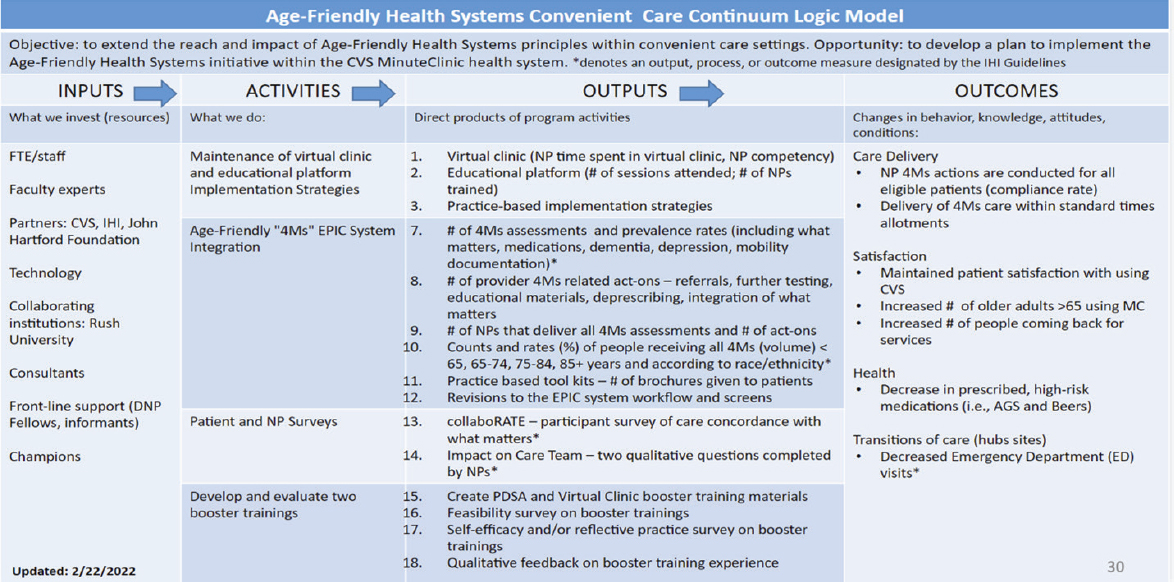
After Pohnert described the details of the 4Ms program, Dolansky discussed implementation of the program. The approach taken to implement the 4Ms into MinuteClinics has bearing on how to implement geriatrics concepts into health professions education and residency, she said. Dolansky described a number of methods and frameworks that were used to expand the reach of the 4Ms, including the learning health care organization, quality improvement, and implementation science. Learning health care organizations are those that are willing to learn and improve; educational organizations must also be willing to learn and improve in order to implement new ideas and approaches. The quality improvement efforts, Dolansky said, were led by the director of clinical quality, who established a quality improvement infrastructure. In clinical practice, she said, a lot of change can be facilitated by the data generated by the electronic health record; educational organizations also need infrastructure in order to use quality improvement approaches. The plan–do–study–act (PDSA) philosophy can be used in small test cycles to reflect on and make changes, she said. The implementation science approaches that were used, Dolansky said, included the Consolidated Framework for Implementation Science (CFIR), the RE-AIM evaluation framework, and the Expert Recommendations for Implementing Change (ERIC). Dolansky encouraged education stakeholders to look to implementation science in order to make changes in their own systems. Dolansky also shared the logic model used for implementing the 4Ms into the CVS MinuteClinics (Figure 2-3); she noted that the tenets of the RE-AIM model (reach, effectiveness, adoption, implementation, and maintenance) guided the development of the logic model.
There are three major components of implementation strategies that are critical for making change, Dolansky said: infrastructure, practice-based
SOURCE: Dolansky presentation, December 8, 2022.
tools, and professional development. At MinuteClinics, the infrastructure that supports implementation of the 4Ms includes data analytics, performance evaluations, virtual huddles, advisories and newsletters, an electronic message board, and the clinical dashboard. These mechanisms for support and feedback are essential for improvement.
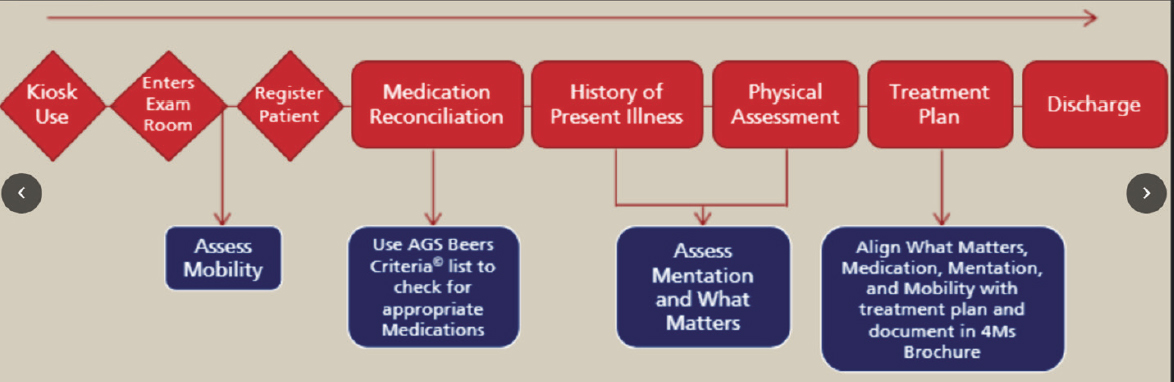
A practice-based tool to support implementation of the 4Ms is the EPIC health record system, which includes a 4M Age-Friendly Evaluation tab and a pocket card that can be given to patients to help them understand age-friendly care. Another useful tool for the 4Ms is a patient brochure that reviews the purpose and history of age-friendly health systems, introduces the 4Ms, and leaves space for the practitioner to document action steps for each M. A process map was developed to help practitioners automatically integrate the 4Ms into their usual primary care visit (Figure 2-4). These types of tools, Dolansky said, would also be helpful for learners in the delivery of geriatrics care in different practice settings.
Professional development was also a critical piece of implementing 4Ms into MinuteClinics, Dolansky said. A variety of platforms and activities were used to reach and educate practitioners, including monthly grant rounds, optional video vignettes, education exchange on “hot topics,” acknowledging age-friendly health system champions, clinical education resources, and a weekly newsletter. One challenge that some of the early career nurse practitioners have, Dolansky said, is a lack of confidence in patient communication. In order to address this, a Confident Conversations tool was created which helps guide providers through the conversations they need to have about the 4Ms. In addition, providers are given a decision tree to help guide their actions after assessment (Figure 2-5), and there is a “virtual clinic” for practitioners to practice and assess their competency in the 4Ms. Virtual clinical practice is an excellent opportunity to expose students to geriatric care, she said.
Interprofessional Implications
The 4Ms is a national movement, and it is important that students, residents, and practitioners all be on board, Dolansky said. In all disciplines, students should be taught early about the 4Ms and how they will be expected to deliver 4Ms care both during and after their education. The Institute for Healthcare Improvement (IHI) has created a module for all health care professionals to learn age-friendly care; this is an excellent resource to prime students on geriatric care (IHI, 2020). At Case Western Reserve University, students from multiple health professions programs can participate in a certificate program for age-friendly learning; the program includes the IHI module and small group discussions about interprofessional collaboration on the 4Ms and uses a virtual clinic. Students are
SOURCE: Dolansky presentation, December 8, 2022.
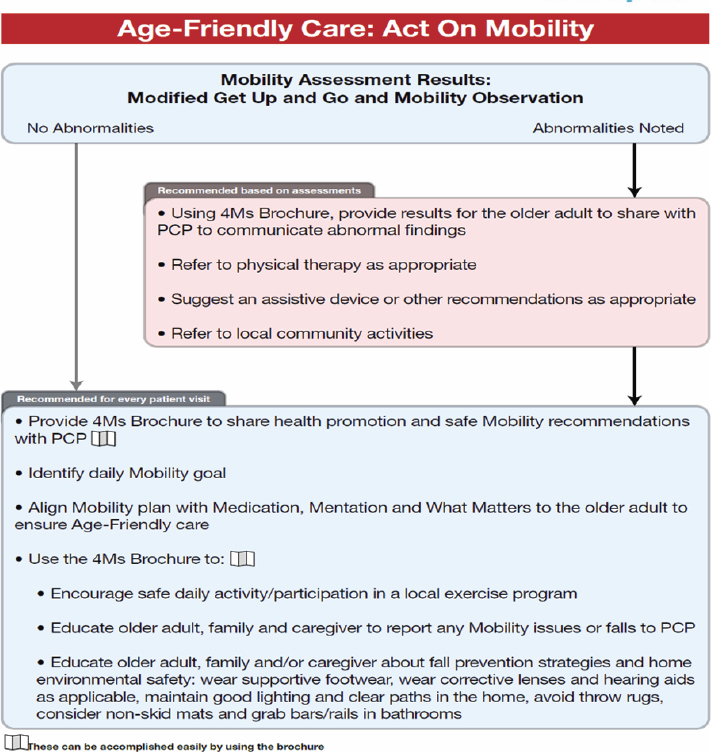
SOURCE: Dolansky presentation, December 8, 2022.
generally technologically savvy, Dolansky noted, and the virtual environment offers an opportunity to educate and train students on experiences they may not get in their practice settings. Embracing these types of educational opportunities, she said, will allow students to have a robust experience along the continuum of aging and to embrace the joy of the delivery of care for older adults.


