The Role of Plant Agricultural Practices on Development of Antimicrobial Resistant Fungi Affecting Human Health: Proceedings of a Workshop Series (2023)
Chapter: 2 Fungal Pathogens in Plant and Human Health
2
Fungal Pathogens in Plant and Human Health
The workshop’s opening panel focused on fungal disease and antifungal drugs, fungicide use in agriculture, and efforts to address antimicrobial resistance (AMR). It was moderated by Tom Chiller, chief of the Mycotic Diseases Branch at the Centers for Disease Control and Prevention. Arturo Casadevall, Bloomberg Distinguished Professor and Alfred and Jill Summer Chair of the Molecular Microbiology and Immunology Department at Johns Hopkins University, discussed the characteristics of fungi that have historically limited their pathogenic effect on humans, the ways in which these characteristics and the climate are changing—thereby increasing the threat of fungal disease—and the limited treatments currently available to address this threat. Tony Dorn, Environmental, Economics, and Demographics Branch chief at the U.S. Department of Agriculture (USDA), National Agricultural Statistics Service (NASS), described the history, methodology, quality measures, and data products of the NASS Agricultural Chemical Use Program. Tim Corrigan, technical officer for AMR and One Health at the World Health Organization (WHO), provided an overview of the Quadripartite Joint Secretariat (QJS) on AMR. He reviewed the partnership’s aims, functions, strategic framework, and key activities.
ANTIFUNGAL DRUG USES IN HUMAN MEDICINE
Casadevall provided an overview of pathogenic fungi and their associated effects on humans. Featuring more than 6 million species, the kingdom fungi—the largest kingdom within biology taxonomy—includes major pathogens of plants, insects, invertebrates, and ectothermic (i.e.,
cold-blooded) vertebrates. Currently, fungi are affecting major ecosystems, causing significant declines in multiple animal populations. For instance, “white nose syndrome,” caused by Pseudogymnoascus destructans, has devastated bat populations in North America. Batrachochytrium salamandrivorans has caused declines in European salamander populations, while Batrachochytrium dendrobatidis has led to catastrophic amphibian declines throughout the world. Additionally, fungi have had detrimental effects on snake and turtle populations.
Requirements for Fungal Human Pathogenicity
Overall, mammals are remarkably resistant to fungi, Casadevall noted. Relatively few fungal species are pathogenic for humans, with fewer than 10 species of major concern to human health. Some pathogenic fungi are host-associated, meaning that hosts spread them to other individuals; these include Candida spp., Pneumocystis jirovecii., and dermatophytes. Although host-associated fungi are often present without causing disease, disruption of the host-microbe relationship—particularly when it affects immunity—can result in pathogenic fungus-related disease. Other pathogenic fungi are environmental and tend to cause disease when the host is immunosuppressed or receives a large inoculum, such as Histoplasma spp., Aspergillus spp., Cryptococcus spp., Coccidioides spp., and Blastomyces spp.
To cause disease in humans, fungi must feature thermotolerance and the ability to survive and replicate within human hosts, stated Casadevall. Host-associated human pathogenic fungi have the capacity to survive mammalian temperatures, yet only 6 percent of fungi species are able to tolerate temperatures greater than 37 degrees Celsius (Robert and Casadevall, 2009). To cause systemic human disease, the organism must also have virulence factors that allow it to resist immune system clearance. A wide variety of such traits includes capsules, toxins, antioxidant systems, intracellular replication, and stress resistance. The combination of thermotolerance and the ability to survive, replicate, and evade sophisticated mammalian immune mechanisms is relatively rare in fungi, he noted.
The advanced nature of immunity in humans and mammals is such that fungal disease typically requires the interference of another disease or immunosuppressant medical treatment. In fact, fungal diseases were extremely rare until the advent of AIDS and immunosuppressant therapies for cancer and other diseases in the late twentieth century, Casadevall explained. These developments bolstered the ability of fungi to resist immune system clearance. Moreover, climate change could affect thermotolerance (Casadevall, 2020). As the climate trends toward warmer temperatures, microbial adaptations could enable fungi to survive above 37 degrees Celsius, thereby resulting in new fungal diseases.
Treatment and Prevention of Fungal Diseases of Humans
Fungal diseases in humans are often chronic, and systemic fungal diseases are typically lethal if untreated. Casadevall remarked that most fungal diseases are not reportable, thus prevalence figures are estimates with high uncertainty. Characterized by having a large burden of organisms, fungal diseases are often resistant to treatment, due to the high probability that some of those organisms have resistance mechanisms. Consequently, effective treatment generally requires prolonged therapy lasting months or years. Fungi and animalia are the most closely related of the classification kingdoms with few major differences to exploit, which hampers drug discovery and limits antifungal drug classes. One difference between the kingdoms is the presence of a cell wall in fungi; the drug class of echinocandins exploits this difference by targeting the cell wall (Sucher et al., 2009). Another difference is that ergosterol, found in fungi cell membranes, serves many of the same functions as cholesterol in animal cells. Aside from the presence of cell walls and ergosterol, the fungi and animalia have such similar biochemistry that it poses an intrinsic and fundamental problem to drug development.
Currently, no licensed vaccines are available to prevent fungal disease. Casadevall emphasized that the capacity to create vaccines for every major fungal pathogen already exists and has been demonstrated in animal models. However, fungal vaccines have not been developed. He added that vaccination—if developed—could serve as an important protection tool against antifungal resistance. Given the rising temperatures associated with climate change, new fungal diseases could emerge this century, some of which will likely arrive with inherent resistance to the drugs currently available. Casadevall added that most known organisms have not yet been tested for susceptibility to current antifungals. Candida auris is one example of an emerging fungus that has developed resistance to multiple drugs.
AGRICULTURAL CHEMICAL USE STATISTICAL PROGRAM
Dorn described the USDA NASS Agricultural Chemical Use Program’s history, methodology, quality measures, and data products. In the early 1990s, NASS began to collect and publish chemical use data. This was partly in response to public outcry against the use of Alar, a growth regulator that posed a carcinogenic risk. The U.S. government responded by establishing initiatives on food safety and water quality. Although those initiatives have evolved over time, the need for reliable, timely, environmental data remains constant. Since 1990, NASS has routinely surveyed U.S. farmers to collect information on chemical ingredients applied to agricultural commodities via fertilizers, pesticides, and fungicides. The program collects data on fruits, vegetables, and major field crops on a rotating basis
that changes annually. Additionally, the program gathers information on pest management practices that farmers utilize to boost the effectiveness of pesticides or as alternatives to pesticides, thereby reducing dependence on agricultural chemicals.
Each year, the USDA Economic Research Service conducts the Agricultural Resource Management Survey from October through December, said Dorn. NASS is a partner in this initiative, contributing chemical use survey data for field crops. This integration allows for the analysis of fertilizer and pesticide data with farm financial information, farm household characteristics, and other agricultural production practices. Rather than survey the entire country, NASS selectively surveys the states responsible for 80 percent of a crop’s production. For instance, states in the Midwest and Southeast grow the majority of U.S. corn and soybeans; Texas and states along the West and East coasts produce most of the country’s fruits and vegetables. Due to limited resources, NASS is unable to survey every commodity annually. Instead, commodities are included in surveys on a rotating basis, with most commodities appearing in the annual survey every 2–3 years. In 2019, the Agricultural Chemical Use Survey collected data on fungicide use on 21 different fruit crops among the 12 states that produce the majority of those crops.1 These data include total pounds of fungicide applied, specific active ingredients, and rates of use. Similarly, in 2020, NASS collected fungicide use data on 22 vegetable crops among the 18 highest producing states.
Survey data are made available in a variety of formats, said Dorn. The NASS website includes links to the Quick Stats 2.0 database, from which users can export data to Excel software.2 This website includes pre-defined queries to expedite research for users. NASS also publishes two-page summaries of highlights from each survey on their website. Documents outlining quality measures and methodology are available for all crops included in Agricultural Chemical Use Program surveys. These documents include scope and purpose, survey timeline, sampling frames and methods, data collection and editing, analysis tools, non-sampling errors, nonresponse adjustment, outliers, estimators, estimation, and state-level sample sizes and response rates. Dorn stated that NASS strives to be as transparent as possible with these data.
Database modernization efforts are currently under way, with rollout of a cloud-based data dissemination system expected in 2023. This system,
___________________
1 More information about the 2019 Agricultural Chemical Use on Fruit Crops survey is available at https://www.nass.usda.gov/Surveys/Guide_to_NASS_Surveys/Chemical_Use/2019_Fruits/fruit-chem-highlights.pdf (accessed July 9, 2022).
2 More information about NASS data products, the Quick Stats database, and pre-defined queries is available at https://www.nass.usda.gov/Surveys/Guide_to_NASS_Surveys/Chemical_Use, https://www.nass.usda.gov/Data_and_Statistics/Pre-Defined_Queries/index.php, and https://quickstats.nass.usda.gov (accessed July 9, 2022).
which will replace the Quick Stats 2.0 database, will feature a new data taxonomy, structure, and a data dictionary for reference. Dorn explained that chemical use data taxonomy and structure do not always fit the structure NASS data products use for crop planting, harvesting, yield, and production data. The design of the new system is expected to be more user-friendly for locating chemical use data. To address user challenges related to searching for specific data within the existing database, an application programming interface will drive the new system, making it easier to sort, query, and locate data. Users will also be able to perform ad hoc queries on all years of historic data.
QUADRIPARTITE ALLIANCE JOINT ACTIVITIES ON ANTIMICROBIAL RESISTANCE
Corrigan, who serves as WHO Liaison Officer to QJS on AMR, provided an overview of this partnership among the Food and Agriculture Organization (FAO) of the United Nations (UN), the United Nations Environment Programme (UNEP), WHO, and the World Organisation for Animal Health (WOAH). In 2010, FAO, WHO, and OIE (now WOAH) solidified a collaboration dedicated to applying a One Health approach to AMR, avian influenza, and rabies. This Tripartite Joint Secretariat on AMR worked closely with UNEP in the AMR area. On January 1, 2022, UNEP appointed a liaison officer to the QJS on AMR. The Tripartite officially expanded to a Quadripartite on March 17, 2022, with the four entities signing a memorandum of understanding to formalize their ongoing partnership and expand their collaboration beyond AMR to address the entire One Health sphere.
The QJS on AMR aims to accelerate a coordinated strategy on human, animal, and ecosystem health by drawing on the core mandates and comparative advantages of the four organizations to address the wide range of needs in the global response to AMR. Corrigan outlined the secretariat’s key functions. The collaboration supports global promotion, advocacy, and political engagement with the Group of Seven and Group of Twenty members and the UN General Assembly. The QJS provides secretariat services and support to the global governance structures recommended by the UN ad hoc Interagency Coordination Group on AMR in their 2019 final report.3 Additionally, the QJS coordinates the AMR Multi-Partner Trust Fund. Furthermore, the QJS coordinates and monitors workplan implementation and mapping
___________________
3 Interagency Coordination Group on Antimicrobial Resistance. 2019. “No Time to Wait: Securing the Future from Drug-Resistant Infections.” https://reliefweb.int/report/world/no-time-wait-securing-future-drug-resistant-infections-report-secretary-general-united (accessed September 30, 2022).
of gaps and opportunities. Corrigan noted that QJS convenes other partners in the sphere to collaborate.
In 2022, the QJS on AMR reached a major milestone with the publication of a strategic framework that presents the background and context for the collaboration between these four organizations, said Corrigan (WHO et al., 2022b) (see Box 2-1).
Global Collaborative Efforts Against Antimicrobial Resistance
Corrigan noted that a key joint venture is the AMR Multi-Partner Trust Fund. Thus far, the trust fund has been implemented in 10 countries—Morocco, Kenya, Zimbabwe, Senegal, Ghana, Cambodia, Indonesia, Ethiopia, Peru, and Tajikistan—with expansion to Bangladesh, Mongolia, Tunisia, Madagascar, and Cameroon taking place in 2022. The trust fund has raised $26 million to be used in joint activities conducted in collaboration with national governments. The aim of these activities is to catalyze
sustainable national multisectoral response and encourage domestic financing for One Health responses to AMR at the country level (WHO et al., 2022a). Corrigan described the trust fund as a mechanism for high-level goals at the global level to translate to impact at the regional and country levels. Currently, the governments of Germany, the Netherlands, Sweden, and the United Kingdom are the trust fund’s main resource partners.
The Global Leaders Group on AMR, a high-level group driving political action, serves as a key global governance structure, said Corrigan. Sheikh Hasina, prime minister of Bangladesh, and Mia Amor Mottley, prime minister of Barbados, serve as co-chairs. The group has developed six priority areas and corresponding key performance indicators, which include political action, transforming systems, surveillance, financing, research and development, and environment dimensions.4 Examples of the group’s impact include helping to build the global consensus around reducing antimicrobial use in food systems, facilitating the Codex AMR negotiations to develop a framework of guidelines (FAO and WHO, 2022), and advocating for a UN General Assembly high-level meeting on AMR in 2024.
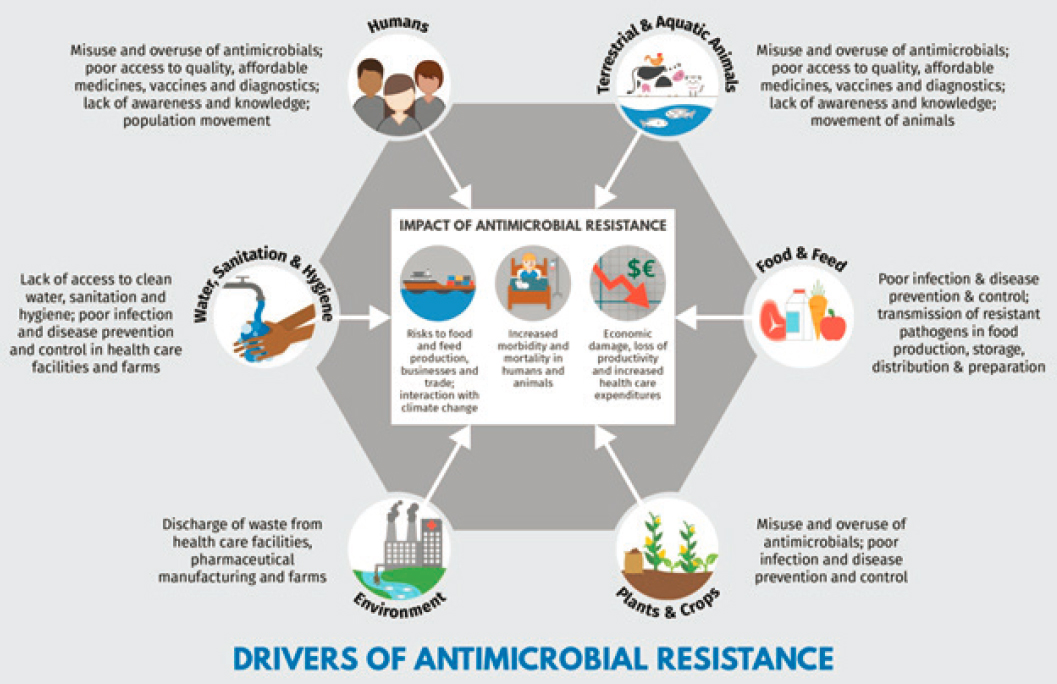
Integrated surveillance of antimicrobial resistance and use across sectors is a priority for the QJS on AMR, Corrigan stated. The QJS established a working group to review and revise currently available guidance documents, definitions, and approaches. This work will inform a proposal for the need, scope, and format of QJS guidance on integrated surveillance, which will include the optimal areas for investment. The working group will also define priority needs across sectors and in different settings, particularly in low- and middle-income countries, to develop approaches that are adaptable to different contexts rather than standardized. The QJS is currently in the process of establishing a Quadripartite Technical Group of external experts who will provide strategic and technical advice to the QJS and the Global Leaders Group. Furthermore, the Global Leaders Group has established an Integrated Surveillance Task Force led by Lothar Wieler, president of the Robert Koch Institute in Berlin, Germany. Corrigan remarked that the varied drivers of AMR (see Figure 2-1) constitute a One Health problem that requires One Health Solutions; the QJS has the appropriate mechanism and structures in place to help address these pressing issues.
___________________
4 More information about the Global Leaders Group on Antimicrobial Resistance is available at https://www.amrleaders.org/resources (accessed July 24, 2022).
DISCUSSION
Thermotolerance, Climate, and Human Body Temperature
Chiller noted that many fungi are unable to survive at 37 degrees Celsius—a feature that contributes to the relatively low number of mammalian fungal pathogens—and asked whether mammalian fungal pathogens are more prevalent in tropical regions. Casadevall replied that fungal diseases are indeed more prevalent closer to the equator and, accordingly, prevalence decreases farther away from the equator. Replying to a query about the role of human body temperature in relation to fungal disease, Casadevall remarked that a recent study analyzed medical data spanning more than a century, finding that the human body temperature in the United States is decreasing over time (Protsiv et al., 2020). Thermometers from 150 years ago worked as well as their modern counterparts, thus the decrease cannot be attributed to a problem of measurement. The authors posited that the decrease of inflammatory diseases over the past century is a plausible explanation for decreasing body temperatures. Casadevall noted that medical challenges such as latent tuberculosis, worms, and exposure to air pollution levels that trigger lung inflammation were far more common 100 years ago than they are today. Moreover, body temperature varies across individuals, both above and below 37 degrees Celsius, so humans with lower-than-average body temperatures may not be protected against some organisms in some climates. Casadevall suggested that the current confluence of two negative trends—fungi adapting to warmer climates and human body temperatures declining—could portend trouble ahead.
Given the extreme weather events in recent years in the American West, Australia, the American Midwest, and Western Europe, Chiller asked whether thermal tolerance in fungi evolves in response to such events or in response to a rise in mean or median temperatures. Casadevall replied that the fungal world is hypothermic in that mushrooms tend to be cooler than the environment and fungal colonies are always cooler than the environment, even at the microscopic level. He posited that this may be related to the increase in oxidative damage that occurs across kingdoms with higher temperatures. Spermatogenesis takes place in cooler areas due to the decreased likelihood of DNA damage, raising questions as to why some organisms appear to be thermally resistant. For example, Aspergillus appear to do well at 45 degrees Celsius. Casadevall surmised that they could be the result of an adaptation for a niche, such as compost piles. The earth has gone through periods of cooling and warming, thus selective events in the past may have created residual capacity for thermal tolerance despite the majority of the fungi kingdom appearing to prefer cooler regions.
NASS Survey Selection Criteria and Confidentiality Considerations
Chiller asked Dorn whether the states selected for NASS survey sampling were chosen due to high volume production per crop or by some other criteria. Dorn responded that production is a factor in quality measures, so commodities are selected based on the number of planted acres, rather than on production. Samples cover at least 80 percent of acres planted for each target commodity. Dorn added that surveys are voluntary and individual information is not disclosed. On occasion, not all data is published to protect the confidentiality of reporting farmers, which can create holes in the data. Chiller queried whether USDA collects any pesticide data they do not make public. Dorn replied that NASS publishes or produces some type of results for all data items collected. The surveys require a time commitment from farmers in answering questions regarding applications of all pesticides, fertilizer, and fungicides for all fields and various crops over the span of a year. Therefore, NASS strives to produce results on these complex surveys for the benefit of the farmers and the public.
Addressing Fungicide Use
Chiller asked whether the QJS on AMR has any projects or activities addressing the role of fungicide in antifungal resistance. Corrigan stated that the QJS is not currently involved in any activities directly related to fungicide. However, a number of initiatives are under way in sector-specific responses linked to existing QJS activities, such as integrated surveillance. Additionally, joint activity in developing a prioritized research agenda for AMR may touch on fungicide. Although the QJS on AMR is not currently addressing fungicide directly, the strategic framework and biennial workplan allow for the addition of new issues and the identification of specific problems requiring action, said Corrigan.
Noting that fungi constitute as much as 80 percent of pathogens problematic in the agriculture sector, Chiller remarked on the critical role of fungicides in plant agriculture. He asked Corrigan whether the QJS on AMR has considered identifying certain crop groups as essential in evaluating their value—whether in terms of economics or calories—at the local, national, or international level. Corrigan replied that declaring a crop as essential remains outside the scope of the strategic framework and current direction of the QJS on AMR, which focuses on activities that can be addressed by all four organizations. Although relevant, this designation is outside of certain mandates of some of the QJS organizations. Dorn added that NASS does not set categories for products due to the range of specialty markets and variations in a product’s importance across specific local settings.
Chiller asked about current trends in the agricultural sector that might be influencing fungicide use. Dorn responded that field application is outside the scope of NASS’s data collection and presentation activities. However, given how expensive fertilizers have become for the agriculture industry, the current input costs of fertilizers and fuels likely factor into fungicide use. To generate returns from investing in rented land, farmers must consider their budgets and contain expenses to yield profit. The unexpectedly large increases in fuel and fertilizer input costs will likely continue to affect fungicide use. Dorn added that NASS will be conducting a 2022 census of agriculture that will collect data including overall expense information at the national, state, and county levels.
Candida auris and the Threat of New Fungal Diseases
Chiller asked Casadevall to describe his hypothesis on the emergence of Candida auris. Casadevall replied that it is simple but has not been proven and will likely be difficult to prove. Candida auris was unknown to medicine until 2007, when it was isolated in an individual’s ear. It soon began causing disease in immunocompromised patients in three regions—South America, India, and South Africa—which have all experienced recent increases in median temperatures. He added that this organism has a significant amount of drug resistance when it emerges from the ground. Candida auris has been found in two locations in the Andaman Islands, in a beach and in a wild marsh. The organism found in the beach was temperature-adapted and possibly dropped there by humans. The marsh isolate was not as temperature tolerant as clinical isolates consistent with the notion that wild strains are adapting to temperature, which continues as these become human host adapted. Although climate change can be framed in terms of an average rise of degrees in temperature, the number of hotter-than-average days is also pertinent, because each hot day is a selection event that may spur change in organisms. His hypothesis is that many potentially threatening organisms are currently controlled by temperatures at which they cannot survive; however, as these organisms adapt, new fungal diseases previously unknown to medicine will emerge, as was the case with Candida auris (Casadevall, 2020).
Given that Candida auris is highly resistant to azoles, Chiller asked for theories on how this resistance developed. Casadevall responded that fungi have enormous biochemical variation in assembling a fungal cell. The biological diversity of fungal organisms, both in terms of how they assemble the fungal cell wall and where melanin and lipids are placed within the cell, contributes to a range of susceptibility. He added that resistance in Candida auris is not surprising, although the finding that amphotericins,
echinocandins, and azoles are indeed active against many of the fungal species is more unexpected.
Potential Fungal Disease Threats and Fungicide Stewardship
Chiller asked about the biggest concerns regarding fungal diseases in the coming century and about how antifungal or fungicide stewardship can be applied across human, animal, and plant settings. Casadevall’s greatest concern is the limited attention devoted to fungal diseases, which represent relatively unfamiliar threats. For instance, humans constantly prepare for war, but place little attention on what is happening to animal species—particularly to frogs, bats, salamanders, turtles, and snakes— and to other kingdoms that have the potential to wreak major havoc on human life, he noted. Casadevall added that although major epidemics of fungal diseases have not yet occurred, they remain a potential threat. He likened this to the mistaken supposition, prior to the advent of HIV, that retroviruses did not cause human disease. Similarly, coronaviruses were previously believed to cause only mild colds, yet three coronavirus epidemics have already taken place this century. Casadevall expressed concern regarding the potential emergence of a fungal disease that is transmissible through human-to-human contact and is resistant to available antifungal drugs. Regarding fungicide stewardship, he highlighted a dilemma in azole fungicide use in agriculture. Reducing antibacterial use in animal husbandry may result in smaller cows, yet these smaller cows will continue to produce food supply. In contrast, fungicides are used to prevent the loss of crops that are required for the food supply. Therefore, it can be challenging to strike the appropriate balance between generating an adequate food supply and curing disease.
Dorn remarked that the effects of climate change on agriculture are part of a public discussion, but media attention rarely focuses on issues of crop loss and livestock effects of fungicides, despite future deleterious impacts on crop production that could be caused by new fungal diseases. Corrigan cautioned that the lack of awareness about AMR, coupled with a large burden of infections, could coalesce into a perfect storm in which people become sick with untreatable diseases, food supplies run low, and a socioeconomic collapse occurs. Thus, he urged the international community to more robustly examine the threat of antifungal resistance and included it among considerations regarding antimicrobial stewardship, guidelines, and data needs.


