Applying Neurobiological Insights on Stress to Foster Resilience Across Life Stages: Proceedings of a Workshop (2025)
Chapter: 2 Lived-Experience Perspectives on Building Resilience
2
Lived-Experience Perspectives on Building Resilience
Highlights
- Resilience is not just an innate personal trait but a process developed through adversity. Building resilience requires conscious effort, support, and a willingness to reframe challenges as opportunities for growth. (Birto, Nelson)
- Stigma surrounding mental illness coupled with systemic failures within health care and government policy remain pervasive barriers to accessible and effective mental health treatment and recovery. (Birto, Nelson)
- Support systems and community connections are vital to recovery. Healing is not a solitary journey; whether through peer networks, mentorship, or advocacy, surrounding oneself with people who understand the experience of mental illness fosters resilience and encourages sustained progress. (Birto, Nelson)
NOTE: This list is the rapporteurs’ summary of points made by the individual speakers identified, and the statements have not been endorsed or verified by the National Academies of Sciences, Engineering, and Medicine. They are not intended to reflect a consensus among workshop participants.
Huda Akil reflected on an earlier conversation with Indida Birto, who was a researcher at Emory University Rollins School of Public Health and a service plan coordinator at Here’s to Life, Inc. at the time of the workshop. Birto shared with Akil her personal concept of resilience through the Japanese art of Kintsugi—where imperfections are embraced and transformed into strength (see Figure 2-1). “That is another way of looking at resilience,” said Akil, emphasizing how lived experience can provide a different lens through which to examine resilience. This chapter explores the journeys of individuals who have built resilience through their lived experiences, enriched by a cultivated social support system and advancements in science.
A SPARK IN THE DARKNESS: ELECTRICITY AS MEDICINE
The journey of Jon Nelson—member of the board of directors of the American Brain Coalition, a lived-experience council of One Mind, a director of lived experience for Motif Neurotech, and Chief Pulverize Officer at Pulverize the Stigma—is a testament to the complexities of living with treatment‐resistant major depressive disorder and the resilience that can emerge from the darkest moments. A self-described “serious mental illness livedexperience activist,” Nelson has dedicated his life not only to overcoming his own struggles but also to voicing the challenges faced by countless individuals battling the relentless grip of depression.
In 2012 Nelson was diagnosed with major depressive disorder, a condition that swiftly escalated into a relentless treatment-resistant battle lasting nearly a decade. During those years, his only constant was a deep, pervasive desire to die—a sentiment he described with stark candor. Despite trying every available medical intervention, he found himself descending into what he plainly calls “hell.” It was this despair that eventually drove him to participate in a clinical trial at Mount Sinai Hospital under the care of Helen Mayberg. The procedure required an intense, eight-hour neurosurgical intervention to install a device that delivers 22.5 million electrical pulses per day to his brain.
Almost immediately after the surgery, Nelson experienced what he calls a “bonus life.” The profound change was “unmistakable,” he noted: The constant suicidal ideation evaporated, and he found himself liberated from the disease that had long warped his perception of life. “Electricity is my medicine,” he later reflected, underscoring the transformative impact of deep brain stimulation. Yet this newfound relief was coupled with an unforeseen challenge—the reawakening of genuine emotion. In the early days following his recovery, he relished small moments of normalcy—walking his dog, enjoying lunch with friends—but about six weeks postsurgery, the resurgence of familiar feelings of sadness, stress, and even anger forced him to confront a new reality. “I have
to learn how to deal with sadness. I can now feel again,” he recounted, highlighting the delicate task of relearning to navigate life’s emotional spectrum.
This period of readjustment was not a solo journey. Nelson formed a community with four other individuals who, like him, had undergone the same procedure. Their quarterly Zoom meetings became a space for shared vulnerability, where fears of relapse lingered. Despite the collective relief of emerging from the clutches of treatment-resistant depression, each member carried an abiding anxiety—a stark reminder that the specter of their former condition was never fully gone. “If this comes back, I don’t think I can survive,” Nelson admitted, capturing the persistent tension between hope and fear.
Amid his personal struggles, Nelson did not shy away from confronting broader societal issues. His narrative highlighted the stigmatization faced by those with mental illness and how the needs and realities of these communities are often dismissed by health care and societal systems. He recalled the compassionate care he finally experienced at Mount Sinai Hospital—being “looked in the eye” and genuinely believed—against the backdrop of chronic neglect, the repeated insurance denials and societal indifference, that had unduly burdened him for years.
At the heart of Nelson’s story lies a deeply personal definition of resilience. For him, resilience is not an abstract concept but the very act of facing each new day despite lingering fears and emotional challenges. “Resilience is waking
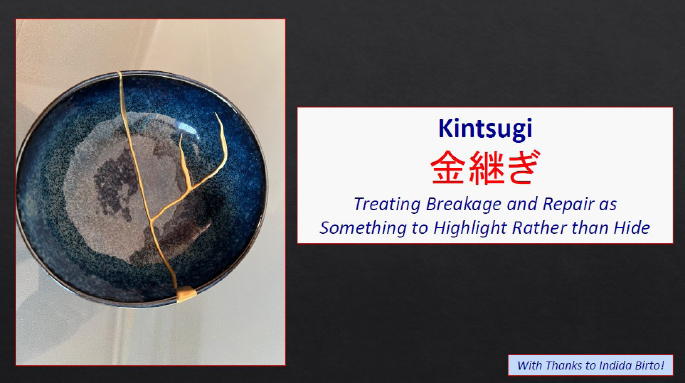
NOTES: A concept, shared by Indida Birto, that highlights repair through casting gold on the fractures of pottery. This bowl, shared by Huda Akil, resembles a neuron and symbolizes the beauty of resilience. Its fractured areas are repaired with gold, representing strength and transformation.
SOURCE: Presented by Huda Akil on March 24, 2025.
up every single day,” he asserted—a motto that frames his ongoing struggle. His resilience is expressed not only through his personal transformation but also in his commitment to forming peer support networks and pushing for change. Even as he battles uncertainties about medication adjustments and the possibility of relapse, his unwavering determination to transform anger into actionable advocacy stands as a powerful beacon for others.
His account is not solely about the marvels of biomedical intervention or the triumph of modern neurosurgery. It is, at its core, a candid exploration of the human spirit—a call to recognize that even in the face of overwhelming darkness, the act of simply rising each morning constitutes an extraordinary form of resilience.
MENDING LIFE’S FRACTURES WITH GOLDEN STRENGTH
Indida Birto shared her personal journey with resilience—a path defined not by innate strength but by the ongoing work of overcoming adversity. Drawing on her extensive background in recovery, HIV care, case management, and research, Birto’s narrative weaves together a story of hardship and emerging purpose. Birto focused on the metaphor of Kintsugi (mentioned previously by Akil), explaining that when someone navigates life’s challenges and mends the metaphorical cracks with gold, they become even more valuable (see Figure 2-1).
Birto’s story begins with a candid reflection on her early years—a time marked by intergenerational family struggles. Growing up in an immigrant family burdened by substance use disorder and behavioral health challenges, she recalled a childhood shadowed by insurmountable difficulties and trapped by circumstances beyond her control. In an environment where understanding and support were limited, her early life set the stage for a gradual yet profound transformation.
A turning point in her narrative was the gradual reframing of adversity. Birto vividly recalled a period when every setback seemed difficult to overcome, yet over time, she began to reimagine her hardships as a service to others. In a resonant moment, she stated, “each of us is a testament to the miracle of resilience. You are a miracle.” This declaration underscored a pivotal shift: understanding that the very experiences that once seemed to define her limitations were, in fact, the building blocks of a renewed self. By viewing each challenge as an opportunity for growth, Birto illustrated how the process of resilience involves continual adaptation and learning from each stumble along the way.
Central to her message is the importance of community and self-compassion. Throughout her journey, Birto embraced support systems ranging from crisis counselors to peer networks, emphasizing that even the smallest gestures
of kindness can help neutralize negative experiences. She poignantly remarked, “Once you make the place upstairs [your mind] a safe place, your life will blossom.” Her words evoke an image of inner space as a sanctuary, one that, when nurtured, allows for personal transformation. In this environment of self-kindness, even setbacks—likened to falling and hitting one’s head repeatedly—can become the stepping stones toward building a resilient identity.
Birto’s experiences also brought to light the fundamental role of small everyday moments in the pursuit of resilience. She recounted instances where, despite significant challenges, moments as simple as observing a worm on the ground or enjoying the beauty of a cherry blossom contributed to a sense of wonder and gratitude. These seemingly trivial details, woven into the fabric of her daily life, reminded her that resilience blooms not only from grand triumphs but also from the cumulative impact of minor, magical moments.
Her narrative, replete with both vulnerability and strength, offered a reflection on resilience as an ongoing journey rather than a fixed destination. In sharing her life’s trajectory—from the depths of despair to experiences of small yet significant victories—Birto invited the workshop participants to recognize that every personal struggle, every setback, has the potential to contribute to a broader tapestry of growth and community connection.
This page intentionally left blank.


