Reducing and Managing Disruptive and Unruly Behavior in Airports: A Guide (2025)
Chapter: 2 Prevent and Mitigate Unruly Incidents
CHAPTER 2
Prevent and Mitigate Unruly Incidents
The airport environment is often chaotic and stressful for all involved in the travel process. Airports can minimize the impact of unruly and disruptive behavior incidents and prevent undesired behavior from escalating into more serious incidents via three key avenues:
- Train internal stakeholders on understanding causation and on strategies for preventing, intervening in, and resolving conflict, including crisis communication and de-escalation techniques.
- Update and develop policies, programs, and procedures designed to alleviate common root causes of unruly behavior at airports, heighten situational awareness, create consistent communication and messaging, discourage unacceptable behavior, and establish responsive regulations.
- Use facility design standards, guidelines, and recommendations to alleviate stress and add or expand services and features that promote health and well-being in the airport.
Addressing these three areas can support the airport’s efforts to prevent and mitigate unruly and disruptive behavior incidents, create a less stressful environment for stakeholders (passengers, employees, users), and improve the travel experience.
2.1 Stakeholder Training
Most unruly incidents can be prevented or mitigated through specific de-escalation techniques and good customer service from aviation stakeholders (e.g., airport employees, air carrier employees, concessionaires, service providers, law enforcement, and federal partners). Comprehensive training for airport stakeholders (see Table 2, recommendation 2.1) may include:
- understanding the airport’s policies, rules, and procedures
- customer service/customer experience
- de-escalation tactics (e.g., verbal judo, emotional regulation)
- behavior and situational awareness
- crisis communication/intervention
- conflict resolution skills
- mental health first aid
Certain stakeholders may need specific training to manage complex incidents, such as state, city, and county regulations governing the sale and distribution of alcohol and licensing for airport restaurant, bar, lounge, and duty-free employees.
Training on these subjects can be conducted in a variety of ways. The most common method among the airports studied was instructor-led training, which allows the trainer and participant to exchange dialogue in real time. This is often accompanied by scenario-based training
or role-playing to practice effective intervention techniques. Another option is to review video footage of an incident to identify the factors that contributed to a successful or unsuccessful resolution.
One airport operator periodically offers short presentations on airport policies, regulations, and customer service to aviation workers. The presentations are typically 5–10 minutes, and the trainer creates flyers illustrating key points to accompany the presentation. The flyers are placed on participants’ seats before the presentation so they can follow along and take the information with them to share with coworkers.
It is important for aviation workers to understand their employer’s policies to confidently and appropriately address customer concerns. They should also understand the effect of their behavior on an upset individual during an interaction, as poor word choices and body language can escalate minor frustration to an unruly behavior incident.
Responding authorities (e.g., supervisors, LEOs, airport managers) should be mindful not to reprimand or educate an aviation worker in front of an unruly individual or other passengers. Once the incident has been resolved, a meaningful conversation with the involved aviation worker to explain how the situation could have been more effectively resolved will impart education and lead to better outcomes in the future. Conducting this interaction in a respectful manner—out of earshot/view of others as much as possible—can help to avoid embarrassing or undermining the worker and their authority.
Turnover is especially high in certain airport positions (e.g., concessions and service providers), which can make it difficult to ensure workers are adequately trained to manage unruly behavior incidents. Frequent training opportunities across all shifts can allow more aviation workers to participate and help close this knowledge gap (see Table 2, implementation note 2.1a). Incorporating these training topics and curricula into new-hire or badgeholder training programs and into recurrent trainings can provide valuable knowledge and skills to ensure the majority of airport stakeholders are trained in basic techniques to mitigate unruly behaviors.
Unruly behavior topics can be incorporated in agendas during regularly scheduled or ad hoc stakeholder meetings to ensure stakeholders are aware of trends or changes to policies. These forums may improve information sharing and stakeholder coordination, and identify innovative solutions to better manage unruly incidents (see Table 2, implementation note 2.1b).
More information on strategies to engage with the airport community can be found in Zoufal et al. (2023).
2.1.1 Airport Rules and Procedures Training
Providing training covering the airport’s rules, policies, and procedures governing management of unruly individuals and incidents can help set the expectations of aviation workers reporting or responding to an incident. This training should include:
- the difference between emergent (i.e., immediate action required) and nonemergent situations
- how to submit a complete description and report to the dispatcher
- law enforcement authority and procedures for responding to a call for service
- navigating the social services offered by airport partners in the surrounding community and the process and time involved
- airport rules, regulations, policies, and procedures, including associated ordinances or local laws
Some interviewed airport operators have noted a rising trend in aviation workers acting unruly, especially during the badging process, and acting aggressive and fighting with coworkers and others at the airport. Several airports in the study promulgated regulations, policies, and ordinances to enforce inappropriate behavior, including adopting language in the badging application that specifically addresses this condition and authorizes the airport to suspend or revoke access privileges from badgeholders displaying such behavior. These provisions emphasize behavior that constitutes interference with operations or noncompliance with the airport’s core values, and cover a broad scope of prohibited conduct, such as confrontations with passengers, coworkers, and anyone at the airport.
One airport developed a security bulletin about unacceptable behavior from aviation workers:
Unacceptable behavior including, but not limited to, verbal or physical assaults, ignoring lawful and reasonable directions by authorized personnel, yelling, and/or profanity by Airport ID badge holders towards passengers, other badge holders, or anyone at the Airport will not be tolerated. The Airport reserves the right to impose all applicable enforcement actions against any person(s) who violate this bulletin, including against any employer or other authorized signatory of such person(s), which may include, the issuance of citations to such employer or authorized signatory, and/or badge revocation as warranted.
It may be beneficial to include elements necessary to successfully prosecute a criminal case in the training course to educate aviation workers on the importance of witness statements and why they may need to appear in court to provide witness testimonies or meet other requirements.
2.1.2 Customer Service Training
Boudreau et al. (2016) describes “moments of truth” as decision points where customers will either have a positive or negative experience based on their interaction with an aviation worker. The decisive moment may come after a canceled or delayed flight, lost luggage, or another factor outside anyone’s control. This is often the moment when customer-facing aviation workers must use customer service and de-escalation skills to ensure the customer does not continue to grow frustrated and angry.
Customer service skills encompass both soft skills (listening, empathy, and compassion) and hard skills (problem-solving and technical knowledge). Honing customer-facing aviation workers’ customer service skills can change the dynamic of an interaction, reduce the potential for conflict, and result in a positive outcome for the individual and the business.
Inferior customer service is often the result of several factors:
- language and cultural barriers between the worker and the customer
- increased demand and higher expectations of a smaller workforce, leading to longer wait times and more frustration for customers
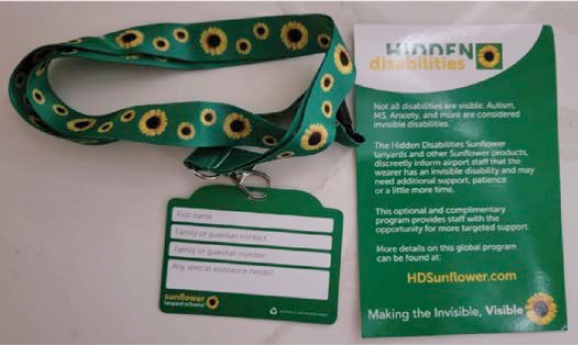
In 2016, London Gatwick Airport (LGW) created the “hidden disabilities sunflower” as a discreet means for passengers to alert aviation workers that they may need extra help, compassion, or more time to complete certain tasks. The program has since spread to multiple countries and industries. Many U.S. airports participate by providing sunflower lanyards (Figure 4) to passengers who request them. As part of the program, aviation workers are trained in what the sunflower lanyards mean and to offer additional support to those wearing them.
- lack of up-to-date training, skills (including communication and interpersonal skills), tools, resources, and policies necessary for customer-facing workers to engage in positive interactions and de-escalate situations
- workforce stress and burnout contributing to emotional exhaustion, disengaged workers, and high voluntary worker turnover
Airports can help address and mitigate these factors through customer service training (see Table 2, recommendation 2.1.2). A review of companies with the highest-rated customer service revealed several commonalities in customer service training topics:
- prioritize and personalize the customer’s experience
- find creative solutions to customer issues
- build rapport through empathy and compassion
- maintain a courteous and respectful attitude
- practice active listening
- identify the customer’s expectations and wants to exceed them
- provide transparency into company policies to show credibility and honesty
- remain reliable yet consistent when answering questions
- be prompt and responsive to customer issues
- accept critical and positive feedback with gratitude
This case example highlights several customer service models used at one of the world’s most renowned quality guest experience providers: Disneyland Theme Park and Resorts. Airports may consider developing similar customer service models for aviation workers to help mitigate stressors for those working and traveling in the airport.
Case Example: Disneyland Theme Park and Resorts Customer Service Models
Disneyland Theme Park and Resorts, “the happiest place on Earth,” has earned a reputation for exceptional guest experiences through meticulously designed customer service standards. The entirety of Disney’s culture is based on identifying guest needs and anticipating their wants. To this end, Disney has developed several models around guest service and empowering cast members to make difficult decisions that can be useful to airports developing or updating their customer service training.
Four Key Basics
Disney’s four key basics (Meneide 2021) empower cast members to make consistently good decisions that can affect guests while representing the Disney product and brand. In priority order, the four key basics are safety, courtesy, show, and efficiency. This places safety as the number one priority followed by courtesy—projecting positive and respectful energy into every interaction with the guests. “Show” requires the cast member to remain in character and fulfill their role and function while also using their time and resources wisely (efficiency).
Seven Service Guidelines
To support courtesy, Disney developed seven service guidelines to ensure cast members provide the same standard of customer service to all guests (Riserbato 2021). In keeping with the Disney brand, the guidelines are named after the seven dwarves from Snow White.
- Be Happy—make eye contact and smile!
- Be like Sneezy—greet and welcome every customer. Spread the spirit of hospitality. It’s contagious!
- Don’t be Bashful—seek out guest contact.
- Be like Doc—provide immediate service recovery.
- Don’t be Grumpy—display appropriate body language at all times.
- Be like Sleepy—create dreams and preserve the magical guest experience.
- Don’t be Dopey—thank every Guest!
Cast members are empowered to create happiness and exceptional experiences for the guests by following these guidelines.
LAST Model
Disney’s LAST model (Davey 2015) is designed to support cast members when making decisions involving unhappy or upset guests. Cast members are trained to:
- Listen: actively listen to the guest’s concern
- Apologize: genuinely apologize for the situation
- Solve: resolve the situation in such a way as to retain their patronage
- Thank: thank them for bringing the issue to your attention and for their loyalty
The LAST model is critical to maintain Disney’s loyal fan base and ensure guests return to the parks.
The Disney Institute
The Disney Institute (https://www.disneyinstitute.com/about/expertise/) offers online and in-person training courses and consultant services to professionals, teams, and organizations on the “Disney method,” which encompasses all the models discussed here and promotes the Institute’s three core mission statements:
- Effective leadership is proactive and can amplify a common purpose.
- A genuinely cared-for workforce will promote a culture of excellence.
- Exceptional service is achievable when thoughtfully architected.
Courses include firsthand observations from the Disneyland parks and practical applications that can be implemented in other organizations and industries.
Conclusion
Disney’s image and culture has been growing and developing for over 50 years and has set the company’s customer service as the gold standard for other industries. In many respects, airports share commonalities with theme parks; both accommodate thousands of individuals daily and place the safety of those individuals above all else while striving for excellent customer service. Airports can learn from Disney’s methods to create enjoyable experiences for their guests during stressful travel journeys and build a culture that empowers airport stakeholders to exhibit exceptional service and make good decisions.
2.1.3 De-escalation Techniques
De-escalation is “the use of communication or other techniques during an encounter to stabilize, slow, or reduce the intensity of a potentially violent situation without using physical force, or with a reduction in force.”
—Department of Homeland Security, Policy 044-05
De-escalation training can have a critical impact on mitigating unruly incidents by calming the individual and communicating information without escalating emotions. Training courses are often a requirement for LEOs and mental health clinicians but are rarely offered to customer-facing workers such as air carrier gate agents, airport customer service personnel, operations and security staff such as contract security inspectors, and restaurant servers, who could benefit from basic de-escalation techniques.
Airports could consider creating a basic de-escalation training module to include with new badgeholder and renewal badge training or other airport training courses to equip aviation workers with a basic understanding of de-escalation techniques to reduce conflict and prevent disruptive behavior from escalating. The four basic principles of de-escalation are:
- Personal safety and the safety of others is the number one priority; maintain a safe distance, avoid being alone with the individual, and remove yourself from the situation if it continues to escalate.
- Recognize when you have reached the limits of your de-escalation abilities and problem-solving authority; seek additional resources when the situation is beyond your capabilities.
- Call for assistance if the situation is escalating to a level beyond your control.
- Actions, verbal communication, and body language can calm or escalate potentially unruly situations; techniques include:
| De-escalation actions |
|
| Verbal communication |
|
| Body language |
|
2.1.4 Behavior and Situational Awareness Training
Behavior and situational awareness training helps the aviation worker detect changes in an individual’s behavior that indicate the potential for escalation to unruly actions. This type of training is beneficial to all airport stakeholders interacting with the public, regardless of their job title or responsibilities. The industry’s adoption of a touchless journey has created an unintentional gap in behavior awareness by significantly reducing the number of airport stakeholders interacting with passengers. Formerly, a passenger would interact with potentially dozens of aviation workers who could help identify signs of stress as passengers moved through the various processes in the air travel journey. Training aviation workers in behavior and situational awareness can help prevent and identify potentially disruptive individuals based on their behavior.
One airport operator discussed an incident where LEOs were dispatched to a possible assault and kidnapping in progress in the public area of the terminal. A fugitive released on bail had assaulted a janitor and was dragging her into the restroom to further assault her. The assailant was apprehended, but the incident led to increased concern over the safety of the janitorial staff. The airport provided safety training in behavior and situational awareness to the entire janitorial staff in response.
A basic behavior and situational awareness training module includes:
- observing the individual (e.g., body language, facial expressions, gestures)
- identifying triggers (e.g., long wait times, flight delays, signs of an altered mental state)
- gauging and working with individuals experiencing an altered mental state (e.g., intoxication, mental health crisis)
- indicators that a supervisor or law enforcement presence is necessary
2.1.5 Crisis Intervention Training
Many agencies and organizations offer crisis intervention training (CIT) for LEOs, security personnel, and healthcare providers working with individuals in crisis. In this report, CIT refers to programs that equip participants with strategies to safely defuse anxious, hostile, or violent behavior, including individuals experiencing a mental health crisis. These programs go by many names but contain similar techniques: crisis communication, emotional regulation, crisis response and intervention (CRIT), psychiatric emergency response training (PERT), mental health first aid, verbal craft or verbal judo, and crisis prevention and intervention (CPI).
Some states and local agencies require CIT or similar programs for their LEOs. It is typically a 40-hour course after which participants can become certified. The length of the training can be challenging for potential attendees and participants, especially for already short-staffed work groups. The certified training may also be limited to specific dates and is often only available at periodic intervals during the year.
CIT resources and documents can be found on several agency and training provider websites. These courses are designed for roles with responsibilities to respond to individuals in crisis and are often too detailed for the average customer-facing worker. Airports can create a modified version of this type of course that includes critical elements from the training:
- Review principles and strategies for working with individuals experiencing crisis or behavioral dysregulation
- – recognize behaviors and early warning cues
- individual not responding to verbal commands
- lack of coherence
- agitation
- talking to themselves
- poor hygiene
- – engage and connect
- do not rush the situation unless immediate action is required
- focus on calming the situation and minimizing the individual’s stress level
- continually assess and re-assess
- actively listen
- watch body language (theirs and yours)
- always be respectful, never dismissive
- – describe the emotional-rational thinking scale (Figure 5)
- rational thinking declines as emotions rise
- lower emotions can help the individual think more rationally and make better decisions
- – recognize behaviors and early warning cues
- Practice effective communication skills
- – demonstrate active listening
- – encourage conversation
- – pay attention to body language and nonverbal cues
- – spend 80% of the time listening and 20% talking (80/20 rule)
- – establish rapport while gathering information about the person

-
- – ask questions or make requests clearly and one at a time
- – avoid distractions
- – provide options
- – project compassionate body language
- – make eye contact and use open-handed gestures
- – modulate your tone of voice
- Provide alternatives to hostile-sounding phrases (e.g., “what can I do to help you?” vs. “what’s your problem?”)
- Expectations and responsibilities
- – it is not your role to diagnose or treat/solve issues
- – call for assistance and specialized help
- – top priority is to verbally defuse and stabilize the situation
- – try to get the individual to a state where voluntary compliance can be achieved
- – crisis intervention and de-escalation take time
- – remain unaffected and unoffended by the individual or your reaction will be from a victim perspective
Airport dispatchers can take CIT designed for emergency dispatchers, call-takers, and 9-1-1 operators to help them identify situations involving a person experiencing crisis or mental illness over the call. In addition to the critical elements highlighted above, the dispatcher training includes:
- key questions to ask of callers
- identifying the most appropriate response personnel to address the call
- relaying the information from the caller to the response personnel
One approach airport operators can take to assist their dispatchers is to flag the names of CIT-trained LEOs on the daily roster so they can quickly dispatch those officers to the scene.
2.1.6 Serving and Selling Alcohol
Aviation workers who serve or sell alcohol can attend their state’s server training in alcohol regulations (STAR), training for intervention procedures (TIPS), ServeSafe, or equivalent program designed to help servers identify when a customer is intoxicated, how to refuse service without escalating the situation, and how to enforce company policies. Airports may be able to add language in concessionaire agreements and leases requiring any individual selling or serving alcohol to attend this type of training.
Airports may consider developing policies that require tenants who serve or sell alcohol to report individuals appearing to be intoxicated to airport police or security/operations. This would allow the airport and/or police to monitor the individual through closed-circuit television (CCTV) or standoff observation.
Table 2. Section 2.1 recommendations.
|
Establish a comprehensive training program for all aviation stakeholders that:
|
 Recommendation 2.1: stakeholder training program
|
|
|
|
Airports should implement comprehensive customer service training to address:
|
 Implementation note 2.1
2.2 Updating or Adopting Programs, Policies, and Procedures
Adopting new programs, policies, and procedures is best accomplished using top-down, leadership-led or -supported initiatives. The corporate level managers or upper-level supervisors of the airport, in collaboration with air carriers and tenants, can use the following approaches to help airport stakeholders mitigate and respond to unruly incidents (see Table 3, recommendation 2.2):
- Collect feedback from customer-facing worker groups and site managers using surveys, focus groups, town hall sessions, etc.
- Establish an information feedback loop to notify workers directly impacted by an incident of any updates, resolutions, or outcomes of the incident.
- Work with airport law enforcement, security, operations, and customer service to identify hot spots—areas where more security presence is needed for deterrence (e.g., around bars, public transit stops, gates with a flight cancellation).
- Develop awareness campaigns for the public to inform them of the consequences of unruly behavior.
- Create or work with regulators to create policies or regulations to help reduce or eliminate common root causes and triggers (e.g., eliminate to-go alcoholic beverages, address disorderly conduct in the airport rules).
- Streamline reporting procedures (e.g., mobile applications, dispatch processes).
- Develop training programs for aviation workers that include customer service, de-escalation techniques, and reporting mechanisms.
2.2.1 Policy and Procedure Audits
Safety risk assessments (SRAs) support the airport in reviewing policies, procedures, communication channels, and training to ensure they are consistent and align with the mission to mitigate and respond to unruly behavior incidents (see Table 3, recommendation 2.2.1). Airports can perform regular SRAs of policies and procedures relating to response to unruly incidents, including a review of:
- customer service and de-escalation training
- airport policies, procedures, rules, and regulations
- airport outreach measures (e.g., bulletins, newsletters)
- notification and alerting methods
- response measures
- tenant leases regarding serving or selling of alcohol
- security and law enforcement patrol routes
2.2.2 Working with Air Carrier Policies
Air carrier employees interact with passengers at critical moments throughout travel, but these opportunities have been reduced as air travel moves toward a touchless journey. In many cases, the gate agent has the last opportunity to assess a passenger’s behavior and exercise the air carrier’s right to deny boarding to passengers not complying with their rules. Air carriers may be reluctant to use this authority because it could impact the flight’s departure or crew time out restrictions related to duty period hours, or the carrier could lose a customer.
In general, air carrier employees are well trained in their employer’s policies but less familiar with the airport’s policies. Airports can work with the air carriers’ policies to facilitate expedited and smooth removal of passengers denied boarding. The airport and responding LEOs or airport representative are responsible for supporting the air carrier’s requests for law enforcement for security and safety incidents and assist in enforcing air carrier policies, but the air carrier representative is the ultimate decision-maker in the status of the passenger in question, unless law enforcement has deemed the individual to be a threat. The pilot in command has the final decision regarding removal of a passenger on board the aircraft or determination that the passenger is prohibited from flying, unless there is an exigent threat determined by law enforcement.
Anecdotal evidence from the research interviews suggests most calls for service for unruly behavior (roughly 85%) are initiated by air carrier employees, and the majority of those calls are considered a customer service issue by the responding LEO/airport representative. Only a small percentage of these calls escalate to the point that law enforcement needs to intervene. Many of the airports surveyed advise the responding LEO/airport representative to stand by, let the air carrier representative handle the matter, and only intervene if the situation escalates or the passenger needs to be escorted from the sterile area.
At one airport, policy dictates that officers respond to the call for service but stand back from the situation until the air carrier representative (e.g., aircraft captain, gate agent, manager) denies the passenger boarding. After this order has been issued, the officers can intervene to escort the individual to the public side. This approach allows the air carrier representative and the passenger to work through the conflict before involving law enforcement.
The airport also encourages air carriers and LEOs to allow the passenger to say the last words of the conversation as this allows them to walk away feeling better about the situation.
Removing the passenger from the aircraft without harm to anyone is the primary goal of LEOs responding to a diverted flight, but physically removing someone while the aircraft is full of passengers can lead to more use-of-force incidents that could injure other passengers or the flight crew as a result of collateral damage. In some instances, the individual does not leave voluntarily, and it is necessary to deboard the entire aircraft for safety. This approach can also reduce the number of bystanders and amount of attention given to the offender. Airports could consider creating written policies mandating that, except in case of an emergency or threat, the aircraft must be deplaned before the LEOs board the aircraft to remove the unruly individual (see Table 3, implementation note 2.2.2a).
Deplaning the aircraft is disruptive to airport operations and the scheduled flight and has the potential to create additional unruly passengers if connecting flights are missed as a result. Responding personnel and air carrier representatives should look for behavioral cues in the deplaned passengers that may escalate into further unruly behavior.
One airport has created a written policy for responding to unruly passengers on board an aircraft:
“If there is no violation of State or Federal law or a threat to public safety, the [Airport] Police will not remove a person from an aircraft due to a business/administrative decision between an air carrier and its passengers (e.g., overbooking of flights or other civil matters).”
“The [Airport] Police will only remove persons from an aircraft in accordance with State or Federal law or at the direction of the pilot in command of the aircraft. Pursuant to the Code of Federal Regulations Title 14, Section 91.3, ‘the pilot in command of an aircraft is directly responsible for, and is the final authority as to, the operation of the aircraft.’ If a pilot in command makes a request to remove a passenger, the [Airport] Police will only do so when that person presents a public safety threat to the pilot, crew, aircraft, or other persons on the aircraft. Such a threat includes any person attempting to interfere with the safe operation of the aircraft.”
Some airports in this study reported that nonlegacy air carriers present unique challenges resulting in unruly behavior incidents. Their limited flight frequency, perceived poor customer service, and no-frills approach where the air carrier may charge extra for many services (e.g., snacks, seat selection, and checked baggage) can create a triggering environment where passengers become frustrated and angry. When a flight is overbooked or canceled by one of these carriers, passengers may not have another flight option to their destination on that carrier for days and are frequently unable to contact customer service. Many legacy air carriers have agreements in place to book passengers on a flight with another legacy carrier to mitigate these challenges, but
nonlegacy air carriers do not have these agreements. Some of the airports the research team interviewed choose to dispatch security personnel to gates with canceled flights as a precaution and preventive measure (see Table 3, implementation note 2.2.2b). Appendix A presents a tabletop exercise guide using the example of a canceled nonlegacy carrier flight that airports can use and adapt for their needs.
2.2.3 Working with Concessionaires
Airports and law enforcement can work collaboratively with concession and restaurant/club servers to ensure compliance with alcohol limits for customers and encourage reporting of any customers who were refused alcohol or reached their serving limit (see Table 3, recommendation 2.2.3). This would allow the airport or law enforcement to monitor the customer to ensure they do not move to another bar or exhibit escalations in behavior.
Among the airports studied, a major concern during COVID was the promotion of to-go alcoholic beverages that could be consumed outside the restaurant. This allowed passengers to consume alcohol unmonitored by restaurant staff and resulted in many unruly behavior incidents. Passengers also attempted to board the aircraft with their drinks, which is a violation of 14 CFR § 121.575:
(a) No person may drink any alcoholic beverage aboard an aircraft unless the certificate holder operating the aircraft has served that beverage to him.
(c) No certificate holder may allow any person to board any of its aircraft if that person appears to be intoxicated.
The FAA’s and TSA’s push for zero tolerance in 2021 resulted in many restaurants discontinuing the to-go beverage promotion to curtail incidents of intoxicated passengers causing unruly incidents in the hold rooms and in flight.
Tenant site managers are critical partners in maintaining a compliant concessions program that includes serving alcohol. If found to be overserving alcohol to customers, concessionaires could lose their license to serve which would impact their revenue stream. In this regard, tenant site managers are often quick to comply and ensure employees are complying with all policies and regulations. Regular tests or inspections can ensure managers are maintaining vigilance.
2.2.4 Awareness Campaigns and Initiatives
Awareness campaigns and initiatives are developed to inform the public and aviation workers about the consequences of displaying unruly behavior in the airport or on the aircraft. ICAO’s Annex 9 requires contracting states to implement awareness campaigns as one strategy to mitigate unruly incidents.
Awareness campaigns should meet two objectives:
- provide examples of both positive and negative behaviors and promote shared goals
- present consequences of negative behaviors, including penalties, fines, and effects on the offender and others (e.g., delayed flights, viral videos, removal of TSA PreCheck screening eligibility status)
Messaging should be strategic and consistently communicated to engage the widest possible audience. Repetitive messaging can be placed in parking lots, airport shuttles, check-in lobbies, gate/hold rooms, tenant break rooms, airport websites and mobile applications, social media, and entrances to establishments that serve alcohol.
Examples of Unruly Behavior Awareness Campaigns
The UK Travel Retail Forum developed the “One Too Many” campaign (Figure 6) in 2018 to promote personal responsibility when consuming alcohol. The campaign targets restaurants, bars, and clubs to encourage safe consumption of alcohol. Most major UK airports adopted the program and Glasgow Airport saw a 52% drop in the number of alcohol-related unruly incidents.
The European Union Aviation Safety Agency created a similar campaign called “Not on My Flight” (EASA 2019) and IATA worked with the Swedish aviation industry and airports to develop the “Fly Safely, Drink Responsibly” campaign (Figure 7) to raise awareness about unruly behavior on aircraft (IATA 2019, IATA 2020).


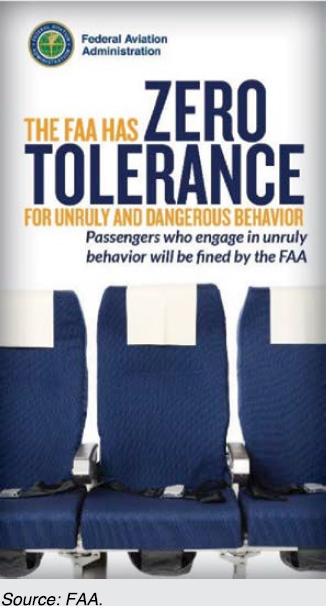
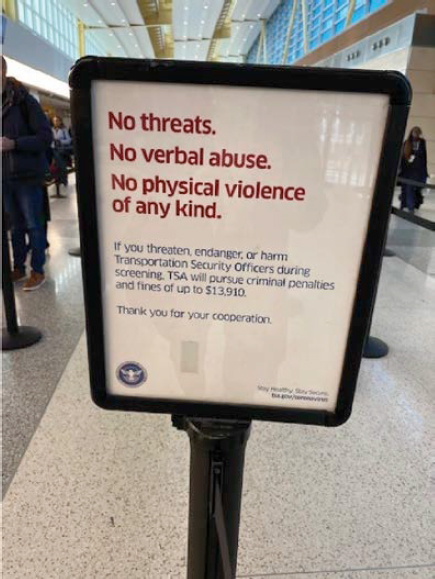
In 2021, the FAA implemented their “Zero Tolerance” policy and developed an accompanying awareness campaign. A toolkit was developed to provide airports digital signage, public service announcements, and other materials (Figure 8). Use of social media and strategic branding (e.g., cups and coasters) were recommended to further spread awareness. Signage was added to the queues of many passenger security screening checkpoints promoting the campaign’s message and TSA’s support of the zero tolerance policy (Figure 9).
In 2022, the Transportation Workers Union (TWU) created the “Assault Won’t Fly” campaign to bring attention to Bill S.1058 Protection from Abusive Passengers Act. Union members handed out information to passengers and aviation workers at multiple airports.
2.2.5 Reward and Recognition Programs
Reward and recognition programs are used to encourage aviation workers to provide excellent customer service and behavior awareness while enforcing airport policies as a strategy to mitigate unruly behaviors. Workers who have demonstrated excellent customer service or use of de-escalation techniques can be rewarded and officially recognized to encourage other aviation workers to also provide excellent customer service or behavior awareness.
Many airports in this study offer monetary rewards, such as gift certificates to restaurants or entry into a drawing for a reward (see Table 3, implementation note 2.2.5). However, the airport’s governing authority may limit the pool of potential rewards to nonmonetary options.
Nonmonetary rewards may include collector’s coins, airport-branded items (e.g., pens, lanyards, stickers), preferred parking spaces for a limited time, or public recognition by senior airport executives, other leaders, or prominent special guests invited to attend the award ceremony sponsored by the airport.
One airport has developed a career enhancement program that encourages its LEOs to take customer service training by offering incentive pay for each course completed. Officers learn the core principles of customer service and can earn up to a dollar more an hour.
2.2.6 Animal Therapy Programs
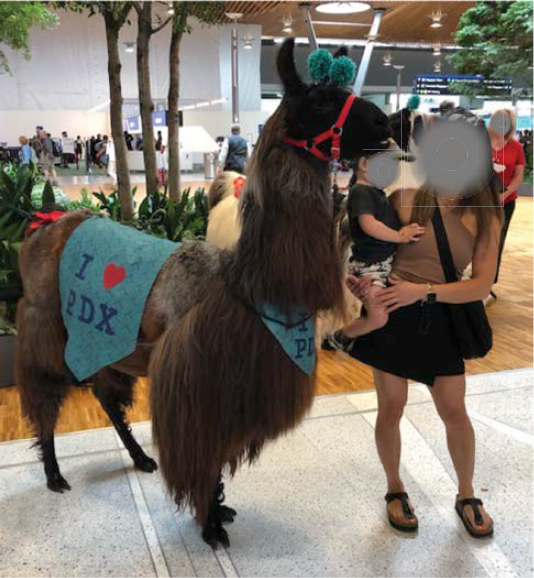
Many airports in the study reported partnering with local volunteers and animal therapy groups to develop programs that provide stress and anxiety relief to travelers and aviation workers (see Table 3, recommendation 2.2.6). Dogs are the most common therapy animals seen at U.S. airports, but more uncommon and exotic animals—such as cats, rabbits, llamas (Figure 10; Sachs 2023), and kinkajous—can join the program if they meet certain criteria. Almost any animal that is calm, loving, obedient, and tolerant of strangers and other animals could be certified to become a therapy animal.
Each local animal therapy group will have their own criteria for the animals and their handlers, but in general the teams must:
- maintain vaccinations (e.g., rabies) and vaccine records
- participate in an airport walk-through to ensure the animal is not reactive to the environment
- be certified by the group, which often includes liability insurance coverage
- wear official vests and badges while visiting the airport (handler and animal)
- be of a certain age (typically, the handler must be at least 18 years old and animals should be of adult age for their species)
- handlers pass a background check
The airport may require the handler to attend ambassador training, which provides key information about the airport layout and rules. The research showed that some participating airports require animal therapy handlers to either obtain airport badges or be assigned escorts for sterile area access.
The animal visits are usually planned, sometimes weekly, biweekly, or monthly depending on the agreements between the airport, animal therapy group, and handler. Each visit lasts 1–2 hours to limit stress on the animal.
2.2.7 Employee Assistance Programs (EAP)
Several airports in this study offer employee assistance programs (EAPs) and resources for a variety of issues, such as depression, anxiety, drug and alcohol use, and domestic abuse (see Table 3, recommendation 2.2.7). The airport will typically enter into a contract with certified mental health clinicians—either as part of a CIT program or separately—to offer their services to airport stakeholders. Clinicians may be requested to work with stakeholders who have gone through an incident at the airport, such as violence from a passenger.
Table 3. Section 2.2 recommendations.
|
Implement top-down, leadership-led initiatives for managing unruly incidents:
|
|
Airports should perform regular assessments of policies, procedures, communications, and training:
|
|
|
|
Airports can establish collaborative oversight of alcohol service by concessionaires:
|
|
|
|
Airports can establish requirements for animal therapy programs:
|
|
Airports can establish employee assistance programs:
|
2.3 Facility Design and Services
The design of the airport terminal and the services offered can affect the passenger’s travel experience. Boudreau et al. (2016) gives multiple examples of services or facility design features that improve customer service and reduce stress and frustration, which may trigger unruly behavior.
2.3.1 Improving Customer Experience
Customer experience management is based on the relationship between customer experience and customer expectations. When the customer’s experience exceeds their expectations, they are pleasantly surprised; if the customer’s experience fails to meet their expectations, they are disappointed. Unfortunately, everyone’s expectations are different, which is why creating an airport for everyone is challenging. Additionally, service is experienced as a continuum, with each unpleasant experience adding to the customer’s stress and anger.
Boudreau et al. (2016) present the 10 most important services during the passenger journey based on a 2014 Airports Council International (ACI) world survey of North American passengers. Improvement in these areas can help mitigate many bad experiences that can escalate into unruly incidents:
- waiting time in air carrier check-in queue
- ease of finding your way through the airport
- waiting time in passenger security screening queue
- cleanliness of restrooms
- internet access/wi-fi availability
- comfort of waiting/gate areas
- availability of restrooms
- restaurant/eating establishments available and open
- feeling of being safe and secure
- courtesy and helpfulness of staff
To improve the customer experience, Boudreau et al. suggest the following strategies:
- Improve airport efficiency through self-service technologies (e.g., self-tagging bag drops, check-in kiosks, automated gates) and common-use technologies and equipment to maximize airport terminal space.
- Create easier navigation through dynamic signage and digital wayfinding; flight information displays (FIDs) and baggage information displays; mobile applications; airport websites; use of Bluetooth, beacons, and geographic information systems (GIS); and operational alerts indicating delays and congestion.
- Reduce waiting times by using technology to monitor queues and alert when another lane or station needs to be opened; inform customers of expected wait times using mobile applications, digital signage, or other method.
- Provide updated information on flights, baggage, concessions, and other relevant services using automated airport alerts (audio and visual); airport mobile applications; social media; digital wayfinding and messaging; virtual assistants; customer service representatives (volunteers, aviation workers, artificial intelligence [AI], robots); and information booths (digital and staffed).
- Streamline parking with automated parking technologies such as entry and payment options, open space indicators, electric vehicle charging spaces, and valet parking.
- Train aviation workers in customer service and reward and recognize individuals who provide excellent customer service.
2.3.2 Queues and Wait Times
Queues and waiting are an inevitable reality of the commercial air travel experience, but are often a major source of frustration, anxiety, and stress (see Table 4, recommendation 2.3.2). Maister (1985) proposed eight factors to the psychology of waiting in queues:
- Occupied time feels shorter than unoccupied time; “waiting” is boring and being distracted helps the time feel as if it passes faster.
- People want to get started, they want to find the entrance and save their place in the queue so they will not be skipped.
- Anxiety makes the wait seem longer; customers want to be confident they have joined the queue, which can be difficult in large crowds without delineation markers to define the start of the queue.
- Uncertain waits are longer than known waits: customers experience less stress when they can estimate their wait in a queue and be reassured that they will not miss their flight.
- Unexplained waits are longer than explained waits: customers want to know why the process is taking so long.
- Unfair waits are longer than equitable waits: customers will not appreciate being skipped in line.
- The more valuable the service, the longer the customer will wait: customers will accept a longer wait for processes that are required (e.g., security screening, boarding) but will have less patience for optional queues (e.g., restaurant seating, restrooms).
- Solo waits feel longer than group waits—tied to the first factor, distracted time feels faster, and group travel is much more social.
Building on these factors, airports can influence customers’ perception of wait time through a few strategies (see Table 4, implementation note 2.3.2).
Deploying wait time indicators (static and dynamic) will inform passengers in the queue how much longer they should expect to wait. Some amusement parks inflate the estimated wait times to give the impression that the queue is moving faster—the constant movement gives a sense of progress.
However, inflating unseen processes could have negative effects potentially leading to unruly behavior. Unseen processes requiring the passenger to wait (e.g., baggage claim, mechanical repairs, flight crew arrival) provide no visual cues to gauge progression and wait time. Overestimating wait times for unseen processes can lead to stress and impatience rather than relief.
Transparency is more valued in these situations to provide passengers accurate information to plan their next steps (e.g., call for a ride, use the bathroom).
Informing passengers of technical, mechanical, or other issues that may extend their wait helps them understand why the wait is continuing. Providing clear information reduces anxiety and uncertainty and improves patience and tolerance. It shifts their perspective from feeling ignored to understanding that there is a legitimate issue being addressed. Transparent communication also fosters trust between passengers and the airport so passengers are more likely to perceive the airport as competent and considerate, even during a delay. Uninformed passengers are more likely to become frustrated, demanding, and angry, but providing information upfront that helps them manage wait-time expectations can keep the situation calmer and mitigate dissatisfaction.
Adding interesting features, such as art or monitors displaying videos, can distract passengers from their wait. Animated characters are good at catching attention with bright colors and simplified forms. Architects and designers often place mirrors around elevator cores to distract customers while they wait. Many amusement parks are known for their interactive queues with characters, unique design elements, and art.
Serpentine patterns should be used with long queues when possible. In addition to creating a compact queue space, dividing the process of moving through the queue into smaller segments can trick the mind into breaking up the wait time into shorter blocks of time. Conversely, long, straight queues can make the wait feel longer.
Queuing theory suggests a single queue feeding multiple service stations is the most equitable and efficient system because everyone is served in the order they arrive, with each person moving to the next available station. However, over time as a steady stream of people join the queue, the wait will grow longer and begin to back up for those arriving later as everyone is funneled into the same queue. This can result in longer overall wait times because the system has a bottleneck with the single entry point.
If large queues are expected, opening multiple service stations and allowing each individual or group to choose which queue to join may provide greater flow through the process and shorter queues. While some individuals may end up in a slower-moving queue, this approach prevents a single massive queue from forming. Instead, the waiting time is spread more evenly across the day because each queue absorbs a portion of the total demand. People arriving later may benefit from choosing a shorter line, reducing their wait and creating a more balanced distribution of waiting times across different periods, individuals, and groups. This method can also prevent one massive surge from overwhelming the process at peak times, keeping wait times more consistent over the course of the day.
2.3.3 Walking Distances
Several airports in this study reported challenges with remote terminals that require passengers to walk long distances (see Table 4, implementation note 2.3.3). This can be frustrating and stressful for passengers running late for a flight or those with limited mobility. Moving sidewalks and automated people movers (trains) are common at some of the larger airports, though they are known to experience mechanical failures that make them inoperable for a time.
Ensuring plenty of seating along the walkway allows passengers to take breaks from walking when needed. Visually interesting displays, such as statues, murals, and art, can distract the customer during the walk and give them opportunities to pause. Signage or displays estimating walking time allow the customer to manage their time and walking speed.
Dallas Fort Worth International Airport (DFW) uses manually operated carts to shuttle customers from one end of the terminal to the other, but the vehicles take up much space in the walkways and have safety considerations.
2.3.4 Cleanliness
It may be more difficult to maintain the appearance of cleanliness in older facilities, despite janitorial efforts, due to worn surfaces and materials, poor lighting, older fixtures and furnishings, darker color schemes that were once popular, and out-of-date signage clutter.
Amenities on the public side of the terminal will require much more effort to keep clean due to the higher volume of users. Facilities or services on the public side that offer privacy with a locking mechanism (e.g., nursing rooms, family restrooms) may become opportunities for non-airport-users to lock themselves inside to use drugs, hide, or sleep, and should be regularly monitored.
Several airports in this study reported experiencing high numbers of migrants living in the public areas of the terminal. These individuals rarely disturb the operations of the airport with unruly behavior, but they can easily double or triple the effort to keep the restrooms clean and stocked with necessities.
2.3.5 Signage and Wayfinding
Strategic and effective wayfinding is based on three principles:
- Continuity: signage should guide the passenger through different areas and diverse architecture by being positioned at the same height and at appropriate intervals throughout the customer journey
- Connectivity: signage needs to be mounted strategically to notify customers of important junctions and the availability of services throughout the airport
- Consistency: signage should use the same design elements to reduce confusion
- terminology and message hierarchy
- visibility and legibility
- typography and symbology
- format and color
- placement
For first-time passengers or those who do not travel often, airport processes can be very intimidating. They may be unaware of certain policies in the airport or in federal spaces—TSA checkpoint, customs, Federal Inspection Services (FIS). Posting informational flyers or showing instructional videos to assist unfamiliar passengers can alleviate their stress and anxiety. Consideration should be given to translating the signage and messaging into commonly used languages at the airport, especially in areas with international passengers.
Information booths and kiosks are useful to help passengers understand their gate’s proximity to the services in the terminal. Information booths are often staffed by volunteers or paid staff who can provide a warm conversation about the airport’s amenities or answer general travel questions. These individuals can also look up flight information if needed. Digital kiosks allow the passenger to explore the terminal, look up the amenities they want, and find their way to their destination.
2.3.6 Noise
Airports are naturally loud environments with boarding and security announcements, paging, televisions, music, beeping from passenger and cargo carts, and crowds. This can create stress in airport passengers, especially those with sound sensitivities and neurodivergent conditions. Reducing some of this noise can help alleviate some of this stress and mitigate factors that may contribute to unruly behaviors.
To reduce some of this noise, airports can increase the use of visual paging on displays and smartphone notifications while reducing the number of audio announcements. Several airports participating in this study reported adopting silent terminal policies to limit announcements to emergencies and weather or only permitting announcements at the gate or in the hold room.
Several airports in this study, along with many air carrier clubs, reported offering quiet rooms, sensory spaces, and areas where children, cell phone conversations, and televisions are restricted.
Construction materials also impact the level of noise in the terminal. Figure 11 shows an example of an older tile (top) which creates a lot of noise as wheeled luggage and carts are dragged across. The airport is in the process of replacing the outdated tiles with a smoother material (bottom) to reduce the amount of noise. Many materials can be used to absorb sound and dampen echoes and noise, such as carpeting, fabric, and fiberglass.
Ceilings with exposed heating, ventilation, and air conditioning (HVAC) systems will have more noise when the system runs. Enclosing these systems can reduce noise in the terminal.
Several participating airports host local musicians to play for the passengers in the terminal. This is an excellent method of increasing the energy of the terminal and potentially lifting the moods of some passengers. However, this approach should be used with caution as individuals with sound sensitivities may have the opposite reaction to live music. Airports can compromise by moving the musicians away from the stressful areas of the airport (e.g., check-in/ticket lobby, security checkpoint) to areas such as the meeter/greeter hall and by ensuring the music remains at a reasonable volume.
2.3.7 Customer Service Representatives and Ambassadors
Airport customer service representatives and ambassadors improve customer service by managing queues, helping with customer questions and needs, conducting cleaning audits of restrooms and terminals, and assisting with irregular operations. They are stationed at key decision points, such as junctions between terminals and airport train stations to help passengers who are lost or confused.
Additionally, customer service representatives and ambassadors can provide companion care for unaccompanied minors, seniors, persons with disabilities, and international visitors. They can help find misplaced items, comfort grieving passengers, and they can also offer help with technology to passengers who are uncomfortable or unfamiliar with airport or air carrier mobile applications or digital kiosks.

Customer service representatives are typically paid positions built into the airport’s organizational structure and budget. There has been a recent surge in young professionals seeking careers in airport management and aviation; airports can hold recruitment fairs at high schools and colleges to find interested individuals willing to start as an airport representative. Several participating airports reported using a contracted third-party customer service provider to offer additional services, such as speaking multiple languages.
Ambassadors are often retirees, many of whom were former airport or air carrier employees desiring to remain active in the industry. Many ambassador programs are volunteer-based with the cost of training and uniform shirts built into the operations budget.
Among the airports surveyed, some provide badges to customer service representatives and ambassadors for accessing and assisting in the sterile area.
Case Example: SFO Customer Experience Programs
San Francisco International Airport (SFO) has made significant efforts to incorporate wellness initiatives into the airport to create a less stressful experience for travelers and the airport community. The airport has initiated several programs and environmental features to help passengers, airport visitors, and employees. These programs and features have been implemented with a view to reducing anxiety, connecting with services, and finding quiet time.
Fear of Flying Clinic
The Fear of Flying Clinic’s mission is to inform clients about all aspects of aviation and replace their fears with solid beliefs using a two-pronged approach: education plus behavioral change.
The Fear of Flying Clinic (https://www.fofc.com/about) is the first of its kind and has been operating at SFO for four decades. The clinic uses a compassionate, fact-based approach to help anxious flyers find relief and empowerment over aviophobia—the fear of flying.
The Clinic uses cognitive behavioral therapy (CBT) to address common aviation misinformation and misconceptions to alleviate fear-based reactions to sounds and noises that are common during flight. Participants are given tours of maintenance hangars and the ATC tower, presentations by aviation professionals (pilots, aircraft mechanics, flight attendants, and air traffic controllers), and an introduction to CBT and other antianxiety tools.
The CBT approach also leverages exposure therapy; participants in the 4-day clinic are encouraged to take the “graduation flight” on the last day so they can test their new knowledge of flying and CBT techniques. The group joins a regularly scheduled commercial flight to Seattle where they enjoy lunch before flying back to SFO.
Many participant testimonials include anecdotes of previous flights when they pushed the emergency button before takeoff, forcing the plane to return to the gate so they could deplane. These incidents can delay flights, potentially for an entire day. The Clinic allows anxious flyers to travel with confidence without disrupting the flight.
Wag Brigade
SFO’s Wag Brigade was launched in December 2013 with a mission to create a more pleasant, enjoyable, and stress-free travel experience for SFO travelers (SFO 2023). The airport partnered with the San Francisco Society for the Prevention of Cruelty to Animals (SPCA) to bring certified animal-assisted therapy (AAT) dogs to the terminals. Members of the Wag Brigade are trained to respond to a variety of emotions, including grief, frustration, and anxiety.
To participate in the AAT program, the animal must be at least 1 year old with a certification from at least one obedience course. All the animals undergo behavior screening to determine their disposition and compatibility for this role, and dogs and their handlers must attain their canine good citizen certification—a 10-skill test of good manners for dogs and of responsible dog ownership for handlers. The animal teams must volunteer with other organizations through SPCA for 6 months to 1 year before they can audition for the Wag Brigade.
Animals in the Wag Brigade are considered “unicorns” (Wells 2021) in the AAT program due to their specific temperaments and their comfort in crowds and around food, which is required to roam the busy airport terminals; only about 10–15% of therapy animals in the AAT program fit the criteria. To test the animal’s disposition, the animals and their handlers must take airport familiarization tours to observe the animals’ behavior. They also shadow a current therapy dog to identify areas to avoid in the airport (e.g., food courts) before they are accepted into the Wag Brigade. Animals on duty wear “pet me!” vests with their names displayed. Occasionally, the animals’ attire will be coordinated to align with the seasons, including costumes in celebration of various holidays (Figure 12).
The animals’ handlers are also evaluated before acceptance into the Wag Brigade. They are required to obtain an airport-issued ID badge that authorizes entry into the sterile area. This vetting process includes an extended background and security check by the airport. The handlers also complete the required sterile area training, as well as in-terminal customer service training that empowers them to assist travelers with general inquiries. Handlers wear an identifiable vest and must always accompany the animal.
Most of the Wag Brigade visits the airport once a week for about a 2-hour period or shift. Once through security, the handlers will head toward gates with delayed or canceled flights in search of travelers needing the assistance of a therapy animal. The animals also participate in “yappy hours” for those curious about joining the AAT program and Wag Brigade.
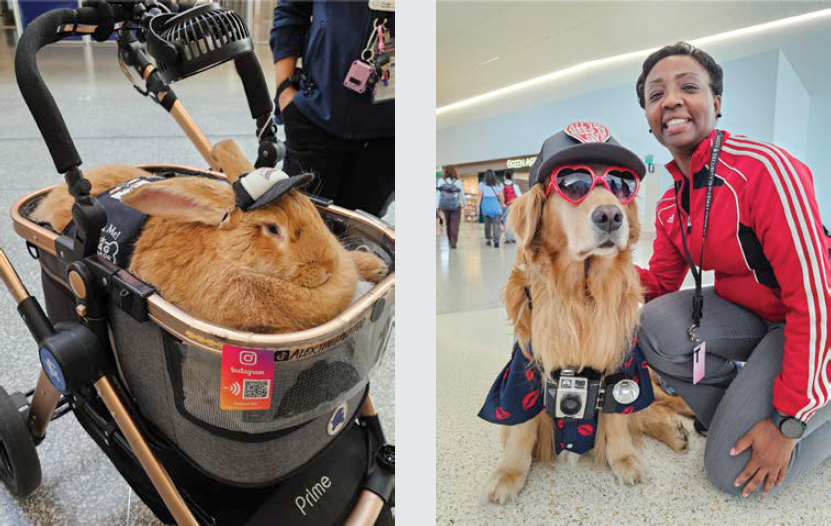
The Wag Brigade currently consists of about 20 dogs, a cat, a pig, and a large-breed rabbit. Many of the animals have collectible “business” cards with their portrait displayed and fun facts about them. The Wag Brigade has assisted many travelers over the last decade and the airport hopes to grow the program with more animals in the future.
Ready, Set, Fly
In 2015, SFO partnered with The Arc San Francisco—a nonprofit organization providing accessible, inclusive services and advocacy for disability justice—to create the Ready, Set, Fly experience (SFO 2018). The program was designed for individuals and families with developmental disabilities, such as autism, Down syndrome, and cerebral palsy, who have never flown before.
Clinical specialists give participating families clinical and behavioral strategies to prepare for and take a commercial flight, assess tolerances and triggers, and access special assistance services at the airport.
The attendees are guided through a mock-up of the ticketing, security, and boarding processes with airport and air carrier volunteers assisting in the experience. A partnering air carrier provides an aircraft for the experience so participants can sit in the aircraft seat, watch the standard safety demonstration, and hear simulated engine sounds.
The Ready, Set, Fly program has been successful in helping individuals and families with developmental disabilities feel confident in their travel preparations. It has also offered excellent opportunities for airport and air carrier employees to understand their role in assisting and accommodating these travelers.
Berman Reflection Room
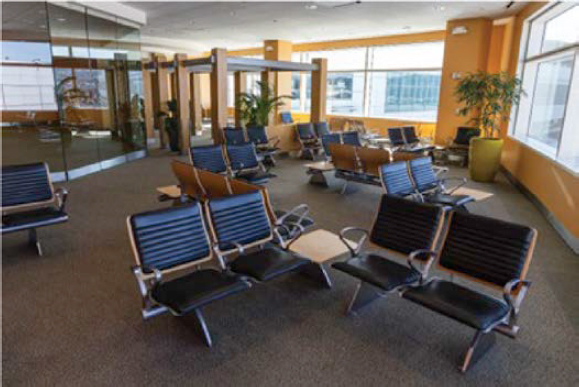
The Berman Reflection Room offers SFO travelers and employees a place for quiet reflection and meditation (Figure 13) and was purposefully designed to be free of technology and noise. Users are not permitted to eat or drink, use phones or electronics, sleep, or solicit inside the space to maintain the quiet atmosphere.
The flexible space opened in 2017 and is located before security in the international main hall to allow anyone in need the opportunity for a private, quiet moment before continuing their journey.
Quiet Airport
In 2018, SFO launched its Quiet Airport program with the goal of reducing the amount of noise in the airport terminal (SFO 2020). The first step was to develop new policies for airport tenants to reduce noise levels and set guidelines for the use of music in tenant spaces.
The next step was to reduce the number of public address announcements and audio pages. The airport established smaller paging zones to create more targeted announcements. Air carrier announcements at the gates were confined to a small radius around each gate. Final boarding calls and gate-change announcements are handled by SFO Communications staff who send a targeted broadcast in the appropriate areas.
The result has been a significant decrease in noise in the terminals and elimination of more than 90 minutes of unnecessary announcements each year. Planned next steps include reducing background noise created by moving systems, such as escalators and moving sidewalks.
MagnusCards
In 2019, SFO partnered with Magnusmode, creators of the MagnusCards mobile application, to create custom step-by-step instructions for several SFO airport processes. Travelers with cognitive special needs or anxiety can use the application to familiarize themselves with the travel processes and airport layout with the goal of creating an easier and more enjoyable experience. The application includes pictures taken at SFO and text-to-speech options for greater accessibility (Figure 14).

Community Ambassadors
The San Francisco Police Department (SFPD) community ambassador program was created to support the City of San Francisco’s alternatives to policing efforts (SFPD 2020). The program began in the downtown area to divert calls unrelated to public safety away from SFPD officers so they could focus on criminal incidents and investigations. Community ambassadors have since been assigned to SFO to assist PEH.
The community ambassadors are unarmed retired LEOs who supplement the SFPD’s foot patrol in the city’s neighborhoods and at SFO. The ambassadors wear a softer uniform: a branded polo shirt and khaki pants (Figure 15). The program capitalizes on the ambassadors’ law enforcement knowledge, experience, and training while appearing less intimidating to the public.
The ambassadors’ primary responsibilities at SFO are to provide a visible presence to deter criminal activity, provide customer service to the public, and answer calls for service that do not need a law enforcement response. Often, ambassadors are dispatched to assist with PEH or persons in crisis to offer local support services, interrupt antisocial behavior, and reverse overdose events. Ambassador training includes
- first aid, cardiopulmonary resuscitation (CPR), and automated external defibrillator
- crisis intervention/de-escalation techniques
- managing implicit bias and procedural justice
- principled policing
- knowledge of services offered by Healthy Streets Operation Center (HSOC), San Francisco’s coordinated response group
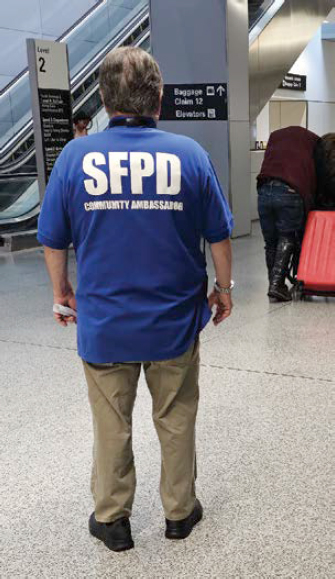
If a call for service requires a LEO or crisis intervention team member, the ambassadors are equipped with a police radio to request assistance. They also use these radios to report crimes in progress or alert airport LEOs of suspicious activities.
The community ambassadors work part-time, 20 hours per week, and are limited to 960 hours per fiscal year. Funding for their services is a line item in the airport’s operating budget.
Conclusion
SFO’s development of these innovative programs, amenities, and environmental design features promote calm and well-being in the airport environment. The blend of uniquely trained personnel, facility design, and animal and CBT programs provides sensory relief from stimulating airport terminals. These targeted strategies are designed to support the needs of neurodivergent travelers and other individuals at the airport who are affected by noise and stimuli in their environment.
Reducing anxiety associated with the travel experience and improving airport user perceptions and well-being create a positive experience for passengers and the entire airport community, which can mitigate environmental and emotional triggers for negative emotions and unruly behavior.
Table 4. Section 2.3 recommendations.
|
Apply Maister’s factors to improve queue experiences:
|
|
|
|
|
2.4 Improvements to Common Design Features and Services
In general, terminals that feel open with tall ceilings and wide walkways are more calming and less claustrophobic, especially when crowded. Many airport terminals were designed decades ago with low ceilings, muted colors, and tight walkways; recent terminal renovations, extensions, and new construction have incorporated design elements that create desired openness,
ambient lighting, nature views, sensory rooms, noise reduction, and other features that induce a feeling of calm.
2.4.1 Parking
Parking is often the first experience a customer has at the airport, and it can be frustrating to find a parking spot. Parking guidance systems can assist customers by using dynamic signage and lights to identify available spots on each level.
Helical ramps allow customers to bypass multiple floors with few or no available spaces while structures with sloped ramps will require the customer to drive by many vehicles and unavailable parking spots to get to the next level. Prolonged time searching for an available parking spot can increase customer frustration and begin the customer’s journey with a negative perspective (see Table 5, recommendation 2.4.1).
As electric vehicles become more common, providing charging spaces can reduce the passenger’s anxiety about returning to a vehicle low on battery. Valet parking is another option to help alleviate parking lot stressors.
At some participating airports, parking lots are far away from the terminal, but walking long distances with luggage can be exhausting. Airport shuttle buses running at regular intervals can alleviate some of this stress by picking up passengers from the parking lot or terminal and shuttling them to their destination. Covered shuttle stops protect passengers from weather and the elements while they wait for the next shuttle.
2.4.2 Restrooms
Availability, cleanliness, and ease of use of restrooms are major factors in the passenger travel experience. The perception of cleanliness and accessibility of restrooms can be improved by (see Table 5, recommendation 2.4.2):
- removing doors at the entrances to multistall restrooms to eliminate struggles with luggage
- adding interesting visuals to distract passengers waiting for an available stall
- enhancing visibility with indirect or diffused lighting
- designing walls and floors with light-colored materials to make the space seem bigger, but dark countertops to downplay water around the sinks
- using quality, long-lasting materials to reduce leaks, cracks, and discoloration
- mounting air dryers and paper towel dispensers between sinks to limit water dripping on the floor
- expanding restroom stalls to accommodate children and carry-on luggage
- using lights or “occupied” signs to highlight available stalls (Figure 16)
- implementing touchless features, such as open entrances, flush valves and faucets, light switches, and alternative drying options (Figure 17)
Restroom users should be able to easily report unsanitary or messy restrooms or supplies that need to be refilled. Buttons can be used to alert the janitorial staff that assistance is needed.
2.4.3 Gate/Hold Rooms
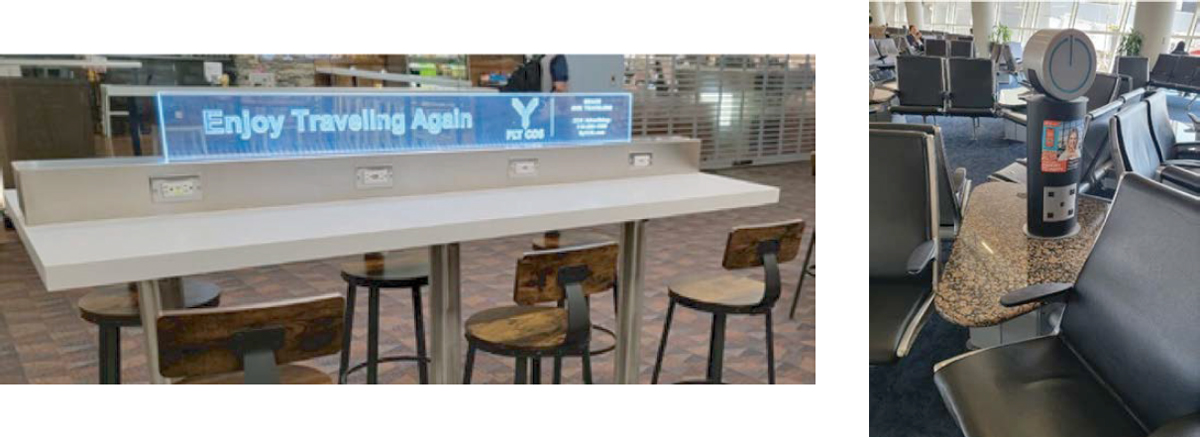
Airport gate/hold rooms—the waiting areas near aircraft boarding gates—can become crowded, especially as the flight departure time nears. Several airports that participated in this research have extended hold rooms into neighboring spaces and walkways to expand


One airport installed duress alarms at the gate counters for the gate agents to use in emergencies. The LEOs found that the gate agents were overusing the alarms for minor customer service issues and training had to be developed to help them understand appropriate conditions to activate the alarm.
seating options, including charging outlets (Figure 18). Adding seating for dining in the hold room allows the customer to eat near their gate without hassle or fear of missing important notifications.
Many unruly incidents occur at the gate counter in the gate/hold room after announcements are made informing passengers of delays or canceled flights, or if passengers are denied boarding. When a gate agent calls for assistance from law enforcement, it is often done through the airport’s telephone system or occasionally via an airport radio. A third option is to add panic or duress alarms to each gate counter that alert the airport dispatch that assistance is needed. Air carriers are often responsible for funding the alarms (see Table 5, recommendation 2.4.3).
2.4.4 Private Lounges
Pay lounges include airport lounges and air carrier lounges that offer customers areas to relax and grab refreshments before their flight. These are often aimed at business travelers with an annual membership pass, but some lounges allow customers to pay for a one-day visit or by the hour, which is convenient for extended layovers. The lounges can offer a large variety of services:
- beverages and food
- restrooms
- showers
- meeting rooms
- office services (computers, printers, fax machines)
- fitness room
- beauty and spa services
- quiet and relaxation rooms
- children’s play area
- televisions, newspapers, and magazines
- wi-fi and internet access
Case Example: COS Lounge Contract
Colorado Springs Airport (COS) Premier Lounge was built for passengers with elite travel status and lounge members. The lounge member contract included language to remove or deny entry to individuals or their guests who disrupt “the businesslike atmosphere of the lounge” (COS n.d.; see Table 5, recommendation 2.4.4):
5. The Colorado Springs Airport reserves the right to remove or deny entry of anyone who conducts himself or herself in a disruptive, abusive or violent manner or who otherwise interferes with the business-like atmosphere of the Lounge. This includes children and the responsible persons accompanying them. The Airport shall not be liable for any loss, damages, or costs of any kind suffered by a passenger resulting from the passenger being refused admission into the Lounge or removed from the Lounge because the passenger or his/her guest failed to comply with these Terms and Conditions.
The contract also included language regarding the consumption of alcohol in the Lounge.
15. [ . . . ] Passengers shall drink sensibly and avoid drinking alcoholic beverages to excess or mixing such beverages with medications. The Airport accepts no liability for passengers drinking to excess in the Lounge and retains the right to limit alcohol consumption to ensure no passenger becomes intoxicated. It is the sole responsibility of the passenger to ensure that he or she is fit for their flight following consumption of alcohol at the Lounge. The Airport, in its sole discretion, reserves the right to refuse service of alcoholic beverages to passengers without sufficient legal identification, passengers that appear to be intoxicated, or for any other reason.
Baggage Claim
As customers reach the end of their travel journey, baggage claim is one of the final stress and anxiety-inducing processes. Estimated wait times on displays can help alleviate some of this stress and allow the customer to utilize the restroom or concessions service while baggage is being unloaded from the flight. Real-time bag tracking technologies are assisting airports in this area.
One airport worked with their air carrier tenant to address customer complaints regarding long waits for baggage. The air carrier paid to have their baggage claim carousel moved farther from their gates, thus increasing the walking distance, to allow the baggage handlers more time to move the bags and reduce the amount of time the customer must wait for their luggage.
Table 5. Section 2.4 recommendations.
|
Airports can implement parking guidance systems with real-time availability indicators
|
|
Airports can implement modern restroom design features to improve cleanliness perception and functionality:
|
|
Airports can install appropriate security measures at gate counters
|
|
Airports can implement clear behavior policies in the contracts signed by lounge members:
|
2.5 Uncommon Design Features and Services
Most airports offer amenities on the public and sterile sides of the terminal, such as restaurants, convenience stores, lounges, etc. However, airports can improve the passenger experience by adding some of the following uncommon facility design features and services.
Services
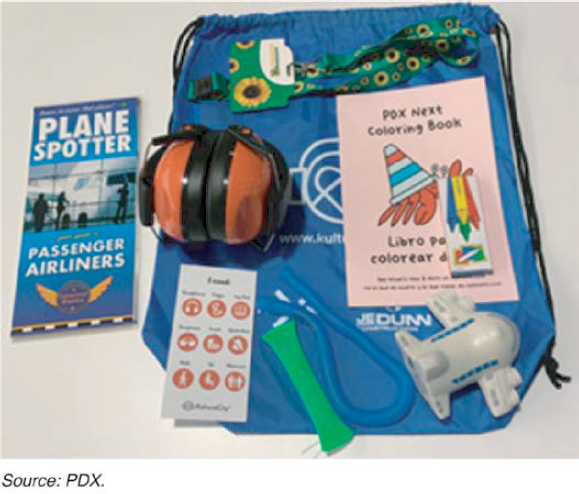
- Accessibility programs: provide services and resources to assist new flyers and neurodivergent passengers. This includes mock process demonstrations, ambassadors who can provide companionship, and giveaway items (Figure 19).
- Amnesty boxes: these boxes are placed around presecurity areas to allow customers to dispose of their state-legal marijuana or psilocybin products without penalty before entering the passenger security screening queue.
- Baggage storage: allows customers to drop bags off before security to fill the time between checking out of their hotel and checking in to their flight.
- Dry-cleaning: offer drop-off services for customers and aviation workers, including same-day alterations, repairs, and cleaning.
- Hotel reservation counters: these staffed booths allow customers to make reservations at nearby hotels before leaving the airport; especially useful when flights are canceled.
- Medical clinics: offer select medical services for passengers and aviation workers. Remediation of physical illnesses may help mitigate some factors that contribute to unruly incidents.
- Optician: convenient for customers who need repairs to glasses or forgot reading glasses at home.
- Pharmacies: in the United States, convenience stores in the terminal offer common medications in travel sizes, such as antinausea, antihistamines, and sleep aids. Pharmacies would offer similar products with the added service of a certified pharmacist.
- Postal service kiosks or booths: allow customers to easily ship home items not permitted through the security checkpoint, so are usually located before security.
- Shower rooms: typically a pay-per-hour service; vendors or the airport may provide shower amenities such as washcloths, soap, and hair dryers.
- Vending machines: vending machines are ideal for airports with food options that close before the last flight or open after the first flight; the machines should accept cash and cards.
Portland International Airport (PDX) has created sensory bags (Figure 19) for their passengers with sensory needs, including neurodivergent travelers. These are complimentary resources from the airport: hearing protection earmuffs, fidget tools, a coloring book, crayons, a sunflower lanyard, Plane Spotter guide, and an emotional thermometer.
Restrooms
- Companion care restrooms: similar to family restrooms but designed to help companions care for adults; includes features such as lifts and an adult-sized changing table (Figure 20).
- Family restrooms or baby care rooms: provide space for families to take care of needs with accessible fixtures, a changing table, and a nursing area.
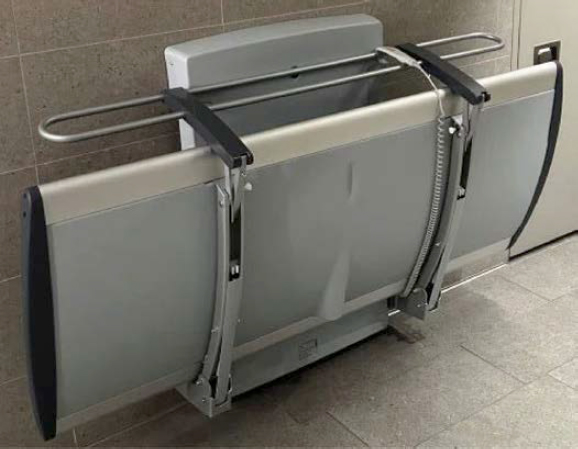
- Lactation or nursing rooms: many nursing people do not feel comfortable nursing in public, and nursing in a bathroom stall can be difficult, especially if traveling alone with the infant. Lactation or nursing rooms provide comfortable privacy for the passenger.
- Pet relief areas: designating pet relief areas after security allows customers to attend to their pets and service animals without leaving the sterile area and having to rescreen at the security checkpoint.
Quiet Spaces
- Nondesignated quiet rooms/sensory rooms: designed to provide a quiet space for passengers; may include soothing and dimmable lighting, noise-reducing finishes, comfortable seating, white noise over the speakers, and interactive elements such as bubble tubes (Figure 21).
- Prayer rooms or chapels: provide a quiet space for customers, often with holy texts available.
- Yoga rooms: time in the yoga room is sometimes a paid service by a vendor or provided by the airport in a quiet room before or after security. Equipment may or may not be provided for free or for a fee.
Entertainment Spaces
- Aquarium: offers an exciting way to spend time before boarding the flight, especially for children.
- Children’s play area: allows children to burn off energy before or after a flight. Some provide televisions playing cartoons.
- Movie theaters: a movie can distract customers for several hours as they wait for longer layovers, delays, and cancellations.
Environmental Features
- Biophilic design (Figure 22): living plants bring nature to the airport. Several airports in this study have created gardens for passengers to spend time with nature and feel grounded between flights. Greenery creates a peaceful, relaxing environment and promotes positive emotions that can alleviate the stress from a chaotic airport atmosphere (see Table 6, recommendation 2.5).
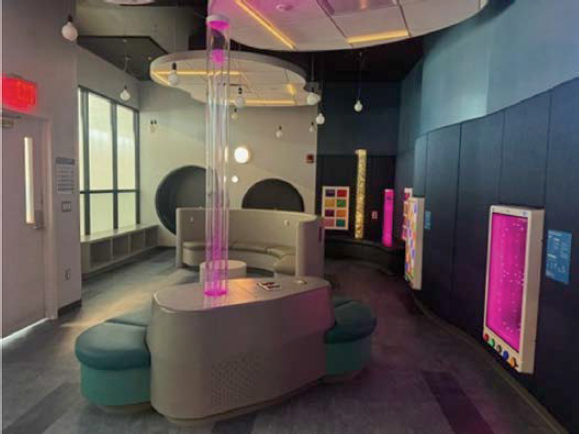
- Outdoor rest/smoking areas: several airports in this study have created a small, designated area post-security for passengers and aviation workers to take a break outside without exiting the sterile area. This outdoor space can be refreshing for passengers who have been traveling for many hours and have many hours of travel remaining. This may also be designated as a smoking area for passengers and aviation workers.
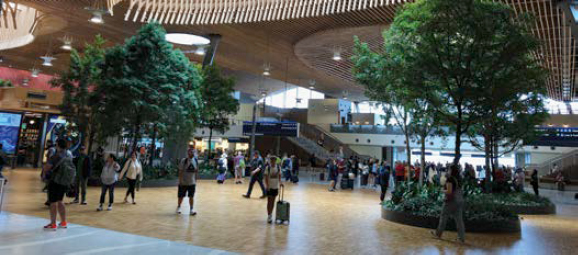
Table 6. Section 2.5 recommendation.
|
Airports can incorporate natural elements into terminal design and renovation projects to promote passenger well-being and reduce stress:
|


