Previous Chapter: Project Activities--Phase II
Page 22
Suggested Citation: "Key Findings." National Academies of Sciences, Engineering, and Medicine. 2025. Risk Management at State DOTs: Building Momentum and Sustaining the Practice. Washington, DC: The National Academies Press. doi: 10.17226/29144.

Key Findings

Through the research conducted, the research team determined several key conclusions. It reviewed the findings from the literature review and gap assessment, industry roundtable, case studies, and state DOT focus group, and the key findings under the four overarching categories are as follows.

Culture of Risk and Organizational Change

Creating a culture of informed risk-taking within an agency enables and rewards individuals and groups for taking the right risks in an informed manner. Agencies that have found the greatest success in building and sustaining risk management have highlighted the value of establishing a supportive internal culture. Staff at every level of the organization must shift mindsets from siloed to cooperative approaches, including updates to organizational structure, staff education, and cross-discipline representation. Although such cultural shifts happen within the broad body of an agency’s staff, they must be initiated by agency leadership starting from the top down.

Process Improvement

To support the operational changes that come along with integrating management practices, agency policy, and subsequently organizational structure, also may have to change. Steps in this change include reconfiguring business processes, realigning agency objectives, or institutionalizing new key practices. This will look different for each agency depending on its unique context and needs, although it may occur in a few common ways.

Communication and Promotion

Buy-in from leadership and at an executive level is essential to building and sustaining risk management within an agency, which ultimately enables informed risk-taking. Support from leadership is the most common starting point among successful agencies. Educating staff on the everyday risks its agency may face is important to aid in mitigating them. It is also important to educate staff on the benefits of mitigating certain risks to understand why risk management should be integrated.

Data, Tools, and Risk Quantification

Providing guidance documents, examples, and tools is key to helping agencies build and sustain risk management.

Page 23
Suggested Citation: "Key Findings." National Academies of Sciences, Engineering, and Medicine. 2025. Risk Management at State DOTs: Building Momentum and Sustaining the Practice. Washington, DC: The National Academies Press. doi: 10.17226/29144.

Digital Content and Website

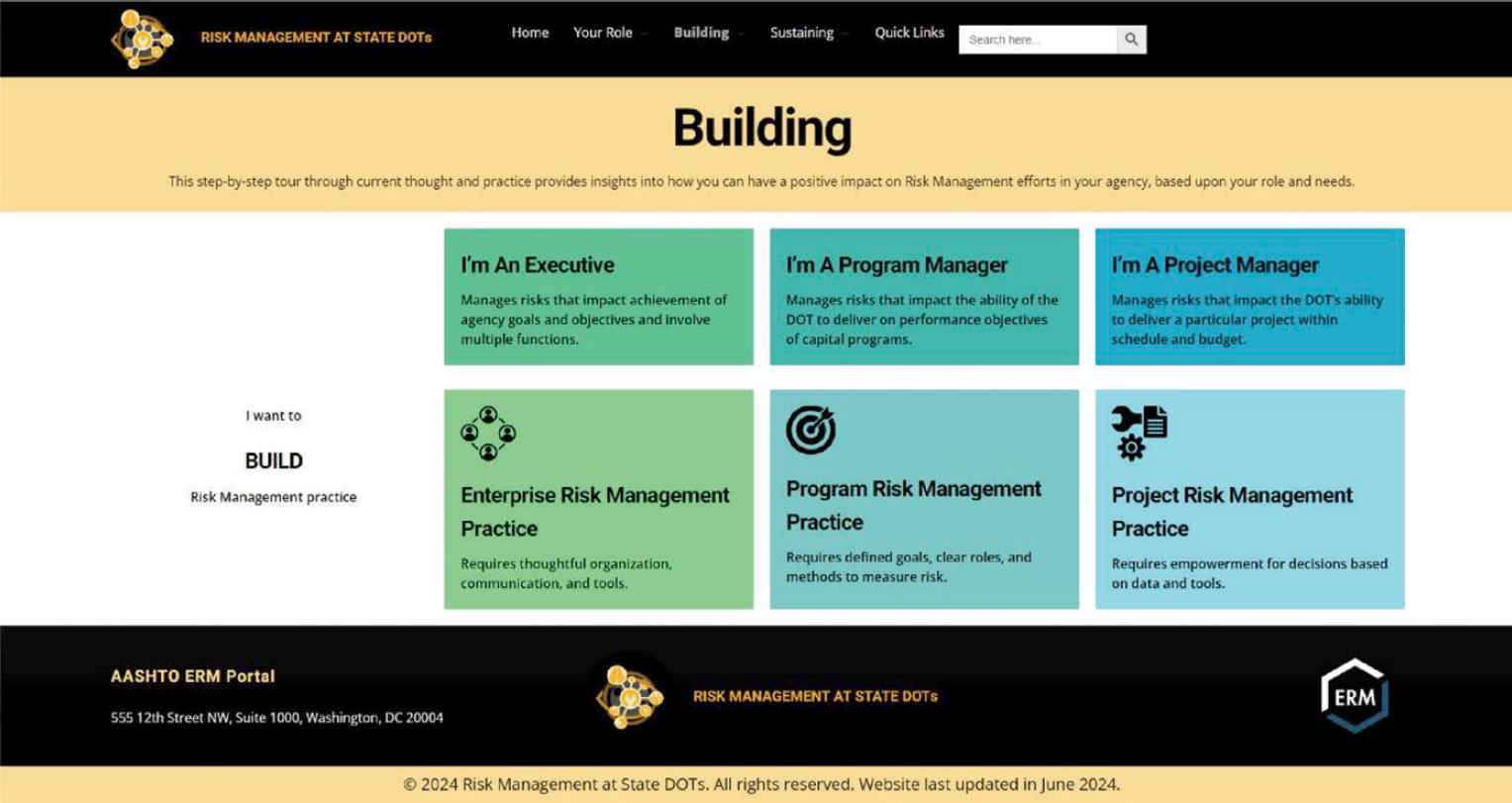
Based on the results of the research and feedback from the project panel and other state DOT practitioners, the content for the website covers the key elements described previously. The website is an easy-to-navigate platform for practitioners at different levels of an agency and in different places on a risk management spectrum. The website can be accessed on the AASHTO Enterprise Risk Management (ERM) Portal (https://www.erm-portal.com/tool-library/). Figures 5 and 6 provide screenshots of the design of the website home page and a content page, respectively.
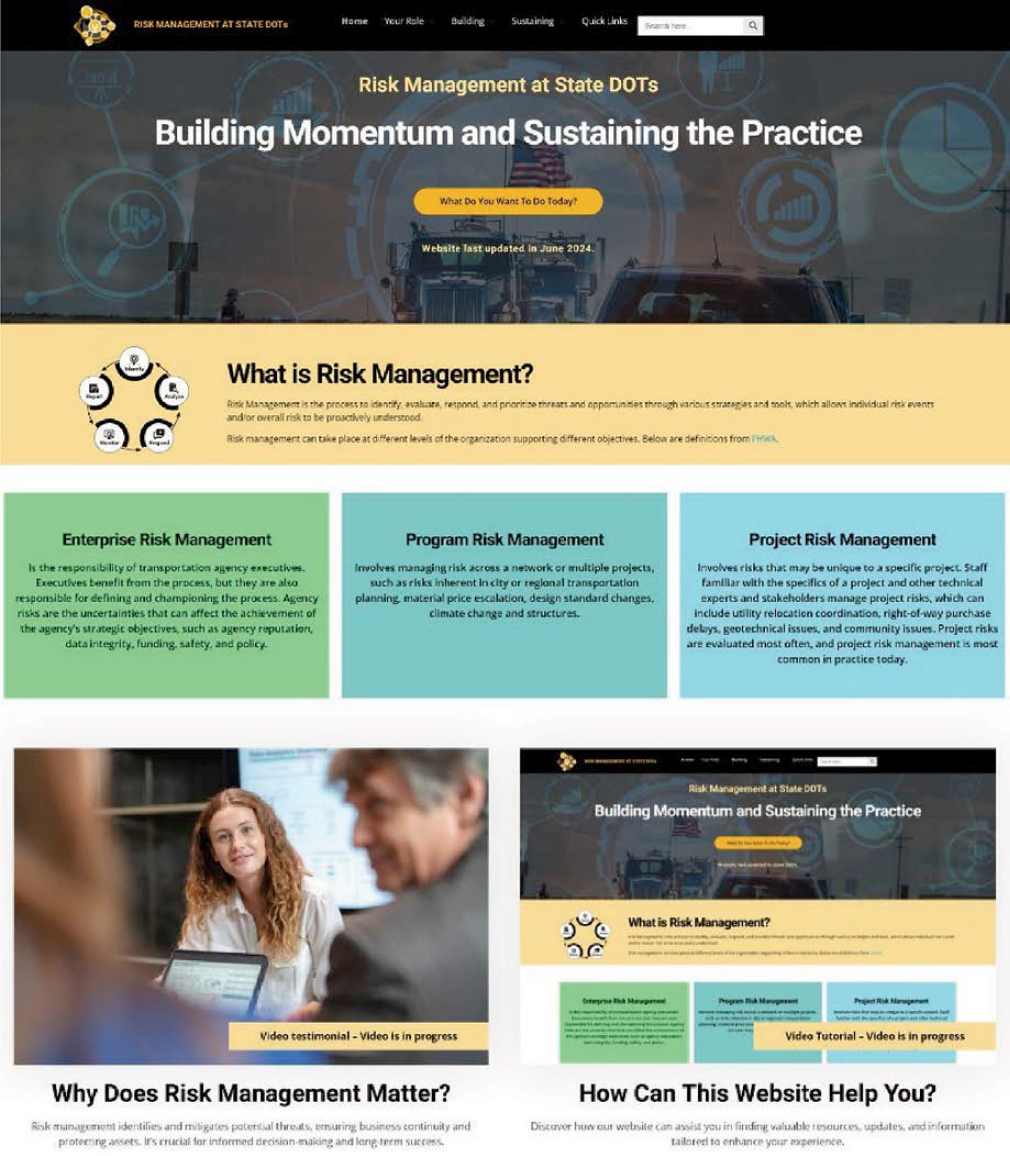
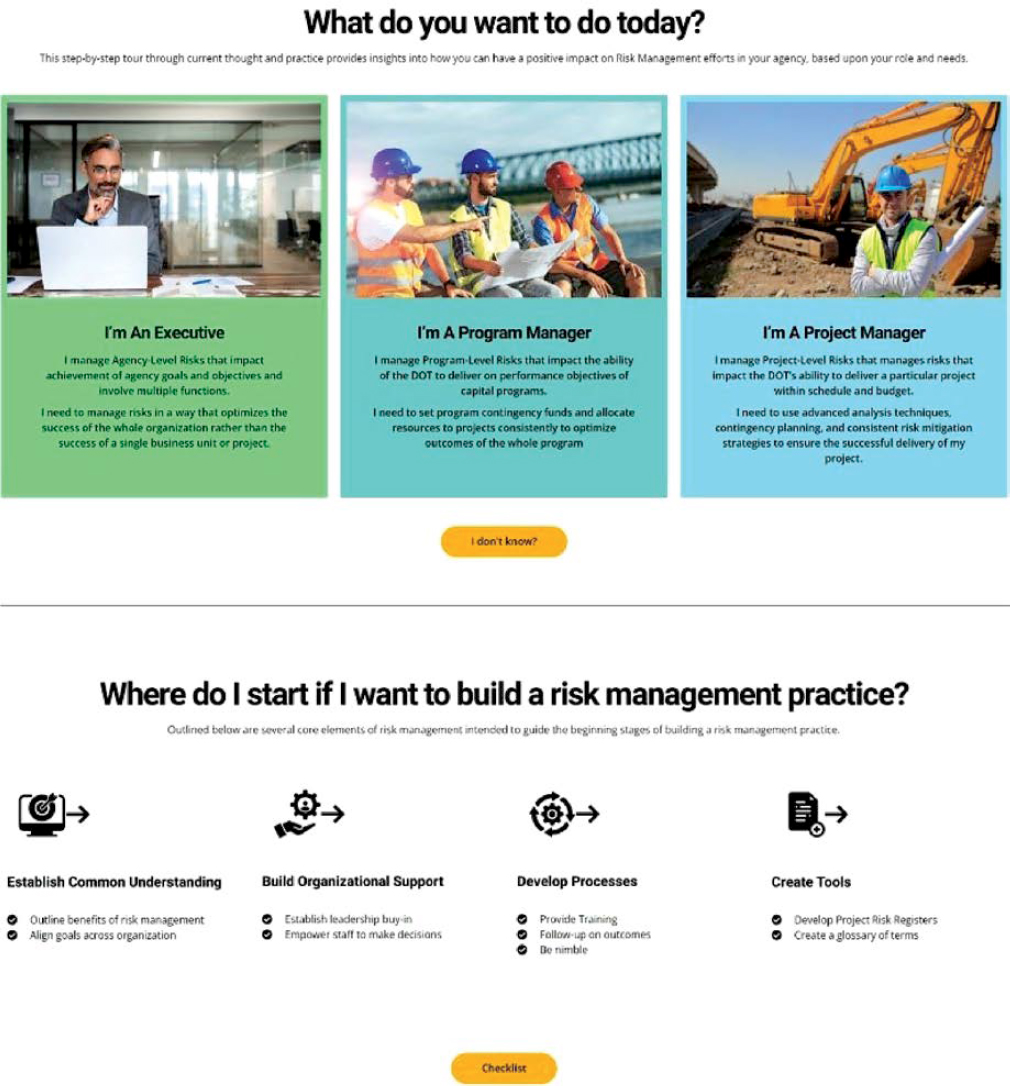
The page begins with a dark-themed header with options Home, Your Role, Building, Sustaining, and Quick Links followed by a search bar. The introduction reads, ‘Risk Management at State DOTs Building Momentum and Sustaining the Practice. What Do You Want to Do Today? Website last updated in June 2024.’ Below the title, a section introduces “What Is Risk Management?” with three boxes labeled Enterprise Risk Management, Program Risk Management, and Project Risk Management.’ Beneath this, two image panels read “Why Does Risk Management Matter?” and “How Can This Website Help You?” The first image panel shows a woman in focus and smiling at someone. The second image panel shows a screenshot of this page from the dark-themed header to the three text boxes. The next section, titled “What do you want to do today?” features three panels: I’m an Executive, I’m a Program Manager, and I’m a Project Manager with respective photos and text. Below these textboxes, a question reads, ‘I don’t know.’ At the bottom, a white section with the question, ‘Where do I start if I want to build a risk management practice?’ is present. This precedes four icons and brief steps or guidance. The titles of these steps are Establish Common Understanding, Build Organizational Support, Develop Processes, and Create Tools. Below the text, a yellow button labeled “Checklist” is centered at the bottom. The layout is structured and color-coded to guide users based on their goals in risk management.
Figure 5. Final website home page.
Page 24
Suggested Citation: "Key Findings." National Academies of Sciences, Engineering, and Medicine. 2025. Risk Management at State DOTs: Building Momentum and Sustaining the Practice. Washington, DC: The National Academies Press. doi: 10.17226/29144.
The page begins with a dark-themed header with options Home, Your Role, Building, Sustaining, and Quick Links followed by a search bar. The introduction reads, ‘Risk Management at State DOTs Building Momentum and Sustaining the Practice. What Do You Want to Do Today? Website last updated in June 2024.’ Below the title, a section introduces “What Is Risk Management?” with three boxes labeled Enterprise Risk Management, Program Risk Management, and Project Risk Management.’ Beneath this, two image panels read “Why Does Risk Management Matter?” and “How Can This Website Help You?” The first image panel shows a woman in focus and smiling at someone. The second image panel shows a screenshot of this page from the dark-themed header to the three text boxes. The next section, titled “What do you want to do today?” features three panels: I’m an Executive, I’m a Program Manager, and I’m a Project Manager with respective photos and text. Below these textboxes, a question reads, ‘I don’t know.’ At the bottom, a white section with the question, ‘Where do I start if I want to build a risk management practice?’ is present. This precedes four icons and brief steps or guidance. The titles of these steps are Establish Common Understanding, Build Organizational Support, Develop Processes, and Create Tools. Below the text, a yellow button labeled “Checklist” is centered at the bottom. The layout is structured and color-coded to guide users based on their goals in risk management.
Page 25
Suggested Citation: "Key Findings." National Academies of Sciences, Engineering, and Medicine. 2025. Risk Management at State DOTs: Building Momentum and Sustaining the Practice. Washington, DC: The National Academies Press. doi: 10.17226/29144.
The screengrab shows the content page for Building a Risk Management Practice where the header shows options such as Home, Your Role, Building, Sustaining, and Quick Links. This precedes a search bar. The page displays the title, ‘Building: This step-by-step tour through current thought and practice provides insights into how you can have a positive impact on Risk Management efforts in your agency, based upon your role and needs.’ Below this, the text ‘I want to BUILD Risk Management practice’ with six textboxes is given. The data given in the text boxes are as follows: Row 1: I’m An Executive who manages risks that impact the achievement of agency goals and objectives and involve multiple functions; I’m A Program Manager who manages risks that impact the ability of the D O T to deliver on performance objectives of capital programs; I’m A Project Manager who manages risks that impact the D O T’s ability to deliver a particular project within schedule and budget. Row 2: Enterprise risk management practice requires thoughtful organization, communication, and tools; Program risk management practice requires defined goals, clear roles, and methods to measure risk; Project risk management practice requires empowerment for decisions based on data and tools.
Figure 6. Content page for building a risk management practice.
Page 22
Suggested Citation: "Key Findings." National Academies of Sciences, Engineering, and Medicine. 2025. Risk Management at State DOTs: Building Momentum and Sustaining the Practice. Washington, DC: The National Academies Press. doi: 10.17226/29144.
Page 22
Page 23
Suggested Citation: "Key Findings." National Academies of Sciences, Engineering, and Medicine. 2025. Risk Management at State DOTs: Building Momentum and Sustaining the Practice. Washington, DC: The National Academies Press. doi: 10.17226/29144.
Page 23
Page 24
Suggested Citation: "Key Findings." National Academies of Sciences, Engineering, and Medicine. 2025. Risk Management at State DOTs: Building Momentum and Sustaining the Practice. Washington, DC: The National Academies Press. doi: 10.17226/29144.
Page 24
Page 25
Suggested Citation: "Key Findings." National Academies of Sciences, Engineering, and Medicine. 2025. Risk Management at State DOTs: Building Momentum and Sustaining the Practice. Washington, DC: The National Academies Press. doi: 10.17226/29144.
Page 25
Next Chapter: Priorities for Future Research
Subscribe to Email from the National Academies
Keep up with all of the activities, publications, and events by subscribing to free updates by email.