Nuclear Terrorism: Assessment of U.S. Strategies to Prevent, Counter, and Respond to Weapons of Mass Destruction (2024)
Chapter: 1 Background and Study Task
1
Background and Study Task
1.1 CHARGE TO THE COMMITTEE
Spurred by an increasingly dynamic international security environment, Congress included a mandate in the National Defense Authorization Act for Fiscal Year 2021 (Section 1299I. Assessment of Weapons of Mass Destruction Terrorism [U.S. Congress 2021]) that the National Academies of Sciences, Engineering, and Medicine conduct an assessment of U.S. strategies for preventing, countering, and responding to nuclear terrorism, and make recommendations to improve such strategies. The committee tasking came prior to Russia’s February 2022 invasion of Ukraine and is included in Box 1-1.
In response to this congressional mandate, the National Academies assembled a committee of experts (referred to as “the committee” in this report) to assess the current strategies and nuclear risk, identify potential gaps in policy, and examine new approaches to the current challenges. The committee consisted of 12 volunteer members and an unpaid consultant, all with years of experience and a broad range of careers spanning (1) the U.S. government including the Department of Energy (DOE), the Department of Defense (DOD), the National Nuclear Security Administration (NNSA), the Department of Homeland Security (DHS), the National Security Council, and the Nuclear Regulatory Commission (NRC); (2) the U.S. Armed Services; (3) NNSA National Laboratories; (4) academia; and (5) nongovernmental organizations.
As directed in the statutory language, this report provides suggested actions for Congress, the White House, and relevant federal agencies to enhance the security of the United States and its allies and partners in managing the nuclear terrorism risk. The report is also written to contribute directly to the general public’s understanding of this ongoing risk, embracing a recognition by the committee that an informed and engaged civil society is critical to preventing, responding to, and recovering from a nuclear terrorist attack.
BOX 1-1
Statement of Task
The National Academies of Sciences, Engineering, and Medicine (NASEM) will appoint an ad hoc topical committee to address specific issues related to nuclear terrorism threats. This committee will address the adequacy of strategies to prevent, counter, and respond to nuclear terrorism, and identify technical, policy, and resource gaps with respect to:
- identifying national and international nuclear risks, and critical emerging threats;
- preventing state-sponsored and non-state actors from acquiring or misusing the technologies, materials, and critical expertise needed to carry out nuclear attacks, including dual-use technologies, materials, and expertise;
- countering efforts by state-sponsored and non-state actors to carry out such attacks;
- responding to nuclear terrorism incidents to attribute their origin and help manage their consequences;
- budgets likely to be required to implement effectively such strategies; and
- other important matters that are directly relevant to such strategies.
The NASEM will produce a consensus report and may produce additional products (such as proceedings of workshops) by mutual agreement with the sponsor. The consensus report will be unclassified with a classified annex.
1.2 STUDY APPROACH
Over the course of 18 months, the committee took a phased approach, building a foundation for the study. Data gathering focused on briefings and panel discussions from experts in the relevant areas and from entities focused on the risks associated with nuclear weapons of mass destruction. The study process incorporated the expertise and experience of the committee, peer-reviewed literature, press reports, and classified reports. The committee received briefings from U.S. government agencies and outside experts to include classified briefings (detailed agendas can be found in Appendix A). This phase also included briefings and discussion with key international partners. Specifically, the committee heard from the following entities:
- academia: Global Resilience Institute at Northeastern University, Belfer Center for Science and International Affairs at Harvard University, Program on Crisis Leadership at Harvard University, Frederick S. Pardee School of Global Studies at Boston University, Oregon State University, and the University of California;
- nongovernmental organizations: Nuclear Threat Initiative, Ploughshares Fund, The Stimson Center, and The Atlantic Council;
- journalists: the National Journal, The Atlantic, and the New York Times; and
- U.S. international partners and allies: Embassy of Canada to the United States, United Nations, INTERPOL, NATO, and the Canadian Nuclear Safety Commission.
This unclassified report contains the conclusions, findings, and recommendations from the study committee that appear in chapters 2 through 9 and are compiled in the report summary. The report also has a classified annex that contains additional information pertaining to sensitive information and restricted programs managed by U.S. government departments and agencies.
1.3 THE U.S. GOVERNMENT AGENCIES FOCUSED ON NUCLEAR TERRORISM
Federal agencies across the U.S. government, staffed by seasoned experts, provide domestic and international programs and capabilities that have built a strong foundation for managing and reducing nuclear terrorism risks. The committee received reports and presentations and had panel discussions with nearly all the key U.S. government agencies involved in this mission. These are captured in Figure 1-2 and described below.
Many of the relevant programs for dealing with the enduring and evolving nuclear threat are funded and managed by the U.S. DOE’s NNSA. The NNSA defines its role along three lines of effort (National Nuclear Security Administration 2021b):
- “Prevent proliferant states from developing nuclear weapons or acquiring weapons-usable nuclear materials, equipment, technology, and expertise, and prevent non-state actors from acquiring nuclear and radioactive materials that can be used for malicious purposes;
- “Counter the efforts of both proliferant states and non-state actors to acquire, develop, disseminate, deliver, or use the materials, expertise, or components of a nuclear or radiological device; and
- “Respond to the full spectrum of nuclear and radiological emergencies at home or abroad, including deliberate attacks and accidents, to minimize the damage from such incidents.”
These lines of effort are the focus of three offices at NNSA that report directly to the administrator: (1) The Office of Defense Nuclear Nonproliferation (DNN) develops and implements policy, programmatic, and technical solutions to eliminate or secure fissile and sensitive radiological materials and limit or prevent the proliferation of materials, technology, and expertise related to nuclear and radiological weapons, interfacing with other federal agencies (National Nuclear Security Administration 2021a). (2) The Office of Counterterrorism and Counterproliferation (CTCP) works closely with the DOD and the Federal Bureau of Investigation (FBI) to counter nuclear threats and respond to
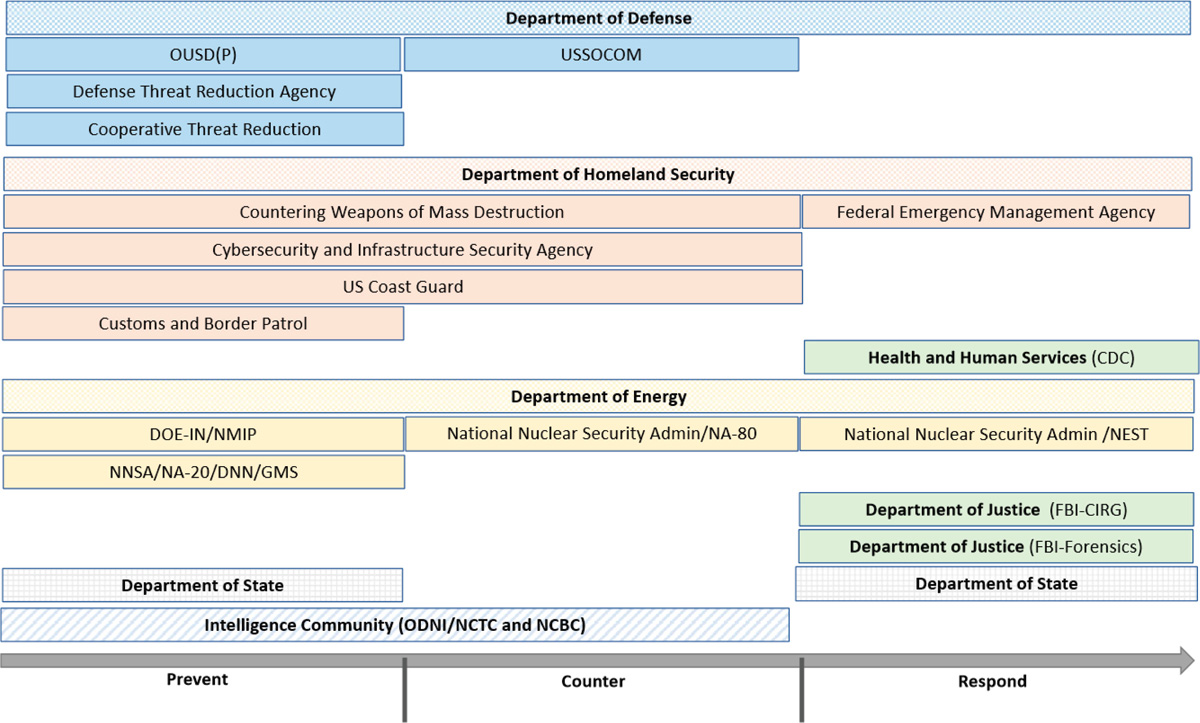
nuclear incidents and accidents, domestically and abroad. (3) The Office of Emergency Operations administers and directs the implementation and integration of emergency management programs across the DOE, including the NNSA.
The 17 national laboratories in the DOE/NNSA complex support these missions for NNSA through research, development, testing, and implementation. These include the NNSA-managed laboratories: Los Alamos National Laboratory, Sandia National Laboratories, and Lawrence Livermore National Laboratory. Other DOE laboratories — including Oak Ridge National Laboratory (along with Y-12), Pacific Northwest National Laboratory, Savannah River National Laboratory, Idaho National Laboratory, Argonne National Laboratory, and Brookhaven National Laboratory—provide considerable support to the counterterrorism mission, domestically and internationally, with other programs scattered throughout the remaining national laboratories (Ashby 2021; Center for Global Security Research 2023; Nicholas 2016; Nicholas and Smith 2022; Pepper et al. 2016; Rowland 2020; Savannah River National Laboratory 2022; Shirey 2018).
The NNSA funds and manages a variety of programs that address international threats and risks, but there are several federal departments and agencies that play important roles in preventing, countering, and responding to nuclear terrorism. The Department of State (DOS), DOD, DHS, FBI, and NRC all fund and manage programs for preventing and responding to nuclear terrorism domestically.
The DHS—formed after the 9/11 terrorist attacks along with its key components to include the U.S. Coast Guard, Customs and Border Protection, FEMA, TSA, and the Countering Weapons of Mass Destruction Office—coordinates efforts to prevent, respond to, and recover from nuclear terrorism incidents and enhance security measures at ports and borders, and it works to detect and prevent the illicit trafficking of nuclear materials. The FBI plays a critical role in national counterterrorism efforts, including countering nuclear terrorism. The Bureau investigates threats, gathers intelligence, and works to disrupt and dismantle networks involved in nuclear terrorism. In addition to intelligence activities, the Critical Incident Response Group and the forensics team within the FBI have key roles for managing the investigation in the aftermath of a nuclear incident.1 The NRC regulates the civilian use of nuclear materials in the United States, preventing nuclear terrorism by preventing the proliferation of nuclear and radiological materials at nuclear power plants, fuel cycle facilities, and other licensed nuclear facilities. The NRC sets regulations and standards for physical protection measures, safeguards, and emergency preparedness to mitigate the risks of nuclear terrorism at nuclear facilities.
The DOD has specialized activities for managing the nuclear terrorism risk to include pathway defeat; weapon of mass destruction (WMD) defeat; and chemical, biological, radiological, and nuclear (CBRN) response (U.S. Joint Chiefs of Staff 2019). Listed below are the relevant DOD lines of effort:
___________________
1 Written materials submitted to a study committee by external sources and public meeting recordings are listed in the project’s Public Access File and can be made available to the public upon request. Contact the Public Access Records Office (PARO) at the National Academies of Sciences, Engineering, and Medicine for a copy of the list and to obtain copies of the materials. E-mail: paro@nas.edu.
- threat assessment and intelligence sharing, contributing to the overall understanding of nuclear terrorism risks;
- deterrence and defense, maintaining a strong nuclear deterrent posture to dissuade potential adversaries from using nuclear weapons or supporting nuclear terrorism;
- nuclear nonproliferation and arms control;
- building capability with international partners to counter and deter weapons of mass destruction and emerging threats; and
- crisis response and consequence management, working alongside other federal, state, and local, tribal, and territorial agencies to provide support, including emergency response coordination, intelligence analysis, logistics, medical assistance, and technical expertise.
The DOS leads diplomatic efforts and supports capacity-building for preventing nuclear proliferation and nuclear terrorism. These diplomatic efforts include engaging international partners in actively participating in nonproliferation initiatives and abiding by legal frameworks for preventing, countering, and responding to nuclear terrorism threats. The DOS plays an essential role in building international consensus, promoting security cooperation, strengthening international organizations and treaties, and addressing the global challenges posed by nuclear terrorism. The DOS is also involved with Cooperative Threat Reduction (CTR) programs to include efforts by the Bureau of International Security and Nonproliferation in building the capacity for dealing with insider threats and bolstering security culture.
Within the intelligence community (IC), a number of agencies to include the CIA, Defense Intelligence Agency (DIA), National Geospatial-Intelligence Agency (NGA), National Reconnaissance Office (NRO), and NSA play important roles in this mission, as do important entities for advancing interagency coordination within ODNI. These include the National Counterterrorism Center (NCTC), the National Counterproliferation and Biosecurity Center (NCBC), the National Intelligence Council (NIC), and the Joint Atomic Energy Intelligence Committee (JAEIC) (National Intelligence Council Joint Atomic Energy Intelligence Committee 2023; Office of the Historian U.S. Department of State 2023).
The NCTC mission is to “lead and integrate the counterintelligence effort by fusing all U.S. government counterintelligence information, providing terrorism analysis, sharing information with partners across the counterintelligence enterprise, and driving whole-of-government action to secure our national counterintelligence objectives” (National Counterterrorism Center 2021).
The NCBC advances the broader objectives of the U.S. counterproliferation mission by discouraging interest by states, terrorists, or armed groups in acquiring, developing, or mobilizing resources for WMD purposes and preventing or obstructing state, terrorist, or other efforts to acquire WMD capabilities, or efforts by suppliers to provide such capabilities (National Counterproliferation and Biosecurity Center 2023). The NCBC is responsible for integrating the intelligence community’s collection and
analytic efforts against the highest-priority threats, including atomic energy and nuclear weapons development in foreign countries.
The primary role of the NIC is to provide strategic intelligence assessments to senior policymakers, including the president, the National Security Council, and other key decision-makers (National Intelligence Council 2023). The NIC’s role is crucial in helping policymakers understand the complex global landscape, identify potential threats and opportunities, and make informed decisions that shape U.S. national security and foreign policy. This includes collaborating with nongovernmental organizations in academia and the private sector.
Finally, the JAEIC has the responsibility to assess foreign atomic energy developments and contribute to national intelligence products, keeping the ODNI aware of foreign atomic energy intelligence regarding national security concerns (National Intelligence Council Joint Atomic Energy Intelligence Committee 2023).
Given the number of federal departments and agencies and the depth and breadth of the unique capabilities and authorities that they bring to the counterterrorism mission, a central challenge that the committee identified is making sure there is all-of-government focus on the mission. Senior leaders at the relevant departments and agencies should prioritize this mission, and the White House will have to provide ongoing oversight that ensures close interagency coordination and focus.
1.4 ORGANIZATION OF THE REPORT
The report is organized into the following chapters:
Chapter 2 describes and assesses the tools and types of nuclear terrorism. Chapter 3 looks at the evolving and increasingly transnational nature of the nuclear terrorism risk. Chapters 4 and 5 examine recent trends in the geopolitical environment and civil nuclear energy sector that are affecting this risk. Chapters 6 and 7 focus on the dangers and challenges of keeping highly enriched uranium (HEU), plutonium, and radioactive
source materials out of the hands of terrorists. Chapter 8 assesses how non-state actors might exploit well-established smuggling pathways to move nuclear weapons, materials, and equipment even in the face of current measures for detecting and interdicting such movements. Chapter 9 addresses the need to plan for and be prepared to respond and recover from a nuclear incident should prevention efforts fall short. The sensitive details and programs specific to efforts to prevent and counter nuclear terrorism are compiled in the classified annex. Note that included in this report is an appendix capturing the recent eras in nuclear security that is in response to the committee’s mandate for this study (Appendix B). The committee felt it was important and valuable for stakeholders and decision-makers to put in context the historical eras for nuclear security.
1.5 PREVIOUS/RELEVANT NATIONAL ACADEMIES REPORTS
The National Academies has published many reports relevant to this study to include nuclear risk assessment, international nuclear policy, and nuclear/radioactive threat reduction (National Academies of Sciences 2023). The committee looked to these previous studies to help inform this report and build on these comprehensive prior efforts.
-
Nuclear Risk and Threat Reduction: There are many factors that influence the probability and severity of a nuclear terrorist attack. Previous National Academies activities have gone into detail on specific factors such as violent extremism, government workforce requirements, and nuclear material management. In-depth analysis of all these factors falls outside of the scope of this committee. However, this report builds on these earlier findings and relevant conclusions and recommendations contained in:
- Governance and Management of the Nuclear Security Enterprise (2020)
- Scientific Aspects of Violent Extremism, Terrorism, and Radiological Security Proceedings of a Workshop—in Brief (2020)
- Cooperative Threat Reduction Programs for the Next Ten Years and Beyond: Proceedings of a Symposium—in Brief (2018)
- Emerging and Readily Available Technologies and National Security: A Framework for Addressing Ethical, Legal, and Societal Issues (2014)
- Assuring a Future U.S.-Based Nuclear and Radiochemistry Expertise (2012)
- Global Security Engagement: A New Model for Cooperative Threat Reduction (2009)
- Making the Nation Safer: The Role of Science and Technology in Countering Terrorism (2002)
- International Policy and Collaboration: The United States and Russia together possess the vast majority of the world’s nuclear weapons and for nearly three decades shared the largest responsibility for mitigating nuclear risk (Arms Control Association 2023; Federation of American Scientists 2023). International cooperation from multiple parties is imperative to prevent proliferation across international
- borders and ensure the security of all countries. The National Academies has a long history of engaging with Russia and other key international stakeholders. The committee’s work was informed by these historic NAS exchanges with Russia and other international partners along with the lessons learned and the recommendations derived from programs to support international nuclear policy formulation. These include:
- Roots and Trajectories of Violent Extremism and Terrorism: A Cooperative Program of the U.S. National Academy of Sciences and the Russian Academy of Sciences (1995–2020; 2022)
- Improving International Resilience and Response to Chemical, Biological, Radiological, and Nuclear Events (2019)
- Brazil–U.S. Workshop on Strengthening the Culture of Nuclear Safety and Security (2015)
- Future of the Nuclear Security Environment in 2015: Proceedings of a Russian-U.S. Workshop (2009)
- Internationalization of the Nuclear Fuel Cycle: Goals, Strategies, and Challenges (2009)
- Russian Views on Countering Terrorism During Eight Years of Dialogue: Extracts from Proceedings of Four U.S.-Russian Workshops (2009)
- U.S.-Russian Collaboration in Combating Radiological Terrorism (2007)
- Strengthening U.S.-Russian Cooperation on Nuclear Nonproliferation (2005)
- Overcoming Impediments to U.S.-Russian Cooperation on Nuclear Nonproliferation- Report of a Joint Workshop (2004)
- Scientists, Engineers, and Track-Two Diplomacy—A Half-Century of U.S.-Russian Interacademy Cooperation (2004)
-
Nuclear Forensics and Technology: Increased interest and funding to support the development of civil nuclear technology has led to recent innovation in nuclear reactors and material detection. The National Academies studies listed below have assessed the landscape and implications of new technology; this report draws from and expands on these reports.
- Merits and Viability of Different Nuclear Fuel Cycles and Technology Options and the Waste Aspects of Advanced Nuclear Reactors (2023)
- Understanding the Societal Challenges Facing Nuclear Power: Proceedings of a Workshop (2022)
- Radioactive Sources: Applications and Alternative Technologies (2021)
- Nuclear Proliferation and Arms Control Monitoring, Detection, and Verification: A National Security Priority: Interim Report (2021)
- Restoring and Improving Nuclear Forensics to Support Attribution and Deterrence: Public Summary (2021)
- Monitoring Nuclear Weapons and Nuclear-Explosive Materials: An Assessment of Methods and Capabilities (2005)
References
Arms Control Association. 2023. “Nuclear Weapons: Who Has What at a Glance.” Last Modified June 2023. https://www.Armscontrol.Org/Factsheets/NuclearweaponsWhohaswhat.
Ashby, Steven. 2021. “Looking Forward from 9/11: PNNL Contributes to Homeland Security.” Tri-City Herald, September 20, 2021, 2021. https://www.Pnnl.Gov/News-Media/Looking-Forward-911-Pnnl-Contributes-Homeland-Security.
Center for Global Security Research. 2023. Lawrence Livermore National Laboratory https://Cgsr.Llnl.Gov/About.
Federation of American Scientists. 2023. “Nuclear Weapons: Nuclear Information Project.” https://Fas.Org/Issue/Nuclear-Weapons/.
National Academies of Sciences, Engineering, and Medicine,. 2023. “Aiding Global Security through Research.” https://Sites.Nationalacademies.Org/Pga/Pga_041596.
National Counterproliferation and Biosecurity Center. 2023. “What We Do.” https://www.Dni.Gov/Index.Php/Ncbc-What-We-Do.
National Counterterrorism Center. 2021. Inside NCTC.
National Intelligence Council. 2023. “National Intelligence Council—What We Do.” https://www.Dni.Gov/Index.Php/Who-We-Are/Organizations/Mission-Integration/Nic/Nic-What-We-Do
National Intelligence Council Joint Atomic Energy Intelligence Committee. 2023. Subject: Charter for the Joint Atomic Energy Intelligence Committee, Annex to Intelligence Community Directive Number 207. https://www.Dni.Gov/Files/Documents/Foia/Df-2017-00410-Ravnitzky-Final-Response.Pdf
National Nuclear Security Administration. 2021a. NNSA: Reducing Global Nuclear Threats.
—. 2021b. “Prevent, Counter, and Respond—A Strategic Plan to Reduce Global Nuclear Threats (NPCR).” https://www.Energy.Gov/Nnsa/Articles/Prevent-Counter-And-Respond-Strategic-Plan-Reduce-Global-Nuclear-Threats-Npcr.
Nicholas, Nancy Jo. 2016. “Los Alamos National Laboratory’s Role in Implementing U.S. Nuclear Policy.” Conference: NNSS International Diplomat Visit; 2016-10-25 - 2016-10-25; Las Vegas, NV. https://www.Osti.Gov/Biblio/1331250.
Nicholas, Nancy Jo, and Jim Smith. June 29, 2022. Programmatic Capability Awareness Workshop: Global Security. Los Alamos National Laboratory. https://Permalink.Lanl.Gov/Object/Tr?What=Info:Lanl-Repo/Lareport/La-Ur-22-26248.
Office of The Historian U.S. Department of State. 2023. “126. Director of Central Intelligence Directive No. 3/4.” https://History.State.Gov/Historicaldocuments/Frus1950-55intel/D126.
Pepper, S., T. Mckinney, and L. Satkowiak. 2016. “U.S. National Laboratory Contributions to Global Nuclear Security.” Conference: International Conference on Nuclear Security: Commitments and Actions; Vienna, Austria; 20161205 through 20161205, United States. https://www.Osti.Gov/Biblio/1338603.
Rowland, Lynzie Rae. 2020. Global Security: 5–10 Year Strategy [Slides]. Sandia National Laboratories (United States). https://www.Osti.Gov/Biblio/1598759.
Savannah River National Laboratory. 2022. “SRNL Global Security Directorate.” https://Srnl.Doe.Gov/Factsheets_2023/Gsd.Pdf.
Shirey, Robert. 2018. Nuclear Nonproliferation and Security Program Office–Highlights 2017. https://www.Osti.Gov/Biblio/1430026.
U.S. Congress. 2021. William M. (Mac) Thornberry National Defense Authorization Act for Fiscal Year 2021.
U.S. Joint Chiefs of Staff. 2019. Joint Countering Weapons of Mass Destruction. Edited By Department of Defense.
This page intentionally left blank.
SOURCE: Federal Emergency Management Agency 2022.


