Microtransit Solutions in Rural Communities: On-Demand Alternatives to Dial-a-Ride Services and Unproductive Coverage Routes (2025)
Chapter: 4 Case Examples
CHAPTER 4
Case Examples
This chapter highlights the key takeaways of interviews with a sample of transit agencies that have implemented microtransit in rural settings. Each case example section contains information about the service offered, including motivations for implementing on-demand microtransit service, key challenges, notable practices, and lessons learned. Seven service providers, listed as follows, were interviewed as part of this synthesis (Figure 16).
- Baldwin Regional Area Transit System (BRATS On-Demand), AL
- Battle Creek Transit (BCGo), MI
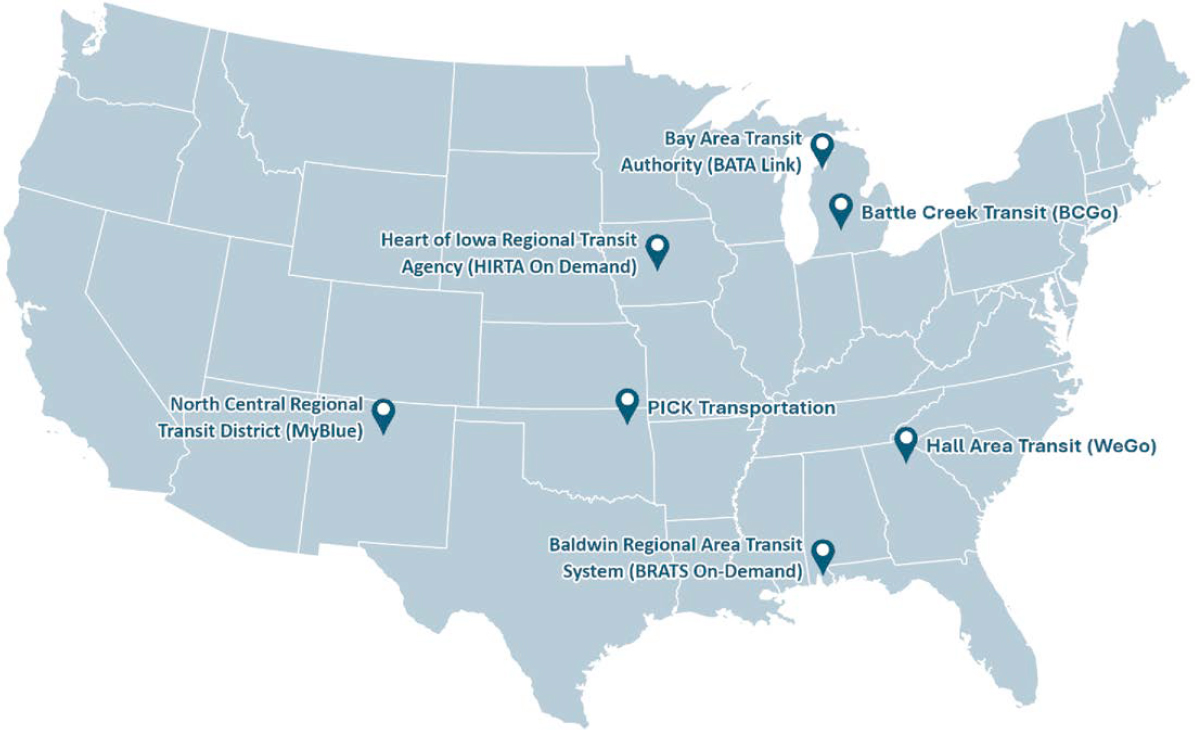
- Bay Area Transit Authority (BATA Link), MI
- Hall Area Transit (WeGo), GA
- Heart of Iowa Regional Transit Authority (HIRTA On Demand), IA
- North Central Regional Transit District (MyBlue), NM
- PICK Transportation, OK
Summary information about their services is provided Table 6.
Table 6. Case example service information summary.
| Service and Location | Service Description | Population and Population Density | Service Days and Hours | Other Services Offered | Fleet Information | Fare Information |
|---|---|---|---|---|---|---|
| BRATS On-Demand: Baldwin County, AL | Countywide (1,590 sq. mi.) | 231,770 (146 per sq. mi.) |
Monday–Friday 7:00 a.m.–4:30 p.m. | Commuter service to Mobile, AL | On-Demand Fleet: 46 Total Fleet: 46 |
Distance-based, cashless; $2.00 for < 5 miles up to $5.00 for up to 35 miles |
| BCGo: Calhoun County, MI | Countywide (719 sq. mi.) | 134,310 (187 per sq. mi.) |
Monday–Friday 6:00 a.m.–7:00 p.m. | Fixed-route bus, ADA complementary paratransit, paratransit | On-Demand Fleet: 5 Total Fleet: 24 |
Distance-based; $3.00 for < 6 miles to up to $15.00 for > 20 miles, $3.00 for additional passengers |
| BATA Link: Grand Traverse and Leelanau counties, MI | Countywide (950 sq. mi.) | 117,540 (124 per sq. mi.) |
Monday–Friday, 6:00 a.m.–10:30 p.m. (limited availability outside Traverse City after 7:00 p.m.) Saturday and Sunday, 7:00 a.m.–7:30 p.m. in Grand Traverse and Leelanau counties and 7:00 a.m.–10:30 p.m. in Traverse City |
Fixed-route service, deviated/flexible fixed-route service | On-Demand Fleet: 30 Total Fleet: 85 |
Flat fare, cash or card; $6.00 one-way trip |
| WeGo: Hall County, GA | Countywide (361 sq. mi.), including the City of Gainesville | 203,140 (563 per sq. mi.) |
Monday–Friday, 5:00 a.m.–9:00 p.m. | Seasonal fixed-route trolley | On-Demand Fleet: 31 Total Fleet: 33 |
Distance-based, cashless; Before 6:00 p.m.: $2.00 for < 5 miles plus $0.50 for each additional mile; after 6:00 p.m.: $4.00 for <5 miles plus $0.50 for each additional mile |
| Service and Location | Service Description | Population and Population Density | Service Days and Hours | Other Services Offered | Fleet Information | Fare Information |
|---|---|---|---|---|---|---|
| HIRTA On Demand: Boone, Dallas, Jasper, Madison, Marion, Story, and Warren counties, IA | Seven-county zone (4,177 sq. mi.) |
365,100 (87 per sq. mi.) |
Monday–Friday, 7:00 a.m.–5:00 p.m. (Note: Story’s and Ames’s service starts at 6:30 a.m. and service ends at 8:00 p.m. in Ames) Saturday, 7:30 a.m.–6:00 p.m. in Ames Sunday, 8:30 a.m.–6:00 p.m. in Ames |
Flexible route | On-Demand Fleet: 72 Total Fleet: 72 |
In town: $2.50 In county: $5.00 |
| MyBlue: Taos and Española, NM | Three zones: Taos Zone: within a 2-mile radius along major arterial in town (approx. 43 sq. mi.) Española Zone: within 15-mile radius of the city center (approx. 652 sq. mi.) Pojaque/Nambé Zone (within Española zone): Nambé and Pojaque pueblos, and Pojaque Valley Schools Jacona Campus (approx. 26 sq. mi.) |
2,050 (48 per sq. mi.); 43,550 (67 per sq. mi.); 3,240 (125 per sq. mi.) |
Monday–Friday, 6:00 a.m.–6:00 p.m. | Fixed-route bus, deviated fixed-route service | On-Demand Fleet: 10 Total Fleet: 75 |
Flat fare; $1.00 for all zones except Pojaque/Nambé (which is no charge) |
| PICK Transportation: Cities of: Bartlesville, Catoosa, Claremore, Coweta, Grove, Kiefer, Miami, Owasso, Ponca City, Poteau, Prior, Sallisaw, Sapulpa, Skiatook, Tahlequah, and Vinita, OK | 19 zones (ranging from ~15 sq. mi. to ~45 sq. mi.) in 16 jurisdictions | Population ranges per zone from 3,800–40,000; Population density ranges per zone from 226–1,546 people per sq. mi. | Monday–Thursday, 5:00 p.m.–9:00 p.m. Friday, 5:00 p.m.–10:00 p.m. Saturday, 10:00 a.m.–2:00 p.m. |
Daytime service varies by agency, mostly demand response | On-Demand Fleet: 44 Total Fleet: varies by agency |
Flat rate, cash or card; $3.00 |
Baldwin Regional Area Transit System, BRATS On-Demand
Service Overview
| Service Location | Service Description | Population | Service Days and Hours | Other Services Offered | Fleet Information | Fare Information |
|---|---|---|---|---|---|---|
| Baldwin County, AL | Countywide (1,590 sq. mi.) | 231,770 (146 per sq. mi.) |
Monday–Friday 7:00 a.m.–4:30 p.m. | Commuter service to Mobile, AL | On-Demand Fleet: 46 Total Fleet: 46 |
Distance-based, cashless; $2.00 for < 5 miles up to $5.00 for up to 35 miles |
Interviewee: Ann Simpson, director of transportation

Background and History
Baldwin Regional Area Transit System (BRATS) is responsible for public transportation service in Baldwin County, AL, which is located on the eastern side of Mobile Bay. BRATS operates countywide on-demand microtransit service as well as a limited-stop fixed-route commuter service to Mobile County.
Using funding from the Federal Transit Administration (FTA), BRATS replaced its dial-a-ride service with technology-enabled on-demand service in September 2020. In implementing on-demand microtransit service, BRATS had key goals, in addition to improving the quality of service overall, of improving transit service in the most rural areas of the county and being able to offer more customer trips. Additionally, the agency hoped that replacing dial-a-ride service would create operational efficiencies by reducing significant amounts of operator downtime, eliminating operator fare collection, improving scheduling, and eliminating a scheduler/dispatcher position. BRATS also saw implementing the new service as an opportunity to transition to smaller, more fuel-efficient vehicles.
Service Description
BRATS first planned its on-demand microtransit service to operate in seven geofenced zones covering the entire county (Figure 17); intra-zone trips could be booked for immediate service while inter-zone trips required advance notice. However, within days of launching, Hurricane Sally hit Baldwin County, and BRATS pivoted to offering a full countywide service with no limits on trip length or destination, which has continued into the present with one exception: customers in the northernmost part of the county are still required to book in advance because of the area’s remoteness. The agency found that the seven-zone network did not meet the needs of
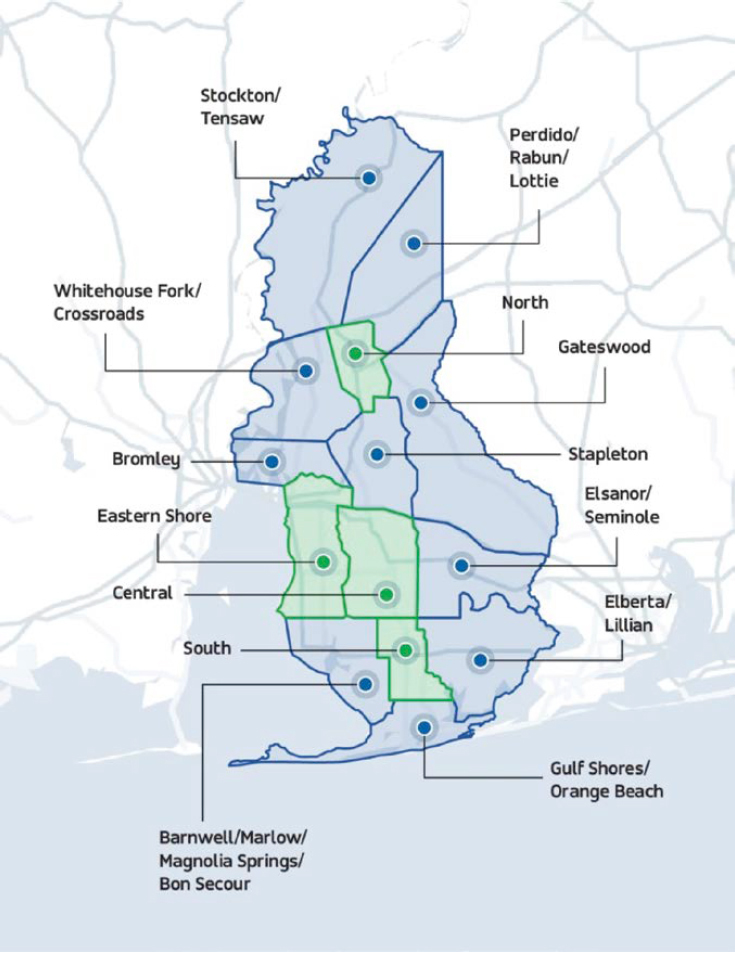
Source: Shared Use Mobility Center, https://learn.sharedusemobilitycenter.org/casestudy/a-county-wide-transformation-of-demand-response-service-into-microtransit-baldwin-county-alabama/
residents because some customers would no longer have been able to make short trips across zone boundaries, a service that had been possible under the demand response service the microtransit replaced.
While BRATS intended its new service to be primarily on demand (i.e., the majority of trips would be booked for immediate service), demand grew significantly and quickly outpaced the supply of on-demand service that could be provided given current resource levels. Currently, 93 percent of the trips are booked up to two weeks in advance. Priority for booking is given to critical care customers, such as those seeking dialysis or cancer treatments, whose trips are booked on a subscription basis as far as four weeks ahead to ensure they get on the schedule. BRATS is able to book just under 60 percent of trip requests; however, about 42 percent of requested trips are ultimately completed because a significant portion of trips are cancelled. BRATS indicated that its cancellation rate has increased, because of the ease of canceling through the app, and that its no-show rate has decreased, due to both the ease of cancellation and the repeated text reminders to passengers about their upcoming trips.
Technology
Since the service launched in 2020, BRATS has partnered with the same software vendor, which is responsible for scheduling the on-demand microtransit service as well as maintaining the mobile app. BRATS has worked closely with its vendor to ensure that the software is configured so that the trip-matching algorithm works well to maximize efficiency. Additionally, BRATS has worked with its vendor to adapt and adjust its systems as demand significantly outpaces supply, and today a majority of customers must rely on advance booking rather than on-demand trips.
Despite challenges in configuration, implementing the on-demand software and launching the mobile app have resulted in improved customer communication and relationships. BRATS is now able to push messages, such as service alerts, to customers en masse, which has significantly improved its ability to communicate with customers. Additionally, the mobile app allows for direct communication with customers about their trips. Before launching on-demand microtransit service, BRATS had a high percentage of no-shows; however, with the mobile app, the agency’s no-show rate has declined significantly. The mobile app notifies customers when their ride is booked and provides real-time status updates about their trip.
Funding
BRATS used an FTA Integrated Mobility Innovation (IMI) grant to fund the procurement and implementation of its automated and dynamic scheduling technology, mobile app, and passenger notification system and replace its previous dial-a-ride service. Today, the operations of BRATS are funded through a mix of federal, local, and directly generated sources (e.g., fare revenues). The State of Alabama does not contribute funds for operations.
Funding remains a challenge for the agency, as the cost of providing service and the level of demand have both increased. Without support from the state, BRATS must rely on local funds to match federal formula grants. Currently, one of Baldwin County’s 14 municipalities contributes financially to the service. This funding limitation, coupled with supply chain delays and operator shortages, has contributed to a mismatch between supply and demand for BRATS service.
Reception and Results
Baldwin County was motivated to implement on-demand microtransit service to provide a higher quality of service to more county residents compared to its previous service, which it has achieved. Since launch, the public support for BRATS’s on-demand service has been largely positive. The service aligns with countywide goals to support economic development and the environment, which has helped ensure support from the county’s governing commission.
With the success of BRATS’s on-demand microtransit service, Baldwin County is increasing its investment in shared mobility options. The county is in the process of entering into a partnership to offer a vanpool service for commuters (Leibold, 2024). A large portion of BRATS’s on-demand microtransit trips are for work commutes, so the agency hopes implementing vanpools will help shift this segment of demand from the on-demand microtransit service to an alternative—and likely more reliable—mode, thereby increasing capacity for service for other trips and customers. Vanpool can be operated at a lower cost to the county on a per-trip and per-hour basis than on-demand microtransit service and provides a level of reliability not possible with BRATS On-Demand.
While feedback from the public and stakeholders has been positive, feedback and support from agency staff in general, and operators in particular, were initially more mixed. The majority
of BRATS’s operators are retirees who work part-time with the agency, so the transition to a new system was challenging. The new technology assigns trips more efficiently than BRATS’s previous software, resulting in less downtime between trips for operators. Over time, operators have become used to the new operating model.
At the same time, implementing the service on a large scale has posed challenges. On-demand microtransit service was a completely new operating model for BRATS, and agency leadership concluded that starting smaller and expanding over time may have made implementation smoother.
Case Example Summary – BRATS On-Demand
BRATS provides countywide microtransit service over a large service area, and doing so requires tradeoffs. In choosing to provide countywide service, BRATS is able to provide service to all its residents, even though that means operating mostly with advanced booking. Providing more immediate on-demand service, given the agency’s existing financial and equipment constraints, would require BRATS to limit its service area to smaller, geofenced zones.
- With demand outpacing supply, BRATS’s service no longer functions primarily as an “on demand” service, essentially transitioning back to pre-booked service as it originally offered. Since launching, the demand for BRATS’s on-demand microtransit service has surpassed supply and continues to grow. BRATS found it was more important to reserve capacity for critical trips (e.g., customers accessing life-saving medical care) than to retain its on-demand functionality. Funding limitations as well as vehicle and operator shortages have contributed to capacity constraints.
- BRATS’s experience demonstrates that revisiting the stated goals of a service is key. In the case of BRATS, the agency determined that its goal of expanding public transportation service into more rural areas was its highest priority, and that goal has been achieved. While starting small and expanding incrementally may have resulted in higher service reliability and efficiency, that would not have met the agency’s highest priority goal for the service.
- BRATS leadership indicated that additional staff engagement could have resulted in smoother implementation. The transition to a new software and operating model was a change that some operators found challenging to adapt to. Adapting to a new way of operating can be difficult, and operators should be engaged as early as possible to ensure they are given the time and resources needed to become comfortable with the new system and way of operating.
- Offering countywide on-demand microtransit that struggles to meet all of the demand has led BRATS to pursue implementation of other modes to meet the transportation needs of customers. A large portion of BRATS’s on-demand trips come from work commuters, for whom lack of availability impacts their ability to maintain employment. Baldwin County has decided to begin providing vanpool service as another public transportation option. The agency hopes implementing vanpools will provide an alternative to on-demand service at a lower cost and with a higher rate of reliability, while also easing some capacity constraints.
Battle Creek Transit, BCGo
Service Overview
| Service Location | Service Description | Population | Service Days and Hours | Other Services Offered | Fleet Information | Fare Information |
|---|---|---|---|---|---|---|
| Calhoun County, MI | Countywide (719 sq. mi.) | 134,310 (187 per sq. mi.) |
Monday-Friday 6:00 a.m.–7:00 p.m. | Fixed-route bus, ADA complementary paratransit, paratransit | On-Demand Fleet: 5 Total Fleet: 24 |
Distance-based; $3.00 for < 6 miles to up to $15.00 for > 20 miles, $3.00 for additional passengers |
Interviewees: Mallory Avis, public transit director, and Kristy Grestini, mobility manager

Battle Creek Transit (BCT) is a department of the City of Battle Creek, MI, that provides fixed-route and paratransit—including ADA complementary paratransit—service primarily in Battle Creek, as well as countywide on-demand microtransit service (BCGo) in Calhoun County.
Funded through a grant from the Michigan Department of Transportation (DOT), BCGo is a pilot that expanded BCT’s service offerings. In implementing BCGo in 2021, BCT’s ultimate goal was to improve transportation access for Calhoun County residents, especially those who live in harder-to-access areas. Operationally, the goal of the pilot project was to integrate the multiple demand response service providers in the county (described in the next section) by having them use the same scheduling, dispatching, and routing software, thus achieving service and financial efficiencies.
Service Description
BCGo operates on-demand microtransit service across Calhoun County. Most (around 80 percent) of BCGo trips are booked from locations within Battle Creek, with a much smaller percentage of trip requests in rural areas of the county. Six percent of trips are requested outside of Battle Creek and Springfield. The on-demand microtransit service fills in service gaps left by BCT’s fixed-route service, which has been reduced due to operator shortages, as well as the previous lack of countywide demand response service available to the public outside the cities of Battle Creek and Marshall. The City of Marshall, which has a population of just under 7,000
and lies about 12 miles east of Battle Creek, has operated its own dial-a-ride service for decades. The Marshall Dial-a-Ride service offers trips within the town and up to 1 mile outside the town boundaries and is funded by a combination of federal and state funding, local property tax revenue, and fares. The City of Marshall also operates the Albion-Marshall Connector service, which is a flexible route operating between Marshall and the City of Albion, which is 12 miles east of Marshall. There is a third nonprofit transit service provider in Calhoun County, Community Action, whose services are available only to people with disabilities and older adults. These services are funded largely through state and county funds as well as a countywide property tax (millage) dedicated to funding services for older adults.
BCGo was intended to offer service that would be primarily on demand; however, due to a high level of demand combined with funding, operator, and vehicle limitations, BCGo is not able to operate most of its service on a fully on-demand basis. Currently, BCGo has capacity to complete only about 20 percent of trip requests.
Over time, BCT has adjusted how BCGo operates to allow for more on-demand trips and trips booked less than a week in advance. Currently, three of the five BCGo vehicles that operate on most days are dedicated to providing pre-booked trips, with most of those vehicles’ capacity booked close to two weeks in advance. The remaining two vehicles’ capacity is made available for booking on Monday of each week to allow for same-day and same-week trips. However, about three-quarters of BCGo’s trips are still booked in the 14-day advance window. For the vehicles reserved for same-week service, the mobile app provides trips within a 60-minute window; however, customers booking through the call center are often able to be accommodated for same-day service only if they have a flexible trip time. The app does not provide customers with the ability to look at availability multiple hours in advance on the same day.
Marshall Dial-A-Ride joined Battle Creek Transit as a collaborating partner for on-demand microtransit service in 2024. While there are no current plans to rebrand Marshall Dial-A-Ride, the service is operating with the same backend software as BCGo, and Marshall Dial-A-Ride customers now have access to the mobile app to book their trips. On the ground, Marshall Dial-A-Ride continues to operate its own zone with dedicated vehicles to ensure that the previous level of service city residents were used to can be maintained. In the future, BCGo will operate in Marshall, both for trips within the town as well as trips to and from the town from other parts of the county.
Technology
For its pilot project, Battle Creek Transit procured a software vendor that had little previous experience operating in the United States and had not previously had to track data in a way that would be conducive to compliance with federal and state reporting requirements. Their partnership was mutually beneficial—BCT was able to procure software at an advantageous cost, and the vendor was able to gain experience in a new market. The partners worked closely together to iron out issues unique to the U.S. market and used “out of the box” thinking to resolve challenges and build a mobile app and backend software to meet BCT’s needs.
For customers, technology adoption has been relatively smooth. About 75 percent of customers book their trips through the mobile app. The rate of mobile app usage for booking has steadily increased over time. BCT participated in many community events and conducted one-on-one sessions with community members to educate them on how to use BCGo and the mobile app. Additionally, word-of-mouth advertising among users has encouraged increased mobile app usage.
Funding
BCGo’s grant from Michigan DOT was initially for a 12-month pilot. However, BCT has been able to successfully acquire extensions and additional grant funding from the state to continue the pilot for three years, given the time it has taken to get the service up and running and to begin the process of integrating multiple providers. However, the current funding will not adequately sustain the service once the grant funding ceases.
The initial implementation of BCGo has proved that it is viable to extend transit service into rural communities across Calhoun County and, at the same time, that the demand far exceeds supply with the current level of resources. The success of the service has created support from local legislators who are now advocating for dedicated funding for continued countywide service. The county has created a transit authority, and a ballot measure for a property tax (or “millage”) that would sustain the service and increase its capacity to up to 20 vehicles will be voted on in November 2024. The countywide transit authority could potentially become responsible for all of BCT’s services; however, municipalities within the county that decline to participate in the millage could also cease to receive BCGo service in the future (Jennerjahn, 2023).
Partnerships
The partnership between BCT and its technology vendor has been the most active partnership thus far into the piloting of the service, with the State of Michigan as the primary funding partner. The integration of the City of Marshall’s demand response service into the same platform as BCGo, while maintaining separate branding and service capacity (i.e., the same number of dedicated vehicles), has been a successful partnership that has resulted from the pilot project as well. While discussions of operational integration with Community Action are not currently active, the participating partners are open to the possibility of furthering those discussions in the future.
Results and Reception
Since implementation, BCGo has been successful in expanding transit options for Calhoun County residents and attracting new customers. In the first year of service, a survey of customers using the mobile app indicated that 55 percent of users had never used public transportation before BCGo was created, illustrating the latent demand for public transportation service that existed in the county. Additionally, implementation of the new microtransit service was the first major change in transit service provided by BCT in over a decade, which made the new service exciting to residents. Its creation became even more important in meeting the community’s transportation needs following the closure of the city’s only taxi company in 2019.
Limited funding has resulted in a demand for the service that far exceeds the supply. However, BCGo is filling a gap in fixed-route service within Battle Creek and reducing the demand on Tele-Transit, BCT’s ADA complementary paratransit service. While paratransit-eligible customers have priority for booking Tele-Transit trips and a flat $3.00 fare on Tele-Transit, many customers are forgoing these benefits to use BCGo. BCGo is more flexible than Tele-Transit because it operates outside the city limits of Battle Creek and can be booked via an app rather than exclusively through a call center. In addition, there have been few customer complaints about BCGo’s fares, even though they can be as high as $15.00 for trips of 20 or more miles.
There has also been support from BCT staff for the service. To ensure support for BCGo among the operators, BCT management worked closely with the transit operators’ union to ensure a smooth implementation. The parties signed a letter of understanding as part of their collective bargaining agreement that created a new class of noncommercial driver’s licensed
(non-CDL) operators and allowed the union to maintain some positions as legacy positions into the non-CDL pool. Having these legacy positions will last for two contract terms and allows some CDL operators to pick a non-CDL shift yet still retain their same rate of pay. These operators must maintain their CDL and, in the case of a staffing emergency, BCT has reserved the right to transition these operators back to operating fixed-route service. BCT made business cards for all operators with information about BCGo that the operators could hand out while on their shift. This helped operators become advocates for the new service.
The biggest challenge for BCT was ensuring that dispatching staff had the support they needed. With the implementation of the new on-demand microtransit software, dispatchers were required to manage and book customers in two separate systems, one for Tele-Transit and one for BCGo. App-based booking has meant that the number of calls dispatched has decreased, while the complexity of the calls has increased. Customers eligible for Tele-Transit can also use BCGo, so dispatchers need to review schedules in both systems to ensure these customers are booked only once and on the service that best meets their needs.
Case Example Summary – BCGo
BCGo has proved that microtransit service can be successful in Calhoun County and has made a case for providing a countywide service. It has also served as a proof of concept for integration of multiple providers on the same technology platform. At the same time, the pilot has highlighted that more funding is needed to meet the demand for transportation in the county. BCGo is able to provide microtransit service across Calhoun County but has found that offering truly on-demand service, especially outside the densest areas of the county, is not feasible within the currently available level of funding.
- Similar to BRATS, the demand for BCGo’s countywide service has significantly exceeded the supply. Since launching, the service has been popular. The demand for BCGo has surpassed supply to the point that the service can complete only 20 percent of trip requests and can only operate as an on-demand service if capacity is reserved for same-week and same-day trips. BCT also implemented overlay zones to help manage capacity throughout the county and maintained desired levels of service and service availability. Funding limitations, in particular, have contributed to constraints.
- Proactive engagement with operations staff and their union resolved potential concerns proactively and made implementation less challenging. BCT and its operators signed a letter of understanding and amended their collective bargaining agreement to create a new class of operators. Operators were generally supportive of the service, given their interest in serving the transportation needs of the community.
- The BCGo pilot program has demonstrated the possibility of merging multiple services onto the same platform while maintaining distinct branding and previous levels of service. Marshall Dial-a-Ride has joined Battle Creek Transit as a partner and now shares on-demand microtransit software. While Marshall Dial-a-Ride remains its own distinct brand, scheduling and dispatching service on the backend are merging with BCGo service, and Marshall Dial-a-Ride customers are now able to use the mobile app to book trips.
Bay Area Transit Authority, BATA Link
| Service Location | Service Description | Population | Service Days and Hours | Other Services Offered | Fleet Information | Fare Information |
|---|---|---|---|---|---|---|
| Grand Traverse and Leelanau counties, MI | Countywide (950 sq. mi.) | 117,540 (124 per sq. mi.) |
Monday-Friday, 6:00 a.m.–10:30 p.m. (limited availability outside Traverse City after 7:00 p.m.) Saturday and Sunday, 7:00 a.m.–7:30 p.m. in Grand Traverse and Leelanau counties and 7:00 a.m.–10:30 p.m. in Traverse City |
Fixed-route service, deviated/flexible fixed-route service | On-Demand Fleet: 30 Total Fleet: 85 |
Flat fare, cash or card; $6.00 one-way trip |
Interviewee: Adam BeVier, operations manager (demand-response) and dispatch supervisor

Background and History
Bay Area Transit Authority (BATA) operates public transit service in Grand Traverse and Leelanau counties in Michigan. BATA’s services include fixed-route bus service in Traverse City and deviated/flexible fixed-route service in Grand Traverse and Leelanau counties as well as an on-demand microtransit service, BATA Link.
BATA launched BATA Link to replace its dial-a-ride service in July 2023 after piloting microtransit service during the COVID-19 pandemic. Through BATA Link, BATA aims to increase connections to fixed-route transit services and provide a higher level of performance that is consistent across its service area than was possible with dial-a-ride.
Service Description
BATA Link service operates countywide in Grand Traverse and Leelanau counties, including within Traverse City. This service provides a connection for rural communities into Traverse City
for work, medical trips, and other needs. Most trips starting in Grand Traverse and Leelanau counties end in Traverse City. BATA Link service is comingled with BATA’s ADA complementary paratransit service, and ADA customers are afforded priority when booking trips.
Customers can book immediate trips but are also able to book trips up to 24 hours in advance. About 60 percent of trips are pre-booked, while the remaining 40 percent are booked on demand. BATA is able to book and complete about 85 percent of trip requests due to staffing constraints, which is contributing to the higher percentage of pre-booked versus on-demand trips.
While BATA Link offers pre-booking, the current booking approach has resulted in improvements compared with BATA’s previous dial-a-ride service, which allowed for trips to be booked up to two weeks in advance. When trips were booked further in advance, BATA experienced high no-show and cancellation rates (30 percent of trips). Introducing the 24-hour booking window through BATA Link has reduced the no-show and late cancellation rate to 2 percent of trips, improving BATA Link’s overall efficiency. Passengers initially expressed concerns about the change. In response, BATA’s team undertook an effort to educate riders about the benefits of the change, particularly increased service availability (freeing up capacity for trips that would previously have been no-shows). BATA found that customers’ concerns went away after they became accustomed to the 24-hour window.
Technology
Technology adoption for BATA Link has been relatively smooth. Prior to service launch, BATA’s technology provider spent time on-site testing and troubleshooting the software, including developing a mock schedule for operators. Because the technology provider came in person to BATA’s offices, the agency was able to launch several test scenarios before officially going live. This resulted in a smoother launch overall. In addition, BATA Link replaced a microtransit pilot, which had also used a mobile app to book on-demand service, so the public and staff were already familiar with the service model.
BATA also prioritized marketing and education to support customers through the implementation of on-demand service. The agency alerted customers many months in advance that they were transitioning software and conducted both outreach and staff training. Call center staff were trained on how to use the mobile app so that if customers called in, they could help the customer troubleshoot issues. Another staff member trained the public on how to use the mobile app at libraries and community events.
Funding
BATA’s initial microtransit pilot, which prepared the agency and its customers for the launch of BATA Link, was funded through a mix of grant funding from the Federal Transit Administration, Michigan Department of Transportation, and the Grand Traverse Regional Community Foundation. However, BATA Link service currently receives no funding through grants. While BATA charges a premium fare ($6.00 per one-way trip) to ride BATA Link, the fares cover about 10 percent of the operating cost, leaving a large gap that must be covered by other sources.
Results and Reception
BATA Link has achieved the agency’s goal of providing a cost-effective, reliable transportation option across its service area. BATA Link is more cost-effective on a per-passenger-trip basis than the dial-a-ride service it replaced. Additionally, operational efficiency is increasing through both the reduction of no-shows and cancellations and more efficient and dynamic routing and trip aggregation. The new software is helping BATA schedule trips in a more efficient manner;
the agency’s average miles per trip is decreasing, and the agency is providing more customer trips. Prior to the implementation of microtransit service, there was more human error in scheduling that decreased efficiency.
Some of the agency’s rural fixed-route services that were suspended during the COVID-19 pandemic were never re-implemented since BATA Link is able to serve those areas more effectively. Many customers appreciate the ability to go door-to-door or curb-to-curb on transit rather than having to go to and from a transit stop. The BATA Link mobile app provides information about available fixed-route services if a customer requests an on-demand trip that can be made via fixed route; however, most customers choose BATA Link even though the fare is more expensive ($6.00 for Link versus $0–$3.00 for fixed route).
BATA employees have been supportive of the Link service. When BATA implemented its initial microtransit pilot in Traverse City, a committee of operators met regularly with planning staff to share what was working and not working with the service. These operators were engaged after the pilot to help develop the RFP for BATA’s current software vendor. Operators indicated what features they found most useful to perform their jobs, and this information was incorporated into the software requirements. Operators also advocated for extensive staff training and public outreach.
Case Example Summary – BATA Link
Through the implementation of Link service, BATA has found that it can expand service for rural customers in Grand Traverse and Leelanau counties. However, microtransit is one of many tools in BATA’s toolbox, and there is a tradeoff between offering a convenient service to customers and a financially productive service.
- By allowing booking of trips only up to 24 hours in advance, BATA has significantly lowered its cancellation and no-show rates. BATA was the only agency profiled that did not allow customers to pre-book further in advance than 24 hours before travel, and it appears to have a lower cancellation and no-show rate compared to the other agencies. While customers initially were concerned about the change, BATA educated them about the service availability benefits, and they were able to adapt quickly following implementation.
- Ongoing engagement with operations staff enabled identification of the capabilities that were most important for the on-demand software to have and enhanced operator advocacy for the new service. BATA engaged its operators extensively during the initial microtransit pilot, launched in 2020, and relied on operator input when developing the RFP for the current microtransit software. BATA’s planning staff gave operators a say in what capabilities the microtransit service would need to offer and provided them the resources to learn the software. As a result, BATA’s operators have become advocates for the service with the public.
- BATA would like to explore incorporation of microtransit customer features, such as app-based booking, into deviated or flexible route service. While BATA offers deviated fixed-route service in its more rural areas, those requests cannot currently be booked through the mobile app. Technology-enabled flexible route service could have similar features and conveniences to microtransit but would operate more efficiently along rural corridors compared to fully on-demand service.
Hall Area Transit, WeGo
Service Overview
| Service Location | Service Description | Population | Service Days and Hours | Other Services Offered | Fleet Information | Fare Information |
|---|---|---|---|---|---|---|
| Hall County, GA | Countywide (361 sq. mi.), including the City of Gainesville | 203,140 (563 per sq. mi.) |
Monday–Friday, 5:00 a.m.–9:00 p.m. | Seasonal fixed-route trolley | On-Demand Fleet: 31 Total Fleet: 33 |
Distance-based, cashless; Before 6:00 p.m.: $2.00 for < 5 miles plus $0.50 for each additional mile; after 6:00 p.m.: $4.00 for <5 miles plus $0.50 for each additional mile |
Interviewee: Phillippa Lewis Moss, Community Service Center director
Background and History
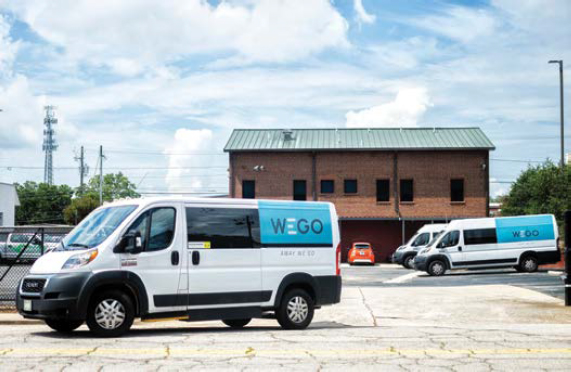
Hall Area Transit is responsible for public transportation services in Hall County, GA, including in the City of Gainesville, which has over 45,000 residents. The agency operates a countywide on-demand microtransit service, WeGo, as well as a seasonal fixed-route trolley service in the City of Gainesville.
Hall Area Transit launched WeGo in August 2020, replacing three underperforming fixed routes in the City of Gainesville. WeGo service expanded countywide in early 2021, replacing the county’s dial-a-ride service. Hall Area Transit implemented WeGo for several reasons. Stakeholders and county residents were frustrated by infrequent and limited reach of the county’s fixed-route and dial-a-ride services. With that in mind, Hall Area Transit launched WeGo to try a new way of operating to better serve county residents both inside and outside of the City of Gainesville, while not increasing operating costs.
Service Description
WeGo provides service across Hall County. Within the City of Gainesville, Hall Area Transit aims to limit wait times for customers to no more than 15 minutes, while outside the city wait times
for trips can be as high as 45 minutes. Expanding the service to the entire county helps ensure that rural residents have access to jobs, shopping, and medical facilities regardless of whether they own a vehicle. When initially launched, the service used virtual stops and requested that customers walk up to 250 feet to a pick-up location; this caused confusion with customers, and most customers preferred not to walk, so WeGo converted to provide more direct door-to-door service.
WeGo succeeds in providing a cost-effective on-demand service to its customers. However, it does so despite challenges. The service is popular; low fares make it an appealing option for travelers. However, on most weekdays, WeGo is not able to book all trip requests—on average, 30 percent of trip requests cannot be met. This difference in supply and demand is due in part to an operator shortage. WeGo is only able to operate about half of its fleet at peak times and is unable to operate service on weekends because of staffing constraints.
Many of the trips that WeGo is unable to book are requested in rural areas of Hall County. About 65 percent of WeGo trips are within the City of Gainesville, and about 35 percent are in the rural areas or between the city and the rural areas. When vehicles come online for service each day, they start in the City of Gainesville. Because of high demand there, vehicles end up remaining in the city, with trip requests from outlying areas often not able to be booked. To help address the mismatch between supply and demand, as well as the apparent higher rate of trip unavailability in rural areas, Hall Area Transit is implementing several strategies:
- Instructed some operators to drive outside the City of Gainesville before logging into the system so they are more likely to receive nearby trip requests from rural residents.
- Increased WeGo fares after 6:30 p.m. The agency did this after discovering that most people after that time were not using the service for critical trips like medical appointments and were more likely to be able to afford a higher fare.
- Looking to re-introduce fixed-route transit in the city, where there is a density of people and jobs. The goal is to create a fixed-route service to connect people between key destinations. Having data on travel patterns from the WeGo service allows them to plan the route using high-quality, real (not modeled or estimated) data on where people need and want to travel.
- Considering implementation—after the new fixed-route service is introduced—of a premium fare for WeGo trips that could be made via fixed-route service instead of WeGo to incentivize the use of fixed-route options and free up capacity to meet the demand for trips that cannot be made on a fixed route.
Technology
WeGo experiences technical problems that interrupt service at least once a month (for 15–60 minutes at a time). WeGo operators have been trained to handle these situations. In most cases, operators have been instructed to return to the locations where they dropped off passengers earlier in the day to pick them up and take them home. Hall Area Transit noted that the software company staff are responsive when WeGo operators ask for assistance.
Funding
Hall Area Transit’s funding outlook has improved as WeGo service has grown. Over time, the support for WeGo service among local elected officials has grown. Many officials have become advocates for the service, which helps ensure local funding continues.
Reception and Results
Overall, adoption of on-demand microtransit service in Hall County has been positive. The experience with WeGo service has shown the county that on-demand microtransit service is
better suited for areas that can’t be well-served by fixed-route service than for its densest areas. Because demand for WeGo is so high within the City of Gainesville, service in the rural areas of Hall County has been more limited.
City of Gainesville and Hall County leadership found value in investing time and resources into alerting the community and helping customers prepare for and adapt to the transition from dial-a-ride service to microtransit. Hall Area Transit’s leadership indicated that allowing adequate time for education and training is critical. Even though some vendors can have a new service up and running within a month, a community will need more time to prepare for this transition. This is especially true in rural areas with higher concentrations of older adults who may be less comfortable using a smartphone application.
Case Example Summary – WeGo
Hall Area Transit provides countywide microtransit services and has found great success in operating this service in both the City of Gainesville and more rural areas of Hall County. However, serving dense areas of the City of Gainesville has limited the availability of WeGo in more rural settings. The agency is experimenting with different approaches to manage demand between its two service areas to ensure that rural customers, as well as urban customers, have a high-quality service.
- The agency’s experience with high demand and subsequent pursuit of fixed-route re-implementation offers lessons learned regarding operating microtransit between rural and urban areas. WeGo began operation as a fixed-route replacement service in 2020, but conditions have changed since then, and Hall Area Transit is re-introducing fixed-route service in some areas of the City of Gainesville. Because the agency maintained its underlying structure when it implemented on-demand microtransit service, it anticipates being able to re-introduce fixed-route service relatively smoothly.
- The agency has identified a new practice for maintaining adequate service coverage in rural areas as on-demand vehicles are generally “pulled” to the core of the county. WeGo drivers have started driving into rural areas before beginning to accept trip requests, helping to ensure adequate service levels in the more rural parts of the county.
- Hall Area Transit has used, and is further exploring use of, fares to incentivize how, whether, and when people use the service. The agency implemented higher evening fares to encourage people to use the service more judiciously for evening trips, which are more likely to be for social purposes. It is also considering creating financial incentives for people to use fixed-route service when a trip can be made on that service (once it is implemented).
- Hall County found that mobile app adoption was slow and more difficult for older adults with little smartphone experience. A significant portion of WeGo’s ridership resides in rural areas and struggled to adapt to using the mobile app. Hall Area Transit invested significant resources in advertising WeGo and preparing its ridership for the new service.
Heart of Iowa Regional Transit Agency, HIRTA On Demand
Service Overview
| Service Location | Service Description | Population | Service Days and Hours | Other Services Offered | Fleet Information | Fare Information |
|---|---|---|---|---|---|---|
| Boone, Dallas, Jasper, Madison, Marion, Story, and Warren counties, IA | Seven-county zone (4,177 sq. mi.) |
365,100 (87 per sq. mi.) |
Monday-Friday, 7:00 a.m. – 5:00 p.m. (Note: Story’s and Ames’s service starts at 6:30 a.m. and service ends at 8:00 p.m. in Ames) Saturday, 7:30 a.m. – 6:00 p.m. in Ames Sunday, 8:30 a.m. – 6:00 p.m. in Ames |
Flexible route | On-Demand Fleet: 72 Total Fleet: 72 |
In town: $2.50 In county: $5.00 |
Interviewee: Julia Castillo, executive director
Background and History
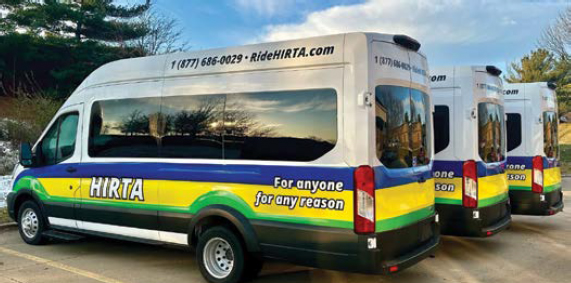
The Heart of Iowa Regional Transit Authority (HIRTA) provides transit service across seven counties surrounding the Des Moines metropolitan area, including the City of Ames, which lies 35 miles north of Des Moines and is the home of Iowa State University. HIRTA, as it exists today, is the result of the merger of seven separate third-party operators. Beginning in 2011, HIRTA started consolidating those operators and directly operating the service, one county at a time. By 2020, HIRTA directly operated demand response service in all seven counties.
In September 2022, HIRTA launched HIRTA On Demand, a microtransit service that replaced its dial-a-ride service and allows riders to book trips on demand via an app or through a call center, as before. HIRTA launched microtransit service following the closure of its software vendor and after holding focus groups with riders and learning that they wanted the flexibility of microtransit. HIRTA’s goals for its on-demand service are to provide a service the community wants; gain new riders while maintaining current ridership; provide flexibility by allowing riders to book, cancel, and pay for trips via an app while maintaining cash and ticket fares; decrease the amount of time trip schedulers are on the phone with customers; and maintain on-time performance.
Service Description
HIRTA’s service area is over 4,100 square miles, with 72 vehicles in the fleet. The service area is one large zone, with riders allowed to travel across counties. Vehicles are stored in the biggest town in each county, with the exception of two counties that store their vehicles in two towns. If one county has an influx of trips, HIRTA will move vehicles between counties. HIRTA often provides cross-county trips, primarily for life-sustaining medical treatment, which are more important than ever as rural medical providers in the service area have closed. Customers are able to book trips via HIRTA’s mobile app and call center for immediate reservations, same-day service, next-day reservations, advance reservations, or on a subscription basis.
Technology
HIRTA has had a positive experience implementing microtransit software. Its technology vendor sent representatives to central Iowa when the service launched to test it and fix any necessary functions in the software. Almost two years after launching, HIRTA still has weekly meetings with this vendor.
In one community with a high proportion of residents who do not speak English as their first language, HIRTA found that people weren’t using the microtransit service despite an apparent need for affordable transportation. The authority hired a bilingual mobility coordinator who conducted outreach and learned that people were not comfortable providing personal information on the mobile app. HIRTA started a flexible fixed-route service called Flex Connect in this community in addition to maintaining HIRTA On Demand service, to give people another option.
HIRTA is currently working on a project called Health Connector with funding from an ITS4US grant that will allow people to book medical appointments and transportation at the same time. [ITS4US Deployment Program is led by the Intelligent Transportation Systems (ITS) Joint Program Office of the U.S. Department of Transportation and is supported by the FTA, FHWA, and the Office of the Secretary of Transportation, https://www.its.dot.gov/its4us/index.htm.] The app will connect to both HIRTA On Demand and scheduling software at area hospitals that coordinates service from a variety of nonemergency medical transportation companies. HIRTA is planning to roll out the pilot in one county in August 2024 and eventually expand the program.
Funding
In implementing HIRTA On Demand, the agency knew there were available funding streams it was not eligible to apply for as a government agency. To work around this challenge, the team created the Heart of Transit, a nonprofit organization, to be able to apply for funds not previously available. The Heart of Transit receives grants from companies that do not fund government agencies, such as $200,000 per year from multiple local United Ways, and uses it to fund services in a way consistent with the terms of the grant. The agency has also received funding from casinos, the American Association of Retired Persons (AARP), and community foundation grants to offer service. HIRTA was able to use AARP funds for benches and bus stop signage for the flex route service. In addition to its nonprofit, HIRTA uses federal, state, and local funding to finance its service.
HIRTA On Demand is more expensive for HIRTA to operate than the previous demand response service. The agency is considering raising fares for on-demand trips or reducing the fare on trips scheduled ahead of time to make the service more efficient and cost-effective.
Reception and Results
HIRTA has received positive feedback from the community. The agency has attracted new transit riders while providing better service to original customers who appreciate the increased flexibility offered by on-demand service. Feedback from drivers and staff was not as positive as public feedback because it completely changed how they do their jobs, but this challenge has been alleviated over time.
HIRTA has monitored key metrics and hired more drivers in some areas due to increased demand to maintain short wait times and high on-time performance. HIRTA has not experienced a driver shortage; before the nationwide driver shortage, it had already been changing its hiring practices to make employment at HIRTA more attractive to jobseekers. HIRTA has implemented a practice of carefully reviewing background checks and, in some cases, hiring formerly incarcerated people as drivers. The authority also made the application process easier and more straightforward to ensure that potential candidates can figure out how to apply.
Case Example Summary – HIRTA On Demand
HIRTA has introduced microtransit across seven counties and has overall successfully met demand with a large fleet of vehicles and at least one vehicle hub in each county. However, because the service is more expensive than the demand response service it previously operated, HIRTA is considering raising fares for on-demand trips.
- HIRTA succeeded in replacing dial-a-ride service with on-demand service across a large geography, possibly due to its large fleet size. The service has been positively received by the community. It is especially important in the face of some rural medical clinic closures. HIRTA maintains a call center, allowing for riders to call to book their service and book service further in advance than the app allows.
- HIRTA has identified strategies to pursue more diverse funding sources. By creating a nonprofit, HIRTA is able to receive funds unavailable to government agencies and to support activities outside the scope of some government transportation programs and funding sources.
- If the agency were to repeat implementation of on-demand service across the entire service area, HIRTA would “start small” and implement it incrementally. HIRTA’s leadership indicated a belief that launching service in one county at a time would have allowed it to make adjustments before expanding. That strategy would have reduced the magnitude of the challenges faced during implementation.
- HIRTA’s Health Connector project, which will enable people to book medical appointments and transportation services at the same time, has potential to be a proof-of-concept that could support more widespread integration of medical scheduling and transportation services. HIRTA believes this increased convenience could reduce the number of people who miss medical trips due to lack of reliable transportation.
North Central Regional Transit District, MyBlue
Service Overview
| Service Location | Service Description | Population | Service Days and Hours | Other Services Offered | Fleet Information | Fare Information |
|---|---|---|---|---|---|---|
| Taos and Española, NM | Three zones: Taos Zone: within a 2-mile radius along major arterial in town (approx. 43 sq. mi.) Española Zone: within 15-mile radius of the city center (approx. 652 sq. mi.) Pojaque/Nambé Zone (within Española Zone): Nambé and Pojaque pueblos, and Pojaque Valley Schools Jacona Campus (approx. 26 sq. mi.) |
2,050 (48 per sq. mi.); 43,550 (67 per sq. mi.); 3,240 (125 per sq. mi.) |
Monday–Friday, 6:00 a.m.–6:00 p.m. | Fixed-route bus, deviated fixed-route service | On-Demand Fleet: 10 Total Fleet: 75 |
Flat fare; $1.00 for all zones except Pojaque/Nambé (which is no charge) |
Interviewee: Bryce Gibson, planning and projects manager
Background and History
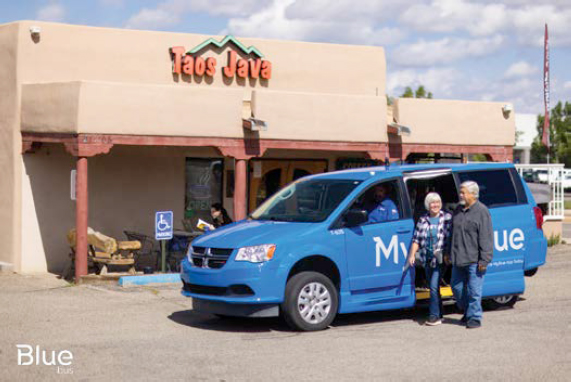
The North Central Regional Transit District (NCRTD) operates public transit service in north central New Mexico, including Los Alamos, Rio Arriba, Santa Fe, and Taos counties. In addition to operating fixed-route bus and deviated fixed-route bus service, NCRTD operates MyBlue, a microtransit service in Taos and Española that offers an app-based booking option. During the COVID-19 pandemic, NCRTD suspended or decreased the level of service on many of its fixed-route services, and some of these changes remain in place due to ongoing staffing shortages.
NCRTD first launched MyBlue in December 2022, replacing the existing paratransit/dial-a-ride service. Initial recommendations for MyBlue were developed as part of NCRTD’s long-range
planning and were based on extensive community outreach. NCRTD implemented MyBlue for several reasons. Internally, NCRTD wanted to improve operational efficiency and decrease the workload on dispatchers. For customers, NCRTD wanted to provide additional flexibility and the ability to make more spontaneous trips.
Service Description
NCRTD operates MyBlue service in three zones in its service area. Customers can book trips via the MyBlue mobile app or through a call center. Trips must be booked via the mobile app or call center at least 24 hours in advance but can be booked up to two weeks in advance. NCRTD also allows customers to book trips on a subscription basis, which can recur indefinitely. NCRTD plans to allow for same-day reservations as the service expands. MyBlue is fully co-mingled with NCRTD’s paratransit service, and paratransit customers requesting trips are prioritized to ensure that their needs are met.
Technology
NCRTD launched the MyBlue mobile app first as a pilot, limiting access to the app to a small percentage of customers and beta testers. While the backend software was fully implemented in 2022, most MyBlue customers did not have access to the MyBlue mobile app until early 2024. This soft launch of the app helped ensure any issues were worked out in advance of full implementation and helped NCRTD manage demand for the service. Operating capacity was limited due to an operator shortage when NCRTD launched MyBlue service, and the agency did not want to open the mobile app to all customers without having the capacity to meet all demand.
While NCRTD’s experience implementing the new software has been positive overall, challenges have arisen, and the agency found that it is vital to lay out expectations with vendors from the start. While NCRTD and its vendor have a contract in place, the agency has had to maintain active communication with the vendor to ensure that the contract terms are met. For example, NCRTD requires that its vendor produce reports to be used for federal, state, and local reporting requirements, such as annual reports for the National Transit Database. While the vendor agreed to these requirements, it took time and coordination to build out the reports.
Funding
NCRTD’s transit service is funded through a mix of federal, state, local, and directly generated funds.
Results and Reception
Implementing microtransit service with advanced, app-based booking was a major investment for NCRTD and changed how the agency operates its service. This has resulted in improved operational efficiencies, but not as great as initially anticipated. Often MyBlue carries one passenger per trip rather than having a large proportion of aggregated (or grouped) trips. NCRTD attributes the lower-than-hoped efficiency improvements to the large service area and nature of the service operating in a rural, low-density setting. The zones in which MyBlue operates cover large geographies, and it is difficult to group trips without making each rider’s trip excessively long. To provide a better customer experience, MyBlue has configured its software to limit how long a trip can take, thereby forgoing some operating efficiencies.
However, the implementation of software allowing app-based booking has ensured that NCRTD operates service in a “better and safer way.” Because the software automates the scheduling and dispatching of trips, dispatchers at NCRTD have found that they do not have the same flexibility to squeeze in a trip as well as they could with the previous dial-a-ride service. For example, the software does a better job of accounting for the time needed for customers to board and alight a vehicle. This can result in fewer trips, but these trips are made in a safer way.
Additionally, while NCRTD has found that its new software makes trips that are as efficient as possible, this sometimes means that operators may have uneven workloads. The algorithm will schedule trips based on where vehicles are located within a zone as well as the origin and destinations of trip requests. This system can result in one operator within a zone having a full manifest and another having a relatively light load. NCRTD has found this to be an issue especially during peak commuting times.
Since the launch, ridership has steadily increased on MyBlue, and the reception has been largely positive. Engaging with and educating the public about the new service has been vital for its success. NCRTD implemented MyBlue to provide a new, more flexible service to its dial-a-ride and paratransit customers, so it was important that those customers feel comfortable with the new system. NCRTD staff focused on one-on-one engagement, meeting customers at bus stops, on fixed-route services, and at key transfer points. The agency also developed step-by-step guides for downloading and using the app to provide a resource for customers. Additionally, while NCRTD invested resources in the mobile app and backend software, it was also cognizant that not all customers own a smartphone or use a bank account. As a result, like most agencies, NCRTD still allows customers to pay for trips in cash and book them over the phone. However, customers can get a discount if they pay for trips through the mobile app.
Case Example Summary – NCRTD MyBlue
- A slow launch in a smaller geographic area was a beneficial strategy for NCRTD. NCRTD launched a small beta test of the mobile app before making it available to the public. This allowed NCRTD to work out any issues before sharing it broadly. It also helped NCRTD manage demand.
- While NCRTD has realized efficiencies from implementing on-demand service, they were not as expansive as hoped. MyBlue has enhanced operational efficiencies among NCRTD staff; however, these efficiencies have not been as great as initially projected. The agency found a lower-than-desired rate of trip aggregation and found that software could not overcome the efficiency challenges associated with operating across a large and low-density service area. The service still requires pre-booking as well.
- NCRTD continues to evaluate what transit service type makes sense for different parts of its service area. The agency has found that, for customers who need to make longer trips, microtransit is operating well as a feeder service to connect them to longer-distance fixed-route services. In NCRTD’s case, microtransit appears to be an appropriate replacement for fixed-route service in some locations and is enabling the agency to focus on fixed-route services primarily along key corridors.
PICK Transportation
Service Overview
| Service Locations | Service Description | Population | Service Hours and Days | Other Services Offered | Fleet Information | Fare Information |
|---|---|---|---|---|---|---|
| Cities of: Bartlesville, Catoosa, Claremore, Coweta, Grove, Kiefer, Miami, Owasso, Ponca City, Poteau, Prior, Sallisaw, Sapulpa, Skiatook, Tahlequah, and Vinita, OK | 19 zones (ranging from ~15 sq. mi. to ~45 sq. mi.) in 16 jurisdictions | Population ranges per zone from 3,800–40,000; Population density ranges per zone from 226–1,546 people per sq. mi. |
Monday– Thursday, 5:00 p.m.–9:00 p.m. Friday, 5:00 p.m.–10:00 p.m. Saturday, 10:00 a.m.–2:00 p.m. |
Daytime service varies by agency, mostly demand response | On-Demand Fleet: 44 Total Fleet: varies by agency |
Flat rate, cash or card; $3.00 |
Interviewees: Laura A. Corff, transit director, United Community Action Program, Inc.; Patricia Dinoa Vilches, principal transportation planner, Indian Nations Council of Governments; Kendra McGeady, director of transit, Pelivan Transit
Background and History
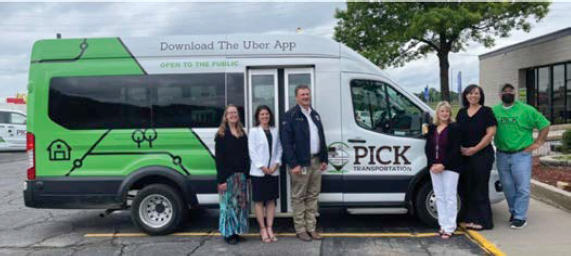
PICK Transportation is a consortium of three rural public transit providers (Pelivan Transit, Cimarron Public Transit System, and KI BOIS Area Transit System) and nine tribal nations in eastern Oklahoma, serving rural communities in Bartlesville, Catoosa, Claremore, Coweta, Grove, Kiefer, Miami, Owasso, Ponca City, Poteau, Prior, Sallisaw, Sapulpa, Skiatook, Talequah, and Vinita cities. (The nine tribal nations included in the consortium are part of the Northeast Oklahoma Tribal Transit Consortium, which consists of the Eastern Shawnee, Miami, Modoc, Ottawa, Peoria, Quapaw, Seneca-Cayuga, Shawnee, and Wyandotte.) The consortium operates on-demand microtransit service in designated zones within each community on weeknights and during the day on Saturdays. Service operates within each zone and generally does not allow travel between zones.
In 2020, the Grand Gateway Economic Development Association was awarded an FTA Integrated Mobility Innovation grant for $1.5 million to develop PICK Transportation. The three transit providers heard feedback from riders about a desire for evening and weekend service, so PICK Transportation was formed to provide after-hours on-demand microtransit service. PICK Transportation service officially launched in June 2021 and continued as a pilot for two years. Following the completion of the pilot program funded through the FTA Integrated Mobility Innovation grant, PICK has continued operations through a partnership with the Oklahoma Department of Transportation.
Service Description
PICK Transportation provides service across eastern Oklahoma, operating in 19 geofenced zones in 16 communities on weekday evenings and mid-day on Saturdays. All service is booked on an on-demand basis (i.e., there is no pre-booking option) and can be booked by phone, a mobile app, or website. While the three providers who created PICK each operate their own systems and call centers, the call center function for the PICK service is consolidated within a single agency.
All members of the consortium manage PICK Transportation service within their own designated communities using vehicles they already own to provide daytime service. While most daytime services operate countywide, PICK Transportation offers travel within its zones, with one exception: PICK Transportation is piloting inter-zone travel between Skiatook and Owasso due to both financial and operational capacity constraints.
Technology
All three agencies that partnered to create PICK felt it was important that the technology vendor be the right fit for the needs of the service. PICK Transportation partnered with one vendor as part of its pilot program funded through the IMI grant. Following the initial pilot period, after the IMI grant funding was expended, PICK Transportation underwent a formal RFP process to procure a technology vendor to continue to support the service. This RFP process enabled the partners to refine and articulate their requirements based on direct experience.
The consortium learned early on that a straightforward and easy-to-use mobile app is vital for customers to adopt the new technology. Booking through the mobile app has increased from about 25 percent when PICK Transportation first launched to over 50 percent in March 2024. Another important feature of the mobile app is that it still allows cash payments, the method used for about half of PICK trips.
Funding
PICK Transportation is currently funded through 5311 federal formula funds with match funding from Oklahoma DOT. While the IMI grant provided a steady source of funding during the initial pilot period for PICK Transportation, it was vital that the consortium obtain a sustainable source of funding for continued operations. The sustainability of the service’s funding is a concern for PICK, especially as it is faced with challenges associated with rising operating and capital costs. PICK Transportation’s leaders have shared data with local economic development agencies regarding the employment trips the service is providing, as well as the broader transportation need in the community that its service is meeting. As a result, several communities have each contributed $5,000 to fund the service.
Partnerships
PICK Transportation is unique in that it operates as a consortium of multiple public transportation operators coming together to provide service in their communities that is supplemental and operated differently from their weekday daytime service. Building and maintaining a strong partnership has been vital to success. The sustained commitment among the consortium membership has enabled ongoing operations. The funding partnership with Oklahoma DOT also has been critical to maintaining the service.
To help the consortium operate as a cohesive brand and manage the day-to-day challenges of both daytime and evening/Saturday service, the members developed and implemented
memorandums of understanding (MOUs) and standard operating procedures (SOPs) to ensure each partner has a clear role and every partner is operating in the same manner. The MOUs make clear and formalize each member’s role and responsibilities as a consortium member, while the SOP formalizes operating practices across PICK Transportation.
Results and Reception
PICK Transportation fills a gap in service on evenings and Saturdays; customer requests for service during these time periods were the impetus for offering the service. Operationally, separating daytime and evening service can be a challenge for the partner agencies. To be successful, the members of PICK Transportation have needed to become comfortable wearing multiple hats and managing two separate services. For example, the agencies all operate their own call centers during the day, but there is a designated call center for PICK Transportation located at Pelivan Transit. PICK Transportation has one dedicated dispatcher who dispatches the entire system. While the call centers for the daytime services may refer customers to PICK for evening services, they are not cross trained on the software and cannot book after-hour trips for customers. Likewise, the PICK dispatcher does not book services for the daytime agencies.
In the future, PICK Transportation hopes to expand to offer countywide service as funding is available to do so. While the service receives requests to offer service to local casinos, this is not possible given current funding constraints.
Case Example Summary – PICK Transportation
PICK fills a gap in public transit service across numerous rural communities in the state. By creating PICK through a consortium, the partners can leverage resources and provide service that, on their own, each would not be able to afford. The primary challenge is that the agencies are all operating two separate systems and must manage a partnership in addition to regular service operations. There are benefits and drawbacks to this approach.
- PICK Transportation is a service that is targeted in its scope and purpose. By focusing on local circulation and the specific hours when there was a gap in existing service, the service has been clear about its targeted role as one service in a broader group of services available across the communities it serves. Offering service in smaller zones with a limited number of vehicles increases the efficiency of the service on a per-trip basis but has the limitation of not being able to offer long-distance trips.
- PICK is a demonstration of what is possible when agencies partner, and it would not have been possible to establish the consortium absent a sustained commitment among all the members. PICK Transportation exists today because of the partnership the consortium members created and sustained, as well as financial support from the state. While on their own the consortium members may not have had the capacity (or been able to get funding) to expand service hours and implement on-demand microtransit service, they are able to do so as a team.
- The ability to generate support from a variety of sources has been critical to the service’s success. Generating support for the on-demand microtransit service at all levels, including operators, transit agency leadership, local political
- officials, and the state department of transportation, has been necessary for PICK Transportation’s success. Having support and a willingness among stakeholders to invest both time and money into PICK ensured the service could continue after the initial pilot period. In addition, PICK shared data regarding the benefits of the service to the community, such as providing employment trips. Through that effort, the service was able to obtain additional funding from local economic development agencies.
- Establishing clear roles was critical for the success of the agencies’ collaborative effort. PICK Transportation’s members wear many hats and have to be comfortable shifting between operating independent daytime service and coordinated evening and Saturday service.


