SUMMARY
Microtransit Solutions in Rural Communities: On-Demand Alternatives to Dial-a-Ride Services and Unproductive Coverage Routes
Overview
Historically, rural public transportation providers have offered dial-a-ride service in areas where fixed-route or deviated fixed-route service is not suitable. Dial-a-ride service typically requires advanced booking by phone and, as trips can be relatively long in distance in rural areas, can often serve no more than two to three passenger trips per vehicle revenue hour.
In the past decade, new technologies have become available that offer passengers the ability to book and pay for trips using a mobile application. These technologies are designed to facilitate spontaneous travel and offer passengers real-time information about their vehicle’s location and their expected wait time. These technologies offer the ability to dynamically generate routes based on real-time trip requests rather than on vehicles operating according to routes designed, sometimes manually, using a set of pre-identified origins and destinations, as they are in dial-a-ride service. Public transportation service provided using these new technologies is typically termed “on-demand transit” or “microtransit.”
This synthesis study explores the question that these developments have increasingly led rural public transit providers to ask: Can on-demand microtransit service work in a rural context, particularly in settings that are truly low-density?
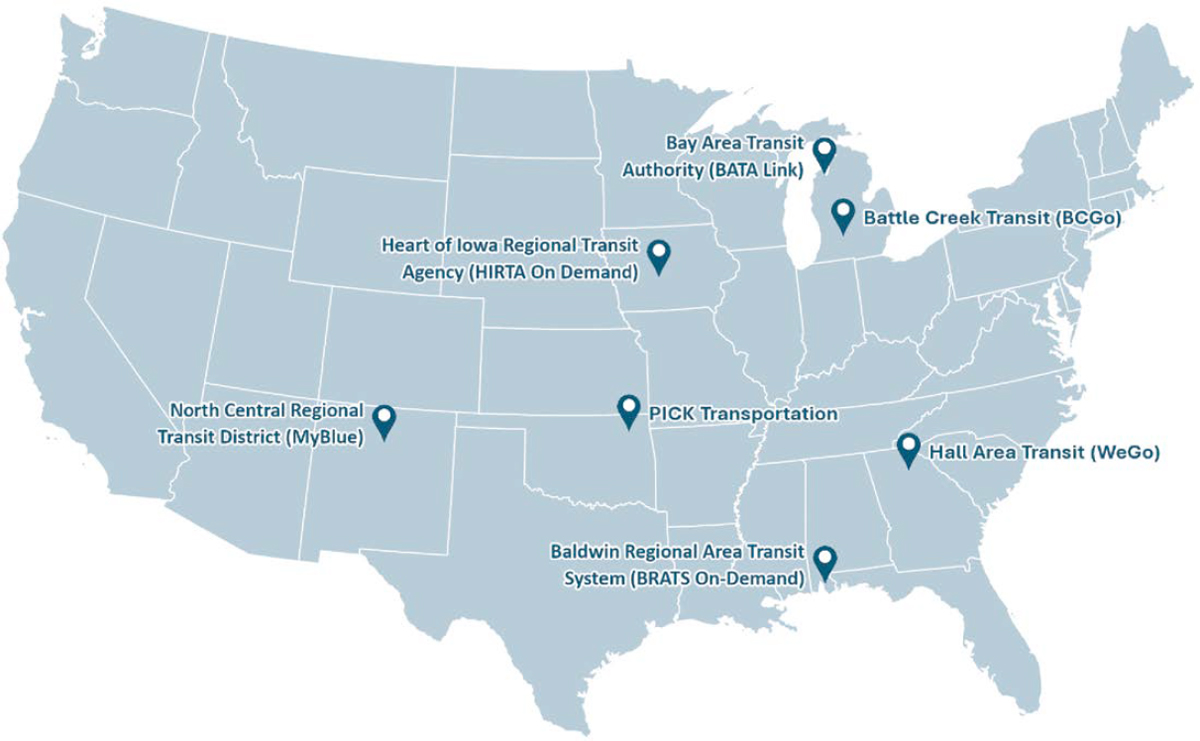
Through a literature review (Chapter 2), a survey of 19 providers (13 that are U.S.-based) of rural microtransit service (Chapter 3), and interviews with seven rural transit providers (Chapter 4), whose locations are shown in Figure S-1, this synthesis explores this fundamental question. The project focused on rural providers operating service at least partially, if not fully, outside of a U.S. Census–defined urbanized area (using the urbanized area boundaries based on the 2020 decennial census).
Key Findings
The project led to the following key findings:
- All agencies surveyed and interviewed reported that rural microtransit customers greatly appreciate the ability to travel spontaneously or on shorter notice and book trips via mobile app (for those who take advantage of that option) and say these features enhance their quality of life.
- Nearly all agencies have found that demand for their service exceeds their supply—often to a greater extent than the services that microtransit was designed to replace or supplement.
- As a result, several agencies are exploring implementing or re-implementing other transit service types to meet the travel needs of more customers in their communities and to decrease the unmet demand for their microtransit services.
- Most agencies that have tried to implement truly on-demand microtransit service across large service areas, and particularly those doing so with relatively fewer resources, have transitioned back to requiring pre-booking due to overwhelming demand.
- The challenge of not being able to meet high levels of demand when serving large geographies indicates that there is an important trade-off to consider when balancing level of service and extent of coverage.
- Most agencies providing rural microtransit still enable subscription trips even if they do not have formal policies that prioritize certain customer or trip types.
- Some agencies have implemented or are exploring customized strategies to manage demand that range from fare adjustments to “releasing” capacity incrementally to specialized operating strategies to increased service availability in rural areas.
- Creating partnerships for small and rural agencies to implement microtransit is a time-intensive practice that has produced significant benefits in some cases, while it has been challenging in others.
- Some case example agencies said they had achieved operational efficiencies, particularly in their internal operations, by implementing new software with app-based booking and dynamic routing capabilities.
- Adoption of app-based booking is not always above 50 percent; adoption requires a population that is receptive to using it combined with hands-on training to help convince hesitant users to try it.
- Distance-based and higher fares are common for rural microtransit providers, particularly those operating countywide or across a larger service area. Complaints about fares are not common.
- With a couple exceptions, most agencies offer service that ends between 4:30 and 7:00 p.m. and that operates only Monday through Friday.
- Zone sizes vary considerably, from under 50 square miles to over 4,000.
- Agencies have taken different approaches to combining or co-mingling their microtransit and paratransit services, with some maintaining a separate paratransit service. Some have seen organic shifts of customers, including ADA customers, from paratransit to microtransit.
- Several agencies said a “slow launch” was an effective strategy, and other agencies said that they wished they had implemented service on a more incremental basis.
- Proactive and ongoing engagement with employees was a strategy that benefited multiple agencies in implementation.
- Federal and state grant programs for microtransit services in rural areas made implementation of services possible for several of the case example agencies.
Future Research
A key finding from this synthesis is that few rural microtransit providers have identified or implemented innovative or complex ways to quantify the benefits of rural microtransit as they related to better economic or societal outcomes. Therefore, this remains an area of practice that could be further explored, given providers’ widespread belief that rural microtransit has highly positive impacts in their communities.


