Thriving on Our Changing Planet: A Midterm Assessment of Progress Toward Implementation of the Decadal Survey (2024)
Chapter: 5 Looking Ahead: Preparing for the Next Decadal Review
5
Looking Ahead: Preparing for the Next Decadal Review
The statement of task for this midterm assessment (reprinted in Appendix A) tasked the committee to recommend any actions that the National Aeronautics and Space Administration (NASA), the National Oceanic and Atmospheric Administration (NOAA), and the U.S. Geological Survey (USGS) should undertake to prepare for the next decadal survey, including information, observables, pathfinders, or technology, and recommend actions that NASA might take to improve the vitality and diversity of NASA scientists and engineers. The committee’s research and deliberations resulted in findings and recommendations for the following categories of actions which should be undertaken prior to the next decadal survey:
- Improve diversity, equity, and inclusion efforts at NASA’s Earth Science Division (ESD).
- Engage a broader constituency representing science and applied science users.
- Develop a framework for continuity.
- Actively engage with the Earth system modeling community.
- Leverage artificial intelligence (AI) and machine learning (ML) technologies to accelerate scientific research and data-driven decision-making.
IMPROVE DIVERSITY, EQUITY, INCLUSION, AND ACCESSIBILITY EFFORTS AT THE NASA EARTH SCIENCE DIVISION TO ENHANCE VITALITY OF THE WORKFORCE
In recent years, NASA commissioned two key reports to examine its efforts toward enhancing workforce vitality and diversity, which were published nearly simultaneously in 2022 (see Figure 5-1). These reports indicate the progress and challenges that NASA has faced in implementing diversity, equity, inclusion, and accessibility (DEIA) objectives for its current workforce, mission science teams, educational partners, and other partnering institutions. Given the expertise of the participants in these two recent reports, this panel finds it appropriate to rely on the expertise of those committees by reiterating relevant highlights of their findings here (see Box 5-1), while also highlighting the connected outcomes of those reports’ findings to the new findings of this report.
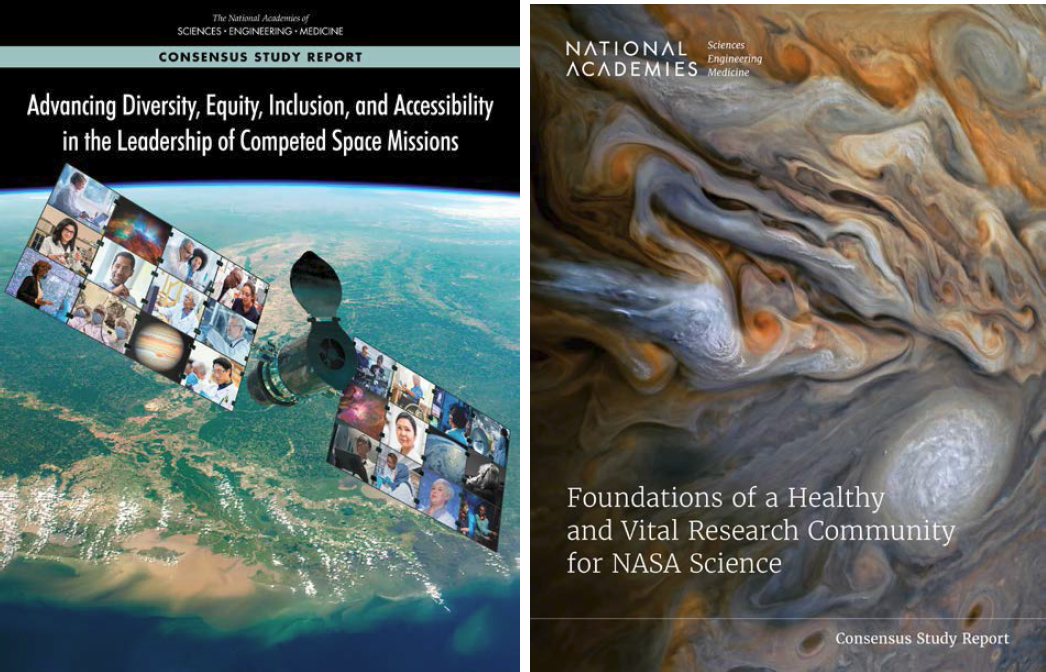
SOURCES: Left: NASEM (2022a). Right: NASEM (2022c).
Finding: Recent National Academies of Sciences, Engineering, and Medicine reports Advancing Diversity, Equity, Inclusion, and Accessibility in the Leadership of Competed Space Missions (NASEM 2022a) and Foundations of a Healthy and Vital Research Community for NASA Science (NASEM 2022c) found that NASA ESD has made substantial effort, yet shown limited progress, in enhancing workforce vitality and diversity, even relative to other divisions.
Recommendation: NASA’s Earth Science Division (ESD) should better coordinate systematic diversity, equity, inclusion, and accessibility plans across all of its program elements, to provide holistic end-to-end support for underrepresented groups in Earth system science and to ensure routine formal review. These plans should be supported by NASA’s ESD with appropriate and sustainable budget allocations and include ongoing opportunities for training, principal investigator development, mission engagement at all career and leadership levels, and sharing best practices.
BOX 5-1
KEY FINDINGS ON PROGRESS TOWARD WORKFORCE VITALITY
Key findings from the National Academies of Sciences, Engineering, and Medicine reports Advancing Diversity, Equity, Inclusion, and Accessibility in the Leadership of Competed Space Missions (2022a) and Foundations of a Healthy and Vital Research Community for NASA Science (2022c) relevant to NASA that are relevant to workforce vitality are as follows:
- NASA has a strong focus on diversity, equity, inclusion, and accessibility in particular areas but lacks consistent and coordinated processes and data collection (beyond demographics) to track progress, especially around race, ethnicity, and disability.
- There is little progress in racial and ethnic diversity across any of the divisions. Lack of data availability makes assessing progress in competed missions difficult to track.
- Although NASA has strong outreach programs at earlier education levels, NASA programs do not target diversity beyond graduate school (and to some extent postdocs), which is in contrast to other federal agencies that have programs geared at early- and midcareer scientists. NASA also lacks coordinated efforts to entrain and train new potential investigators into the mission science process.
- NASA’s Earth Science Division lags other divisions in gender diversity of membership on competed science teams. NASA Planetary Science has made substantially more progress relative to other divisions in terms of gender balance of mission principal investigators.
In addition to impacting progress on decadal survey science, applications, and programmatic balance as noted throughout this report, the infrequency of competed mission and instrument opportunities also impacts NASA ESD’s ability to make and demonstrate progress on its DEIA goals. For many scientists, smaller, cost-capped missions such as the Earth Venture and Earth System Explorer offer an opportunity to gain experience, training, and hands-on mentorship, and open competition extends these benefits to scientists at a wide range of institutions. Recent mission solicitations, including the Earth System Explorer call, required a diversity and inclusion plan, which is a positive step in ensuring intentional team building, and have experimented with dual-anonymous peer review. The decreasing cadence of Earth Venture and Earth System Explorer competitive solicitations makes it more difficult for scientists to demonstrate their potential and to take on leadership roles in the future, and for NASA ESD to demonstrate progress on DEIA objectives.
Finding: The lack of competed mission opportunities, including the reduced cadence of Earth Venture solicitations and the delay and reduction in number of Earth System Explorer calls, has limited opportunities to achieve or demonstrate progress on workforce development goals and DEIA objectives.
ENGAGE A BROADER CONSTITUENCY
As described in Chapter 2, the demand for Earth observations has grown in response to the near-term challenges of climate adaptation and mitigation. Recent organizational changes at NASA have prioritized actionable, accessible information and direct engagement with a variety of stakeholders across public, private, and philanthropic sectors. Ensuring that future satellite missions continue to support these needs in a balanced way will be critical for planning and structuring the next decadal survey. Typically, NASA has received input from scientists with a very high level of technical understanding that has helped to define
requirements of needed observations. This type of input will hopefully continue, ensuring that disciplines across the Earth sciences are fully represented. However, the process will need to evolve to also incorporate feedback from end users and decision makers who bring a wealth of information about the needs of their constituencies, but less experience with mission requirements and planning.
Finding: The increased availability and variety of Earth observations has resulted in an exponential growth of their use to advance science and applications, support operational decisions, and address a broad myriad of societal needs.
Recommendation: Prior to the next decadal review, NASA, the National Oceanic and Atmospheric Administration, and the U.S. Geological Survey should engage a broader Earth sciences constituency by
- Identifying Earth observation stakeholders, improving understanding of their short- and long-term needs, and encouraging participation of the community of stakeholders in the next decadal survey. These stakeholder groups should include both the scientific community and communities impacted by climate change, including historically marginalized and underrepresented groups that are often disproportionately impacted.
- Sponsoring workshops to engage the entire Earth system community to better address observational needs for interdisciplinary and crosscutting issues. The workshops should
- Gather input on priorities,
- Communicate expected program resource constraints to help set expectations,
- Sensitize participants to the need for working within a holistic Earth system science rather than disciplinary framework when considering implementation options,
- Support development of brief reports outlining community progress and expressing observation needs at discipline and crosscutting topic area levels (e.g., sea level, modeling), and
- Ensure systematic representation of interdisciplinary topics to ensure they do not fall through the gaps in community organization.
DEVELOP A FRAMEWORK FOR DETERMINING THE BALANCE BETWEEN INVESTMENTS IN CONTINUITY AND DISCOVERY
Remote sensing plays a critical role in observations of Earth’s atmosphere, surface, and extraterrestrial forcings. Despite rapid changes in climate and life on Earth, and expectations that more comprehensive, detailed, and sustained observations will be required to thrive on our changing planet (as noted in the decadal survey), the United States still lacks a strategic framework for ensuring the continuity of key Earth observations beyond specific mission lines such as LandSat and Gravity Recovery and Climate Experiment (GRACE), which have developed large user communities that demand continuity for societal and economic benefit. As space-based Earth observations are increasingly used in applications that impact daily life, the number of stakeholders relying on remote sensing data, and the types of data they rely on, have grown significantly. Without accompanying resources, however, providing continuity for in-demand observations comes at the expense of other (also important) priorities for new measurements, research, and innovation.
Recognizing the societal and economic importance of ensuring the continued availability of space-based observations in support of essential services, Europe has taken the lead by establishing the Copernicus program and its associated Sentinel satellites to ensure long-term continuity of key services. The United States does not currently have a mechanism or funding to ensure long-term continuity beyond weather and land-imaging observation needs.
The decadal survey recommended that NASA ESD “lead development of a more formal continuity decision process to determine which satellite measurements have the highest priority for continuation” (NASEM 2018). However, that decision process has not been implemented to date. As stated by a recent Keck Institute for Space Studies (KISS) report (KISS Community 2024), “the United States lacks an overarching, systematic plan or framework to identify, prioritize, fund, and implement sustained space-based Earth observations to meet the nation’s full ranges of needs, government policy, and societal support.” Three recent reports suggest1 the creation of a “framework” for determining which Earth measurements should be made continuously.
To date, there has also been insufficient consideration of alternative means of obtaining information that might otherwise require continuing observations. For instance, modeling might play an important role in extending the information provided by retired missions in gaps prior to the launch of new “continuity” missions. This already occurs on an ad hoc basis, for instance, delays in the launch of GRACE Follow-on resulted in a gap of approximately 1 year. Model-based sensitivity experiments can play a role in evaluating the implications of gaps of varying length and can also provide information as to the importance of overlap between missions.
Finding: Despite the decadal survey’s recommendation that NASA ESD lead development of a more formal continuity decision process, current ESD decisions with regard to observation continuity remain ad hoc and do not generally communicate what future observations will be prioritized or how budgets need to expand in order to accommodate new and sustained observations.
There is an urgent need to follow Recommendation 4.6 from the decadal survey, including its call to “ensure that no flight program element is compromised by overruns in any other element” and “lead development of a more formal continuity decision process (as in NASEM 2015) to determine which satellite measurements have the highest priority for continuation, then work with U.S. and international partners to develop an international strategy for obtaining and sharing those measurements” (NASEM 2018, p. 195).
Proceeding in a manner that is contrary to this recommendation with respect to continuity has created unrealistic expectations in the science community and leaves NASA ESD without an effective mechanism to deal with future requests for adding or expanding monitoring programs such as Landsat Next, in the absence of budget increases to support the increased scope.
NASA may be able to better leverage existing resources by relying more on NOAA and other federal agencies (e.g., USGS, Department of Defense) and international partner measurements by promoting the continuity of measurements to address Earth science goals identified by the decadal survey rather than the continuity of specific missions or instruments. As an example, measurement continuity was achieved through NASA and NOAA partnership in the transition of highly impactful measurements from MODIS and AIRS (launched in 2002, with an early afternoon overpass) at NASA to the Visible/Infrared Imager Radiometer Suite (VIIRS) and Cross-track Infrared Sounder (CrlS) measurements (launched in 2011, 2017, and 2022) at NOAA. This continuity did, however, come with compromise as even here the NOAA satellites do not provide VIIRS measurements with a morning overpass as a continuity of the NASA MODIS measurements (launched in 1999), leading to the inadequate diurnal sampling which is a real concern to the U.S. and international science and applications community. Detailed budget and potential national interest concerns are beyond the scope of this committee.
___________________
1 See KISS (2024), NSTC (2023), and NASEM (2018) for an example of a quantitative framework.
ACTIVELY ENGAGE WITH THE EARTH SYSTEM MODELING COMMUNITIES
With the current emphasis on developing strategies to enable adaptation to climate change, there is a need to improve the quality of Earth system prediction on a variety of timescales ranging from hours to centuries, to improve the spatial scale of information provided, and to more robustly characterize uncertainties. These improvements should focus on atmospheric and oceanic models as well as models of land surface dynamics (e.g., permafrost, soil moisture, carbon cycle) and the response of weather and climate to volcanic eruptions. For example, digital twin concepts, including the European Union–sponsored DestinE (see Figure 5-2), seek to (1) develop high-quality, high-resolution digital replicas of components of the Earth system, (2) improve the computational efficiency of forecast models to support higher-resolution predictions, and (3) expand use of AI/ML techniques to support spatial downscaling and assessment of different scenarios that support decision-making. Earth observations play a critical role in such efforts and are needed to improve process representation in models and efforts to downscale information to finer spatial scales. Earth observing system design studies can also benefit from quantitative input and design partnership from modeling centers.
In order to advance these efforts, interdisciplinary engagement from the Earth system modeling community is needed as is engagement of scientists working on weather and air quality prediction, subseasonal to interannual prediction, and decadal- to century-scale projection, which are often separated in different laboratories developing different modeling tools. It would also be valuable for the next decadal survey to engage with existing organizations, including the U.S. Global Change Research Program’s (USGCRP’s) Interagency Group on Integrative Modeling, and coordinate through events like the U.S. Climate Modeling Summit to work toward alignment of modeling and observing priorities.
Finding: Engagement of the Earth system modeling communities is needed to ensure that future satellite missions enable improvements in prediction across the range of time and space scales that are influenced by climate-related and natural hazards.
The committee recognizes that many Earth system modelers have been involved in the two previous decadal surveys. However, it has not been clear how priority observables will be used to address critical issues in model performance and predictive skill.2 It is also critical to seek input that is free of traditional discipline silos because understanding and prediction of many of the feedback mechanisms of greatest concern require a combination of variables that have historically been considered by different decadal survey panels with limited coordination.
Recommendation: Through requests for information and workshops, NASA, the National Oceanic and Atmospheric Administration, and the U.S. Geological Survey should more actively engage the Earth system modeling community to devise strategies to more fully exploit existing and potential Earth observations for advancing model parameterizations and predictions.
___________________
2 Perhaps the best known of these are model deficiencies in prediction of precipitation as it will respond to a warming climate (ref. related to AMIP 6 comparisons having greater variability in predicted precipitation over land than AMIP5) with key practical consequences for instance for water supply, food production, flooding, and many other societal impacts. Progress in improving model precipitation prediction, aside from the side benefits of improved computing and hence improved model spatial resolution, has been slow and there remain open questions as to how satellite observations can best contribute to improved model predictions. A recent GEWEX workshop (ref. GEWEX Quarterly, Vol. 33, No. 2. 2023), for instance, concluded that subseasonal to seasonal predictions were not utilizing nearly enough global satellite observations to constrain parameterizations that were critical and verifiable at these timescales.

SOURCE: From P. Voosen, 2020, “Europe Builds ‘Digital Twin’ of Earth to Hone Climate Forecasts,” Science 370:16–17, https://doi.org/10.1126/science.370.6512.16. Reprinted with permission from AAAS.
DEVELOP AND IMPLEMENT ARTIFICIAL INTELLIGENCE AND MACHINE LEARNING TECHNOLOGIES TO ACCELERATE SCIENTIFIC RESEARCH AND DATA-DRIVEN DECISIONS FROM SATELLITE OBSERVATIONS
NASA is well positioned to accelerate scientific research (including AI/ML innovation) and data-driven decision support by leveraging the expanding wealth of high-quality satellite data and the rapidly evolving AI/ML landscape. Enhanced data utility will be achieved by, for example,
- Enhancing accessibility to satellite data through standardized data curation mechanisms and data processing pipelines that can be readily used to prototype, evaluate, and deploy AI/ML models;
- Developing new methods (e.g., AI/ML) for autonomous extraction of information about variables (e.g., temperature), processes (e.g., clouds versus radiation), and phenomena (e.g., severe storms) from past and new satellite data;
- Developing real-time data analysis systems to facilitate exploratory study and data-driven intelligence; and
- Integrating AI/ML into mission planning and operations to optimize resources allocations.


