An Assessment of the National Institute of Standards and Technology Center for Neutron Research: Fiscal Year 2023 (2024)
Chapter: 2 Assessment of Scientific and Technical Programs
2
Assessment of Scientific and Technical Programs
In this chapter, the panel addresses the first issue in the statement of task (see Chapter 1), assessing the scientific and technical programs at the National Institute of Standards and Technology (NIST) Center for Neutron Research (NCNR). That portion of the statement of task asked two sets of questions: How does the quality of the research performed at the NCNR compare with that of similar world-class neutron facilities? Is the quality of reactor operations, neutron instrumentation, and scientific use of the NCNR adequate for it to reach its stated objectives? The statement of task also asked for recommendations for how the quality of these various aspects of the NCNR could be improved.
NCNR RESEARCH COMPARED WITH SIMILAR WORLD-CLASS NEUTRON FACILITIES
Around the world, the breadth and impact of neutron science, including characterization and measurement and fundamental research, are severely limited by a lack of experimental capacity. The world’s major neutron facilities, including NCNR, are significantly oversubscribed. NCNR provides a broad suite of instruments, while focusing its effort on several key areas that take advantage of the technical strengths of the facility. This allows for world-class—and, in some cases, world-leading—impacts in a wide range of areas, including neutron studies of soft matter, quantum materials, manufacturing and engineering, and energy-storage materials. The research performed at NCNR has a breadth and depth that is world-leading and that builds on decades of work by highly competent, creative, and dedicated scientists and technical staff.
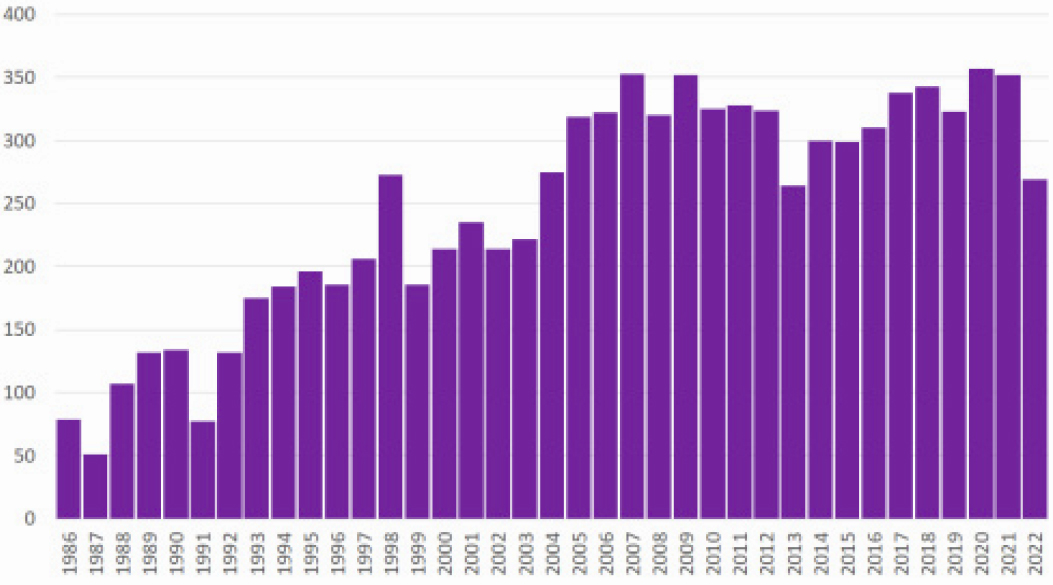
During the period of this assessment—the past assessment was in fiscal year 2021 (NASEM 2021), there has been no neutron production at NCNR, and as such the research output has been declining as data collected prior to the unplanned outage are being analyzed and published. A positive effect of the unplanned reactor outage is that instrument scientists, not being fully occupied supporting users at ongoing experiments, have been able to engage with users and with early-career staff onsite to focus on aftercare—that is, providing post-experiment support to collaborate on data analysis and drafting publications. This has delayed the inevitable reduction in journal publications based on NCNR-generated data, although signs are now emerging that publication metrics are beginning to decrease sharply, as expected. Figure 2-1 shows NCNR publications by year.
The scientists at NCNR have continued their research activities by making applications for beamtime at other facilities. It is a testament to the quality of the research program that the team has been extremely successful in receiving beamtime at highly competitive, world-leading facilities, such as the Institut Laue-Langevin (ILL) in France and Oak Ridge National Laboratory (ORNL). They have also been successful in supporting users and onsite early career staff in developing beamtime proposals at other facilities.
The lack of available beamtime and loss of collaborative opportunities with users associated with the shutdown are making NCNR a less attractive workplace for instrument scientists, resulting in several key staff departures. This had not yet had an impact on the research output during the review period, but it is a cause for concern as the organization prepares to start the reactor up again and restart the user program.
QUALITY OF REACTOR OPERATIONS, NEUTRON INSTRUMENTATION, AND SCIENTIFIC USAGE OF NCNR
Reactor Operations
As explained in Chapter 1, the NCNR reactor underwent an unplanned shutdown in February 2021 and was not approved for resumption of operations until March 2023. Beginning on June 1, 2023, the reactor started operating at a greatly reduced power—1 MW, or 5 percent of its usual operating power—with an elevation to higher operating power levels expected sometime during the summer. The goal of these reduced-level operations was to make sure that the reactor would perform safely and efficiently with the modifications that have been made. Given this situation, the panel was unable to assess current reactor operations at NCNR because there were none, but panel members were able to get a sense of the reactor’s future through conversations with various members of the NCNR management and staff.
Recently, a cold source project to replace liquid hydrogen, used as the moderator to produce cold neutrons, with liquid deuterium was proposed. The liquid deuterium will enable an enhancement of the long-wavelength flux of cold neutrons when the reactor is converted from highly enriched uranium to low enriched uranium. This cold source upgrade is estimated to take approximately 11 months and is proposed to occur in 2024. The panel acknowledges NCNR’s reason for wanting to accomplish this upgrade soon—namely, to mitigate the risk of the growing possibility that those who service and maintain the current cold source will retire, impacting NCNR’s ability to maintain its current cold source. However, the proper use of work planning and controls will minimize the impact of such knowledge loss, should it occur. The panel does not feel this concern is sufficient to justify a long interruption of the scientific program and is deeply concerned about the impact of another outage so soon after restarting on the U.S. neutron research community and NCNR’s ongoing relevance to that community. The panel believes that it would be prudent to delay the outage to install the cold source by up to a year to mitigate the impact of the second outage.
The reasons for this are the following. First, it is important for NCNR to use this additional time to work with all users—NIST, academic, and corporate—so that they can conclude as many experiments as possible. Some students may need to conclude doctoral dissertations. During the past shutdown, many users were allotted limited time on beam lines around the world; this is of course not optimal. Other users temporarily worked on complementary, or different, topics. It should be emphasized that because neutrons provide unique insights in the spatial and temporal behavior of virtually all kinds of materials, for a plethora of applications, users will always depend on neutron scattering techniques. Hence, users look forward to taking advantage of the technique when it is available. The panel interviewed members of the executive community for the user group, and they were clear that despite the shutdown, they were committed to continuing to exploit neutrons to study materials behavior. Neutrons provide unique insights into the behavior of condensed matter that are not available from other techniques. Second, the Spallation Neutron Source (SNS) at ORNL will not be available to users from August 2023 until July 2024. A shutdown of NCNR that coincides with the SNS outage would have a devastating impact on the U.S. neutron scattering community.
Recommendation 2-1: The National Institute of Standards and Technology Center for Neutron Research should delay the proposed shutdown to install the cold source by up to a year, starting no earlier than the first quarter of 2025.
Recommendation 2-2: The National Institute of Standards and Technology Center for Neutron Research leadership should develop a plan to demonstrate how the time during the future planned shutdown for the cold source upgrade will be used to ensure that the user base will be maintained and engaged currently and in the future.
A new reactor design has been proposed with capacity for 50 instruments, and this new design will contribute to significantly increasing both the capacity and the capability of the instrument suite. The outcomes of the CHIPS and Science Act of 2022 are strongly applauded by this panel because they support the necessary wide availability of neutrons. The new reactor design and implementation is, in part, in response to this new challenge. The panel commends NCNR on this new design and strongly encourages further development.
Safety
At the October 2022 meeting of the NCNR Safety Assessment Committee (SAC), the assessment team described conversations with many personnel, presentations by team leaders and management, and several reports and documents and concluded that there is a unified front in pursuing the restart of NCNR and a genuine investment in the mission. The breadth and depth of this effort was impressive. The SAC report noted that the chief reactor operational concerns are sustainment and retention. This assessment agrees with those conclusions and has encountered a similar attitude among the operational staff. The operations staff appear to have bought into the safety culture improvements and are incorporating it into their daily work. A challenge remains in maintaining the commitment to sustaining this high level of professionalism in reactor operations when budgetary pressures from the ramp-up in scientific activities begin to compete with flat budgetary resources. High operational performance is linked to a sustained financial commitment to operations. See Chapter 4 for details.
One of the outcomes of the accident that led to the reactor shutdown is that the already strong safety culture at NCNR, demonstrated by a strong safety record over the decades, has been strengthened. The NCNR safety organization now directly reports to the NCNR director. The overall safety and security procedures at NCNR encompass not only the operation of the facilities, but also the users and researchers that come to NCNR to conduct work. As the safety culture is strengthened, it is important that newly implemented safety and security procedures not unnecessarily impede the scientific progress of the
facility and the researchers. Development of the new procedures would be best accomplished as a collaborative effort between the personnel responsible for safety and those responsible for accomplishing the mission.
Recommendation 2-3: The National Institute of Standards and Technology Center for Neutron Research leadership should ensure that the new procedures implemented for the safe operation of the facility also serve to support the achievement of its mission.
Instrumentation
NCNR supports a complementary suite of scattering instruments able to investigate a wide range of structural and dynamic length and time scales particularly suited to soft matter science. These include the ultra-high-resolution, small-angle neutron scattering (USANS), very-small-angle neutron scattering (VSANS), small-angle neutron scattering (SANS) with two 30-meter SANS, MAGIK (multi-angle grazing incidence K-vector) reflectometer, Polarized Beam Reflectometer, horizontal reflectometer (to be sunset), the new Chromatic Analysis Neutron Diffractometer or Reflectometer (CANDOR), Neutron Spin Echo Spectrometer (NSE), and High-Flux Backscattering Spectrometer instruments.
In total, the NCNR instrument suite has 30 instruments, which can be broken down as follows:
- 17 neutron scattering instruments operated by NCNR;
- 11 imaging, analytical chemistry, and neutron physics instruments operated by the NIST Physical Measurement Laboratory and Material Measurement Laboratory (MML);
- The nSoft SANS instrument operated collaboratively by MML and NCNR; and
- A test station.
This section assesses the quality of those instruments and their value to users of NCNR.
During the past 2 years, as the reactor has been offline, NCNR staff have worked to enhance the operational capabilities of the instrument suite, and it has upgraded some instruments and added others. For example, the staff has worked to maintain the world-leading status of the Multi-Axis Crystal Spectrometer (MACS) and VSANS instruments. The VSANS, commissioned within the past 5 years, has world-class flexibility in instrument configuration allowing for faster data acquisition times over a wide range in length scales. And the operation of MACS has been brought up to modern standards and incorporated into the NCNR standard control system. This will enable faster measurements and more reliable and repeatable operation. The addition of event-mode data collection—as part of the Center for High Resolution Neutron Scattering (CHRNS) Non-Equilibrium Neutron Scattering initiative—will enable MACS to continue production of world-leading, innovative science, and it should continue to be competitive with the best cold neutron spectrometers and deliver world-leading science for years to come.
A new neutron spin echo instrument, the NSE II, is being installed and is scheduled to be commissioned in 2023 or 2024. This project, which is well advanced, will make the NSE instrument world-class in its ability to study molecular dynamics.
Another new instrument, CANDOR, offers unique capabilities and will enable significant enhancements in measurement speed for the study of surfaces and interfaces. The instrument team made use of the unplanned outage to make modifications to enhance the sensitivity of the instrument. This instrument, when outfitted with a full complement of detector banks, will be world-leading for the study of surface and interfacial kinetics.
The planned upgrade of the primary spectrometer of the Spin Polarized Inelastic Neutron Spectrometer (SPINS) cold triple-axis spectrometer is well under way, with procurements made for the neutron optics. This upgrade will bring SPINS up to world-class performance and lay the foundation for a future upgrade of the secondary spectrometer using a multi-analyzer system. The secondary spectrometer
upgrade, once funded, will enable SPINS, renamed Polarized Large Angle Resolution Spectrometer, to become a world-leading instrument.
The Double Axis Residual Stress Texture Single Crystal instrument at BT-8,2 which is an engineering diffractometer for stress and texture analysis, underwent significant enhancements, which are nearing completion during the unexpected outage. These upgrades include the integration of a new monochromator and detector, an improved sample positioning assembly, and the incorporation of devices for uniaxial, shear, and multiaxial stress with a digital image correlation setup. These advances are expected to deliver an improvement of more than 10 times from the detector and approximately 2 times at monochromator in detection efficiency for cubic systems, signifying a significant advance for this instrument. The improved monochromator is innovative for multiple-peak texture measurements.
The BT-8 diffractometer at NCNR is comparable to Kowari at the Australian Nuclear Science and Technology Organization and Salsa at the ILL. All of them use a bent silicon, double-focusing monochromator at a neutron guide position, a sample stage, and a two-dimensional detector with higher resolution in the diffraction-sensitive direction. Incoming fluxes at a typical gauge volume have yet to be benchmarked at BT-8. The implementation for multiple-wavelength measurements is innovative, although limited by peak overlap. The sample environments, especially the load frames on BT-8, are innovative and in line with the best capabilities in the world. In particular, the multiple stress-tensor deformation applications during texture measurements as well as simultaneous measurements of macroscopic surface strain development using digital image correlation will attract various collaborations from academic and industrial users.
There are also several other ways in which NCNR has delivered new instruments, upgrades, and supporting software to maintain its world leading position. Of particular note,
- SANS neutron guide upgrades will increase the neutron flux by approximately two times, improving the rate of data collection and measurement quality.
- Sample automation and autonomous sampling will significantly improve throughput.
- Upgrading instruments to include time resolution with neutron data collection will open new fields of study.
- Applications of a large goniometer for 20 kg samples and a base table for 200 kg samples allow the users flexibility of sample volume and dimensions for various applications.
While the enhancements described above should enable the various instruments to remain among the best in the world at what they do, the same cannot be said of the BT-4, the SPINS spectrometer, and the BT-1 powder diffractometer. For instance, according to the metrics of performance, the SPINS spectrometer is ranked seventh in the world. The BT-1 diffractometer is 30 years old, and while it still provides very valuable information, the experiments take a great deal of time and special expertise to carry out. Furthermore, the BT-4 thermal triple axis instrument is 40 years old. In order to make NCNR relevant and be able to compete with the best spectrometers and diffractometers at other neutron facilities, it is extremely important to upgrade BT-4 and BT-1 to make them relevant again.
More generally, while NCNR investments in soft condensed matter physics are adequate, the investments in hard condensed matter physics are not. Given the lack of cold neutron spectrometers in the United States, MACS alone is clearly not adequate to satisfy the demand of the community, particularly because the second target station at the spallation neutron source is still many years away. The installation of a dedicated cold-guide for the upgraded SPINS, along with an improved front end of the spectrometer, is good news. However, the budget allocated for improvement of the backend of the spectrometer is inadequate. Having a half-upgraded instrument will not help the community advance the science enabled by the instrument. A properly upgraded SPINS will attract and serve a large hard condensed matter physics community for decades to come. It is not prudent to rely entirely on National Science Foundation
___________________
2 BT stands for beam tube. But the instruments are referred to as “BT” and that is the nomenclature used in this report.
(NSF) Major Research Instrumentation (MRI) grants or similar programs for improvement of the SPINS instrument because these programs are subject to review by panels who may not understand the importance of neutron spectroscopy and the composition of which could change from one competition cycle to the next. To provide reliable and competitive cold neutron spectrometers to the community, it will be necessary to include the improvement of the instrument as a core part of the budget for the NCNR suite of instruments. Otherwise, the hard condensed matter physics program at NCNR will be much less competitive and may not be the top choice for the user community. Having one cold spectrometer at NCNR is clearly not sufficient, particularly when SPINS has the potential to be one of the best cold neutron spectrometers in the United States.
Finding 2-1: Instruments such as BT-1 and BT-4 are workhorses, and their normal operation will be important for users around the country, particularly during the period of SNS upgrade.
Finding 2-2: The performance and adequacy of spectrometers and diffractometers, which are used by the hard condensed matter community, will likely not meet the future needs of the community in the United States unless some key investments are made.
Conclusion 2-1: It is extremely important for NCNR management to find resources and prioritize the upgrade of the SPINS instrument in the future cold source guide hall to provide a properly and fully upgraded instrument to the hard condensed matter science community. Relying on NSF MRI grants and other agency programs may prove to be unreliable funding sources.
Recommendation 2-4: To support the hard condensed matter science community, the National Institute of Standards and Technology Center for Neutron Research (NCNR) should
- Upgrade the BT-1 power diffractometer and BT-4 instruments to make them relevant again.
- Fully upgrade the Spin Polarized Inelastic Neutron Spectrometer (SPINS), including the backend of the instrument, to provide a fully upgraded instrument. To accomplish this, NCNR should make the SPINS upgrade a central part of its hard condensed matter science portfolio and fund it accordingly. NCNR should not rely on funding vehicles like the National Science Foundation Major Research Instrumentation grants to accomplish this.
The issue of instrumentation personnel is also of concern. The NCNR instruments are currently operated in a collaborative manner, having, on average, one instrument scientist on each. However, owing to the rising demand for sustained world-class scientific research and support for external users, including industrial partners in structural material manufacturing, it has become crucial that additional scientific personnel be hired to support the neutron instruments. Such an expansion will be crucial to fulfill research obligations and effectively support the expanding user base resulting from the rising demand noted above, which in turn will reinforce NCNR’s position as a prominent hub for materials research and collaboration. NCNR recognizes the need for additional scientific staff to meet the growing demand, enhance support for external users, and achieve its objectives more effectively.
Scientific Use
The unplanned outage has meant that there was no direct scientific use of the neutron instruments throughout the period of this review. NCNR staff have made use of the shutdown to bring forward work that will enhance scientific use once the facility restarts.
FAIR Data Management
One of the staff’s tasks during the shutdown was aimed at making NCNR data findable, accessible, interoperable, and reusable (known as FAIR). Under this project funded by CHRNS, Open Researcher and Contributor ID (ORCID) persistent digital identifiers have been fully integrated into NCNR’s information management system and the New Instrument Control Environment (NICE) so that digital object identifiers are automatically generated for NICE experiments. Sample metadata are entered into NICE, and a database of metadata is automatically populated. Metadata from preexisting data files have been extracted and published. A search page and programming interface for searching metadata has been added. A process metadata pipeline plan was drafted for MACS integration with NICE. And data processing manifest exports have been established for all CHRNS experiments.
Sample Environment
The Liquid Insertion Pressure System for SANS is designed for the in situ study of biomolecule solutions under high pressure. It enables SANS data collection on liquid samples—biological macromolecules and other liquids—at pressures up to 350 Mpa, with simultaneous temperature control within the range −20° to +65°C. Ongoing developments at NCNR include a new insertion base and improved cooling capabilities. This equipment is a complete renewal of the previous hydrostatic pressure cell system that had been running on outdated hardware and will enable a much wider range of problems to be studied in areas of food science, industrial processing, and fundamental colloid science.
Autonomous Formulation Laboratory
The Autonomous Formulation Laboratory is a joint program among the nSoft consortium, NCNR, and NIST’s MML, which is focused on accelerating materials discovery and formulation optimization through artificial intelligence and machine learning-directed, multimodal scattering experiments. The core of the Autonomous Formulation Laboratory platform is an open-source, NCNR-developed platform to prepare liquid mixtures via pipetting, transfer those mixtures to a measurement cell, perform a SANS (or small-angle X-ray scattering or other method) experiment, and provide the data to an artificial intelligence guidance server.
REFERENCE
NASEM (National Academies of Sciences, Engineering, and Medicine). 2021. An Assessment of the Center for Neutron Research at the National Institute of Standards and Technology: Fiscal Year 2021. Washington, DC: The National Academies Press. https://doi.org/10.17226/26418.


