Summary
BACKGROUND AND TASK
Since 1959, the National Institute of Standards and Technology (NIST) has annually enlisted the National Academies of Sciences, Engineering, and Medicine to convene expert panels comprising individuals from academia, industry, and various scientific and engineering fields. Their primary task is to evaluate the quality and efficacy of NIST’s six measurements and standards laboratories, as well as the sufficiency of resources available to these laboratories. These evaluations are carried out under contract, initiated by NIST. For the fiscal year 2023, NIST has commissioned the National Academies to assess the NIST Center for Neutron Research (NCNR). The task of the Panel on the Assessment of the National Institute of Standards and Technology (NIST) Center for Neutron Research was to assess NCNR’s scientific and technical programs; its portfolio of scientific and technical expertise; the adequacy of the budget, facilities, instrumentation, and human resources; and the effectiveness of NCNR’s dissemination efforts. The statement of task is presented in more detail in Chapter 1. The assessment process involved a site visit by the panel, encompassing laboratory tours, one-on-one interactions with NCNR researchers, and subsequent inquiries following the site visit. Leveraging its collective experience and expertise, the panel then appraised NCNR in accordance with the predefined scope of work and provided recommendations accordingly. NCNR was last reviewed in 2021, 2 years ago (NASEM 2021).
NCNR, situated in Gaithersburg, Maryland, is an integral part of NIST. Its primary focus is to provide neutron measurement capabilities to the research community in the United States. It serves as a national hub for research employing thermal and cold neutrons, making its instrumentation accessible to eligible applicants. Many of its instruments leverage high-intensity cold neutron beams generated from a state-of-the-art liquid hydrogen moderator. NCNR’s mission encompasses the following three core objectives: to operate NCNR safely as a cost-effective national resource; to enable a broad program of research using neutron techniques and to develop and apply new neutron measurement techniques; and to operate NCNR as a national resource for researchers from industry, university, and other government agencies.
In February 2021, the NCNR reactor underwent an unplanned shutdown after fission products were detected in the helium sweep and ventilation exhaust systems. This was due to a safety event, specifically a fuel element that had unlatched from its seat in the reactor, resulting in the reactor’s fuel temperature violating its safety limit. NCNR submitted a request to the U.S. Nuclear Regulatory Commission to restart the reactor on October 1, 2021, identifying the root causes of the shutdown and corrective actions. After significant clean-up efforts and corrective actions, NCNR was approved to restart reactor operations on March 9, 2023. Since June 1, 2023, the reactor has been operating at 1 MW; its normal operating power is 20 MW. Elevation to higher power levels of operation are expected to be implemented later during the summer of 2023. Testing of effluents, as well as a careful assessment of the short- and long-term fixes that were implemented as a result of this accident will occur continuously to ensure safety and performance of the reactor. NCNR leadership felt that the restart of reactor operations made an assessment of NCNR appropriate at this time.
Because the reactor was shut down during the entire assessment period, 2021 through the first half of 2023, there was no work conducted at NCNR to assess. However, the staff at NCNR have used the
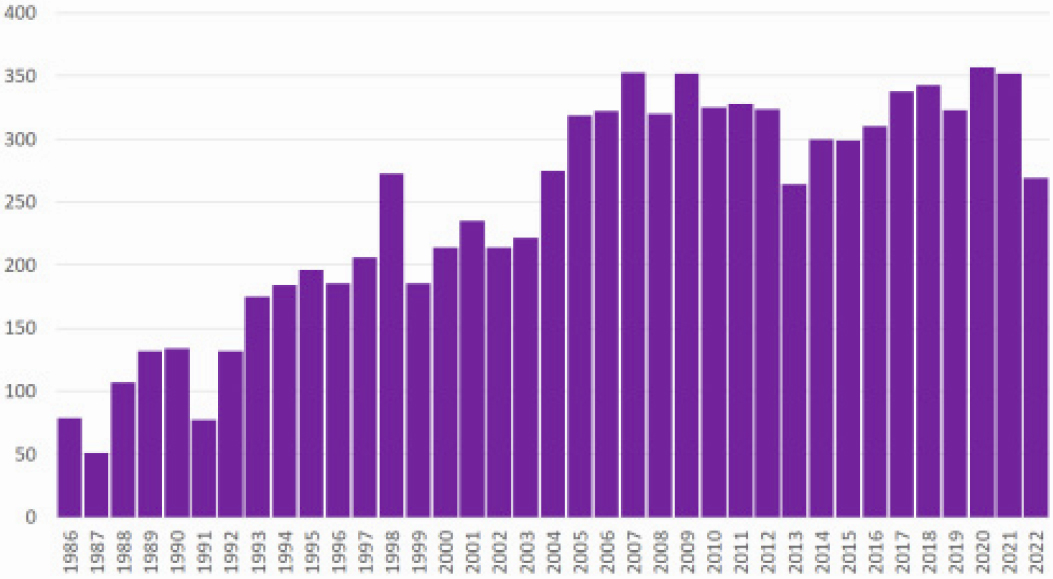
time to engage with users to focus on aftercare, which entails offering assistance in data analysis and publication drafting, leading to a continued outstream of publications.
In 2020, the year prior to the unplanned shutdown, more than 3,000 researchers from U.S. government laboratories, academia, and industry performed experiments at NCNR. New instruments, including the Chromatic Analysis Neutron Diffractometer or Reflector (CANDOR) and the very-small-angle neutron scattering (VSANS), were made available to researchers, initiating an era of important new advances in different areas of hard and soft matter materials research. The new instrument designs have significantly improved the efficiencies of experiments, providing significantly more data to researchers with shorter experiment durations. The resulting data provided new insights into the spatial and temporal behavior of materials at various length scales. The newly improved neutron depth profiling instrument and sample environment enhancements provided unprecedented information about in operando monitoring of lithium-ion transport processes, which is otherwise very difficult to obtain. This work will contribute to higher-capacity battery systems, increased safety, and longer lifetimes of installed batteries. VSANS has enabled observation of the flow of liquids over wider spatial and temporal scales—for the first time ever. The development of new data analysis strategies, new theoretical understandings, and machine learning (ML) and artificial intelligence (AI) tools were exploited to garner this information.
It is noteworthy that the research productivity, measured by peer-reviewed publications in high-impact factor journals, remains high despite the shutdown. This was, in part, made possible by NCNR staff who provided significant assistance to researchers to better understand, analyze, further extract information, and in some cases to develop models, from yet-to-be-published neutron data. NCNR researchers have been able to devote more time helping users to analyze their data in greater detail, uncovering new insights, and to more carefully plan future experiments. The recent shutdown also enabled the planning of new instrumental and sample environmental designs. Since the unplanned shutdown in February 2021, both instrument design and engineering improvements to the guide halls have continued and are expected to further enhance the tools available to the users of NCNR. The number of NCNR publications by year is shown in Figure S-1.
MAIN MESSAGES
Important challenges confront NCNR as it emerges from this shutdown, resumes normal operations, and prepares for future collaborative research with the user community. There are concerns about NCNR’s support of and continued relevance to the U.S. neutron research community as it exits a long, unplanned shutdown and plans to enter another lengthy shutdown after perhaps less than a year of operations. Another concern is continuing the commendable progress in improving the NCNR safety culture in a way that the scientific work at the laboratory is not unduly hindered. NCNR has a number of old instruments that need either to be recapitalized or replaced. NCNR’s budget has generally not kept pace with inflation and has experienced some challenges since the February 2021 shutdown. This has had a negative impact on both the technical and engineering aspects of the laboratory and on the expert workforce necessary upon which users’ research critically depends. Finally, NCNR has come to rely more and more on AI and ML but does not have a coherent, organized approach to the use of these tools, nor does it have—or have access to—the high-performance computing infrastructure necessary to fully use these advanced and powerful tools. These topics are addressed below, not in order of importance—the panel did not prioritize its recommendations, as that is something more properly done by the laboratory—but in the order of occurrence of recommendations on these topics.
NCNR Availability and Relevance
As noted above, impressive things were accomplished during the recent reactor shutdown, both in instruments and the facility as well as in scientific productivity. Yet, the fact remains that NCNR has not been able to support new work by researchers and students since February 2021. This has had a significant impact on the neutron user community and on the ability of students to conduct research. The NCNR reactor should be very close to resuming normal operations by the time this report is published. But a cold source upgrade, to replace liquid hydrogen with liquid deuterium as a moderator to produce cold neutrons, is planned less than a year after the reactor resumes normal operations in support of NCNR’s users. The liquid deuterium will enable an enhancement of the long-wavelength flux of cold neutrons when the reactor is converted from highly enriched uranium to low enriched uranium fuel. This cold source upgrade is expected to take approximately 11 months and is planned to occur in 2024. The obvious concern is that scientific progress will no doubt be undermined if NCNR undergoes yet another shutdown for a prolonged period after the recent shutdown of more than 2 years. In addition to the further disruption to the neutron research community, the panel is concerned about the impact of this plan on NCNR’s continued relevance to that community. A further concern is that the members of user community might be discouraged from reengaging with NCNR due to uncertainty associated with future shutdowns; this is something that deserves careful consideration.
Recommendation 2-1: The National Institute of Standards and Technology Center for Neutron Research should delay the proposed shutdown to install the cold source by up to a year, starting no earlier than the first quarter of 2025.
Recommendation 2-2: The National Institute of Standards and Technology Center for Neutron Research leadership should develop a plan to demonstrate how the time during the future planned shutdown for the cold source upgrade will be used to ensure that the user base will be maintained and engaged currently and in the future.
Safety
One of the outcomes of the accident is that despite a strong safety record over the decades, new safety processes and protocols are being introduced. The safety organization now directly reports to the
NCNR director, elevating the oversight of this part of operations and improving the safety culture of the facility. The panel notes that the overall procedures for safety and security include the hosting of guest researchers performing experiments and are not restricted to NCNR staff. It is important that the new rules that are being considered to ensure the safety of the guest users and NCNR personnel not unreasonably impede the scientific productivity of the facility. Hence, a collaborative effort between personnel responsible for safety and those responsible for accomplishing the mission is needed in implementing the new rules.
Recommendation 2-3: The National Institute of Standards and Technology Center for Neutron Research leadership should ensure that the new procedures implemented for the safe operation of the facility also serve to support the achievement of mission objectives.
Aging Instruments
The Multi-Axis Crystal Spectrometer (MACS)-II spectrometer is the best in its class, but the BT-41 and Spin Polarized Inelastic Neutron Spectrometer (SPINS) spectrometers and the BT-1 powder diffractometer need to be upgraded to be competitive with similar instruments around the world. Hence, based on its performance metrics, the SPINS spectrometer is ranked seventh in the world compared to other similar instruments. The BT-1 diffractometer is 30 years old. While it continues to provide very valuable information, the experiments take an unreasonable amount of time and require specialized expertise. The BT-4 thermal triple-axis instrument is 40 years old and is in need of an upgrade or replacement. Instruments such as BT-1 and BT-4 support a tremendous amount of work and will be particularly important for users during the period of the planned upgrade of the Spallation Neutron Source at Oak Ridge National Laboratory. Finally, the MACS spectrometer alone is not sufficient to meet the current and future growing needs in the United States. The current instrument suite is not likely to meet the future needs of the U.S. hard condensed matter research community. Despite the new instruments that have come online, there is a dire need for new instrumentation.
Recommendation 2-4: To support the hard condensed matter science community, the National Institute of Standards and Technology Center for Neutron Research (NCNR) should
- Upgrade the BT-1 power diffractometer and BT-4 instruments to make them relevant again.
- Fully upgrade the Spin Polarized Inelastic Neutron Spectrometer (SPINS), including the backend of the instrument, to provide a fully upgraded instrument; to accomplish this, NCNR should make the SPINS upgrade a central part of its hard condensed matter science portfolio and fund it accordingly. NCNR should not rely on funding vehicles like the National Science Foundation Major Research Instrumentation grants to accomplish this.
Budget and Workforce
There are concerns about loss of staff, and the associated scientific and instrument expertise, at NCNR due to the shutdown and decreasing operational funding budgets. The 2018 and 2021 reports (NASEM 2018, 2021) noted that core financial support for the program has decreased steadily for many years, and the number of scientists per instrument has been decreasing. This has been described as a potential crisis. However, while the base funding has increased, and funding for the Center for High
___________________
1 BT stands for beam tube. But the instruments are referred to as “BT” and that is the nomenclature used in this report.
Resolution Neutron Scattering (CHRNS), a partnership between the National Science Foundation (NSF) and NIST, increased slightly since its renewal and 11 permanent staff have been lost since 2018. Hence, after adjusting for inflation, the annual base, or core, funding for largely operating, maintaining, and advancing instrument design has been decreasing since 2015. Despite this challenge, NCNR staff are to be commended for continuing to support the high-quality user program, while also making important and new innovations in instrument design and efficiencies. The productivity of the external users has remained high due largely to support from NCNR staff. Staff continue to work long hours to achieve the mission, which will eventually negatively affect their morale. Staffing challenges for instruments, particularly for small-angle neutron scattering, are daunting.
Also, at the time this report was drafted, the number of licensed engineers and technicians is insufficient to operate the reactor 24 hours per day, continuously. However, NCNR is working to address the reactor operations staffing issue by training additional personnel, and these individuals are expected to have successfully passed their licensing exams by the time normal operations resume. Still, non-competitive pay and a lack of opportunities for professional development are obstacles to attracting and retaining the best talent. The panel concluded that NCNR’s scientific and technical research services appropriations need to increase by at least 20 percent to correct for inflation-driven budget erosion since 2018 and allow NCNR to address its instrument and workforce challenges.
It is the understanding of the panel that, due to the shutdown, NSF’s financial support for CHRNS is currently halted, hopefully temporarily. Some educational efforts have continued, but the lack of support does pose important potential challenges. NSF funding for this collaboration provides support for instrument upgrades, scientific staff to help users, and user services. It also supports reactor operation and the cold neutron source as well as beamlines for MACS, the Neutron Spin Echo spectrometer, CANDOR, the High Flux Backscattering Spectrometer, and VSANS. These are considered the best-in-class instruments for studies of nano-magnetism, quantum magnetism, and the structure and dynamics of soft matter. This research has broad societal applications (see Chapter 3), and the termination of NSF funding to CHRNS (see Chapter 5 for impact of CHRNS) would be a blow to neutron research vital to the United States and its industry.
Major efforts are needed to address this shortcoming in support from NSF, because the implications are significant. Another shutdown is proposed for the reactor in order to carry out an upgrade to the cold source. The panel does not believe that this is a reason to halt financial support; many of the activities that are supported by the collaboration can and should continue, regardless of whether neutrons are available to users.
Recommendation 4-1: The National Institute of Standards and Technology Center for Neutron Research (NCNR) leadership should address its funding challenges. The recommendations and potential from the CHIPS and Science Act of 2022 may be significant. However, the funds have not been appropriated and the timing of new resources remains unclear. NCNR should provide information about the return on investments in neutron characterization and measurement capabilities to science and industry. It should also provide insights into lost opportunities, over the coming years, associated with the limited availability of neutrons. The goal here is to demonstrate the urgent need for additional financial support.
Recommendation 4-3: The National Institute of Standards and Technology Center for Neutron Research should continue to fund and execute an adequate suite of capital improvement projects to better exploit the instrument suite.
Recommendation 4-4: The leadership of the National Institute of Standards and Technology (NIST) Center for Neutron Research (NCNR) should engage with NIST leadership to secure the funding necessary to hire more world-class scientific staff to meet the demands of resuming normal operations, prevent a degradation in NCNR’s capabilities due to
understaffing, and to allow for growth in NCNR’s work in the future. NCNR should explore special pay rates to help it recruit and retain the best available staff. That will, of course, require an adequate budget.
Artificial Intelligence, Machine Learning, and High-Performance Computing
National laboratories around the United States have made significant investments in advanced computing, including high-performance computing, to support their programs. This has been necessary because of the adoption of new advanced analytical tools, including increasingly sophisticated AI and ML tools requiring huge amounts of computational power, to solve problems across diverse fields. The world’s first exascale computer, Frontier, is now operational at Oak Ridge National Laboratory. Other Department of Energy national laboratories—including the Pacific Northwest National Laboratory, National Renewable Energy Laboratory, Argonne National Laboratory, and Lawrence Berkeley National Laboratory—have high-performance computers to solve a range of science and engineering problems. In talking with many NIST staff about their research, it became apparent to the panel that most NCNR programs take advantage of AI and ML for data analysis. They accomplish this in suboptimal ways, using disparate and unrelated efforts across different groups in an ad hoc manner. Unfortunately, this is not sustainable for NCNR and the growing sophistication of state-of-the-art algorithms required for data analysis.
Recommendation 4-2: The National Institute of Standards and Technology Center for Neutron Research should develop a plan for access to, and use of, high-performance computing resources to support initiatives in scientific computing, artificial intelligence, and machine learning and to ensure the ability to scale up to meet the needs of scientist-driven initiatives.
REFERENCES
NASEM (National Academies of Sciences, Engineering, and Medicine). 2018. An Assessment of the Center for Neutron Research at the National Institute of Standards and Technology: Fiscal Year 2018. Washington, DC: The National Academies Press. https://doi.org/10.17226/25282.
NASEM. 2021. An Assessment of the Center for Neutron Research at the National Institute of Standards and Technology: Fiscal Year 2021. Washington, DC: The National Academies Press. https://doi.org/10.17226/26418.


