An Assessment of the National Institute of Standards and Technology Center for Neutron Research: Fiscal Year 2023 (2024)
Chapter: 1 Overview of the National Institute of Standards and Technology Center for Neutron Research
1
Overview of the National Institute of Standards and Technology Center for Neutron Research
The mission of the National Institute of Standards and Technology (NIST) Center for Neutron Research (NCNR) is to “provide safe and reliable operations in service to the neutron science community, supporting U.S. economic and technological advancement.” NCNR is a user facility that provides neutron beamtime and instruments to investigators. It is a world-leading institution for neutron research with a history of high-impact scientific and technological advances in areas of broad societal importance, including fundamental advances in measurement science, hard and soft matter science, quantum information science, artificial intelligence, cybersecurity, and the foundations of neutron science. In addition to thousands of contributions to high-impact scientific and technical publications, more than 1,200 patents have been informed by research conducted at NCNR; in recent years, the average has been approximately 50 patents per year.
The NCNR reactor underwent an unplanned shut down in February 2021. Fission products were detected in the helium sweep and ventilation exhaust systems, owing to a safety event. A fuel element had unlatched from its seat in the reactor, resulting in the reactor’s fuel temperature violating its safety limit and partially melting some fuel. Significant clean-up efforts and corrective actions resulted in an approval to resume limited reactor operations on February 1, 2023. Since June 1, 2023, the reactor has been operating at 1 MW; its normal operating power is 20 MW. It is expected that the reactor will resume full-power operations in the fall of 2023. Effluents will be continuously monitored to ensure reactor safety and performance.
NCNR is one of seven NIST laboratory programs, with partnerships that include the National Science Foundation’s (NSF’s) Center for High Resolution Neutron Scattering (CHRNS) and nSOFT, a consortium of corporate entities. The NCNR budget for fiscal year (FY) 2023 is $87 million, which supports 170 federal employees and 70 associates who enable and support the work of more than 2,500 investigators. NCNR hosts and operates 30 beam instruments, 5 of which are operated by CHRNS. Its collaboration with NSF presents a unique opportunity to train many researchers who go on to become experts in neutron science, including academics in institutions in the United States and around the world, as well as corporate researchers who have played an important role in the applications of neutrons to industrial projects. CHRNS is also responsible for introducing undergraduates, teachers, and high school and middle school students to the impact and overall societal value of neutron science. Applications of work conducted at NCNR include processing and manufacturing in the automobile, chemical, and pharmaceutical industries as well as the production of vaccines. Moreover, the successful launch of the nSOFT consortium is complementary to the CHRNS partnership.
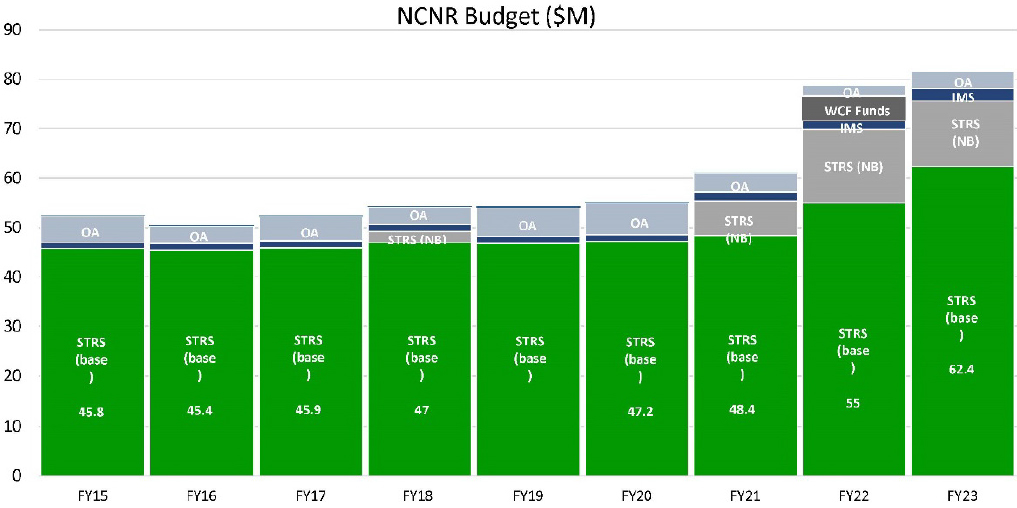
Figure 1-1 shows the NCNR budget from FY 2015 through FY 2023. It shows several categories of funding. Base scientific and technical research services (STRS) funding is the regularly appropriated funding that NCNR receives to conduct its work. Non-base (NB) STRS funding represents time-limited appropriations in addition to the base STRS funding. These NB STRS funds have principally been for recovery from the reactor incident. The funds from the NIST program Innovations in Measurement Science (IMS) are awarded competitively through a NIST-wide process. NCNR leads two IMS projects. Funding from the NIST working capital fund is shown for FY 2022. Other government agencies (OA) funding is from reimbursable work done for other federal agencies.
STATEMENT OF TASK
In 2023, responding to a request from the director of NIST, the National Academies established the Panel on the Assessment of the National Institute of Standards and Technology (NIST) Center for Neutron Research (referred to as the “panel”) with the statement of task reprinted below.
The National Academies shall appoint a panel to assess independently the scientific and technical work performed by the National Institute of Standards and Technology (NIST) Center for Neutron Research. The panel will review technical reports and technical program descriptions prepared by NIST staff and will visit the facilities of the Center for Neutron Research. Visits will include technical presentations by NIST staff, demonstrations of NIST projects, tours of NIST facilities, and discussions with NIST staff. The panel will deliberate findings in closed sessions and will prepare a report summarizing its assessment findings and recommendations.
NIST has requested that the laboratories be assessed against the following broad criteria:
- Assess the NCNR’s scientific and technical programs.
- How does the quality of the research performed at the NCNR compare to that of similar world-class neutron facilities?
- Is the quality of reactor operations, neutron instrumentations, and scientific utilization of the NCNR adequate for it to reach its stated objectives? How could it be improved?
- Assess the portfolio of scientific and technical expertise within the NCNR.
- Does the organization have world-class expertise in reactor operations and the development and utilization of advanced neutron instrumentation? If not, in what areas should it be improved?
- How well does the organization’s scientific and technical expertise support the research programs and the organization’s ability to achieve its stated objectives?
- Assess the adequacy of the NCNR’s budget, facilities, instrumentation, and human resources.
- How well do the facilities, instrumentation, and human resources support the NCNR’s technical programs and its ability to achieve its stated objectives? How could they be improved?
- Assess the effectiveness by which the NCNR disseminates its program outputs.
- How well are the NCNR’s instrument development activities and research programs driven by stakeholder needs?
- How effective are the mechanisms by which the NCNR provides access to its instrument suite by a broad subset of the scientific community? Are these mechanisms sufficiently comprehensive?
- How well does the NCNR monitor the scientific use and impact of the facility? How could this be improved?
CONDUCT OF THE ASSESSMENT
The panel, which consisted of 11 volunteers with expertise corresponding to the research done at NCNR, conducted an in-person review of NCNR in Gaithersburg, Maryland, from June 21 to 23, 2023. During that visit, the panel engaged with NCNR leadership and staff, who delivered comprehensive presentations. These presentations were complemented by tours of the NCNR facilities and interactive discussions between NCNR staff and the panel. Written responses to inquiries raised by the panel were also provided by NCNR staff.
In developing its assessment, the panel relied on the collective experience, technical expertise, and knowledge of its members. The assessment primarily adopted a qualitative approach, relying primarily on the materials provided—as well as presentations, poster sessions, and tours—by NCNR staff and leadership. It is important to note that the exclusion of specific NCNR projects from this report does not imply a negative perspective; the panel focused on the points it judged most significant in the information provided to it. The report centers on NCNR’s ongoing work, highlighting opportunities and challenges associated with it.
It is worth mentioning that NIST has a distinct review body known as the Visiting Committee on Advanced Technology, which addresses the broader question of the direction that NCNR or any other NIST laboratory should be taking. Hence, deliberations on whether NCNR is pursuing appropriate research fall beyond the scope of this particular review.
STRUCTURE OF THE REPORT
After this introductory chapter, the report has four additional chapters addressing the major points 1–4 in the statement of task above; that is, NCNR’s scientific and technical programs (Chapter 2); NCNR’s portfolio of scientific and technical expertise (Chapter 3); NCNR’s budget, facilities, instrumentation, and human resources (Chapter 4); and NCNR’s dissemination of its program outputs (Chapter 5). There is a certain amount of unavoidable overlap between chapters—for instance, aspects of NCNR’s instruments are discussed in both Chapter 2 and Chapter 4—but each chapter is focused on the specific questions raised in the relevant portion of the statement of task. Chapter 3 discusses the use of instruments in the context of scientific research. Accordingly, each chapter contains conclusions and recommendations focused on the particular aspect of NCNR that it addresses; so, for instance, recommendations regarding NCNR’s scientific and technical expertise are found in Chapter 3.


