Modernization of Federal Inspection Services Facilities at U.S. Airports (2025)
Chapter: FIS 2050 Sessions
FIS 2050 Sessions
Part 1: Before Flight Departures
Moderator
AmyClaire Brusch, Managing Director, Policy and Regulatory Affairs, Airports Council International–North America
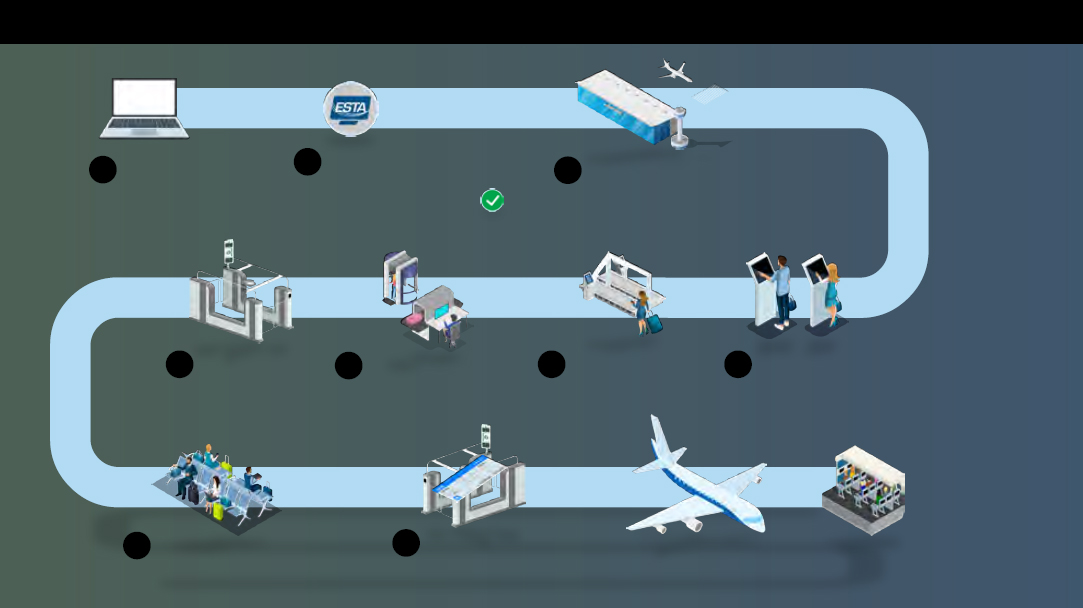
AmyClaire Brusch moderated a session to look at some of the areas of the traveler journey that will be changing for passengers traveling to the United States before the flight begins. The generic process was described as shown in Figure 12
Potential Changes in Processes
Participants were asked to provide input on potential changes to processing, summarized as the following seven changes:
- Predeparture activities (Steps 1 and 2) are to be integrated for “travel-ready” passengers, who have coordinated all regulated areas of compliance (i.e., health, travel authorizations, visas).
- Airline check-in (Step 4) at the foreign airport (Step 3) is to be eliminated or reduced in footprint dramatically.
- Bag drop (Step 5) may rely on increased off-airport, common-use, and (possibly) third-party delivery services available to passengers.
- Passenger and carry-on item screening (Step 6) could have data transmission to the United States before departures.
- Dual-purpose CBP/TSA screening was outlined as Step 6; the screening of passengers and baggage would not be limited to explosives or threats to civil aviation but might potentially expand to include customs interdiction for drugs or other prohibited items.
- Services for ordering duty-free goods before arriving at the departure gate (Step 8) were contemplated by several participants as a way to further generate revenue for airports.
- Greater use of facial recognition (see Figure 13) was contemplated in Step 9, in addition to CBP or TSA making targeted requests for at-gate screening for specific individuals.

Implications for Federal Inspection Services
One of the technologies that could impact FIS modernization is facial recognition, through which biometric data can be shared with CBP, airlines, and airports. Facial recognition can be used to enable a bidirectional flow of integrated information, assigning passengers to specific CBP clearance lanes, informing them of connecting flight times, and allowing for an overall more efficient use of space.
While the Insight Event participants speculated on seven changes that may or may not be feasible for implementation, they also identified four major implications for FIS facilities at U.S. airports:
- Economizing on time: To optimize the use of time before flights, passenger volumes should be modeled not by hourly estimates but in finer, more granular
- increments, such as five-minute intervals. This more precise approach would enable CBP to manage resources more effectively and ensure that officers are available when flights arrive. Real-time data, such as weather updates from the FAA and air traffic control, can further support efficient officer deployment.
- Enhancing travel readiness: Travelers should be encouraged to secure travel authorization well ahead of check-in, which will reduce help congestion in airline check-in areas and lower CBP rejection rates, such as those triggered by the Electronic System for Travel Authorization.
- Increasing the use of technology: Expanding the use of biometrics and digital tokens at each stage of the journey would also lead to significant operational improvements.
- Streamlining baggage handling: Placing baggage drop-off points before check-in, supported by earlier access to baggage information, can streamline the process. These drop-off points may be located off-site and used as common facilities, further improving efficiency.
- Integrating and sharing data: Utilizing a single application programming interface (API) for data sharing among airlines, airports, CBP, and other stakeholders would improve coordination and communication. Integrating CBP and TSA processes at passenger screening points will also improve inspection efficiency.
Additional Research Identified by Participants
Potential areas for further applied research could include exploring the use of collaborative decision-making software to develop models for optimizing resource allocation. This research could involve partnerships with universities, airports, airlines, and CBP to study how real-time data might enhance operational efficiency. Additionally, investigating the implementation of biometric systems at foreign boarding gates to streamline international arrivals could yield valuable insights into improving passenger processing times. Another promising area of research is innovative off-site check-in and baggage drop-off methods at foreign airports, including the use of package delivery services such as FedEx. Another area of research could focus on determining optimal health screening processes to ensure passenger safety and operational efficiency. These studies could lead to significant advancements in airport operations and passenger experience.
Investigating the use of APIs to facilitate data sharing among CBP, airlines, airports, and other government entities, while addressing associated legal requirements such as privacy, could enhance coordination and compliance. This research could also encompass interactions with other travel entities, such as hotels and restaurants, as well as the integration of visa validation by the U.S. State Department.
Additionally, defining a single “travel-ready” app that consolidates all necessary travel information and services could streamline the passenger experience. Finally, examining the evolution of aviation security measures, including the handling of liquids and gels,
carry-on regulations, and the differences in imaging requirements for checked bags between CBP and TSA could lead to improved security protocols and passenger convenience.
Giving FIS a more contemporary name and terminology could improve clarity and public perception. The use of voice-controlled agents (e.g., Siri or Alexa) and other AI technologies to generate real-time data can significantly enhance operational efficiency. However, this also introduces cybersecurity implications that must be addressed to protect sensitive information. Ensuring consistency in processes while managing global variability (such as language differences) is crucial to maintaining a seamless and secure travel experience.
Part 2: Arrivals to the United States
Moderator
Ellen McClain, International Bridge, Inc. [formerly Deputy Assistant Secretary (Transborder Security), DHS]
Ellen McClain moderated a session to examine FIS modernization in the United States arrivals process. In addition to highlighting the potential for expanding CBP Preclearance, McClain looked at the process for individuals cleared by CBP upon landing after a flight to the United States.
While there are differences in the arrival process at some airports, such as Seattle–Tacoma International Airport’s Bags First program, the general process for passengers arriving at a FIS facility is as shown in Figure 14:
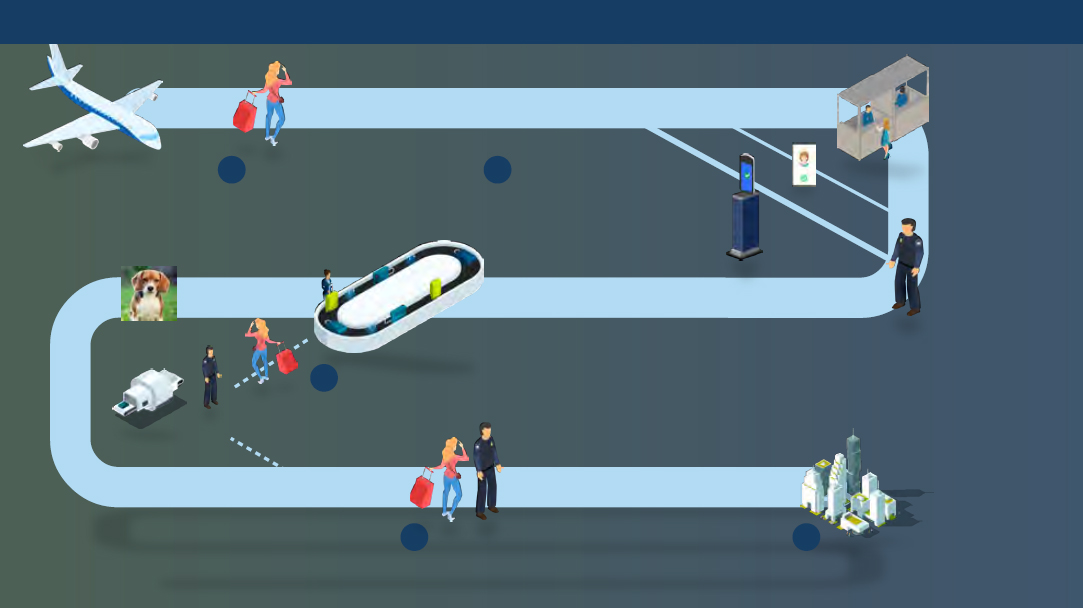
Between Steps 2 and 3, arriving passengers may proceed to a CBP booth for processing by an officer, or, if eligible, may use channels dedicated to Mobile Passport Control or Global Entry.
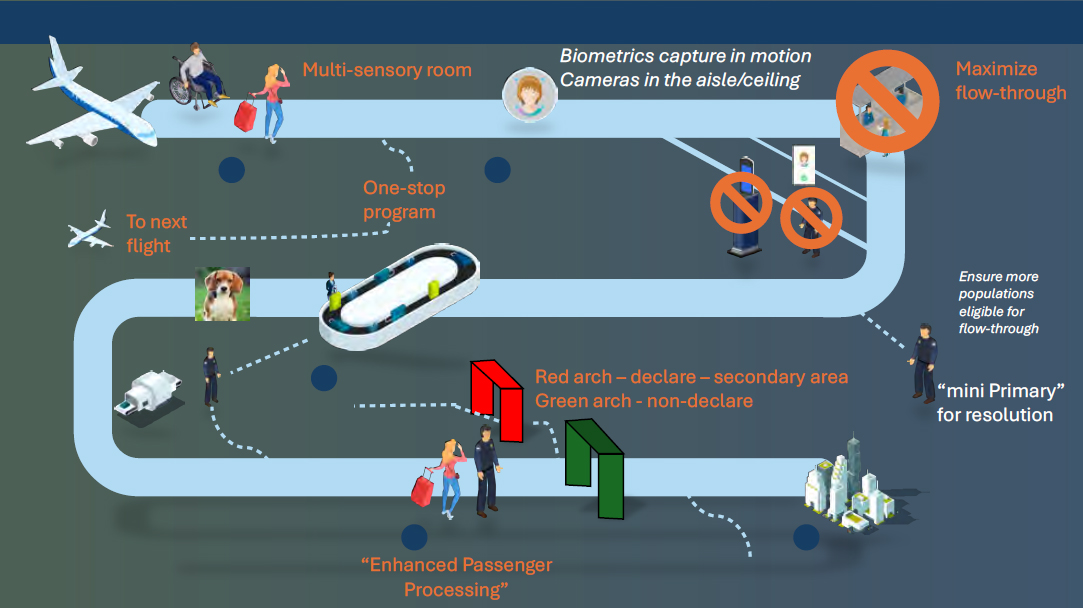
Participants described a number of areas for potential change in the international arrival process:
- Sterile corridors between Steps 1 and 2 may need to include a multisensory room to help the increasing population of neurodiverse individuals.
- If pilot projects for one-stop security become permanent, the greatest benefit or improvement to airline network connectivity would come from allowing passengers to proceed directly to connecting flights before reaching primary CBP inspection at Step 2. Booths, kiosks, and other fixed elements may be replaced by in-motion facial recognition in the sterile corridor between Steps 2 and 3.
- Control and border security issues may require CBP officers to employ a separate “mini primary” inspection process to help resolve problems with missing or conflicting information.
- For most passengers, border entry to the United States would be seamless and would not require a stop at a designated primary process.
- Existing deployment of CBP’s Enhanced Passenger Processing, which began at DFW and YVR (Vancouver International Airport) in 2024, could be expanded at Step 4, along with the use of green/red declaration zones to improve egress.
The changes discussed with Insight Event participants are noted below, appended in the current flow diagram as shown in Figure 15.
Implications for FIS Modernization
Modernizing CBP operations at U.S. airports to create a friendlier and more seamless entry into the United States has significant implications. By implementing seamless processing and leveraging existing investments in biometrics, CBP can improve security while facilitating a better travel experience for legitimate travelers, who make up the vast majority of arrivals. Biometric technologies, such as facial recognition, can expedite identity verification, reduce wait times, and improve the overall efficiency of the entry process. This approach not only strengthens security measures but also ensures a smoother and more welcoming experience for travelers.
Another key aspect of FIS modernization is understanding the diverse needs of the traveling public, including those with visible and invisible disabilities. A one-size-fits-all approach to CBP processing can be challenging for individuals with specific needs. By accelerating seamless processes for most passengers while offering customized processing channels, CBP can create a more accommodating environment. This strategy ensures that all travelers receive an appropriate level of attention and support, enhancing their overall experience and satisfaction.
The shift toward more flexible and space-efficient facilities is another important consideration for CBP modernization. Traditional fixed elements such as kiosks and booths may no longer be the most effective way to manage passenger flows. Instead, planners and architects need to design adaptable spaces that can support evolving processing methods. This includes designing areas that can easily be reconfigured to meet changing demands and incorporating technology that supports dynamic and efficient passenger processing. By doing so, airports can optimize their use of space and resources, leading to more streamlined operations.
Ultimately, the modernization of CBP facilities at U.S. airports aims to balance security and efficiency with a positive passenger experience. By embracing new technologies and flexible design principles, CBP can continue to protect the nation’s borders while making the entry process more pleasant and accessible for all travelers. This forward-thinking approach not only improves operational effectiveness but also reinforces the United States’ commitment to welcoming visitors from around the world.
Additional Research Identified by Participants
Potential applied research projects could focus on defining and optimizing airport flex space to accommodate various uses, including CBP and non-CBP functions, as well as different sectors. This research could explore how to design spaces that can be easily reconfigured to meet changing demands, such as increased baggage handling capacity or additional CBP administrative functions. By understanding the requirements and constraints of these different uses, airports can create more adaptable and efficient facilities.
Another area of potential research is inclusive design, which seeks to create environments that all airport passengers can use. Research in this area could involve studying how to develop airport environments that are welcoming and functional for all passengers, including those with disabilities. By incorporating inclusive design principles, airports can ensure that everyone has a positive and seamless travel experience.
Wayfinding is another critical aspect of airport design that could benefit from applied research. This research could investigate the wayfinding needs of different populations, utilizing technologies such as archways, Google Glass, and mobile apps to provide dynamic and personalized navigation assistance. Understanding how different groups of passengers interact with wayfinding systems can help airports develop more effective and user-friendly solutions.
Finally, research could focus on improving the welcoming experience for people arriving in the United States. A research project could explore the aesthetics of airport spaces and how they can be integrated with tourism elements to create a positive first impression for visitors. By analyzing how design affects passenger experience, airports
can create environments that are not only functional but also inviting and reflective of the local culture and attractions.
Outside of formal research programs such as ACRP, additional avenues for analysis were identified in the following areas:
- Accessibility and foreign language support: Analyzing forecasted needs for accessibility and foreign language assistance is vital for ensuring that airports can adequately serve a diverse passenger population. This research might include examining demographic trends and passenger data to predict future requirements for language services and accessibility features. By understanding these needs, airports can better plan and allocate resources to provide effective assistance to all travelers.
- Passenger experience with in-motion biometric capture: Investigating how passengers perceive and interact with in-motion biometric capture can provide valuable insights into the development of seamless border entry and enhanced passenger processing. This research could focus on how passengers perceive and interact with biometric technologies, identifying any potential concerns or areas needing improvement. Understanding the user experience can help refine these technologies to ensure they are both efficient and easy to use.
- Trust and data sharing with other governments: Analyzing trust and data-sharing practices between other governments, such as the collaboration between Aruba and countries in the Caribbean for joint risk management, is essential for international cooperation. This research could examine the effectiveness of current data-sharing agreements and identify best practices for building trust and ensuring data security. The upcoming pilot projects planned for the FIFA World Cup 2026 could serve as case studies for evaluating these practices in a real-world context.
- Effectiveness of “declare” versus “non-declare” channels: Studying the effectiveness of “declare” (red lane) versus “non-declare” (green lane) pathways can provide insights into space requirements for FIS planning. This research could analyze passenger flow data and the efficiency of each channel, helping to identify the optimal layout and resource allocation for inspection facilities. Understanding these dynamics can lead to more streamlined and effective border processing.
- Exploration of the potential for one-stop programs in international travel: Research on implementing the one-stop program, particularly at major hubs such as DFW and Hartsfield–Jackson Atlanta International Airport (ATL), could reveal opportunities for simplifying and enhancing the travel experience. This research could evaluate the benefits and challenges of consolidating multiple security and customs checks into a single process, potentially reducing wait times and improving passenger satisfaction.
- Mobile and wearable technologies for officers: Research might look at how CBP officers can use mobile and wearable technologies to improve operational efficiency and officer safety. This research could determine types of equipment currently in use, assess their effectiveness, and identify potential areas for innovation. Understanding the impact of these technologies can help airport planners develop strategies for their integration into daily operations.
- Future of U.S. preclearance: Investigating the future of U.S. preclearance, including the challenges of funding and cost recovery, is essential for understanding its potential benefits to national security. This research could examine the current state of preclearance operations, potential expansion to additional sites, and financial implications. By analyzing these factors, stakeholders can make informed decisions about the future direction of preclearance programs.
- Standardized symbols: Implementing universally recognized standardized symbols in both dynamic and static airport signage can enhance wayfinding, helping passengers navigate airports more efficiently with less confusion and improving the overall travel experience.
- Reduction of acronyms: The use of acronyms in signage (e.g., EPP, SBE, GE, and MPC) can be confusing for passengers. Simplifying signage with straightforward, one-letter labels for different locations can make airport navigation easier and more intuitive.
- Space for administration: Airport planners need to forecast additional space and infrastructure requirements for CBP administrative support areas for CBP. This will include planning for swing space that can be used flexibly to accommodate varying needs.
Part 3: Baggage and Connectivity
Moderator
Lawrence Studdiford, President and Owner, Studdiford Technical Solutions, LLC
Lawrence Studdiford moderated a session to examine checked baggage and connectivity with the areas of FIS modernization. The first set of baggage processing flows to be described is related to one-stop security connectivity for bag processing at a foreign airport, using Seoul Incheon Airport (ICN) as an example, as depicted in Figure 16. (To be clear, in this scenario, Studdiford does not envision CBP officers working overseas at ICN but rather using data and imagery from ICN to enable one-stop processing before the flight takes off).
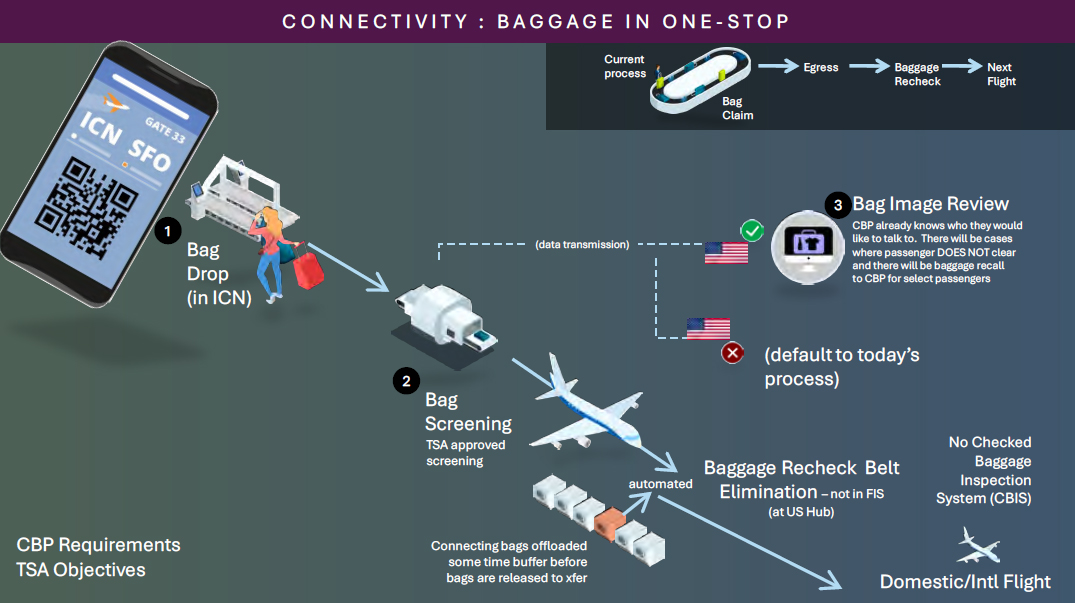
The salient points for the flows involved are
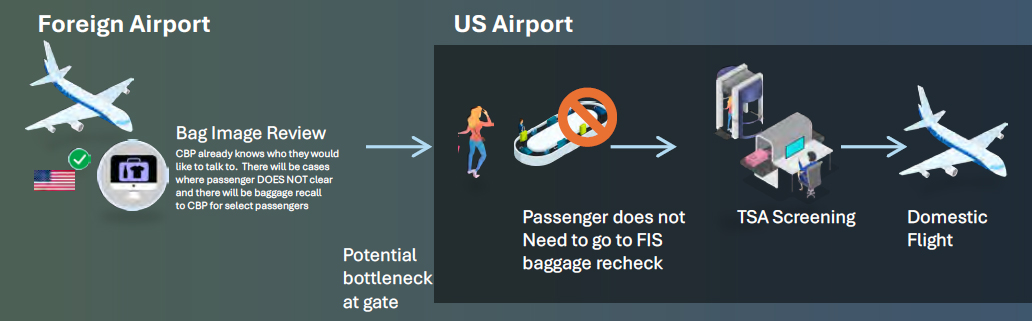
- TSA-approved screening for checked bags in Step 2, suitable for rescreening elimination at a hub airport; and
- Potential for bag image review by CBP based on a foreign explosive detection system.
Participants commented on international remote baggage screening (IRBS, see Figure 17) to emphasize that passengers should not have to pick up bags at the FIS facility before they head to a connecting domestic flight.
Implications for FIS Modernization
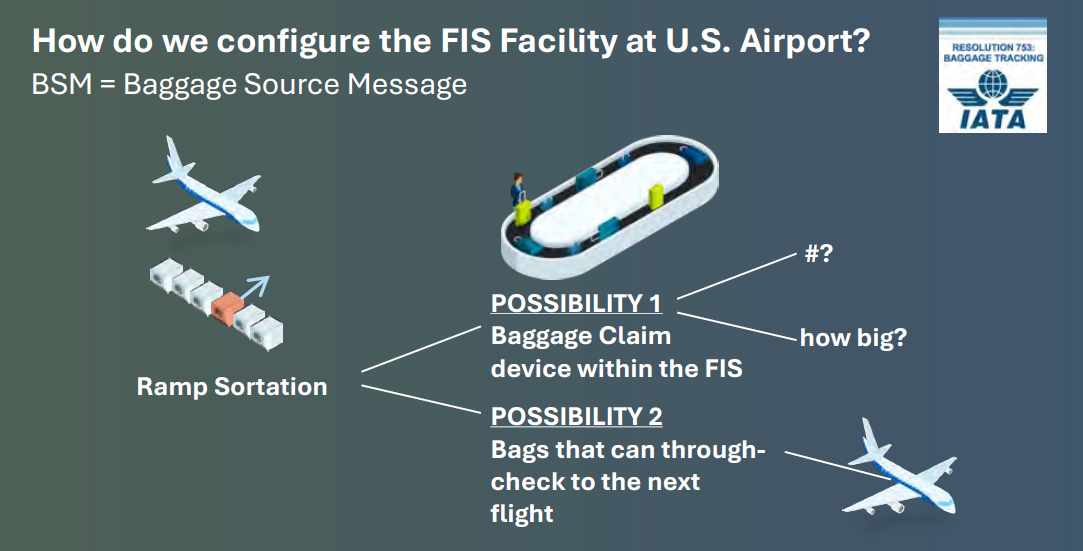
One area of importance for airport planners is determining the size and number of baggage claim devices needed at FIS facilities in U.S. airports. Traditionally, this planning has focused on needs during peak hours. However, if in the future bags may bypass the baggage claim and recheck processes, airport planners must consider two scenarios: first, where bags are claimed in the CBP facility (the status quo) and, second, where bags are through-checked to another domestic U.S. destination without passengers needing to claim them.
Planning for a potential pathway to allow CBP to conduct a secondary referral is an important consideration. This dual approach requires a flexible design capable of handling both scenarios efficiently. As illustrated in Figure 18, there are two aspects of the process where further attention would be helpful. The first is the way airlines sort bags at the ramp to facilitate better connections processing. This involves examining current practices and identifying potential improvements to streamline the transfer process.
Another potential area of focus is the use of baggage source message (BSM) data, as outlined in the International Air Transport Association’s Resolution 753. This standards document provides a framework for tracking and managing baggage, enabling the analysis of BSM data to determine the number of connecting bags and their proportion of total baggage volume. By leveraging this data, airport planners can gain insights into baggage flow patterns and make informed decisions about the design and operation of baggage claim facilities.
In summary, airport planners must adopt a forward-thinking approach to the size and number of baggage claim devices, considering both traditional and emerging scenarios. By incorporating flexible designs and utilizing data-driven insights, airports can enhance the efficiency and effectiveness of their baggage handling processes, ultimately improving the passenger experience.
Additional Research Options Suggested by Participants
Participants identified numerous research projects that might lead to a better understanding of how international bags and passengers connect through U.S. hubs before reaching their final destinations, both inside and outside the United States. One area of research focus suggested by participants was the use of automated guided vehicles (AGVs) for baggage transfers. Research in this area could explore the potential benefits and challenges of implementing the use of AGVs, including their impact on efficiency, costs, and overall baggage handling processes. By examining the feasibility and effectiveness of AGVs, airports can determine whether this technology could enhance their operations.
Another important area of research focuses on trends in individual carrier systems (ICS) and other baggage handling options. This research could analyze the costs, business case, and other aspects of implementing ICS and alternative systems. Understanding the advantages and limitations of different baggage handling technologies can help airports make informed decisions about which systems to adopt, ultimately improving the efficiency and reliability of baggage transfers.
Additional research could focus on reducing the number of bags that need to be claimed inside the CBP facility. This could involve exploring the implications of IRBS on airport operations, as demonstrated by the DFW case. By examining how remote screening can streamline the baggage claim process, airports can identify ways to reduce congestion and improve passenger flow. Similarly, investigating automated bag recheck
systems at transfer airports could provide insights into how technology can facilitate smoother connections for passengers and their luggage. Additional research areas include the way that CBP’s International Remote Baggage Screening initiative, along with other predeparture data-sharing efforts, can improve border clearance processes. Future trends in baggage claim and retrieval systems, event-driven flexibility in baggage handling systems for events such as the FIFA World Cup 2026, and preflight baggage storage systems with pre-screening policies are also critical areas to explore. Additionally, integrating TSA and CBP screening processes for international flights, the potential for digitizing passports, and developing a CBP logistics and staffing model are essential topics that can contribute to more efficient and secure airport operations. By addressing these research areas, airports can better prepare for the evolving needs of international travel and enhance overall passenger experience.
Airports and airlines can also benefit from the systematic collection of specific data points to enhance their planning for connecting bags with passengers, such as the percentage of arriving flights that connect to domestic or international destination and the volume of flows of baggage and passengers. By linking this information to BSM data, airports can gain valuable insights into baggage handling patterns and improve their operational efficiency.
Another important aspect is forecasting volume for checked baggage inspection systems. Accurate forecasting can help airports ensure they have the necessary infrastructure to handle varying volumes of checked baggage, thereby reducing bottlenecks and improving the passenger experience. This data can also inform decisions about investments in new technologies and equipment to enhance baggage inspection processes.
Additionally, knowing the number of passengers who will be cleared before their bags, as well as the number of passengers whose bags will arrive before they do, is essential for optimizing baggage handling and passenger processing. By collecting and analyzing this data, airports can develop more effective strategies for managing the flow of passengers and their luggage, ensuring a smoother and more efficient travel experience for all.
Data on baggage, baggage handling, and hub connectivity can provide critical insights that can help airports and airlines better understand and plan for the complexities of connecting bags with passengers. By leveraging this data, airports and airlines can make informed decisions that enhance operational efficiency, improve passenger satisfaction, and support the seamless movement of travelers and their belongings.


