Modernization of Federal Inspection Services Facilities at U.S. Airports (2025)
Chapter: Breakout Sessions
Breakout Sessions
Overview of Participants and Breakout Sessions
Speakers
Solomon Wong, President and CEO, InterVISTAS Consulting, Moderator
Jennie Santoro, Project Director, Aviation Practice Area Leader, Gensler
Justin Lowe, International Operations Manager, Port of Seattle, Seattle–Tacoma International Airport
Lawrence Studdiford, President and Owner, Studdiford Technical Solutions LLC
John Wagner, Former Deputy Executive Assistant Commissioner, U.S. CBP; President, John Wagner Consulting LLC
One of the core objectives of the ACRP Insight Event was to capture a diversity of viewpoints. An interactive mechanism was used by meeting facilitators to solicit audience input from smartphones and tablets to learn more about participants.
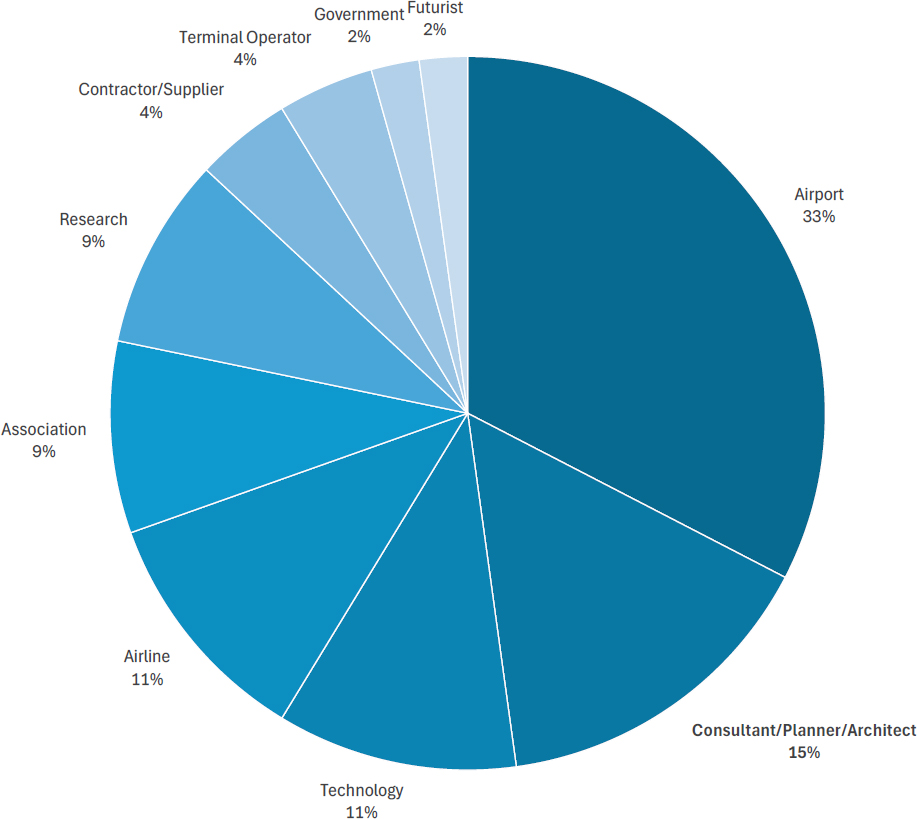
FIS facilities can be operated by airports, terminal operators, or by airlines themselves. As shown in Figure 4, the distribution of participants who attended the Insight Event represented the range of different stakeholders involved in FIS. (Please refer to Appendix A for the list of registrants for the event.)
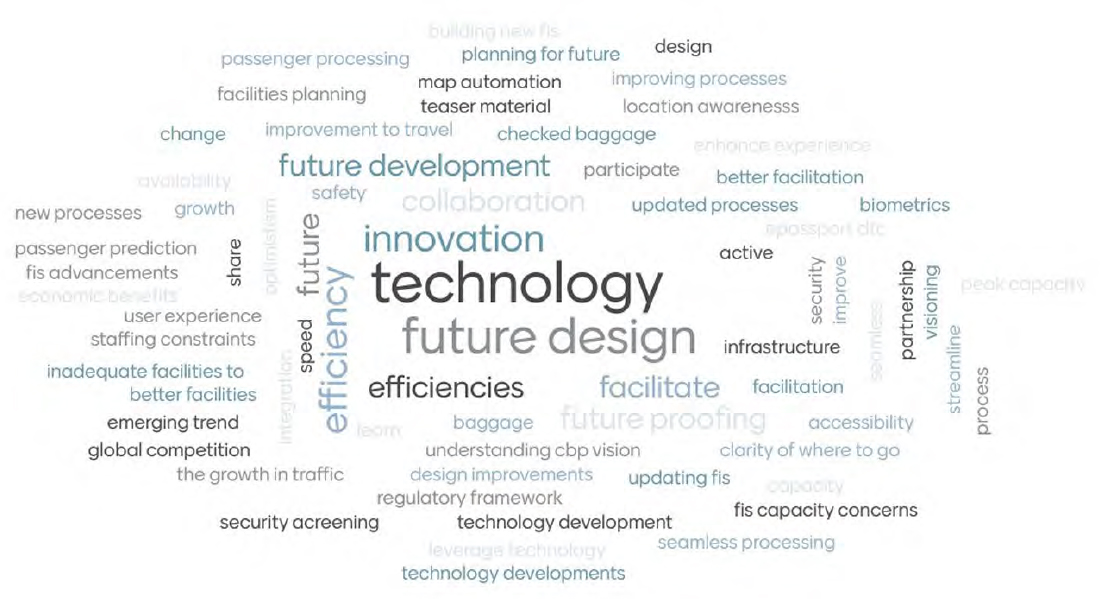
Event participants provided feedback on specific challenges and opportunities when thinking about FIS facility modernization. Out of 92 responses, participants reported topics for consideration for FIS modernization predominantly in technology, future design, innovation, and efficiency of facilities (see the word cloud in Figure 5).
The breakout session moderators advanced brief overviews of the four breakout sessions.
Jennie Santoro, moderator for Breakout Session A: Design Planning and Technology, stated that in 1971, the predecessor agencies for CBP separated processes into “primary” and “secondary.” Shortly thereafter, Seattle–Tacoma International Airport’s Satellite South terminal and other airport facilities designed for Boeing 747s and larger peak-hour volumes were established. The development of airline hubs also contributed to more compressed traffic volume during peak hours. More than 50 years later, design thinking is evolving, incorporating a range of aspects of facility planning.
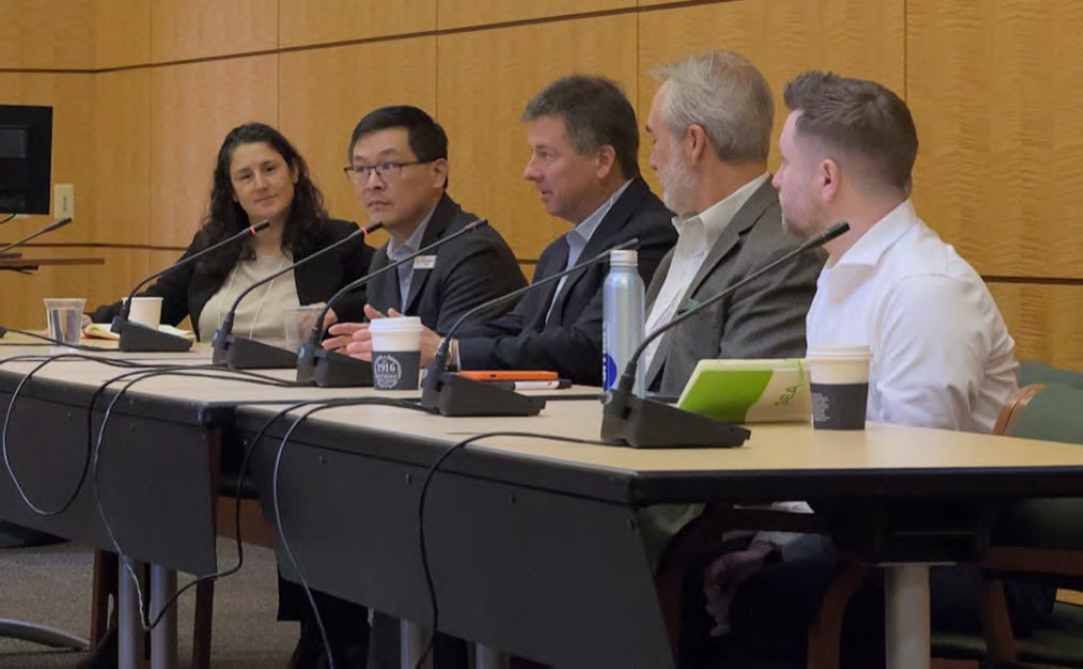
Figure 6. Overview of breakout sessions.
Justin Lowe, moderator for Breakout Session B: Accessibility & Wayfinding, observed that human-centered design and thinking are important considerations for airports to keep in mind. Different times of day bring people from different demographics to FIS facilities: people speaking other languages, or who have disabilities both visible and invisible, may be encountered. With standards and processes that vary between airports, ensuring easy wayfinding for passengers is crucial.
Lawrence Studdiford, moderator for Breakout Session C: Baggage & Connectivity, observed that flexibility in the processing of checked bags for international-to-domestic connections is often overlooked in facility design. This connectivity is vital for airlines, particularly in reducing minimum connection times and establishing reliable schedules. The biggest hassle for older passengers is the number of times bags need to be handled and dropped off, especially during connections. Baggage handling has evolved, with tracking systems that can now locate bags and potentially share images of checked bags between countries.
John Wagner, moderator for Breakout Session D: Risk & Resilience, noted that increasing passenger volume and congestion at airports present significant challenges for CBP, airports, and airlines. As passenger numbers continue to rise, the existing infrastructure struggles to keep pace, leading to longer wait times and overcrowded
facilities, thereby increasing overall risk. CBP’s evolution over the past two decades has seen significant improvements in risk management. FIS facilities have been made more resilient to withstand a range of shocks, from cybersecurity attacks to surges in traveler volumes. Separating the flow of passengers with high or unknown risk from other passenger flows remains effective. CBP’s Traveler Verification Service uses biometric facial recognition technology to verify the identity of travelers. Advanced detection equipment spots hidden border threats such as smuggled fentanyl.
Breakout Session A
Design/Planning & Technology
Panelists
Jennie Santoro, Project Director, Aviation Practice Area Leader, Gensler, Moderator
Justin Lowe, International Operations Manager, Port of Seattle, Seattle–Tacoma International Airport
Lawrence Studdiford, President and Owner, Studdiford Technical Solutions, LLC
John Wagner, Former Deputy Executive Assistant Commissioner, U.S. CBP; President, John Wagner Consulting LLC
Description of Topic
Each stakeholder involved in FIS and CBP design and technology planning has its own objectives, but facilitating efficient passenger processing is in the best interest of all parties. Operational flexibility, which includes efficiently categorizing people, addressing infrastructure challenges, and integrating with airline operations, is crucial.
Balancing staffing and resources during peak terminal usage and incorporating redundancy and flexibility in infrastructure are both essential. Facilities need to be adaptable to mixed use. Managing facility construction and phasing challenges is a significant concern.
Ensuring technical reliability and usability as well as operational and infrastructural consistency is important. Airport planners must integrate new technological developments as well as accessibility standards into their designs. Design adaptations can help ensure that new FIS facilities can accommodate potential new CBP processes and technologies.
The session explored the aspirational vision for facilities as the welcome mat to the United States and areas that can evolve with new technology. Discussions included increasing the flexibility of facilities of all sizes, such as the combined general
aviation/commercial flight FIS in Brownsville, Texas, and shared facilities in larger hubs, to better utilize capital assets.
FIS Modernization
Solutions for 2050: By 2050, several innovative solutions will be enhancing passenger processing and airport facility efficiency. A virtual token will carry passenger information from curb to gate, and U.S. citizens will enjoy a nonstop walk-through process. Prescreening and screening occur at the point of origin, while MPC-style screening happens during the flight. Passengers receive tailored messages and information to pre-queue them before entering the facility. Intelligence about operations provides more real-time information on wait times. Health screening for incoming passengers is integrated, and remote bag processes eliminate the need to carry bags. Advances in technology address space constraints, with some of the advanced solutions of 2025 supporting the 2050 vision.
Future-proofing facilities. To ensure airport planners and designers are prepared for future demands on FIS facilities, focus should be placed on creating operational flexibility through such measures as establishing swing spaces and multifunctional areas and enabling mobile capabilities for staff covering multiple locations (see Figure 7). Enhancing screening processes and creating appropriate screening locations for the development of advanced air mobility (AAM) systems are essential. Minimally invasive screening processes are predicted to reduce processing bottlenecks in the future. Accurate estimation of time in process is crucial, as is strengthening cybersecurity and information security to ensure system resilience in case of failures. Managing the perception of wait time and the actual time spent in the process is also important.

Figure 7. CBP depiction of mobile interview.
Breakout Session B
Accessibility & Wayfinding
Panelists
Justin Lowe, International Operations Manager, Port of Seattle, Seattle–Tacoma International Airport, Moderator
Jennie Santoro, Project Director, Aviation Practice Area Leader, Gensler
Lawrence Studdiford, President and Owner, Studdiford Technical Solutions, LLC
John Wagner, Former Deputy Executive Assistant Commissioner, U.S. CBP; President, John Wagner Consulting LLC
Description of Topic
The breakout session identified several key challenges to improving accessibility and wayfinding at airports. A shortage of trained staff to assist passengers with disabilities impacts the level of support available. Non-English-speaking travelers can face language barriers; travelers with disabilities may find that wheelchairs are unavailable. Passengers often struggle with the technologies used in FIS, leading to confusion and delays. The current wayfinding process for international arrivals is not sufficiently effective. The arrival process for passengers, from the time a plane lands through FIS, lacks personalization and adequate guidance. Passengers are expected to know where they are going; instead, they often feel uncertain about where to go and what to do next. Passengers may struggle to get into the right queue or arrive at the correct queue on time. Passenger uncertainty is exacerbated by confusing signs and poor wayfinding within the airport. This is a problem that CBP and airports must resolve jointly.
Standardization of procedures, technologies, and signage across airports can help streamline operations and reduce the time passengers spend in CBP processing and in navigating the airport. The session discussed the potential for dynamic wayfinding, which finds the fastest route through a facility on any given day. As facilities become less static and more dynamic, the challenge will be to ensure that users can navigate international clearance and CBP processes easily. The session highlighted the need for simplified pathways, better lighting, and universal signage systems to enhance the passenger experience at airports.
FIS Modernization
In the modernized airport of 2050, several innovative solutions will have been implemented to enhance accessibility at CBP facilities. Addressing language issues is a priority, ensuring that non-English-speaking passengers can navigate the airport with ease. Facility designs are optimized to minimize walking distances, making the journey
more comfortable for all passengers. Enabling passenger self-sufficiency is a key focus, allowing people to navigate the airport efficiently on their own.
Creating a welcoming and kinder environment for first-time travelers is emphasized. More customer service staff and customs officers are able to process and provide better support for travelers, including those with mobility or hearing disabilities. Standardization across all airports has been achieved while retaining airport flexibility and a local sense of place. A holistic approach enhances the overall passenger journey.
Solutions for 2050: By 2050, several solutions will have been implemented to improve wayfinding. Simplifying and reducing the number of pathways has made navigation easier for passengers, and wayfinding systems have been made universal and consistent across all airports while allowing for local customization to retain a sense of place. App-based mobile pathways facilitate easier movement through the airport. Entry points have been consolidated to streamline the process. Enhanced collaboration between CBP and airlines ensures that passengers are well-informed about the process for each entry path. Face-recognition technology has been implemented to efficiently process each passenger, and a balance has been struck between cutting costs and providing excellent customer service. The process of handling checked bags has been improved to remove them from the FIS, benefiting passengers with connecting flights. Additionally, various methods for passengers to seek help have been developed, ensuring that support is readily available when needed.
The Sunflower Lanyard Program has been expanded to identify passengers who may need additional assistance. Often, the presence of a disability is thought of in terms of visible signs, such as a wheelchair or the use of devices to help visually impaired individuals. The sunflower is a globally recognized symbol to help highlight invisible disabilities discreetly, including but not limited to autism, PTSD, and other conditions that might not be immediately apparent.
Future-proofing facilities. To ensure that CBP facilities are prepared for future demand, several key accessibility considerations have been identified. The introduction of self-driving wheelchairs will enhance mobility for passengers with disabilities, while wider queuing areas will improve passenger flow through security and inspection points. Multiple resting areas will be provided to offer passengers a place to relax during their journey, and moving sidewalks will facilitate faster, easier movement through the airport.
Simplifying and reducing the number of pathways through an airport minimize confusion. Reducing clutter and maintaining open spaces improve navigation. The use of brighter signs, static floor lights, and colors that comply with standards of the Americans with Disabilities Act enhances and ensures visibility and accessibility. Consolidated lines streamline passenger flow, and forward-facing booths promote easier interaction. Applying human-centered principles to signage makes signs easier to understand, further enhancing the passenger experience.
These future-proofing strategies aim to create a more efficient, accessible, and comfortable environment for all passengers, ensuring that CBP facilities can adapt to evolving needs and technologies.
Breakout Session C
Baggage & Connectivity
Panelists
Lawrence Studdiford, President and Owner, Studdiford Technical Solutions, LLC, Moderator
Jennie Santoro, Project Director, Aviation Practice Area Leader, Gensler
Justin Lowe, International Operations Manager, Port of Seattle, Seattle–Tacoma International Airport
John Wagner, Former Deputy Executive Assistant Commissioner, U.S. CBP; President, John Wagner Consulting LLC
Description of Topic
The primary challenges faced by passengers and their checked bags at CBP facilities in international airports revolve around efficiency, reliability, and trust. One significant issue is the need to expedite the process of getting bags on connecting flights through FIS. Additionally, the current stopping points can be problematic due to the number of claim devices involved, long receiving times, and multiple touchpoints, which contribute to delays and passenger frustration.
Manual bag screening is another area of concern, affected by changes in staffing levels and high arrival volumes at peak times. Physical constraints, such as limited facility size and bag volume, affect efficient movement and processing. Reliability issues, including the inconsistent and uncertain baggage arrival and flight connection times, can further complicate the passenger experience. Varying minimum connection times and differences between checked and unchecked bags add to reliability concerns.
Inconsistent messaging and competing regulatory priorities between agencies regarding baggage create additional layers of complexity. Building and maintaining passenger trust, as well as fostering trust between international partners, are essential for improving the system.
The session highlighted the importance of considering baggage and connectivity in facility planning to determine when and where bags and passengers can be reunited for CBP processing.
FIS Modernization
As of 2025, the harmonization of screening algorithms and baggage systems is one of the most advanced achievements in FIS modernization. Significant progress has been made in making these processes and technologies universal across airports, leading to a more streamlined and efficient experience for passengers and airport operations.
Solutions for 2050: By 2050, several innovative solutions will have been implemented to enhance the efficiency of international processing at U.S. airports by CBP. One significant change is removing the need for connecting bags to be processed through FIS, unless a secondary referral requires special CBP processing. This direction could streamline the arrivals process and reduce congestion. Additionally, improved sorting methods have been introduced, ensuring better coordination between baggage and passenger sorting processes and enhancing overall efficiency.
A crucial aspect of these advancements is maintaining an equilibrium between staffing and technology. By achieving a balance, airports can optimize human resources while leveraging technological solutions to maintain high service standards. Detection standards have also been better aligned and standardized, ensuring consistent and reliable security measures across all airports.
The scalability of one-stop security measures has been a key focus, enabling these systems to be efficiently scaled up as needed. The expansion of preclearance facilities abroad has further streamlined the processing of international passengers, reducing the burden on domestic facilities. Moreover, globally recognized screening methods, such as preflight bag screening, have significantly reduced processing times at FIS.
Advances in AI interpretation of screening requirements, combined with robust cybersecurity measures, further enhance the efficiency and speed of screening processes, keeping pace with the flow of passengers and baggage. The introduction of bag fingerprinting, biometrics, and radio-frequency identification (RFID) tracking allows for continuous monitoring of every bag throughout its journey, providing an added layer of security and convenience. Remote bag drops let passengers drop off their bags before arriving at the airport, and bypassing baggage claim allows their bags to be sent directly to their destination, such as their hotel or home. Airports will have shifted their focus towards the total cost of system ownership, considering long-term operational costs rather than just upfront expenses, ensuring more sustainable and cost-effective solutions.
Future-proofing facilities. To future-proof airport facilities, the focus should be on several key areas. Technology plays a vital role, with improved infrastructure needed to track passengers and baggage simultaneously, as well as combination screening to enable the same equipment to deal with different threats. Updates to existing
technology are necessary to reflect new capabilities and better enable international standardization and harmonization.
Robust IT infrastructure is crucial to support technological advancements, ensuring seamless operations. Technology needs to be flexible enough to track the status of every bag, whether inbound, outbound, or transferring, and whether screened or unscreened (see Figure 8). Securing funding for design improvements is also vital to adapt and enhance facilities and processes.
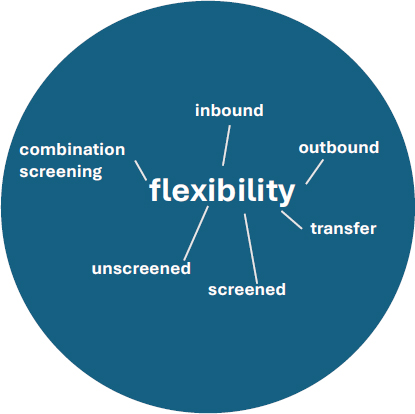
Removing the requirement for physical infrastructure for baggage processing can lead to more efficient operations. Lastly, regulations should be focused on outcomes, with specific performance requirements, and should remain technology-agnostic to keep pace with evolving technological capabilities.
Breakout Session D
Risk & Resilience
Panelists
John Wagner, Former Deputy Executive Assistant Commissioner, U.S. CBP; President, John Wagner Consulting LLC, Moderator
Jennie Santoro, Project Director, Aviation Practice Area Leader, Gensler
Justin Lowe, International Operations Manager, Port of Seattle, Seattle–Tacoma International Airport
Lawrence Studdiford, President and Owner, Studdiford Technical Solutions, LLC
Description of Topic
Regulatory constraints hinder the modernization of border processing systems. Outdated regulations can limit the adoption of new technologies and processes that could enhance efficiency and security. Managing diverse traveler types, from seasoned visa holders to first-time arrivals, adds another layer of complexity, requiring tailored approaches to ensure smooth processing for all passengers.
Processing times for non-eligible travelers remains a persistent challenge, often leading to delays and increased workload for CBP officers. Shifting levels of operational efficiency and a heavy reliance on manual processes further strains resources and reduces overall effectiveness and efficiency of processing. Personalization and segmentation of services are challenging to manage, as different traveler profiles require different levels of scrutiny and service.
Determining what travelers will declare is another significant challenge. The current system relies heavily on manual interventions, which, while necessary, are time-consuming and can lead to bottlenecks. Secondary checks for every traveler add to the processing time, making it difficult to maintain a smooth flow of passengers.
Implementation challenges arise. Some airports and airlines are willing to try new processes and technologies, while others are held back by fear of failure or general risk aversion. While not universal across all entities, the motives of profit and public service can sometimes be misaligned and impede progress.
FIS Modernization
By 2050, the way risk and resilience are managed in border processing will have been transformed by the modernization of FIS. One of the key advancements is segmented traveler processing (see Figure 9), through which travelers are categorized based on risk, eligibility, and travel history, as tracked by advanced data systems. This segmentation enables more efficient and targeted processing, ensuring that resources are allocated where they are most needed.
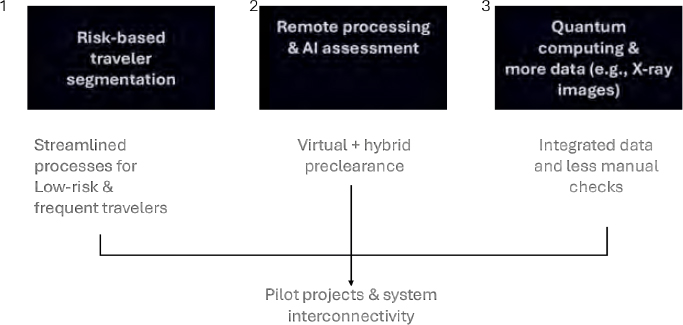
Solutions for 2050: By 2050, virtual facilities and pre-arrival processing—such as inflight border clearances and the use of digital travel credentials—will be commonplace. The need for extensive physical infrastructure at airports will be reduced, as much of the CBP processing will be completed before travelers even land. Advanced AI and biometric systems will play a crucial role in identity verification and risk management, ensuring a high level of security while minimizing manual intervention.
Processing systems will rely more heavily on technology, with individualized, data-driven risk assessments becoming standard. Detailed global data will be shared with national security agencies, enabling risk assessments to be conducted before travelers board their flights. Officers will use wearable technology for virtual inspections, enhancing flexibility and efficiency in remote operations.
Congestion will be reduced and the overall travel experience improved through streamlined processes for frequent and low-risk travelers, automated passport control and risk-based traveler segmentation programs, and advanced baggage imaging systems. Biometric checks using facial recognition while passengers are in motion will be tested.
Pilot programs for remote processing and AI-based assessments will also be tested and refined, paving the way for broader implementation. Privacy concerns will need to be carefully managed. Efficiency and security will be further enhanced through experimentation with virtual and hybrid pre-clearance systems.
System interconnectivity will be prioritized to ensure that various technologies and processes function seamlessly together. Routine tasks will be automated, with human oversight ensuring secure and efficient screenings. Manual checks will be minimized through real-time data integration, enhancing both speed and accuracy.
Data tracking will be revolutionized by quantum computing, enabling the analysis of travel patterns and transactions to identify potential risks. A risk-based, data-driven
approach to screening will be adopted as standard practice, and airlines will explore innovative technologies to reduce confusion and improve passenger experience.
Continuous improvement will be supported by fostering a culture of trial and error. The adoption of new technologies and processes will be facilitated by organizational changes that embrace innovation, ensuring that the modernization of FIS keeps pace with evolving threats and opportunities. Through these efforts, airports, airlines, and CBP, working collaboratively, will create a resilient and efficient border processing system for the future.


