Stormwater Retrofit Programs and Practices Through Third-Party Partnerships (2025)
Chapter: 3 Survey Questionnaire Results
CHAPTER 3
Survey Questionnaire Results
3.1 Questionnaire Rationale
A survey consisting of 25 questions was prepared using the Alchemer online platform and distributed to all the states, Puerto Rico, and the District of Columbia. The survey consisted of questions designed to identify varying levels of general stormwater quality efforts among the states, as well as more specific questions regarding regional- or watershed-level efforts in stormwater quality, the types of partnerships the agency participated in, and how those partnerships are structured.
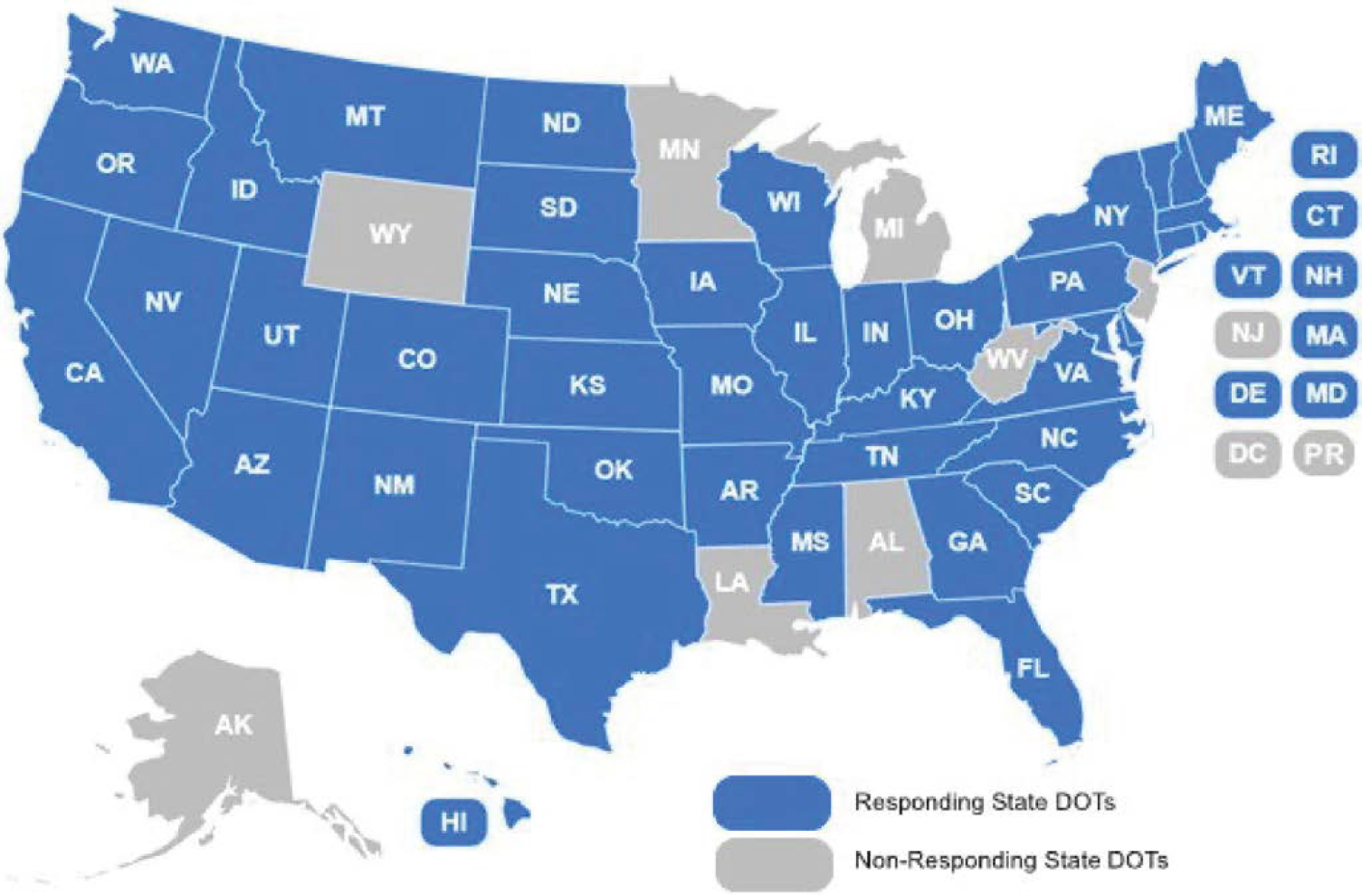
Forty-two state DOTs responded to the survey. Seven of the 42, which had no partnership or regional or offsite stormwater quality experience, did not answer the questions on the survey regarding those issues. Figure 3.1 shows the states that responded to the survey.
A wide geographic variation was obtained, with all regions of the country, a variety of climate and landform types, and urban versus rural states represented. The 25 questions were ordered first to find general information regarding stormwater programs then to get more specific information regarding partnerships and regional or watershed-based efforts, as well as to compare practices regarding new development versus retrofits. Twenty of the questions were multiple choice, with 10 seeking a single response representing the predominant situation in the state and 10 allowing the respondent to select all that apply. Eleven of the multiple-choice questions also included an option for “other” and the request that the respondent specify what the “other” might be. Four of the multiple-choice questions included an option to respond that none of the listed choices applied. Three questions were yes/no, and two were short answer. Four of the questions included follow-up questions only asked based on the response to the original. The final question of the survey asked whether the respondent was interested in participating in a follow-up interview to delve into more details about the state DOT’s stormwater program.
3.2 Questionnaire Synopsis
A listing of the 25 questions and a summary of the responses follows. The complete survey is included in Appendix A, and a complete tabulation of responses is included in Appendix B.
The first five questions of the survey asked for contact information and established whether the respondent DOT owns or manages permanent stormwater facilities, as well as what regulatory agencies the DOT operates under and what type of permits the DOT holds for their permanent stormwater facilities. Thirty-five of the respondents own or operate permanent stormwater facilities, while seven do not. Of the seven that do not own or operate such facilities, four state DOTs indicate that such facilities do not exist, and two state DOTs respond that they exist but are owned or managed by a local agency. One DOT wrote that these facilities are limited within the DOT and the few that they own or operate were likely included in the designs by a local public agency.
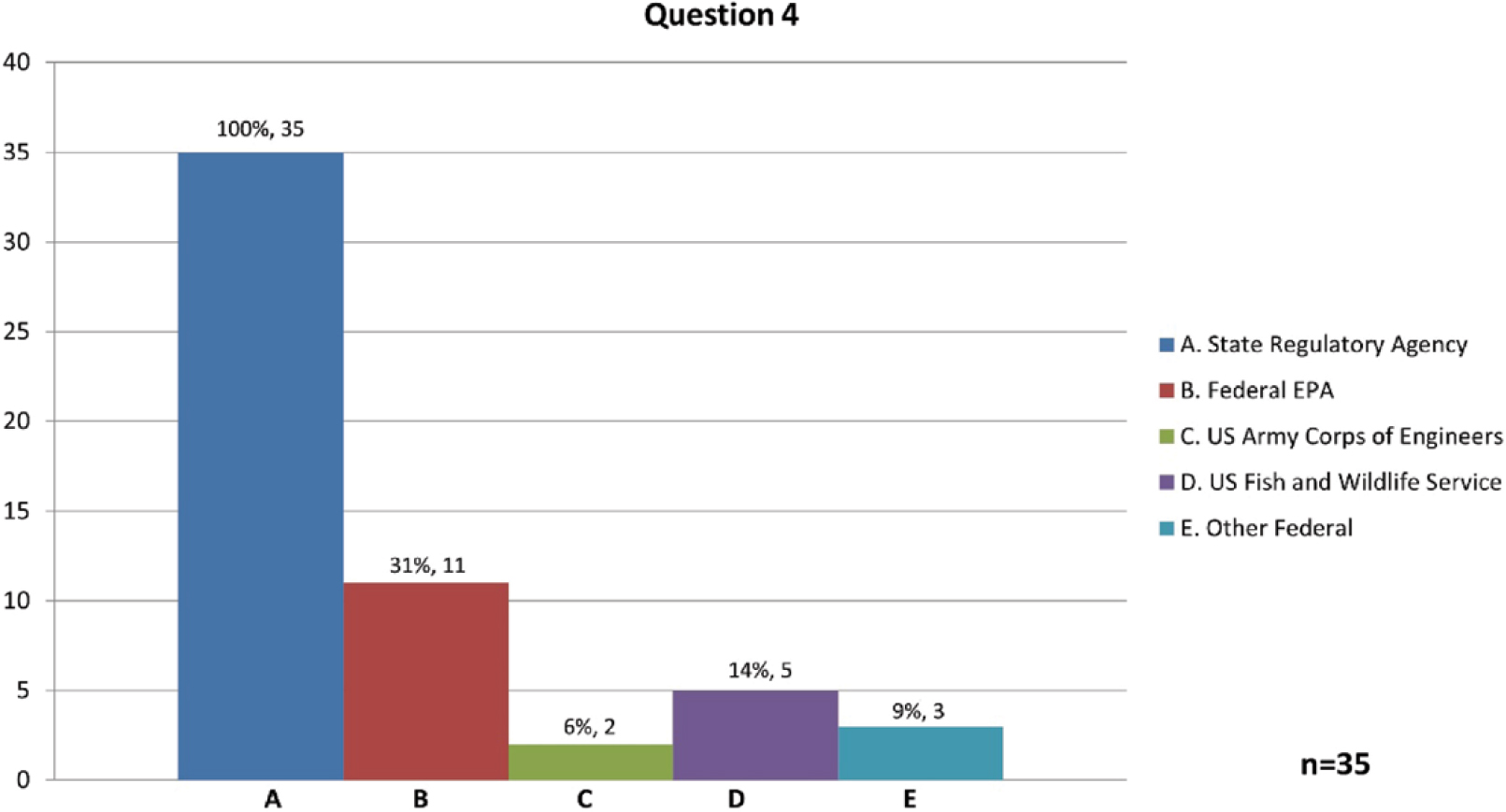
Of the 35 state DOTs that own or operate permanent stormwater facilities, all are regulated by a state agency (Figure 3.2). Sixteen of the respondents indicated other regulatory instruments also apply, including those from the National Oceanic and Atmospheric Administration (NOAA) and the National Marine Fisheries Service (NMFS).
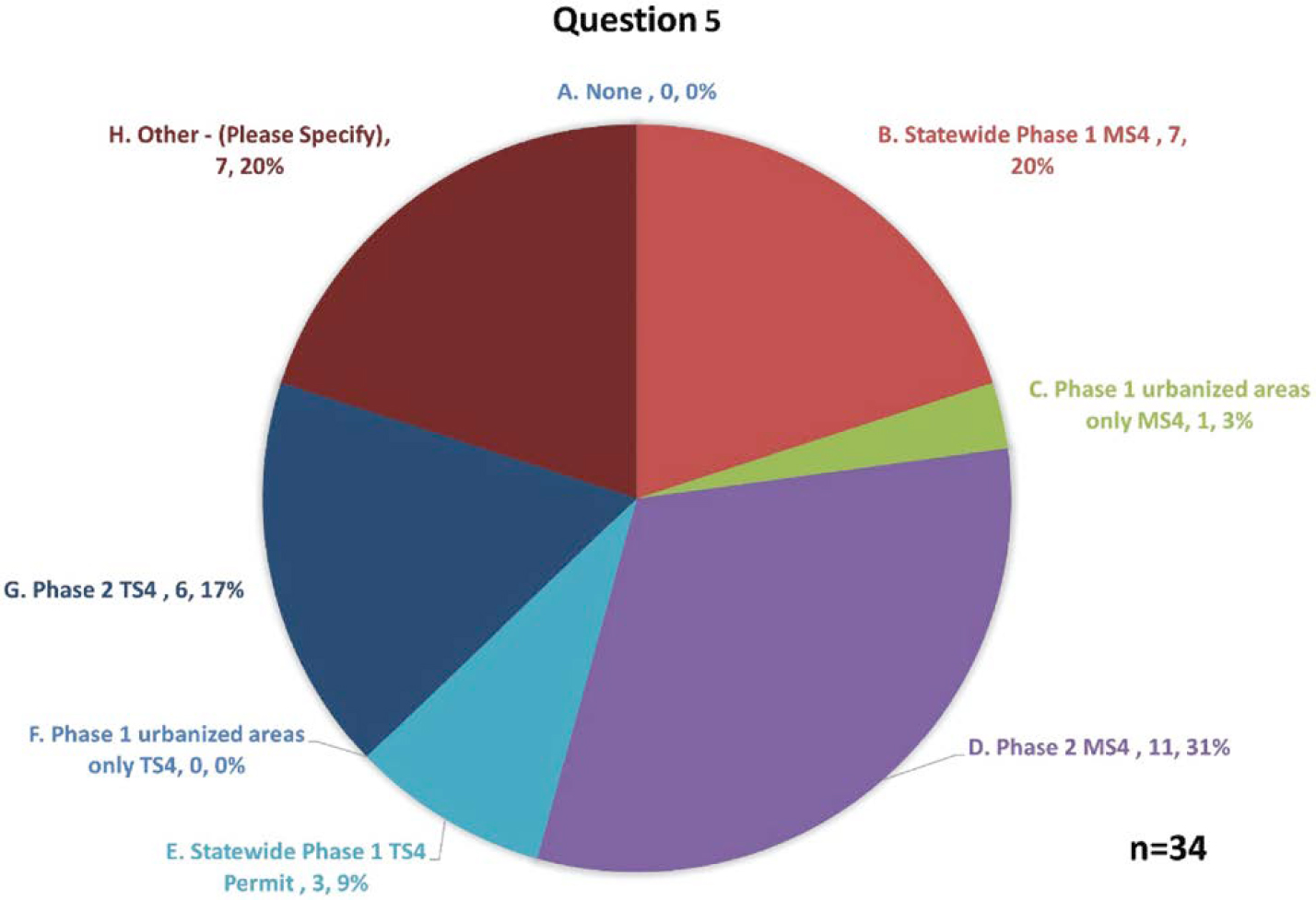
Nineteen of the 34 respondents hold some variety of an MS4 permit, while nine hold a TS4 permit. The seven DOTs that responded “other” each hold a variety of permits, a common arrangement being both a Phase 1 MS4 in urbanized areas and a Phase 2 MS4 for either the remainder of the state or for only the less-urbanized areas eligible for Phase 2 (Figure 3.3).
Question 4: Which agencies regulate your transportation facilities and require permanent stormwater facilities? (Select all that apply.)
Question 5: What type of separate storm sewer system (MS4 or TS4) permit does your DOT hold?
The next five questions explored the use of retrofit construction, whereby permanent stormwater facilities are constructed to reduce, minimize, or treat runoff from existing transportation facilities. Respondents were asked whether they owned or operated such facilities and the regulatory or other reasons that require their development. Respondents were then asked to identify specific triggers that initiate these retrofits, the specific types of retrofit facilities they own or operate, and how those efforts are funded. Finally, the responding DOTs were asked whether they had any written guidance for the construction and performance of such facilities and any written guidance for third-party agreements.
Question 6: Does your DOT have a stormwater retrofit program where permanent stormwater facilities are constructed to reduce, minimize, or treat runoff from existing facilities?
Eighteen of the 35 respondents have a retrofit program, 15 do not, and two state DOTs have such a program, but it exists in name only and is not funded or staffed.
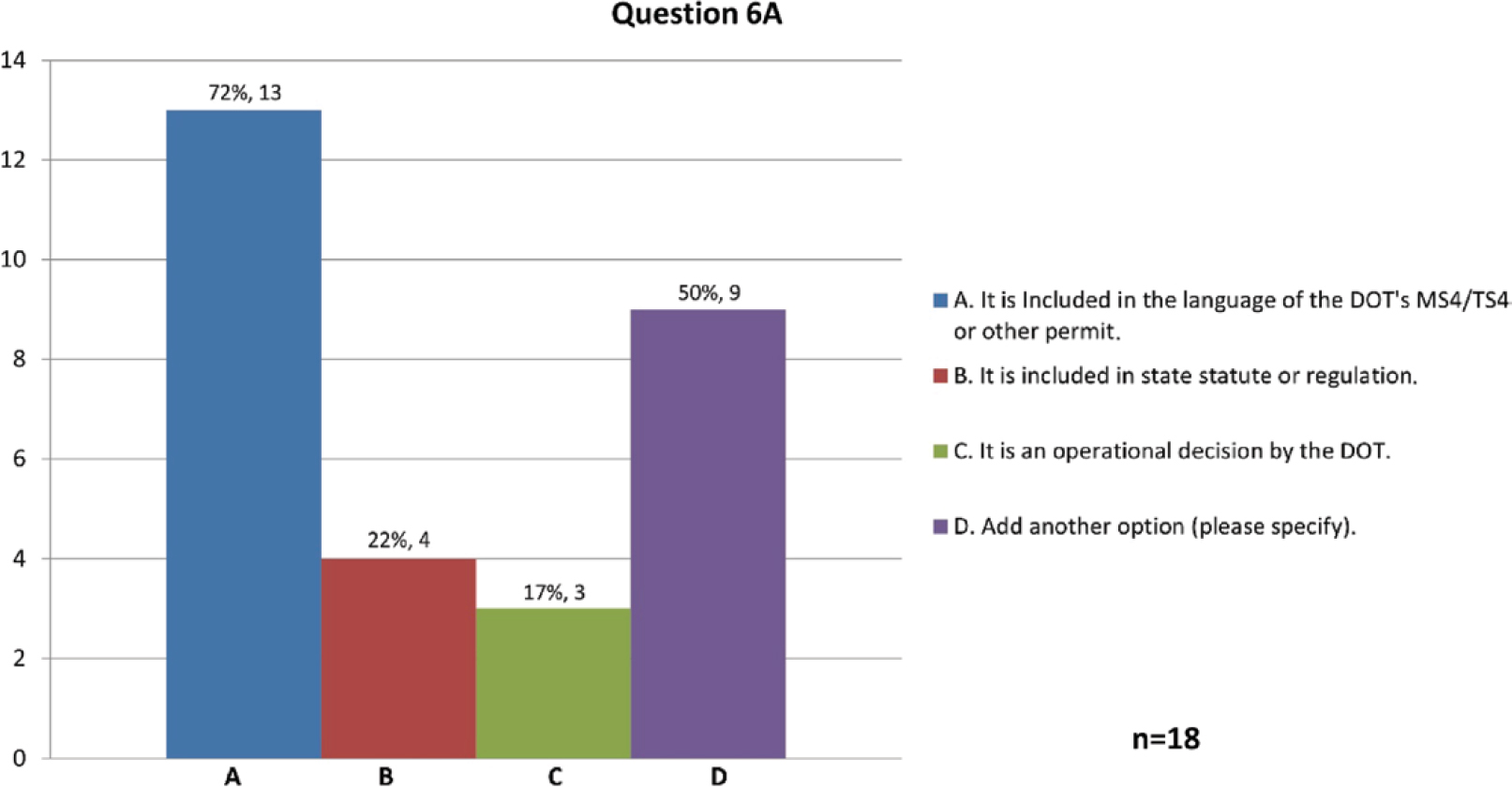
The follow-up question, 6A, asked, “If you responded yes to question 6, what regulation motivates the establishment of this permanent stormwater facility retrofit program? (Select all that apply.)”
Thirteen of the 18 respondents indicated that the requirement is included in their MS4/TS4 permit (Figure 3.4). Of the 9 respondents who chose “other,” 2 listed an EPA or U.S. Department of Justice (DOJ) consent decree, 2 listed TMDL reductions, and one listed the Endangered Species Act. One respondent, the Pennsylvania DOT, expanded on their MS4 permit language. The Pennsylvania DOT permit requires certain pollutant load reductions from existing facilities but does not mandate how those reductions are achieved. Stormwater “retrofits” are available to the Pennsylvania DOT, but they have been minimally used to this point. The New York DOT noted that the language in their MS4 permit has been taken from TMDL implementation plans.
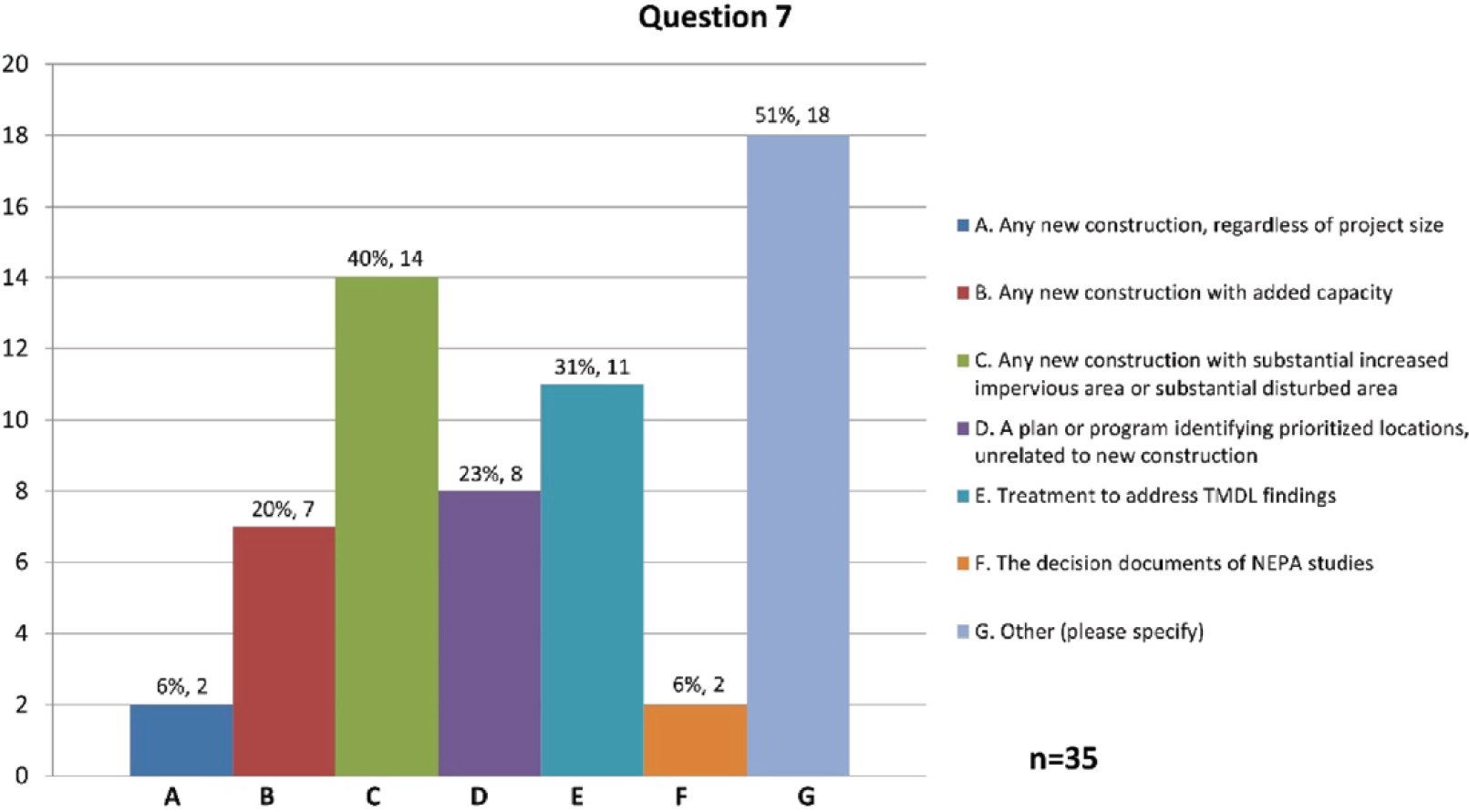
Question 7: What triggers the construction of the permanent stormwater facility retrofits? (Select all that apply.)
Fourteen of the 35 respondents listed impervious area as a trigger, while 7 included new construction with increased capacity and 8 listed prioritized locations (Figure 3.5). Eleven of 35 included TMDL findings. Among the 18 respondents who answered “other,” 2 states listed sensitive waters or aquifers; one listed EPA/DOJ consent decrees; and 2 listed nutrient load reduction strategies either included in the MS4 permit or independent of the MS4 permit.
Question 8: What types of permanent stormwater facility retrofits does your DOT utilize? (Select all that apply.)
Figure 3.6 shows that flow-through filtration is the predominant method of stormwater management, followed by retention and detention facilities. There is notable use of other features like
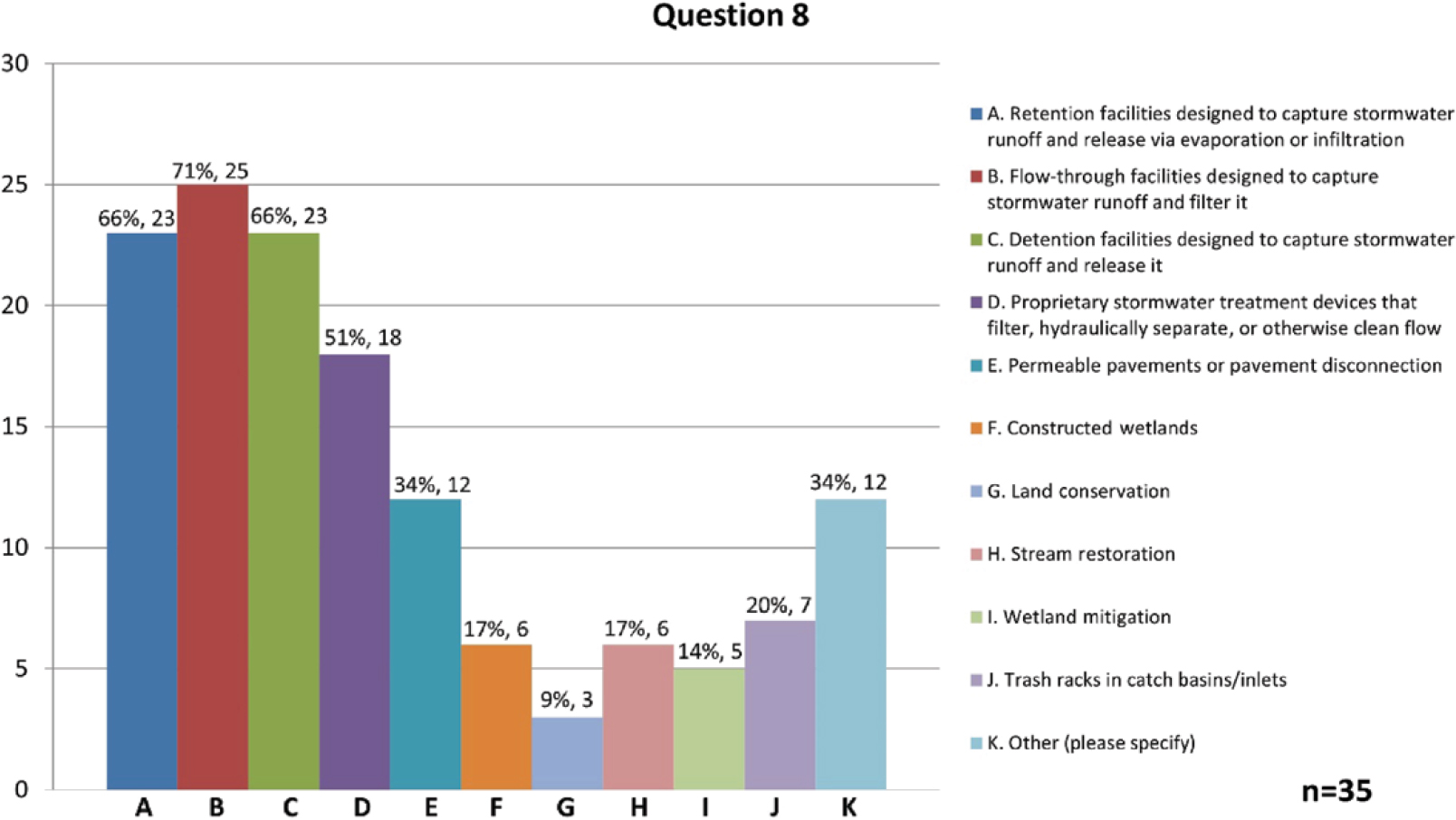
permeable pavement, constructed wetlands, and stream restoration. The devices listed in the “other” responses include deep sump inlets and grass-lined swales. Some “other” responses could be included in the larger categories. For example, grass-lined swales are flow-through facilities, while deep sump inlets with a sealed bottom are a type of detention facility and those with an open bottom are a type of retention facility.
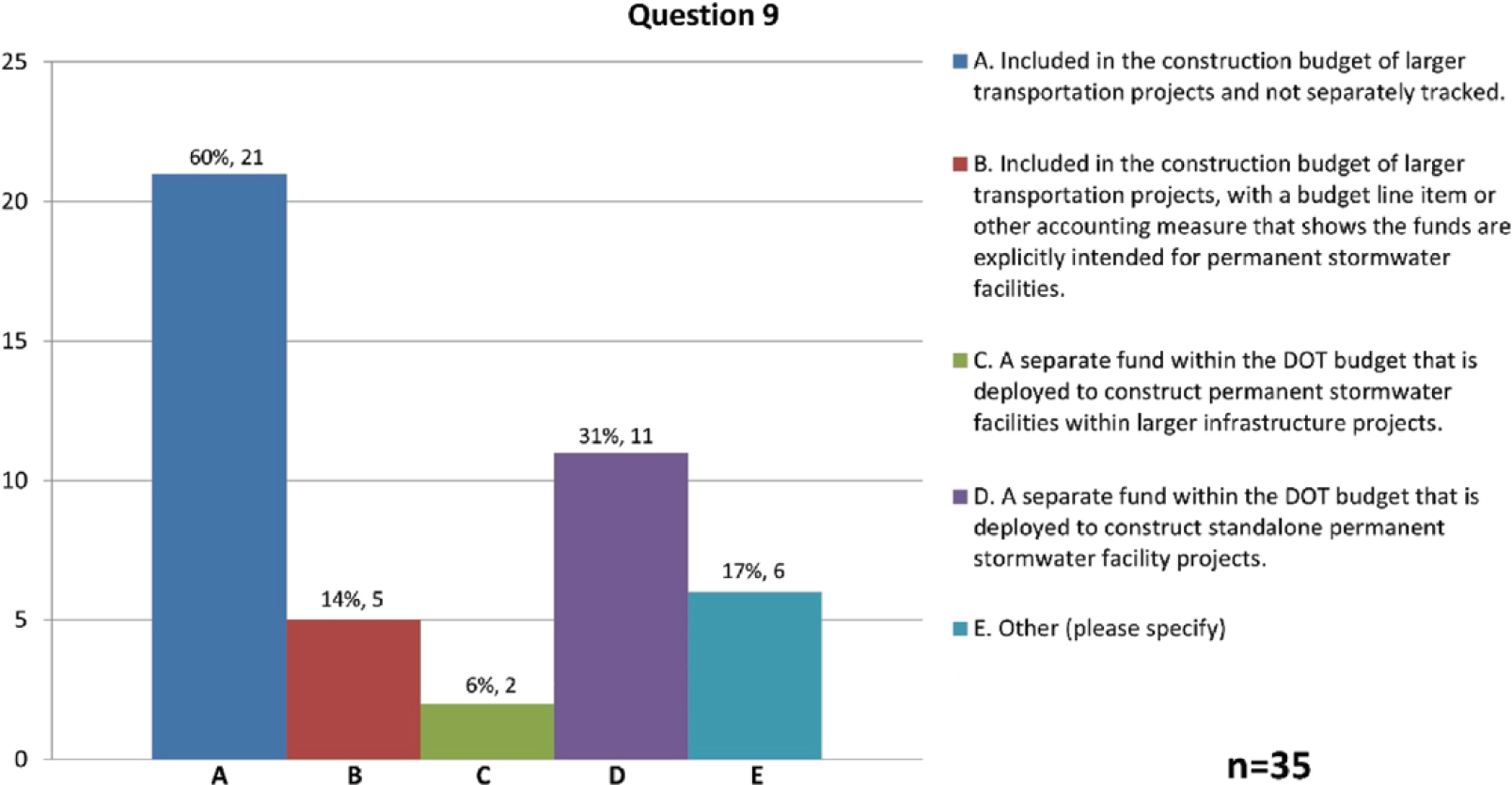
Question 9: How is the construction of permanent stormwater facility retrofits funded? (Select all that apply.)
Of the 35 responses received for the question asking how retrofits are funded, 21, or 60% indicated that stormwater facility retrofits are included in the budget of larger projects and not separately tracked, while 11 respondents indicated that their DOT uses a separate fund to construct stand-alone facilities (Figure 3.7). Items listed in the “other” category include maintenance funding for BMP retrofits, MS4 TMDL restoration funding, and public-private partnerships. Five of the 6 respondents who answered “other” noted that they have no retrofit program, so those responses are not included in the analysis.
Question 10: Does your DOT have any written guidance on the establishment of third-party agreements for permanent stormwater facility retrofits?
Four state DOTs—Connecticut, Delaware, Indiana, and New Hampshire—responded yes, and 31 responded no. The remaining states did not respond. The Delaware DOT uploaded their shared use agreement template, and it is included in Appendix E.
Question 11: Does your DOT have any written guidance regarding the performance, inspection, operation, and maintenance of permanent stormwater facilities?
Twenty-two of the 35 respondents indicated that they have such guidance, but only for DOT-owned facilities. Five DOTs have guidance for both DOT- and third-party–owned facilities, and 8 respondents have no guidance. Twenty states uploaded documents to the survey.
The next group of questions examined the responding DOTs’ approach to offsite runoff, overlapping MS4 regulations, third-party partnerships, and the extent and structure of those partnerships.
Question 12: When constructing or funding permanent stormwater facility retrofits, does your DOT design the facility to treat runoff from non-DOT sources?
Figure 3.8 shows how often responding DOTs design facilities that treat non-DOT runoff. The respondents that answered “never” were then asked whether their DOT had ever considered or pursued constructing or funding permanent stormwater facility retrofits to treat runoff from non-DOT sources but had not completed the project. One of the 14 states indicated that this was the case.
Similarly, respondents that had constructed facilities to treat non-DOT runoff were asked what motivated that construction. Of the 20 states responding to the follow-up question, 5 treated offsite flows to eliminate the need for onsite flow treatment that might be more difficult, 4 said the practice is mandated by a regulator, 2 indicated they are motivated by a stormwater quality banking system, 3 participate in a regional watershed quality cooperative, and 6 responded “other.” The notable reason listed under “other” is commingled runoff, noted by 4 of the 6, with TMDL treatment and regulatory requirements listed by the other 2.
Question 13: When your DOT works within the boundaries of other MS4 permittees (municipalities, counties, etc.), which MS4/TS4 permit requirements are controlling for improvements constructed by your DOT?
Seventeen of the 34 respondents follow the state DOT permit requirements, 2 follow the underlying municipalities, 5 follow whichever was more stringent, and 10 respondents indicated that it varies depending on the situation.
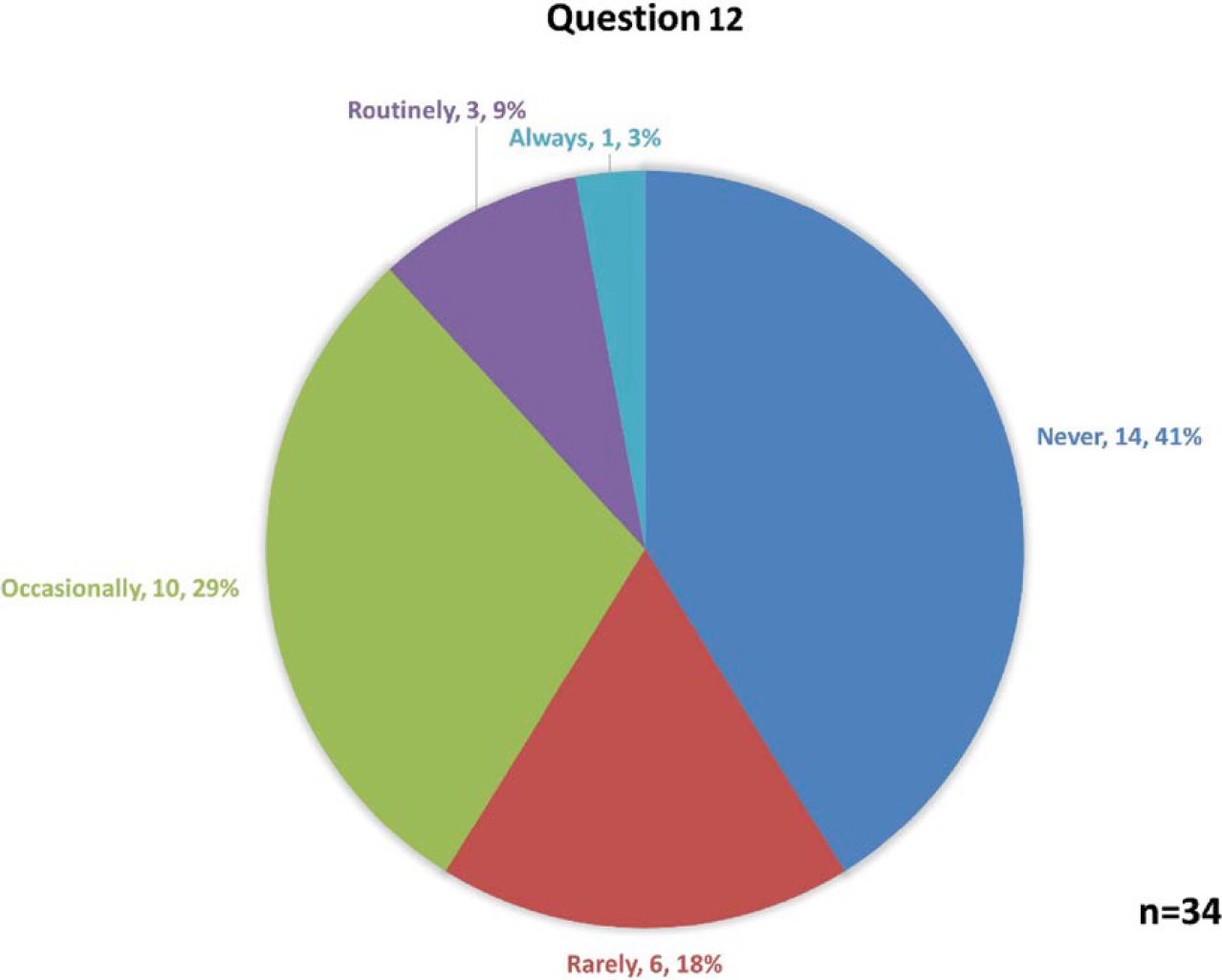
Table 3.1. Fraction of facilities with third-party partners.
| Percentage Ranges | Constructed with Third-Party Partners | Operated or Maintained with Third-Party Partners |
|---|---|---|
| 0% | 12 | 14 |
| 1% to 10% | 17 | 14 |
| 11% to 20% | 1 | 1 |
| 21% to 30% | 1 | 1 |
| 31% to 50% | 0 | 2 |
| 51% to 100% | 1 | 0 |
Questions 14 and 15 asked what approximate percentage of a DOT’s permanent stormwater facilities were either constructed or operated and maintained with third-party partners. Thirty-two states responded to each question with the distribution of responses shown in Table 3.1.
Questions 14 and 15 demonstrate that the vast majority of the responding DOTs have relatively few facilities constructed or operated via partnerships. The states that indicated they have construction partnerships that cover more than 10% of their inventory are Colorado, South Carolina, and Virginia. Responding DOTs that indicated they have operation or maintenance partnerships covering more than 10% of their inventory are Colorado, Florida, Nebraska, and Virginia.
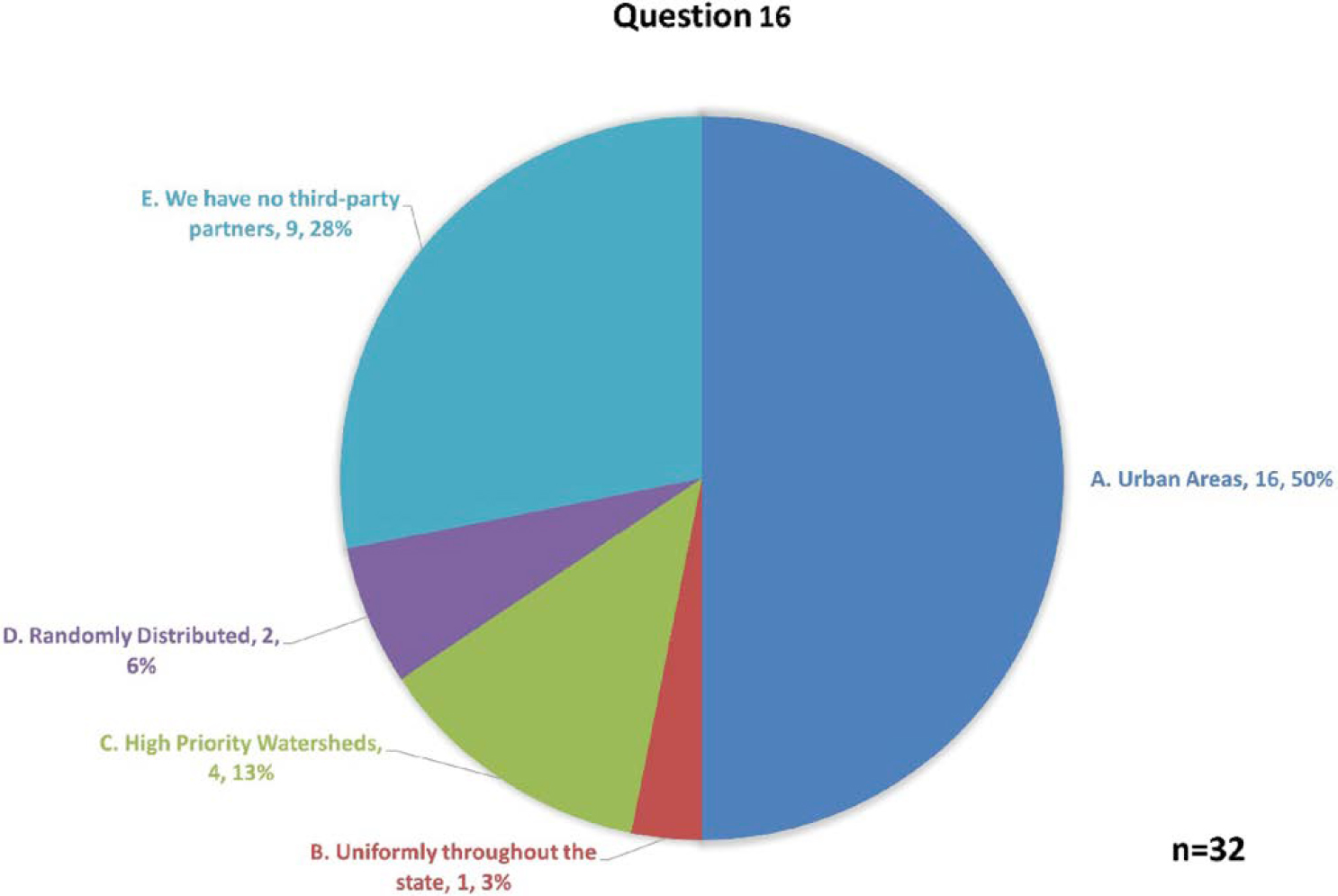
Question 16: Are your DOT third-party partners primarily located in . . . ?
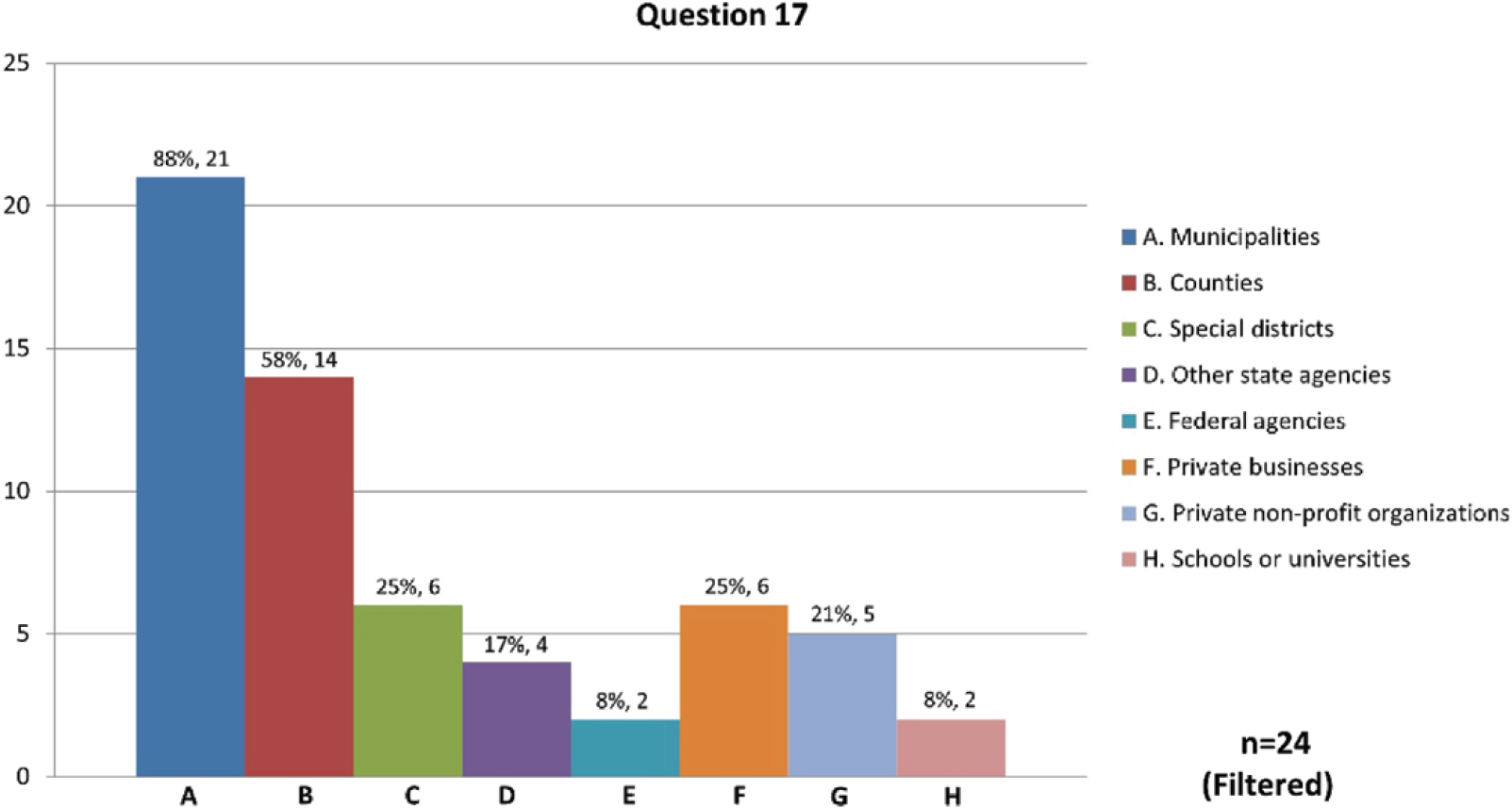
Question 17: What type of third-party partners does your DOT have? (Select all that apply.)
Of the 24 responding DOTs that have partnerships, 21 reported they partner with municipalities and 13 with counties (Figures 3.9 and 3.10). Municipalities are often MS4s, and that is likely why they are a frequent type of partner.
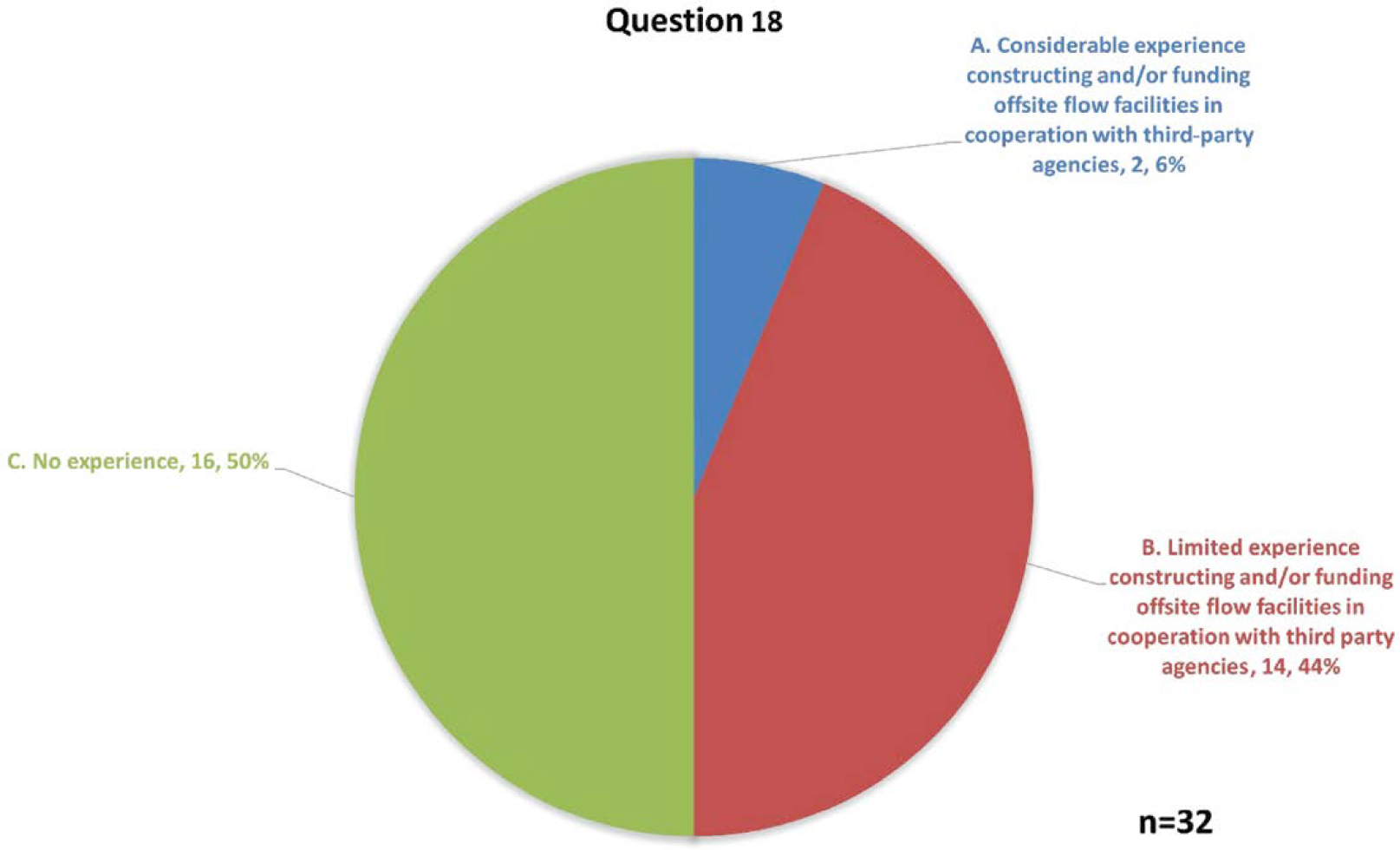
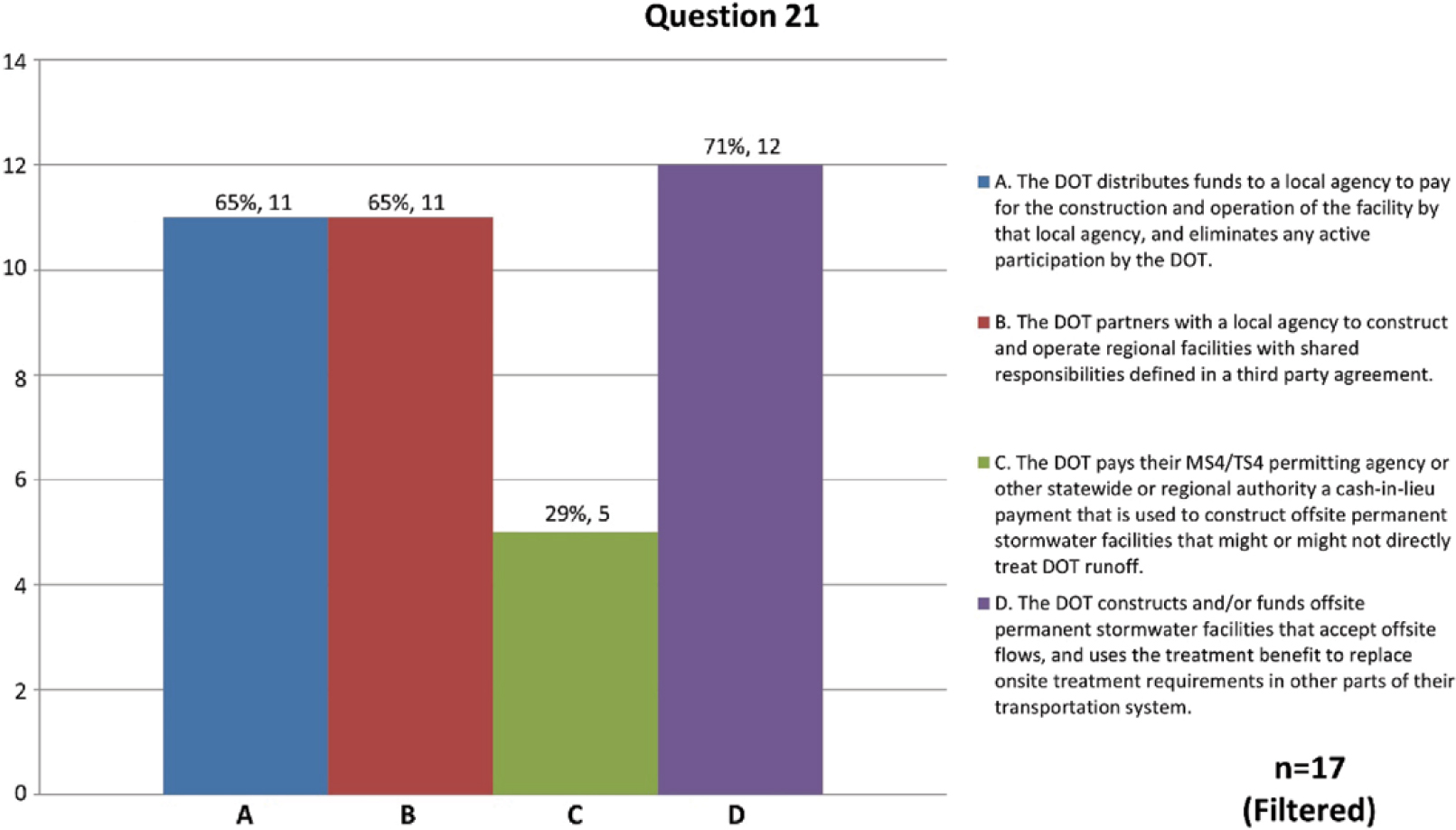
Questions 18, 19, 20, and 21 surveyed the respondents on their level of experience with partnerships in general (Question 18), the types of partnership frameworks that have been used for retrofit projects (Question 19), and new development projects (Question 20). Question 21 asked the respondents whether they would consider those same partnership frameworks and whether or not the DOT had used them in the past. In Questions 19 through 21, the responses were filtered to remove the “none of these options apply” response. The respondents that selected “none of these options” were typically the respondents that answered in Question 18 their DOT had no or limited experience with third-party partnerships (Figure 3.11).
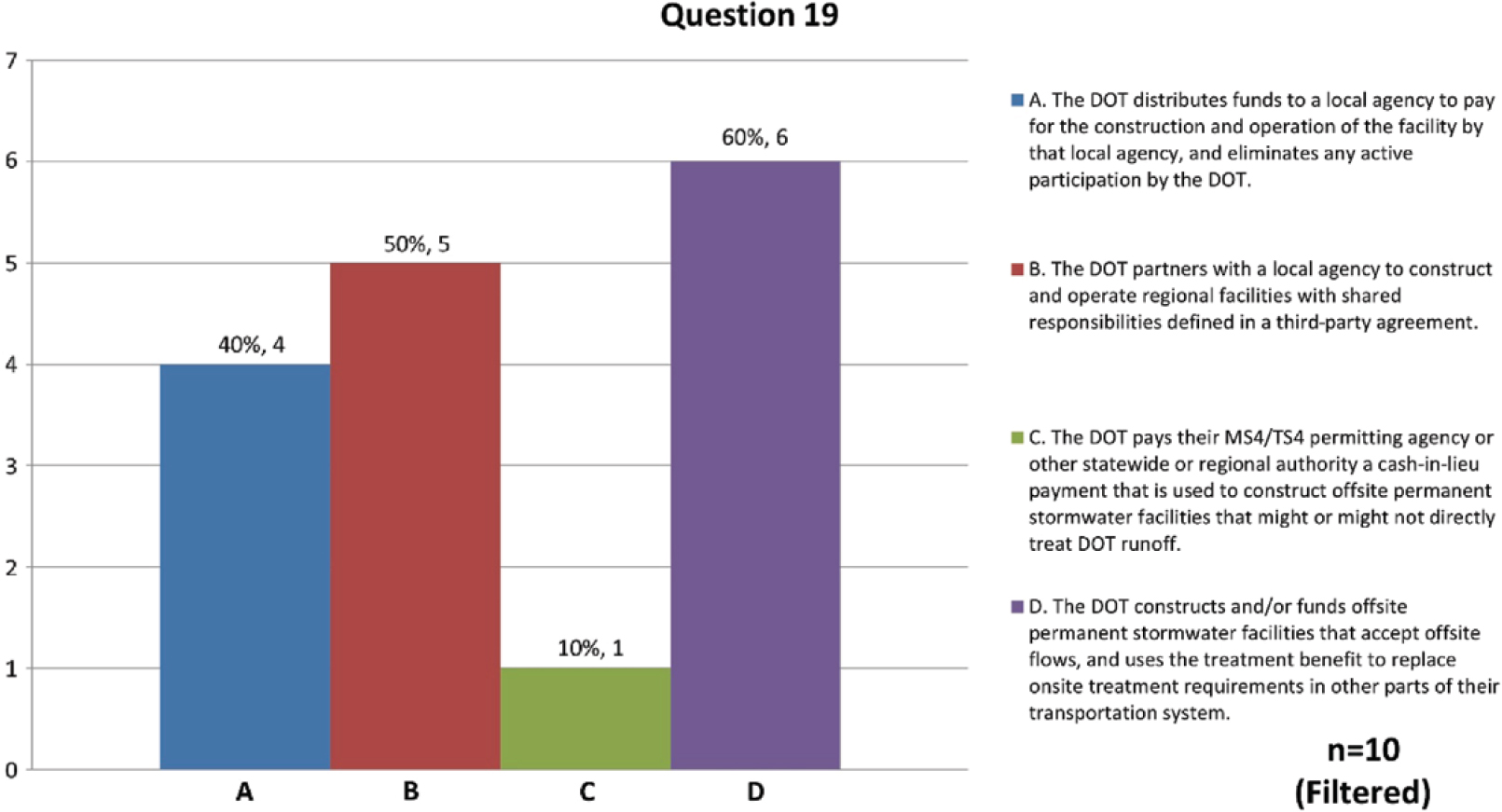
Question 19 found that 10 state DOTs use at least one of the partnership structures listed for retrofits (Figure 3.12). Twenty-two survey respondents do not use any of the listed options. Question 20, posing the same question for new development, had similar responses (Figure 3.13). Question 21 garnered 17 filtered responses, with 11 to 12 of the respondents indicating that they would consider each of the three choices that construct facilities, with only 5 respondents answering that they would consider offering partners a cash payment in lieu of participating in construction (Figure 3.14).
Question 18: What best describes your DOT’s experience on the construction and/or funding of offsite flow permanent stormwater facility retrofits that provide offsite flow treatment (i.e., facilities that treat runoff from offsite, non-DOT sources). These offsite flow permanent stormwater facilities could either treat solely the offsite flows or be shared facilities where both DOT and offsite flows are treated in the same facility. In this survey, we are primarily interested in water quality treatment facilities, not flow reduction facilities.
Question 19: Has your DOT used any of the following approaches to participate in offsite flow permanent stormwater facilities retrofit projects, not new development? In this survey, we are primarily interested in water quality treatment facilities, not flow reduction facilities. (Select all that apply.)
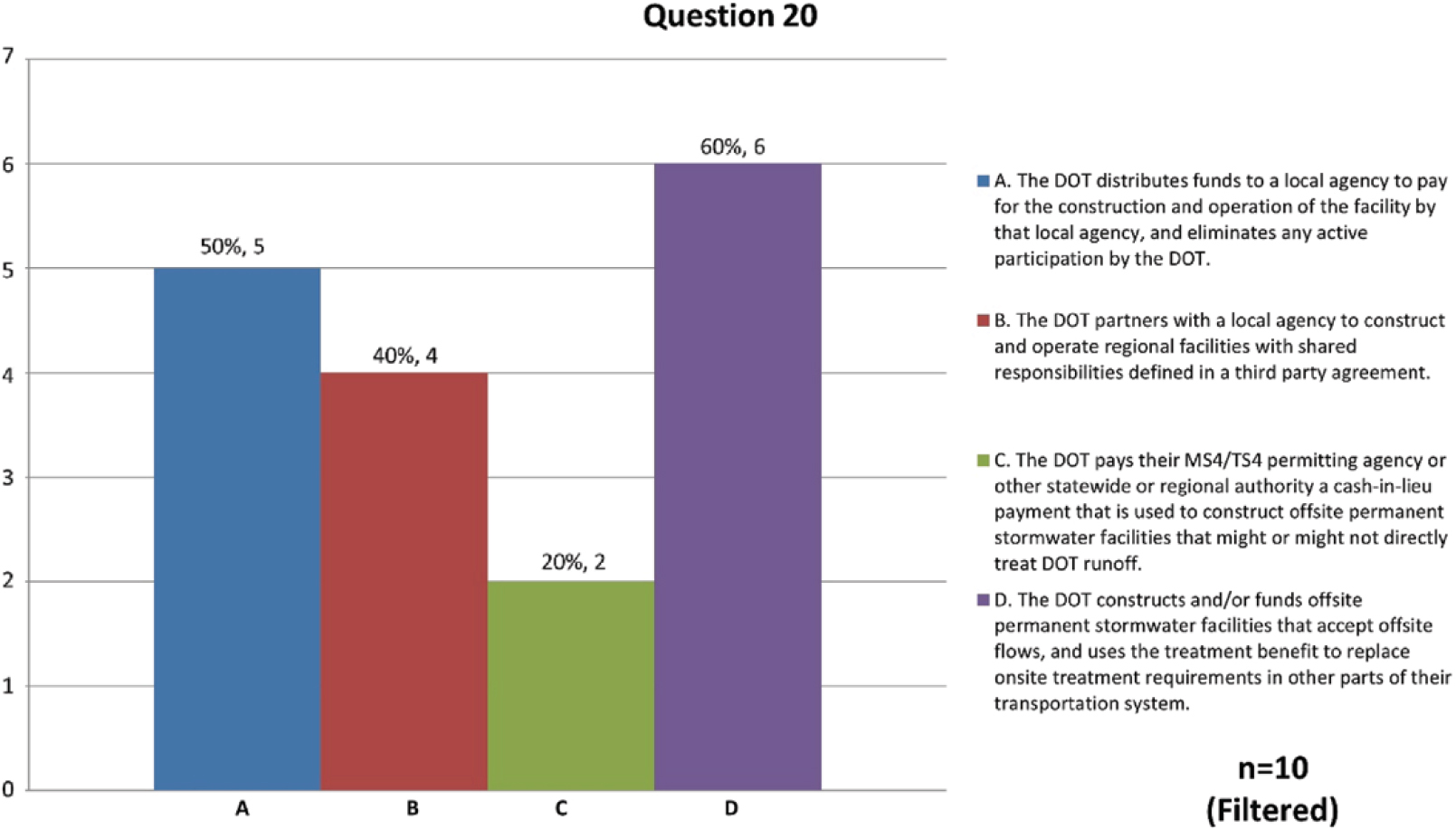
Question 20: Has your DOT used any of the following approaches to participate in offsite flow permanent stormwater facilities for new development, not retrofits? In this survey, we are primarily interested in water quality treatment facilities, not flow reduction facilities. (Select all that apply.)
Question 21: Regardless of your answer to questions 19 and 20, check any of the approaches that your DOT has considered to construct offsite flow permanent stormwater facilities. In this survey, we are primarily interested in water quality treatment facilities, not flow reduction facilities. (Select all that apply.)
The final group of questions sought to identify various experiences gained through third-party partnerships, and the final question sought to identify state DOTs interested in participating in follow-up interviews to further discuss their stormwater programs.
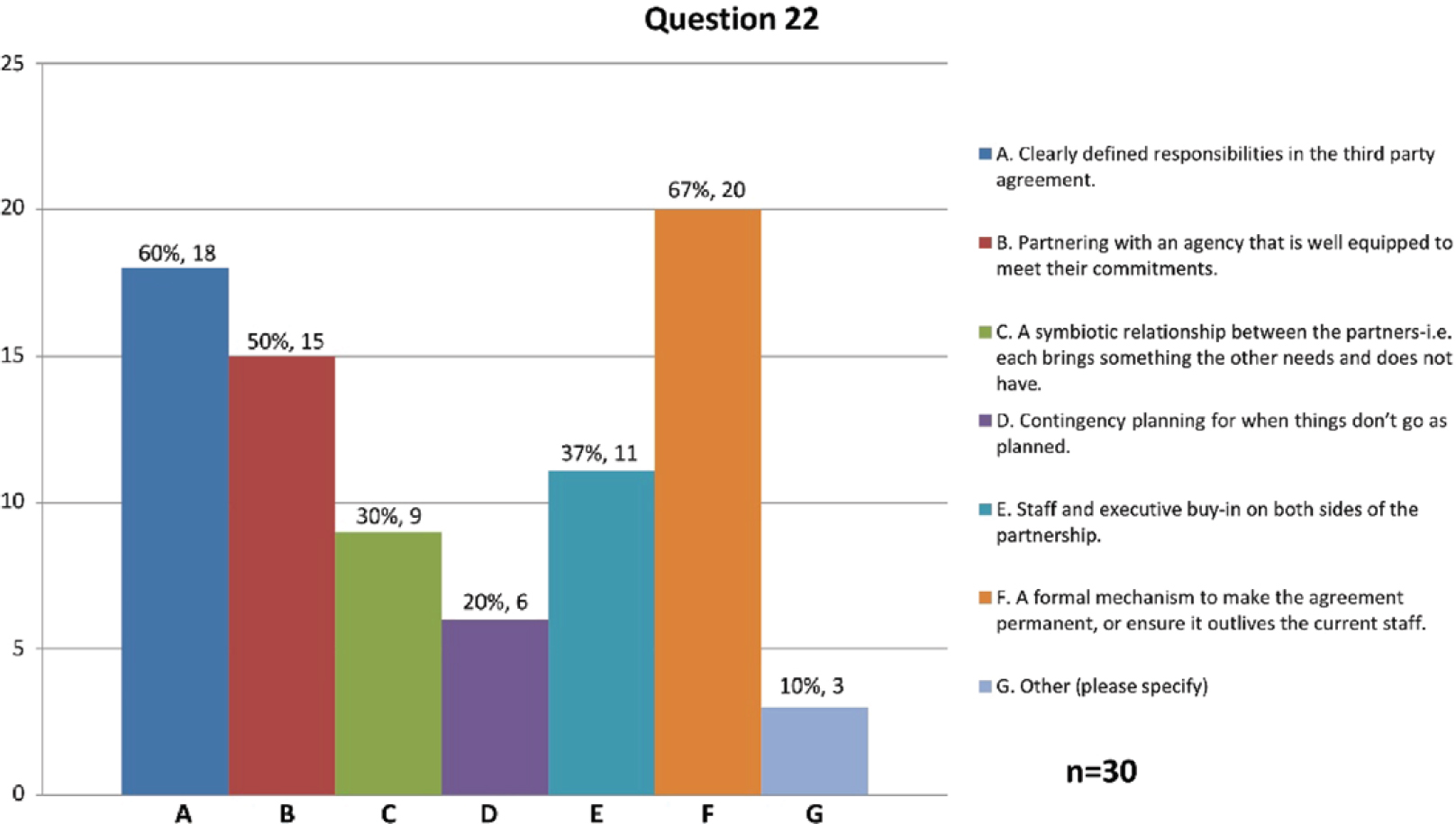
Question 22: In partnering with another agency on offsite flow permanent stormwater facilities, what are the most important ingredients for success that your DOT has experienced? (Select all that apply.)
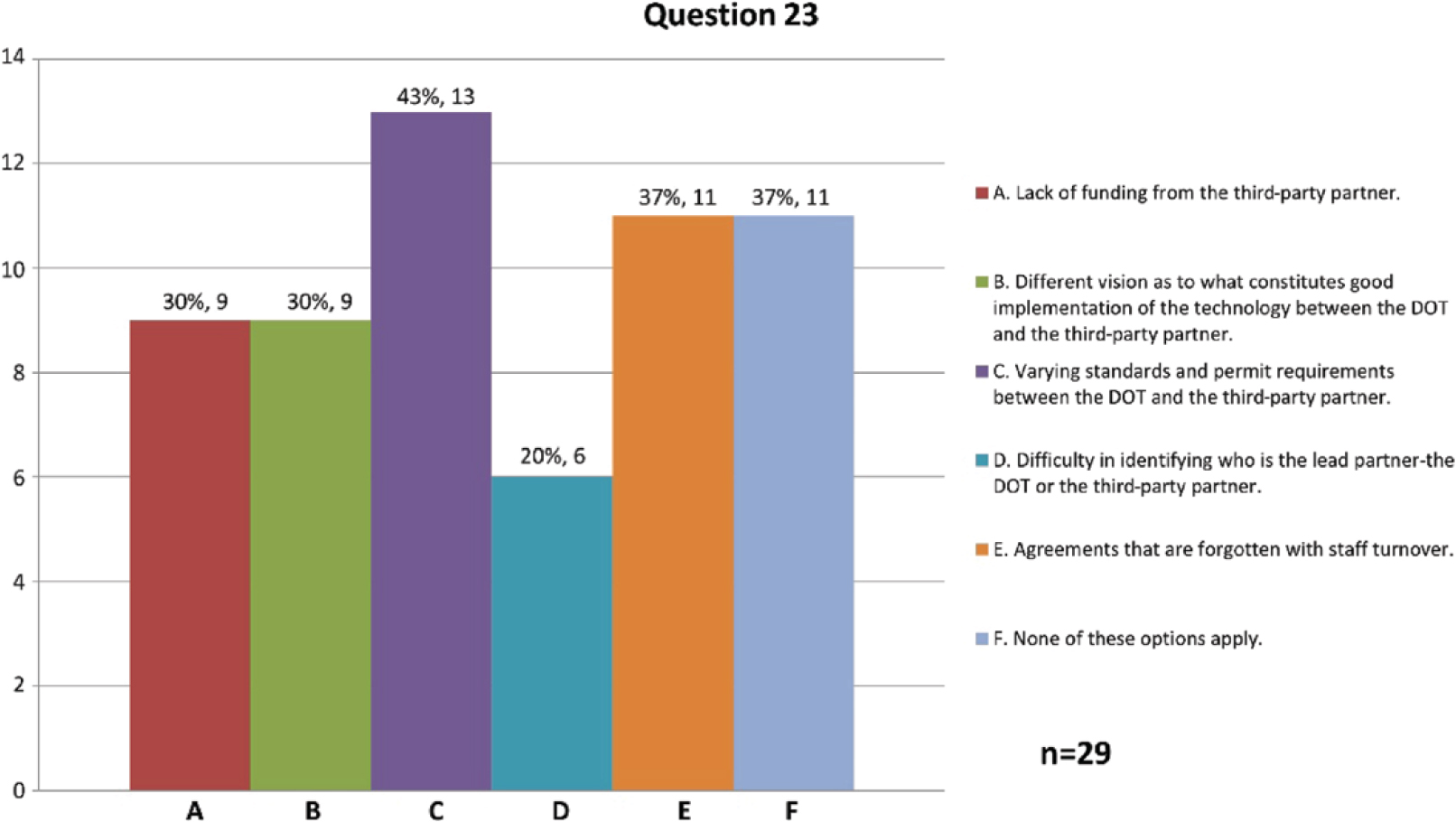
In response to Question 22, at least half the 30 state DOTs indicated that clearly defined responsibilities, partners well equipped to meet their commitments, and a formal mechanism to make agreements permanent are important ingredients for success. Three state DOTs listed ingredients for success not included in the survey choices: buy-in from regulators to grant compliance credits, effective intergovernmental agreements, and parties having the legal authority to establish partnerships (Figure 3.15). Question 23, conversely, asked about any obstacles DOTs encountered in third-party partnerships (Figure 3.16).
Question 23: In partnering with a third party on offsite flow permanent stormwater facilities, what are the obstacles to a successful partnership that your DOT has experienced? (Select all that apply.)
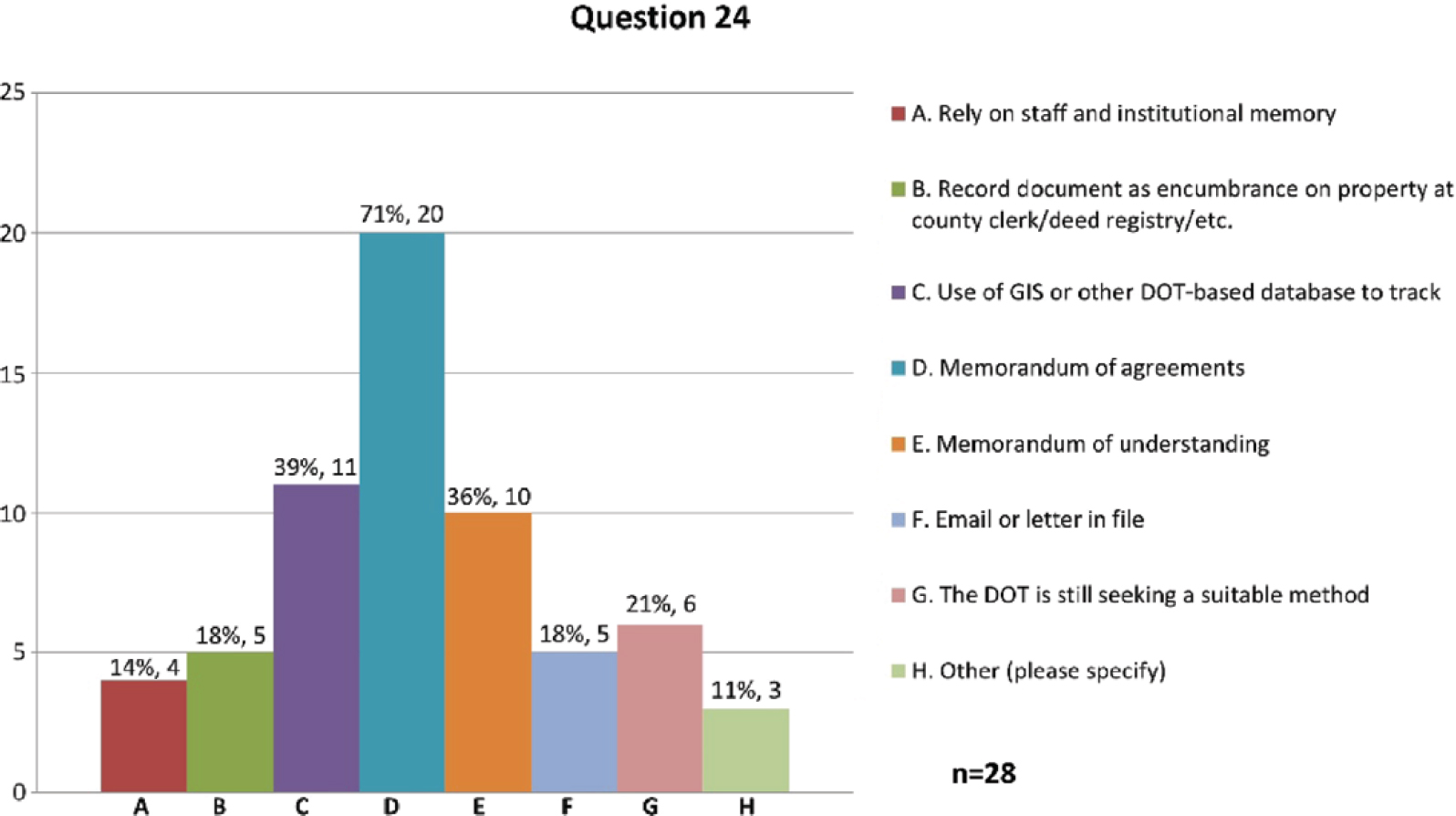
Question 24: How does your DOT ensure that third-party agreements for permanent stormwater improvements are memorialized so that commitments made for construction, operations, maintenance, and stormwater permit compliance continue to be met in the decades ahead? (Select all that apply.)
In response to Question 24, 22 of the 28 state DOTs indicated that memorandums of agreement are the technique used to document partnership agreements. GIS databases and memorandums of understanding are also used by a significant fraction of DOTs. Three state DOTs listed techniques for memorialization that were not included in the survey choices. All three are similar in that they rely on an outside permitting agency to regulate the construction and maintenance agreement for the facility (Figure 3.17).
Question 25 asked whether the DOT was willing to participate in follow-up interviews, and 14 states showed interest. Four state DOTs were selected for the follow-up interviews based on their willingness to participate and the content of their responses to the survey. Climatological and geographic diversity of the selected case examples as well as diversity in their urban/rural settings were also considered. These state DOTs selected for interviews all indicated in their survey questionnaire responses that they participate in a significant number of either construction or operation and maintenance permanent stormwater facility partnerships.
3.3 Summary of Survey Results
The survey questionnaire was designed to determine the existing state of the practice of state DOTs regarding permanent stormwater facilities retrofits and third-party partnerships.
Thirty-five of the 42 survey respondents own, operate, or maintain permanent stormwater facilities. All 35 respondents who own, operate, or maintain permanent stormwater facilities
hold a state regulatory permit. These permits are a variety of MS4 and TS4 permits, both Phase 1 and Phase 2, as well as a wide variety of urban and non-urbanized coverage throughout the respondent DOTs.
Eighteen of 35 survey respondents have a permanent stormwater facility retrofit program, and those programs are motivated by language in MS4, TS4, or other permits for 13 of the 18 respondents. Ten of the 18 respondents listed multiple motivations; included among those are TMDL responsibilities and EPA/DOJ enforcement orders or agreements.
Twenty out of 34 of the respondents reported that they never or rarely handle offsite flows with their permanent stormwater facilities. The 14 state DOTs that reported either always or frequently handling offsite flows have no clear-cut single reason for doing so. Replacing difficult onsite treatment, regulatory compliance, and TMDL treatment were all mentioned with about equal weight, as is the difficulty separating commingled flow.
Nineteen of 32 respondents reported that they participate in permanent stormwater facility partnerships but at a limited level, between 1% and 10% of their total facilities. Only 5 respondents reported that they either construct or operate/maintain a significant fraction (greater than 10% of their total) of permanent stormwater facilities under third-party partnerships. Approximately two-thirds of all partnerships occur in urban areas, and the most common partners for state DOTs are municipalities or counties.
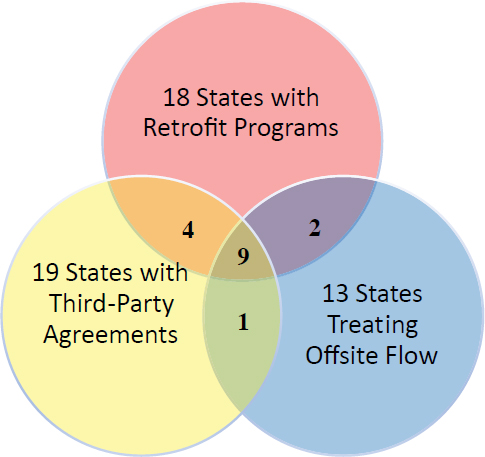
Figure 3.18 illustrates that there is some correlation between retrofit programs and both the treatment of offsite flows and the use of third-party agreements. Fifteen of the 18 state DOTs that have retrofit programs also regularly or occasionally treat offsite flows, participate in third-party agreements, or both. Only one DOT that treats offsite flow and participates in third-party agreements does not have a retrofit program.
Four of the 5 respondents who reported that their DOT owns or operates a significant portion (>10%) of partnership permanent stormwater facilities do not have a retrofit program defined in their permit. Two of the 5 reported that they never treat offsite flows, and 3 of the 5 reported that they do so only occasionally.
Two respondents indicated that they have considerable experience with third-party partnerships. One of these routinely treats offsite flows, the other treats them rarely. Both have retrofit programs.
The survey questionnaire results indicate that a significant fraction of state DOTs own, operate, and maintain permanent stormwater facilities but that the treatment of offsite flows, the construction of retrofit facilities, and the use of third-party partnerships are not as widespread. Nine of the 34 responding states include all three of these efforts in their water quality programs but typically engage in them only at a limited level. Only half of the responding states have a retrofit program, while three-fifths never or rarely treat offsite flows. There is no clear motivation for the treatment of offsite flows, but retrofit programs are typically motivated by permit or regulatory requirements. Over 75% of the survey respondents have some form of written guidance for permanent stormwater facilities, but the majority of this guidance is only for DOT-owned infrastructure, not third-party facilities.
Over half the survey respondents use retention facilities, detention facilities, flow-through facilities, or proprietary stormwater devices that hydraulically separate pollutants from stormwater runoff. Less popular techniques include permeable pavement, wetland mitigation, stream mitigation, land conservation, trash/debris racks, and grass swales. Funding for stormwater treatment is typically included in the cost of larger transportation projects for 60% of the survey respondents. Over one-third of the survey respondents also have a separate fund to construct permanent stormwater facilities, as either stand-alone projects or part of a larger project.
Seven of the 42 responding state DOTs do not own, operate, or maintain permanent stormwater facilities. Two of the 7 indicated that the facilities within their state are owned, operated, and maintained by local agencies. One of the seven is developing a plan to implement a permanent stormwater program, and four of the states indicated that they have no such facilities.


