Airport Parking Reservation Systems and Techniques (2025)
Chapter: Appendix B: Survey Analysis
APPENDIX B
Survey Analysis
B.1 Overview
An Airport Parking Reservation Systems and Techniques survey (“the survey”) was developed to assess the benefits, costs, and operational and financial results of airport online parking reservation systems. The survey was hosted by Steer using Microsoft Forms (Figure B.1).

The remainder of this appendix is divided into the following sections:
B.2 Survey Respondents
Over 25 airport operators were contacted to participate in the survey. A total of 18 airport operators representing 20 airports provided responses, including seven large-hub airports, two medium-hub airports, six small-hub airports, and two non-hub airports. Table B.1 provides a list of respondents to the survey and the applicable airport(s) and associated airport hub types based on U.S. FAA 2023 definitions and enplanement volumes.
Table B.1. List of airport survey respondents.
| Operator | Airport(s) | FAA Hub Type (2023) |
|---|---|---|
| Burbank-Glendale-Pasadena Airport Authority | BUR Hollywood Burbank | Medium |
| Charlotte Aviation Department | CLT Charlotte Douglas International | Large |
| City of Phoenix Aviation Department | PHX Phoenix Sky Harbor International | Large |
| City and County of San Francisco | SFO San Francisco International | Large |
| DFW Airport | DFW Dallas Fort Worth International | Large |
| Gerald R. Ford International Airport Authority | GRR Gerald R. Ford International (Grand Rapids) | Small |
| Greenville-Spartanburg Airport Authority | GSP Greenville-Spartanburg International | Small |
| Los Angeles World Airports | LAX Los Angeles International | Large |
| VNY Van Nuys | General Aviation | |
| Louisville Regional Airport Authority | SDF Louisville Muhammad Ali International | Small |
| Manchester-Boston Regional Airport | MHT Manchester-Boston Regional | Small |
| Metropolitan Washington Airports Authority | DCA Ronald Reagan Washington National | Large |
| IAD Washington Dulles International | Large | |
| Municipal Airport Authority of the City of Fargo | FAR Hector International | Small |
| New Orleans Aviation Board | MSY Louis Armstrong New Orleans International | Medium |
| Port of Oakland | OAK Oakland International | Medium |
| Omaha Airport Authority | OMA Omaha Eppley Airfield | Medium |
| Richland-Lexington Airport District | CAE Columbia Metropolitan | Small |
| Operator | Airport(s) | FAA Hub Type (2023) |
|---|---|---|
| San Diego County Regional Airport Authority | SAN San Diego International | Large |
| Sonoma County Department of Transportation | STS Charles M. Schulz Sonoma County | Non-Hub |
Source: U.S. FAA 2024
B.3 Survey Questions
The survey included a total of 17 questions listed in Table B.2. The survey included skip logic and branching, allowing respondents to skip to different questions depending on the responses provided. An illustration of this skip logic and branching can be found in Figure B.2.
Table B.2. Survey questions.
| ID | Question | Response Type |
|---|---|---|
| Q1 | Please identify your airport (IATA code) - if you are affiliated with an airport operator that runs multiple airports, please fill in separate entries for each airport. | Free Text |
| Q2 | Does your airport offer customers the option to reserve parking products through an online booking system? |
Choice:
|
| Q3 | If available, what are the costs for equipment and other capital costs associated with the online booking system? | Free Text |
| Q4 | If available, what are the operating expenses for the online booking system for airport and/or contract staff? | Free Text |
| Q5 | What percentage of parking inventory does your airport currently make available through the online booking system? Please provide a percentage breakdown on a per product basis. | Free Text |
| Q6 | Does this inventory change over time? For instance, a lower proportion of inventory is made available during peak holiday travel. |
Choice:
|
| Q7 | Does your airport parking online booking system offer discounts compared to the “roll-up” or “drive-up” rate? |
Choice:
|
| Q8 | If yes, does your discount vary by the lead time before the departure date? | Free Text |
| ID | Question | Response Type |
|---|---|---|
| Q9 | While in the online booking system, does your system offer customers the ability to upgrade to a different parking product? For example, when the customer selects economy/long-term parking, an offer to upgrade to valet or another higher value parking product? |
Choice:
|
| Q10 | While in the online booking system, are customers offered other services or offers? Please select all that are applicable. |
Multiple Choice:
|
| Q11 | Does your airport capture customer data through the online booking system into a customer relationship management (CRM) system? |
Choice:
|
| Q12 | Is this information used to offer (or push) discounts for future parking? |
Choice:
|
| Q13 | Is this information used to offer other discounts for airport services? |
Choice:
|
| Q14 | Do you have data that suggests the online booking system has increased the parking share of customers accessing the airport (for example, as against other modes such as on-demand ride app services like Uber and Lyft, taxis, pick-up and drop-off, transit, etc.)? |
Choice:
|
| Q15 | What benefits has the online booking system provided the airport? |
Multiple Choice:
|
| ID | Question | Response Type |
|---|---|---|
| Q16 | Reflecting on the overall experience of purchasing, installing, testing, and using the online booking system, please rate your overall satisfaction on a scale from 1 to 5. |
Choice:
|
| Q17 | Would you be available for additional follow up for the study? |
Choice:
|

B.4 Survey Results
The average survey completion time was just under 28 minutes. The following section details the response for each of the 17 individual questions as introduced in the preceding section.
Question 1: Please identify your airport (IATA code) - if you are affiliated with an airport operator that runs multiple airports, please fill in separate entries for each airport.
Question 2: Does your airport offer customers the option to reserve parking products through an online booking system?
As illustrated in Figure B.3, 17 respondents offer customers the option to reserve parking products through an OBS, while one operator respondent reported not having one. This operator previously had an OBS but removed it.

Question 3: If available, what are the costs for equipment and other capital costs associated with the online booking system?
Responses have varied from a fixed annual implementation fee to a per transaction fee. The responses vary depending on how these systems are procured and/or operated and whether other components beyond an OBS were purchased.
For instance, one airport procured this system based on a term agreement with a fixed implementation fee, while another airport purchased its OBS system with other parking and garage improvements.
The following lists the responses received. For commercial sensitivity reasons, vendor names and specifics have been removed in the responses. Provided costs are assumed to be real at the time these airports implemented their OBS.
- Three-year agreement [ . . . ] with [ . . . ] option years. Implementation fee - $25,000.
- PARCS $4 [million] + Parking Guidance System $8 [million] + Garage improvements $10 [million] = $22 [million].
- None. Our reservation program partner [ . . . ] set it up and charges us a fee for every transaction.
- PARCS equipment was already installed. [$50,000] for system implementation.
- It is provided by [the vendor] who has a contract with [another vendor].
- Not available. The only hardware costs are the AVI scanners.
- The system is online and managed by our parking operator. There are no equipment and/or capital costs associated with this change, only software development and monitoring of the website/program.
- The cost to integrate [the vendor’s] parking reservation system [ . . . ] with [the PARCS system] was approximately $25,000 plus the bar code readers [for a total approximate capital cost of] $42,200.
- The costs for equipment and other capital expenses associated with our online booking system are as follows: 5 Entry Lane Stations with QR Code Readers at $10,831 each, totaling $54,155. 1 Exit Lane Station with QR Code Reader, totaling $11,713. 3 Exit Lane Transaction Panels with QR Code Reader at $7,278 each, totaling $21,834. 3 Exit Lane Booth Handheld Scanners with QR Code Reader at $411 each, totaling $1,233. Equipment Installation $9,888, and Shipping $2,382. Grand total, approximately $101,205.
- Implementation was $164,138.
- None, because our system is new (November 2019) and was part of the initial capital purchase of the new system.
- Provider covered infrastructure [expenses].
- We do not have any equipment costs, as our PARCS equipment integrates with our Parking Reservation system. [ . . . ]
Question 4: If available, what are the operating expenses for the online booking system for airport and/or contract staff?
Responses varied from a fixed annual fee to a per transaction fee. As per the responses in Question 3, the operating costs vary depending on the scope of the contract with the vendor. For example, some airports procure the OBS as a standalone product, while others have this as part of a broader parking operations contract.
The following lists some responses:
- [$0.50] per transaction for both bookings and customer registrations [with a] $1,500 minimum monthly fee per month.
- [$570,000 per year] and [marketing of $1.6 million per year] for a total of [$1.6 million per year].
- Annual OBS fixed costs, transaction fees, and SMS texting of [approximately $55,000] annually.
- None. [The airport] added reservation parking to the existing parking program, so there were not [any] additional operating costs that incurred from adding this product.
- [$250,000 Commercial Management] Cost [and Management Fee of $400,000. Annual Fees (such as credit card transaction and payment service provider fees, texting, hosting, loyalty, etc. vary)] based on the number of online reservations.
- [The airport] currently [has] a software agreement with our reservation provider where [a pay per transaction fee] is based on a tiered pricing structure.
- On average, approximately $5,000 per month.
- Operating expenses for the online booking system are based on transaction volume, transaction fee range is $0.50 to $1.65. [ . . . The Airport pays] for the transaction fee as part of the reservation booking fee. Contract staff expense to operate the booking system is approximately $55,000 annually.
- The operating expenses for the online booking system for contract staff are approximately [$126,000] per year.
- Approximately [$200,000] annually for the system.
- Annually Operating Platform Expense - $35,000 Parking Operator Staff Expense - $1,040 per year ($20 per hour × 52 hours a year)[, ] [ . . . ] Staff Expense - $13,000 per year ($50 per hour × 5 hours per week × 52 weeks)[, and] Consultant Expense - $11,700 per year ($300+$150 per hour × 26 hours a year).
- 2.99% credit card fee plus a reservation fee of $1.99 per reservation. For 2023, [the] total expense was [approximately $79,000].
- [$2,000] per month for website, support, and analytics.
- Set-up costs were approximately $25,000, and we have annual costs of $30,000 [ . . . ] to operate our reservation system.
Question 5: What percentage of parking inventory does your airport currently make available through the online booking system? Please provide a percentage breakdown on a per product basis.
Each airport has provided a wide range of responses. Due to commercial sensitivity, detailed responses have not been provided. However, in summary:
- Some airports outsource these types of decisions to their parking operator, while other airports have fixed proportions that vary by product.
- Most airports tend to make between 10% and 40% of the total parking and valet capacity available for reservations.
- A few airports do not restrict the capacity made available through online parking reservations.
Question 6: Does this inventory change over time? For instance, a lower proportion of inventory is made available during peak holiday travel.
Figure B.4 provides a summary of the responses. Most airport operators (15) make changes in parking inventory that is reservable in the online parking reservation system, while two airport operators do not make changes to parking inventory at the time of the survey response.

Question 7: Does your airport parking online booking system offer discounts compared to the “roll-up” or “drive-up” rate?
As illustrated in Figure B.5, 13 airport operators provide discounts (of varying proportions) compared to the drive-up rate, while four airport operators do not provide such discounts.

Question 8: If yes, does your discount vary by the lead time before the departure date?
Of the 13 airports that offer discounts as per Question 7, as illustrated in Figure B.6, 10 of those airports have discounts that vary based on the lead time before the departure date, while three airports have a fixed discount before the departure date.

Question 9: While in the online booking system, does your system offer customers the ability to upgrade to a different parking product?
As shown in Figure B.7, the majority of airport operator respondents push upgrades to different parking products (for instance, from a remote, value-oriented parking product to a terminal garage product). Four airport operators do not push upgrade offers.

Question 10: While in the online booking system, are customers offered other services or offers?
Figure B.8 illustrates the results of this question. Aside from other, four airports offer automobile-related services, such as, but not limited to, cleaning, within the parking reservation system. It does not appear that survey participating airport operators have yet used their parking reservation systems to push other airport services; whereas international airports, such as Vancouver International and Manchester International, offer customers the ability to purchase airport lounge access.

Question 11: Does your airport capture customer data through the online booking system into a customer relationship management (CRM) system?
As illustrated in Figure B.9, 10 surveyed airport operators capture customer data from the airport parking reservation system to a CRM, while seven do not.

Question 12: Is this information used to offer (or push) discounts for future parking?
Among the 10 airport operators that capture customer data into a CRM as per Question 11, as illustrated in Figure B.10, eight of those airport operators surveyed use the information to offer or push discounts for future parking reservations.

Question 13: Is this information used to offer other discounts for airport services?
Among the 10 airport operators that capture customer data into a CRM as per Question 11, as illustrated in Figure B.11, apart from one airport operator, most airport operators have not yet used this information to offer (or push) discounts for other airport services.

Question 14: Do you have data that suggests the online booking system has increased the parking share of customers accessing the airport (for example, as against other modes such as on-demand ride app services)?
As illustrated in Figure B.12, the majority (nine airport operators) of responses do not have data that suggests online booking systems have increased the parking share of customers accessing the airport, while eight have and track for that data.

Question 15: What benefits has the online booking system provided the airport?
Figure B.13 lists the different response choices (multiple selection) and the number of respondents that agreed with the option. Improvements to customer experience appeared to be the benefit that applied across most airport operators. Meanwhile, the majority of airport operators have observed improvements to parking utilization (or occupancy) of parking facilities as a result of a parking OBS, with the same number highlighting that the future demand data is a benefit for the airport. Fewer airport operators (11) noted that the additional customer data is a benefit, and even fewer (seven) noted that airport OBSs have increased revenues compared to pre-OBS integration.

Question 16: Reflecting on the overall experience of purchasing, installing, testing, and using the online booking system, please rate your overall satisfaction on a scale from 1 to 5, where:
- 1-Very Dissatisfied
- 2-Dissatisfied
- 3-Neutral
- 4-Satisfied
- 5-Very Satisfied
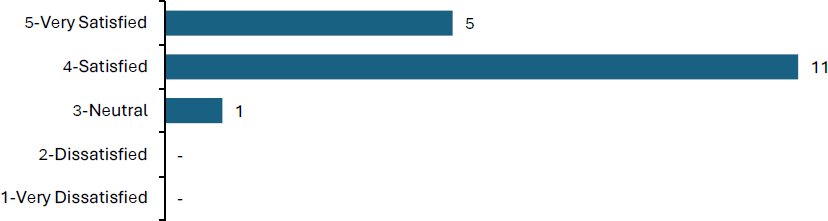
As illustrated in Figure B.14, most airport operators were satisfied or very satisfied with their experience purchasing, testing, installing, and using an OBS. Only one airport operator provided a neutral response.
Question 17: Would you be available for additional follow up for the study?
The purpose of this question is to identify potential airport case example candidates and survey clarification, if required. Apart from one airport operator, most airport operators were available for follow up, as illustrated in Figure B.15. Airports that answered “Yes” were considered potential candidates for the Case Example Interview.

This page intentionally left blank.
Abbreviations and acronyms used without definitions in TRB publications:
| A4A | Airlines for America |
| AAAE | American Association of Airport Executives |
| AASHO | American Association of State Highway Officials |
| AASHTO | American Association of State Highway and Transportation Officials |
| ACI–NA | Airports Council International–North America |
| ACRP | Airport Cooperative Research Program |
| ADA | Americans with Disabilities Act |
| APTA | American Public Transportation Association |
| ASCE | American Society of Civil Engineers |
| ASME | American Society of Mechanical Engineers |
| ASTM | American Society for Testing and Materials |
| ATA | American Trucking Associations |
| CTAA | Community Transportation Association of America |
| CTBSSP | Commercial Truck and Bus Safety Synthesis Program |
| DHS | Department of Homeland Security |
| DOE | Department of Energy |
| EPA | Environmental Protection Agency |
| FAA | Federal Aviation Administration |
| FAST | Fixing America’s Surface Transportation Act (2015) |
| FHWA | Federal Highway Administration |
| FMCSA | Federal Motor Carrier Safety Administration |
| FRA | Federal Railroad Administration |
| FTA | Federal Transit Administration |
| GHSA | Governors Highway Safety Association |
| HMCRP | Hazardous Materials Cooperative Research Program |
| IEEE | Institute of Electrical and Electronics Engineers |
| ISTEA | Intermodal Surface Transportation Efficiency Act of 1991 |
| ITE | Institute of Transportation Engineers |
| MAP-21 | Moving Ahead for Progress in the 21st Century Act (2012) |
| NASA | National Aeronautics and Space Administration |
| NASAO | National Association of State Aviation Officials |
| NCFRP | National Cooperative Freight Research Program |
| NCHRP | National Cooperative Highway Research Program |
| NHTSA | National Highway Traffic Safety Administration |
| NTSB | National Transportation Safety Board |
| PHMSA | Pipeline and Hazardous Materials Safety Administration |
| RITA | Research and Innovative Technology Administration |
| SAE | Society of Automotive Engineers |
| SAFETEA-LU | Safe, Accountable, Flexible, Efficient Transportation Equity Act: A Legacy for Users (2005) |
| TCRP | Transit Cooperative Research Program |
| TEA-21 | Transportation Equity Act for the 21st Century (1998) |
| TRB | Transportation Research Board |
| TSA | Transportation Security Administration |
| U.S. DOT | United States Department of Transportation |


