Navigating the Energy Transition in the Gulf of Mexico: Proceedings of a Workshop (2023)
Chapter: 1 Introduction
1
Introduction
The Gulf Research Program (GRP) developed this proceedings to describe ideas arising from the workshop titled Navigating the Energy Transition in the Gulf of Mexico. This 2-day, in-person workshop, involving 22 participants from private-sector, government, nongovernmental, and academic organizations, was held in Washington, DC, on December 6 and 7, 2022. Participants were invited by GRP staff through recommendations from expert interviews, professional referrals, and planning committee members to represent a diverse range of backgrounds and expertise related to energy policy, production, transportation, and consumption (see Appendix C: Workshop Participants). Importantly, the number of participants was limited to optimize equitable engagement; the participants do not necessarily represent all possible perspectives related to the energy transition. The design, facilitation, and analysis of the workshop was supported through a partnership with the Center for Naval Analyses, an independent, nonprofit research and analysis organization dedicated to the safety and security of the nation.
As its name suggests, the goal of the workshop was to facilitate participants’ ability to identify and better understand challenges and opportunities associated with the ongoing energy transition in the Gulf of Mexico. The energy transition away from hydrocarbons to carbon-free sources of energy (e.g., wind, solar, hydrogen) has profound ramifications for this region, given its prominent role in oil and natural gas production. The objectives for this workshop were the following:
- Explore progress to date, opportunities, capabilities, and impediments to implementing an energy transition and compare this with our current national and regional energy transition goals.
- Discuss technical and nontechnical gaps that would require attention in order to support an energy transition, with an emphasis on safety and environmental justice in the Gulf of Mexico.
- Foster a community built on the participants that extends beyond the event to support the development of follow-on activities and the broader initiative to influence and impact a safe and just energy transition in the Gulf of Mexico.
The workshop had two main outputs. First, participants identified 291 positive and negative impacts associated with two future scenarios spanning from 2022 to 2050. These impacts build out these two alternative states of the world, reflecting participants’ expertise and perspectives. Second, participants reviewed more than half of these potential future impacts, discussing strategies for Gulf stakeholders to better prepare for and mitigate the potential negative impacts and to accelerate and increase the positive ones.
All of the takeaways reflect comments and discussions at the workshop and are presented as stated by workshop participants. Readers should not regard these as carrying the weight of recommendations from the National Academies of Sciences, Engineering, and Medicine. The views cited are not necessarily consensus views of the group, and the group was not composed to meet National Academies’ standards for study committees that make consensus findings and recommendations. The takeaways do reflect key ideas presented or discussed by one or more workshop participant(s), so the material presented here could be considered suggestions coming from informed individuals.
WORKSHOP STRUCTURE
Central to the workshop was a serious game1 designed to facilitate exploration of and information sharing about the energy transition in the Gulf of Mexico. Specifically, the game used the following two mechanisms to stimulate discussions among participants:
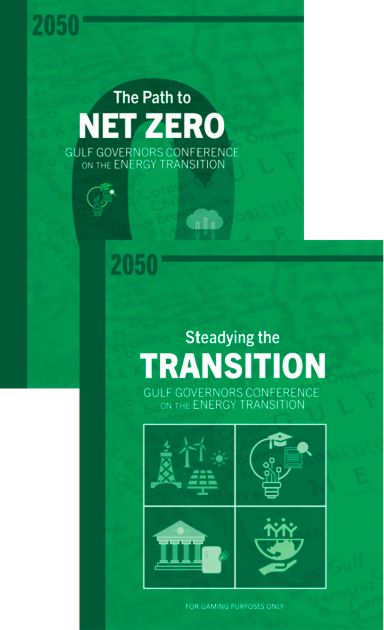
- Future scenarios: Two scenarios describing alternative futures for the Gulf energy transition provided an initial framework for participant discussions (see Appendix A: Game Scenarios). These scenarios were presented as executive summaries from a fictitious Gulf Governors Conference on Energy in 2050 (see Figure 1-1). The first scenario, Path to Net Zero, assumes that the United States achieves current federal goals of 100 percent clean electricity by 2035 and net-zero emissions by 2050. The second scenario, Steadying the Transition, presents a future without aggressive, sus-
___________________
1 A serious game is designed for an analytic, educational, or contextual purpose rather than for recreation.
Source: CNA.
- tained government support for the transition to renewables. As a starting point, the scenarios use projections from Princeton University’s Net-Zero America: Potential Pathways, Infrastructure, and Impacts,2 with modifications to account for recent developments. The workshop designers intended the two scenarios to represent boundary conditions on what plausibly might take place with the energy transition in the coming decades.
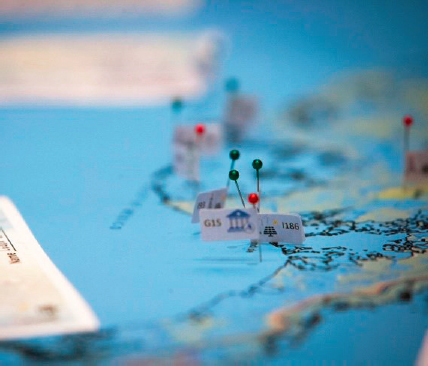
- A map of the Gulf region: Participants interacted with a large printed map of the Gulf region, which was divided into six sections, each covering a 5'x5' table. The map sections served as the gameboard for participants to record proposed impacts—both positive and negative—associated with the scenarios. Specifically, players described impacts on notecards and then placed pins—linked to these notecards by coded labels (i.e., flags)—to mark the locations where these impacts would occur (see Figure 1-2).
___________________
2 The Net-Zero America High Electrification pathway informed the Path to Net Zero scenario, and the Reference pathway informed the Steadying the Transition scenario. See https://netzeroamerica.princeton.edu.
Source: CNA.
- In addition, for each impact, participants were asked to make an overall determination of whether it represented a positive or negative impact from the perspective of their expertise group, which was reflected in the pinhead color (either green or red). The pins served as visual cues to where key changes might take place in the future of the Gulf region. Meanwhile, the notecards served as the primary means of data collection for the workshop.
Prior to the event, participants received the two scenarios as readaheads. They also received handouts of the scenarios during the event.
Each day of the workshop addressed a different scenario. Day 1 focused on the Path to Net Zero scenario, which was broken down into two turns—one focusing on changes occurring from 2022 to 2035 and the second focusing on the years from 2036 to 2050. Day 2 focused on the Steadying the Transition scenario, consisting of one turn covering 2022 to 2050. Appendix B: Workshop Agenda lists the complete workshop agenda for the 2 days.
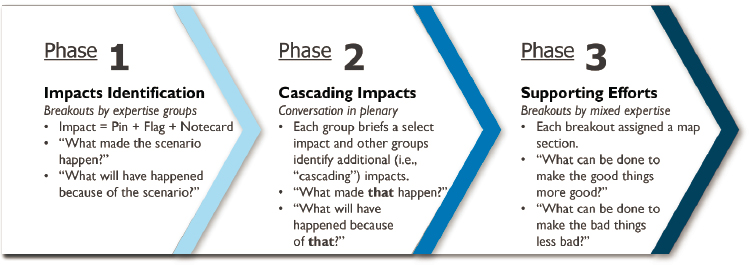
Each turn included three phases (see Figure 1-3):
- Phase 1: Impacts Identification. Participants were placed into one of four expertise groups—academia/technical, community, governance, or industry—and answered two questions from the perspective of their group: (1) What made the scenario happen? and (2) What will have happened because of the scenario? Participants were free to discuss the scenario and confer with other members of their group before and while writing their ideas, which was accomplished by placing a pin (with a flag
Source: CNA.
- label) in the appropriate map location and describing the impact on an accompanying notecard. Each participant was encouraged to identify at least three impacts during this phase. Toward the end of this phase, facilitators reconvened the members of each expertise group who decided on the top one or two impacts they were most interested in sharing with the other groups in Phase 2.
- Phase 2: Cascading Impacts. In this plenary session, a representative from each group briefed one of their selected impacts. The facilitator then asked participants from the other three expertise groups to identify any additional impacts that could cascade from the impact briefed (e.g., How would your group be affected if this happens?). By the end of this phase, these cascading impacts—added to the map—enriched the picture of opportunities and challenges that could emerge in the scenario.
- Phase 3: Supporting Efforts. Mixed groups—consisting of representatives from each of the four expertise groups—focused on different sections of the Gulf region where more impacts were identified. As time permitted, groups discussed the impacts and identified what could be done to mitigate the negative impacts and enhance the likelihood or effects of positive impacts.
As mentioned above, an important aspect of the game was how players were divided and assigned during the various phases of each turn. The four expertise groups used in the game, along with each group’s corresponding icon (used prominently in flag labels, notecards, and player nametags), are listed in Table 1-1. In identifying, targeting, and assigning participants for the workshop, GRP staff attempted to ensure that each group had a minimum of five members.
TABLE 1-1 Expertise Groups and Associated Icons
| Expertise Group | Group Icon |
|---|---|
| Academia/technical |  |
| Community |  |
| Governance |  |
| Industry |  |
Source: CNA.
ORGANIZATION OF THIS PROCEEDINGS
Following the introduction, Workshop Results addresses the impacts and supporting efforts identified by participants, grouping and summarizing their ideas in several ways. First, Expertise Group Impact Selections discusses the 12 impacts briefed by expertise groups in Phase 2 and their connection to cascading impacts identified by participants in other groups. Next, Recurring Themes lists common themes identified from the 291 impacts and provides both a summary of the impacts described under the theme and any associated supporting efforts. Next, observations based on cross-comparisons of the turns and scenarios are provided. The final subsection, Geospatial Clusters, presents a more in-depth breakdown of select areas of the Gulf region where clusters of impacts were observed.
The main body of the proceedings concludes with Final Remarks, a summary of participant comments taken from the Day 2 hotwash session, and Beyond the Event, a discussion on how the GRP plans to use this proceedings in future programming. The Day 2 hotwash session provided an opportunity for
participants to reflect on their workshop experiences and highlight some key takeaways, including possible opportunities moving forward for both participants and the GRP.
The proceedings also includes the following appendixes:
- Appendix A: Game Scenarios includes the two scenario narratives for the workshop.
- Appendix B: Workshop Agenda details the sequence and time allocated for sessions.
- Appendix C: Workshop Participants lists all the players who attended the event.
- Appendix D: Biographical Sketches of Planning Committee Members provides additional background information about these individuals.
- Appendix E: Additional Impacts presents additional impacts that were not discussed in the main body of the proceedings.
This page intentionally left blank.


