Offshore Situation Room: Enhancing Resilience to Offshore Oil Disasters in the Gulf of Mexico: Proceedings of a Workshop (2021)
Chapter: 1 Introduction
1
Introduction1
On April 20, 2010, an explosion and fire occurred on the Deepwater Horizon offshore drilling rig, resulting in the deaths of 11 oil rig workers and triggering a massive response and recovery effort for what would become the largest offshore oil spill in U.S. history. More than a decade after, the Gulf Research Program (GRP) of the National Academies of Sciences, Engineering, and Medicine hosted the Offshore Situation Room (OSR) event to explore how robust our prevention and response activities would be if another offshore oil disaster were to occur today. The key question was, “What can we do today?” to make sure another offshore oil disaster does not happen, and if it does, to make sure we are better prepared for it.
The GRP developed these proceedings to describe the event structure and ideas resulting from OSR. OSR was originally planned as an in-person event to be held on the Long Beach campus of the University of Southern Mississippi. To increase interactions with local government and communities, the OSR planning committee and the GRP recognized the importance of hosting the event in the region affected by the Deepwater Horizon disaster. However, in March 2020, the event had to be postponed due to
___________________
1 This Proceedings of a Workshop was prepared by the workshop rapporteurs as a factual summary of what occurred at the event. The planning committee’s role was limited to planning the event. The opinions and prioritized actions were developed by the event participants and do not represent the views of the planning committee or the National Academies of Sciences, Engineering, and Medicine.
the COVID-19 pandemic. Although nothing can replace the in-person experience, OSR was successfully converted to a fully virtual event that took place over 3 half-days during June 15–17, 2021. The purpose of OSR was to bring together leaders in the energy industry, oil spill crisis and disaster management, environmental protection, and Gulf of Mexico communities to identify ways to reduce the risk of an offshore disaster happening, improve the response, and decrease the impacts if it does. OSR was a highly interactive event and could only accommodate a limited number of participants. The OSR planning committee and the GRP invited 60 participants based on their expertise and strived for diversity and balance of perspectives, backgrounds, and sectors.
Specifically, the OSR planning committee designed the event to address the following objectives:
- Develop a concise, prioritized list of questions that need to be addressed to support successful prevention, response, and recovery that would minimize the impacts of an offshore oil disaster.
- Provide a collaborative atmosphere where participants can share ideas, capabilities, and information, and build a community dedicated to the successful prevention of, response to, and recovery from an offshore oil spill disaster.
- Explore capabilities for and impediments to prevention, response, recovery, and understanding impacts of an offshore oil disaster in the Gulf of Mexico.
- Highlight how changes in policy, response, resilience, and restoration efforts may affect outcomes of a major offshore incident.
OSR had a mix of interactive sessions and “serious” games to best stimulate and capture ideas from the collective set of experts. Although it captured lessons learned from past events such as Deepwater Horizon, OSR was intended to be forward looking. As the GRP’s Executive Director Lauren Alexander Augustine noted in her introductory remarks, “We want to be able to not just learn lessons from past things but to apply them to future things.” OSR was designed to crystallize current understanding, develop new insights, and set the stage for potential future activities that may enhance offshore energy safety, environmental protection, and community resilience.
This Proceedings of a Workshop summarizes the presentations and discussions that took place over 3 half-days. The OSR event did not attempt to
establish any conclusions or recommendations. Rather, the primary output of the event is a prioritized list of actions—based on participant expertise and insights from playing the OSR games—to enhance resilience to future offshore oil disasters in the Gulf of Mexico. Participants identified 114 of such actions during the event.
EVENT STRUCTURE
OSR was designed around a set of four “serious” games (see Box 1-1). Three incident-phase games—the Prevention and Preparedness Game; the Response Game; and the Impacts, Recovery, and Restoration Game—focused on different phases of a potential offshore oil disaster. Each participant played one of these three games, which were designed to prompt reflection and promote discussion about the current knowledge, capabilities, and needs in each phase of an incident. In addition, every participant also played the Needs and Planning Game, which drew on insights from
playing the incident-phase games to identify, discuss, and prioritize actions to enhance resilience to future offshore oil disasters in the Gulf of Mexico. All four games used during the event were designed using various concepts: the Prevention and Preparedness Game, as well as the Needs and Planning Game, were structured thought experiments, whereas the Response Game and the Impacts, Recovery, and Restoration Game were board games.
Brief descriptions of each of the games are as follows2:
- Prevention and Preparedness Game: The goal of the Prevention and Preparedness Game is to explore potential future offshore oil disasters and identify what might cause them along with what could be done to prevent and prepare for them. During the game, two teams work semi-competitively to generate plausible scenarios for what could result in the next major offshore oil disaster in the Gulf of Mexico and what could be done to address it. One team generates events and failures that could lead to a major offshore oil disaster, while the other team identifies actions that could be a barrier to prevent the disaster or to mitigate its impacts. By the end of the game, players develop a rich mental model of plausible hazards and mitigations as well as ideas to bring to the Needs and Planning Game to help prevent and prepare for the future offshore oil disaster in the Gulf of Mexico.
- Response Game: The goal of the Response Game is to apply available resources and technologies to stop the flow of oil and mitigate the spill to minimize the impacts on the ocean, its coastal areas, and their inhabitants. During the game, participants assume the roles of different stakeholder groups involved in an offshore oil spill response. During an ongoing oil spill, they take actions according to their roles to contain and clean up any spilled oil and arrest the flow at its source. By the end, players develop a shared understanding of the current response capabilities and challenges of an offshore oil spill response; the complexities of communication and operations during a major response; and potential areas for future advancements in operations, coordination, and information management to bring to the Needs and Planning Game.
___________________
2 For copies of the player instructions for each game, which were provided to the participants prior to the event, see https://www.nationalacademies.org/event/06-15-2021/offshore-situation-room-enhancing-resilience-to-offshore-oil-disasters-in-the-gulf-of-mexico.
- Impacts, Recovery, and Restoration Game: The goal of the Impacts, Recovery, and Restoration Game is to assess the impacts of an offshore oil spill on the community and the environment, explore the complexities of recovery and restoration, and examine how best to allocate limited funding to complete restoration projects. During the game, six teams—representing the five littoral states in the U.S. Gulf of Mexico and the federal government—seek to restore the Gulf ecosystem and communities following a major offshore oil disaster. Teams work to complete restoration projects, coordinating the pursuit of optimal strategies to meet both their own goals and those of the broader Gulf ecosystem. By the end, players gain an understanding of the challenges of and opportunities for collaboration and enhanced communication and planning across this shared ecosystem to bring to the Needs and Planning Game.
- Needs and Planning Game: The goal of the Needs and Planning Game is to identify what we can do today to make sure the next offshore accident does not happen, and if it does, to make sure we are better prepared for it. During the game, participants who previously participated in each of the incident-phase games identify what is necessary to enhance prevention and better prepare for, respond to, and recover from a major offshore oil disaster in the Gulf of Mexico. Guided by their expertise and their experiences in the OSR incident-phase games, they engage in structured brainstorming to identify and prioritize the actions that could be implemented between now and 2030 to improve the region’s current capabilities.3 In the end, participants develop a prioritized list of actions they believe would help enhance resilience to future offshore oil disasters in the Gulf of Mexico.
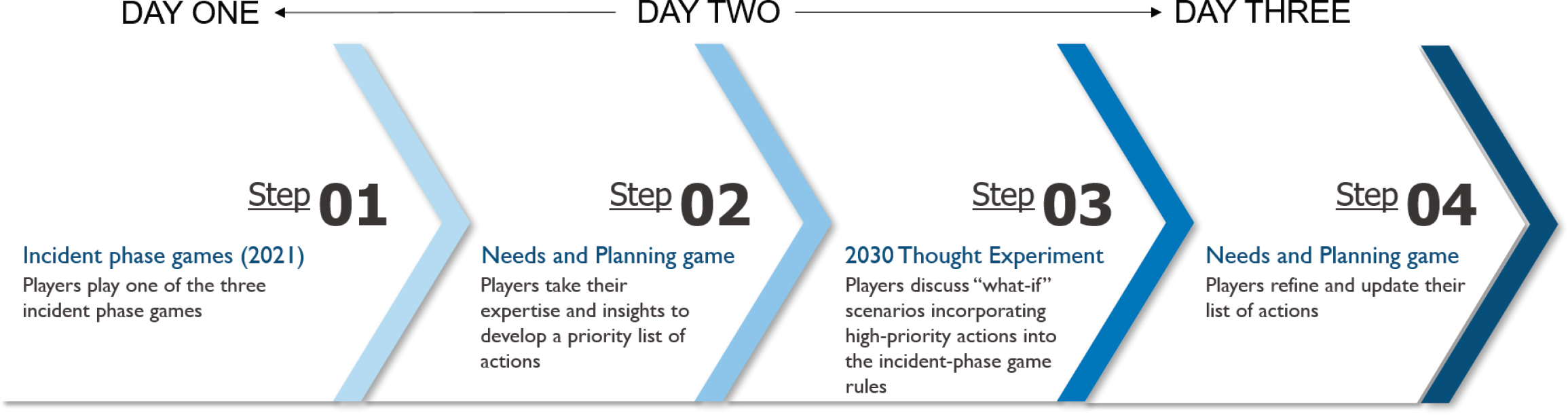
Figure 1-1 shows the step-wise sequence of game execution across the 3 half-days.4 The purpose of the sequencing was to increase interaction among the diverse group of participants, allow for greater information exchange,
___________________
3 Please note that Needs and Planning Game participants were not tasked with determining who would be responsible for implementing each action. Nor were they claiming responsibility for implementing any ideas they set forth. The game focused on idea generation and prioritization.
4 For a detailed breakdown of all of the OSR sessions, see Appendix B.
SOURCE: James Pettigrew presentation, June 16, 2021.
and identify and refine a list of possible actions to enhance resilience to future offshore oil disasters in the Gulf of Mexico. The incident-phase games on Day 1 (Step 1) fed into the first instance of the Needs and Planning Game on Day 2 (Step 2). During this iteration of the Needs and Planning Game, the focus was on development of a prioritized list of actions. Players then participated in a thought experiment, allowing them to discuss how each of the incident-phase games would have been different if they had access to some of the highly prioritized actions that were identified in the Needs and Planning Game. The intent of the 2030 Thought Experiment (Step 3) was to provide participants with an opportunity to reflect on synergies, overlaps, and gaps coming out of the first Needs and Planning Game.5 Hence, the 2030 Thought Experiment fed into the second instance of the Needs and Planning Game (Step 4) held on Day 3, in which the focus was for each Needs and Planning Game stakeholder group to revise its prior list of actions.
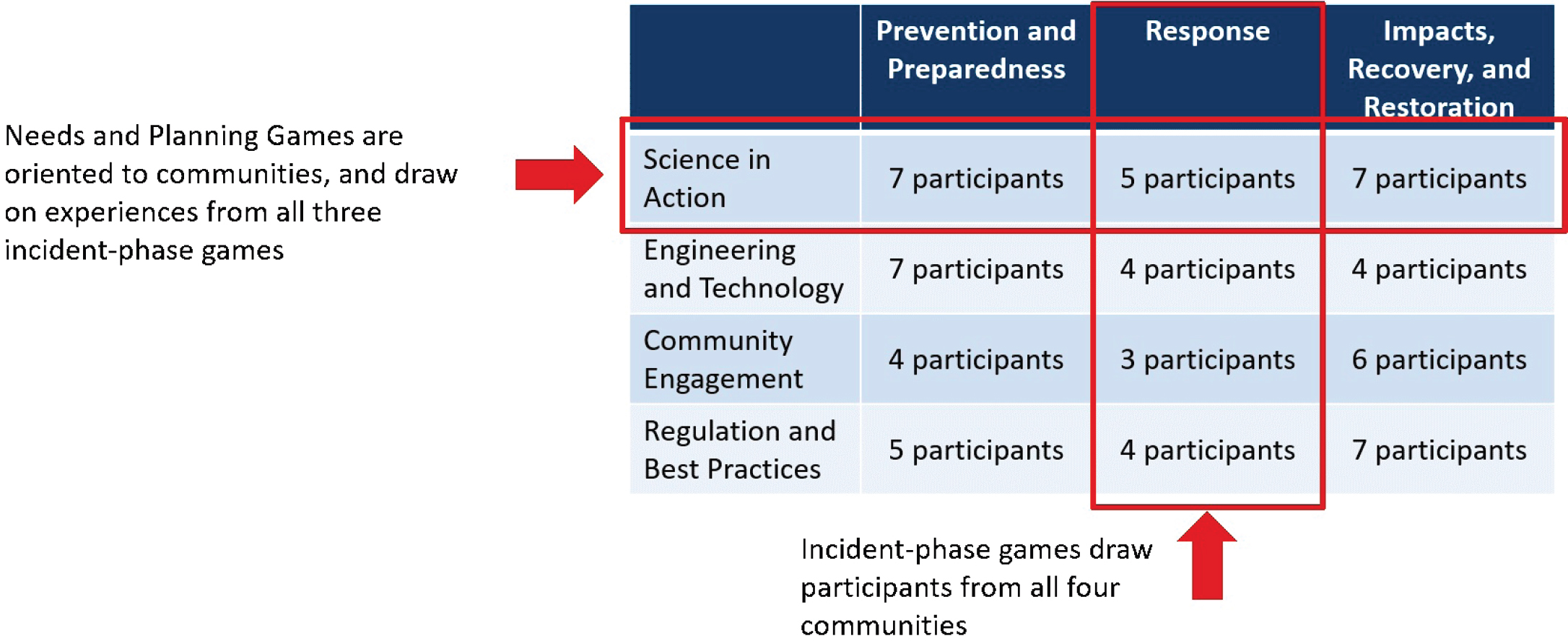
Another important structural component to OSR was how participants were assigned to games. OSR included 60 experts from industry, academia, community, various levels of government, and nongovernmental organizations (see Appendix D for the list of the participants). To maximize interactions among the participants, the OSR planning committee assigned each participant to two groups: (1) a stakeholder community group (Science in Action, Engineering and Technology, Community Engagement, Regulation and Best Practices) and (2) an incident-phase group (Prevention and Preparedness; Response; Impacts, Recovery, and Restoration) based on the participant’s background (see Figure 1-2). The incident-phase games drew participants from across all four stakeholder community groups, and each participant played only one incident-phase game. A total of five incident-phase games took place simultaneously (one Prevention and Preparedness Game; two Response Games; and two Impacts, Recovery, and Restoration Games). The Needs and Planning Game sorted participants by their assigned stakeholder community group, drawing on the experiences of participants from all three incident-phase games. Each stakeholder com-
___________________
5 As discussed later in this proceedings, four parallel executions of the Needs and Planning Game took place on Days 2 and 3 of the event, with each corresponding to one of the four predefined stakeholder groups. As such, the 2030 Thought Experiment exposed participants to high-priority actions coming out of the remaining three Needs and Planning Games that they did not play in.
SOURCE: James Pettigrew presentation, June 16, 2021.
munity group conducted a separate Needs and Planning Game during the event, which resulted in the simultaneous execution of the following four Needs and Planning Games on Days 2 and 3:
- Science in Action
- Engineering and Technology
- Community Engagement
- Regulation and Best Practices
During OSR, each participant played one incident-phase game (Prevention and Preparedness; Response; or Impacts, Recovery, and Restoration) and one Needs and Planning game (Science in Action, Engineering and Technology, Community Engagement, or Regulation and Best Practices).
ORGANIZATION OF THIS PROCEEDINGS
The main body of this proceedings contains six chapters. Following the “Introduction,” the “Opening Plenary” section highlights insights provided by Admiral Thad Allen during his opening remarks at the event. Next, “Incident-Phase Games Observations” identifies discussion points and participant takeaways from the three incident-phase games. In “Needs and Planning Game Actions,” each subsection starts with an overview of a particular stakeholder community group’s discussions before segueing into a list of the highest-priority actions for that group as determined by participant voting. These actions were generated by the OSR participants during highly-interactive sessions over the 3 consecutive half-days. The final two sections of the main body of the proceedings, “Closing Plenary” and “Next Steps,” include reflections about the event and possible opportunities moving forward.
The proceedings also includes the following appendixes:
- Appendix A: Identified Actions presents the full list of actions identified in each of the Needs and Planning Games.
- Appendix B: Event Agenda details the sequence and time allocated for every plenary and breakout session held each day.
- Appendix C: Biographical Sketches of Keynote Speaker and Planning Committee Members provides additional background information about these individuals.
- Appendix D: Registered Event Participants lists all of the participants who attended the event.
This page intentionally left blank.


