Review of the Restructured Research and Analysis Programs of NASA's Planetary Science Division (2017)
Chapter: 1 Introduction
1
Introduction
Planetary science encompasses a broad range of scientific disciplines that address questions such as how planets form, how they work, and why life developed and is sustained on at least one planet in the solar system. The Planetary Science Division (PSD), one of four divisions within NASA’s Science Mission Directorate (SMD), addresses these questions through scientific investigations that include robotic space missions, ground-based observations, modeling activities; and experimental, analytical, and theoretical studies. All of these investigations follow NASA’s strategic goals for planetary science, which are rooted in community-based input and periodic review by the National Academies of Sciences, Engineering, and Medicine,1 beginning with reports from the Committee on Lunar and Planetary Exploration (COMPLEX) from the early 1970s to the late 1990s. Building on this history, NASA’s strategic goals for planetary science are currently addressed by the planetary science decadal surveys. These surveys are performed approximately every 10 years by an ad hoc committee and rely heavily on community input and engagement. The most recent planetary science decadal survey, Vision and Voyages for Planetary Science in the Decade 2013-2022,2 identified three cross-cutting themes (Box 1.1)3 for investigation over the decade 2013-2022. While these themes are generally similar to those from the prior planetary science decadal survey, New Frontiers in the Solar System: An Integrated Exploration Strategy,4 the questions underlying these themes had evolved over the previous decade as new discoveries were made, mission activities retired key questions, and new technologies became available.
Although the planetary science decadal survey themes and questions provide a consensus perspective from the planetary science community, they provide only one of several inputs into NASA’s strategic plan for planetary science. In particular, NASA weighs issues, such as synergy with other mission directorates (notably the Human Exploration and Operations Mission Directorate and its human exploration goals), defense of the human race against threats from asteroids and comets, and characterization and utilization of space resources, that may enable further robotic or human exploration. For that reason, NASA’s planetary science questions and goals (Box 1.2),
___________________
1 Effective July 1, 2015, the institution is called the National Academies of Sciences, Engineering, and Medicine. References in this report to the National Research Council are used in an historical context identifying programs prior to July 1.
2 National Research Council (NRC), Vision and Voyages for Planetary Science in the Decade 2013-2022, The National Academies Press, Washington, D.C., 2011.
3 Ibid., p. 11.
4 NRC, New Frontiers in the Solar System: An Integrated Exploration Strategy, The National Academies Press, Washington, D.C., 2003.
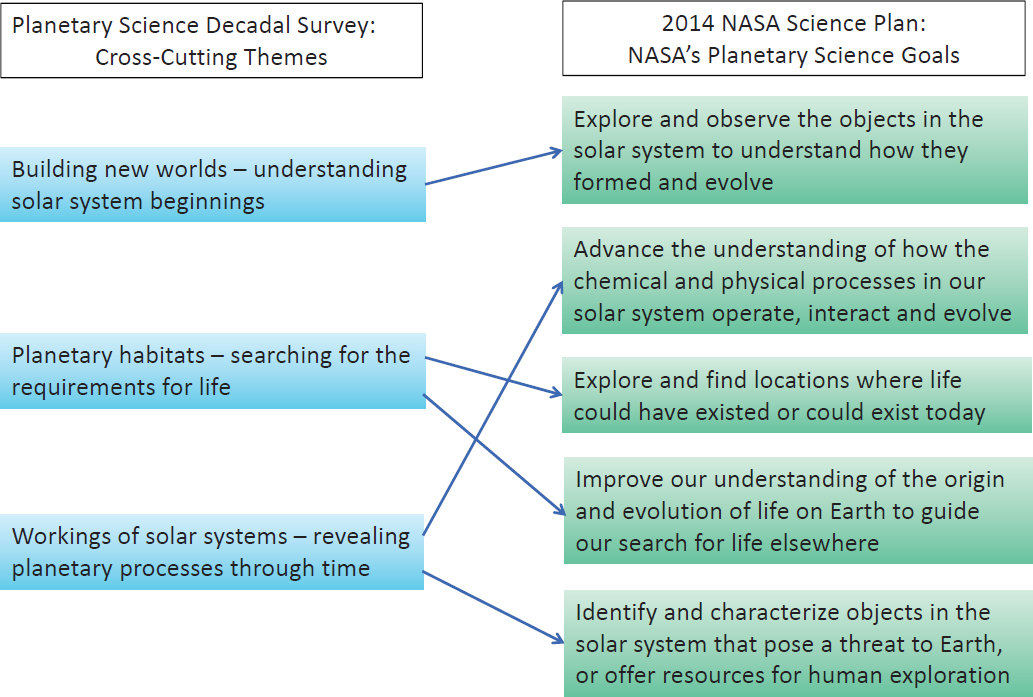
as articulated most recently in NASA’s 2014 Science Plan,5 are more expansive than those of the decadal survey. Nevertheless, clear linkages can be drawn between the decadal survey’s cross-cutting themes and the planetary science goals in the NASA science plan (Figure 1.1).
The questions and goals in NASA’s 2014 Science Plan guide NASA’s planetary science activities, including robotic missions, infrastructure support, technology development, and research and analysis (R&A) activities. Activities under the rubric of R&A usually include new science instrument technology development; suborbital research flights on aircraft, balloons, and sounding rockets; analysis and interpretation of spaceflight data; development of theory and computer simulations; and ground-based telescopic measurements and laboratory investigations—all in support of spaceflight missions. Within this report, the term “R&A” is specifically used to encompass all program elements that are solicited through the annual Research Opportunities in Space and Earth
___________________
5 NASA, 2014 Science Plan, Washington, D.C., 2014, pp. 60-61.
Sciences (ROSES) NASA Research Announcement (NRA),6 which includes core research, core technology, and strategic and focused program elements (as detailed in the section “Planetary Science Division R&A Program Elements” later in this chapter). The data analysis activities are largely contained within the strategic and focused research program elements. Historically, R&A has also been referred to as research and data analysis (R&DA).
PRIOR RELATED STUDIES ON PLANETARY R&A
Several prior advisory reports are directly relevant to the committee’s current study. In 1998, the National Research Council (NRC) examined the full range of R&DA activities being conducted by NASA’s Office of Space Science and Applications. The 1998 report7 discussed the roles and characteristics of different elements of the R&DA program, illustrated how they contribute to NASA’s overall science mission, and examined funding trends and other measures of program content and balance for the 5- to 10-year period leading up to the study. The first recommendation in the report addressed principles for taking a strategic approach to managing R&DA, saying that NASA should
___________________
6 NASA, Research Opportunities in Space and Earth Sciences—2016 (ROSES-2016), NASA Research Announcement (NRA) NNH16Z DA001N, February 2016.
7 NRC, Supporting Research and Data Analysis in NASA’s Science Programs: Engines for Innovation and Synthesis, National Academy Press, Washington, D.C., 1998.
- Regularly evaluate the impact of R&DA on progress toward the goals of NASA’s strategic plans;
- Link NASA research proposal solicitations to addressing key scientific questions that can be related to the goals of the strategic plans;
- Regularly evaluate the balance between the funding allocations for spaceflight programs and the R&DA activities required to support those programs;
- Regularly evaluate the balance among various subelements of the R&DA program; and
- Use broadly based, independent, scientific peer-review panels to define suitable metrics and review the agency’s internal evaluations of balance.
The 1998 NRC report8 also recommended that NASA explicitly consider how R&DA programs address needs for infrastructure (e.g., facilities and institutions) and human capital (e.g., graduate students), and it recommended that NASA improve its capabilities for using funding data as tools in managing the R&DA program strategically.
In 2007, the U.S. Congress directed NASA to task the NRC conduct a new analysis of SMD’s R&A programs, particularly regarding factors relevant to managing the balance between resources for spaceflight missions and
___________________
8 Ibid.
supporting research activities. The report from that study9 again outlined and illustrated the various important roles that R&A programs perform as enablers of NASA’s science missions, and it presented a set of principles, metrics, and recommendations for effective strategic management of R&A programs. The report’s first recommendation was that NASA should ensure that its mission-enabling activities are linked to the strategic goals of the agency and of NASA’s SMD and that they be structured so as to
- Encompass the range and scope of activities needed to support those strategic goals;
- Provide the broad knowledge base that is the context necessary to interpreting data from spaceflight missions and defining new spaceflight missions;
- Maximize the scientific return from all spaceflight missions;
- Supply a continuous flow of new technical capabilities and scientific understanding from mission-enabling activities into new spaceflight missions; and
- Enable the healthy scientific and technical workforce needed to conduct NASA’s space and Earth science program.10
The 2009 NRC report also emphasized the importance of taking a strategic approach to managing NASA’s portfolio of mission-enabling activities. Such an approach would include the following attributes:
- Clearly defined mission-enabling objectives, strategies, and priorities that can be traced back to the overall strategic goals of NASA, SMD, and the relevant discipline division;
- Clearly articulated relationships between mission-enabling activities and the ensemble of ongoing and future spaceflight missions that they support;
- Clear metrics that permit program managers to relate mission-enabling activities to strategic goals, evaluate the effectiveness of mission-enabling activities, and make informed decisions about priorities, programmatic needs, and portfolio balance;
- Provisions for integrating support for innovative high-risk/high-payoff research and technology,[11] interdisciplinary research, and scientific and technical workforce development into mission-enabling program strategies;
- Active involvement of the scientific community via an open and robust advisory committee process; and
- Transparent budgets that permit program managers to effectively manage mission-enabling activity portfolios and permit other decision makers and the research community to understand the content of mission-enabling activity programs.12
In 2011, NASA PSD established a Supporting Research and Technology Working Group under the auspices of the Planetary Sciences Subcommittee of the NASA Advisory Council’s Science Committee to provide advice about implementing the recommendations of the 2009 NRC report. The working group’s charge included the following tasks:13
- Identify those mission-enabling research and analysis activities that are required to support the strategic goals of the NASA SMD Planetary [Science] Division;
- Map these activities to existing PSD program elements and identify activities that overlap multiple elements and activities unsupported by any element; and
- Provide recommendations to PSD regarding the application of “active portfolio management” to meet its strategic goals.14
___________________
9 NRC, An Enabling Foundation for NASA’s Earth and Space Science Missions, The National Academies Press, Washington, D.C., 2009, often referred to as the Fisk report.
10 Ibid., p. 47.
11 For the definition of high-risk/high-payoff research and technology, see NRC, An Enabling Foundation, 2009, p. 40.
12 NRC, An Enabling Foundation, 2009, p. 48.
13 Planetary Sciences Subcommittee, Assessment of the NASA Planetary Science Division’s Mission-Enabling Activities, 2011.
14 NRC, An Enabling Foundation, 2009, p. 28.
In its report, the working group concluded that the then current mission-enabling activities “can be mapped clearly to the specific scientific objectives contained in the NASA 2010 Science Plan.”15 However, the working group also concluded that “many of the research and analysis programs overlap” and that PSD “should consider consolidating programs to eliminate overlap as a part of the portfolio management strategy.”16 While the working group report presented a number of examples of how a detailed mapping could be constructed to link broad scientific objectives to program elements and then to specific research activities, the authors found that to be much too ambitious a task for the working group to perform within its available time and resources. Consequently, the report recommended that NASA carry out such an endeavor as part of its regular response to decadal survey reports. Finally, the working group offered a large number of specific findings and recommendations regarding both near-term and recurring actions that NASA could take to improve program management and execution.
PLANETARY SCIENCE DIVISION R&A PROGRAM ELEMENTS
NASA PSD reorganized its R&A program in 2013, resulting in a revised set of program elements for which research proposals were first solicited in the ROSES 2014 NRA. Selections under this NRA were first awarded using fiscal year (FY) 2015 funding, such that approximately 33 percent of FY2015 R&A funding was awarded to proposals submitted under these revised program elements, with the rest supporting ongoing research activities. The current PSD R&A program elements fall largely within four groups as follows:17
- Core research program elements,
- Core technology program elements,
- Strategic program elements, and
- Focused program elements.
These program elements are detailed in Appendix C of the ROSES 2016 NRA.18 A brief synopsis of the major ongoing program elements is given below, drawn from the ROSES 2016 NRA and presentations to the committee.19
Core Research Program Elements
Each of the following core research program elements have a broad science scope that directly addresses PSD science goals:
- Emerging Worlds (EW)—Research in the area of Emerging Worlds aims to understand the formation and early evolution of the solar system, as well as planetary systems in general. The central goal of this program element is to understand how the Sun’s family of planets, satellites, and minor bodies (including small bodies and planetary rings) form and evolve.
- Solar System Workings (SSW)—The Solar System Workings program element supports research into atmospheric, climatological, dynamical, geological, geophysical, and geochemical processes occurring on planetary bodies, satellites, and other minor bodies (including rings) in the solar system. This program element seeks to address the physical and chemical processes that affect the surfaces, interiors, atmospheres, exospheres, and magnetospheres of planetary bodies.
- Habitable Worlds (HW)—Research supported in Habitable Worlds seeks to use knowledge of the history of Earth and the life upon it to determine the processes that create and maintain habitable environments,
___________________
15 Planetary Sciences Subcommittee, Assessment of the NASA Planetary Science Division’s Mission-Enabling Activities, 2011, p.1.
16 Ibid.
17 Jonathan Rall, PSD R&A Lead at NASA Headquarters, Restructuring Planetary Science’s Research & Analysis Program, Planetary Science Subcommittee, January 2014, slide 23.
18 NASA, ROSES-2016, 2016.
19 Rall, Restructuring Planetary Science’s Research & Analysis Program, 2014.
-
search for ancient and contemporary habitable environments, and explore the possibility of extant life beyond Earth.
- Exobiology (EXO)—The goal of research in Exobiology is to understand the origin, evolution, and distribution of life on Earth. Research is centered on the origin and early evolution of life on Earth and the potential of life to adapt to different terrestrial environments. This research is conducted in the context of NASA’s ongoing exploration of Earth’s stellar neighborhood and the identification of biosignatures for in situ and remote sensing applications.
- Solar System Observations (SSO)—Within the Solar System Observations program element, Near Earth Object Observations (NEOO) supports NASA’s commitment to discover and inventory potentially hazardous near Earth objects with sizes down to ~100 meters and to characterize that population through determination of their orbital elements. This program element also considers proposals that characterize a representative sample of these objects by measuring their sizes, shapes, and compositions. Planetary Astronomy (PAST) supports both ground-based astronomical observations and suborbital investigations of the solar system involving sounding rockets and balloons. Proposals are solicited for observations over the entire range of wavelengths—from the ultraviolet to radio—that contribute to the understanding of the solar system.
Core Technology Program Elements
Each of the following core technology program elements provides funding for technologies that support PSD science and mission activities:
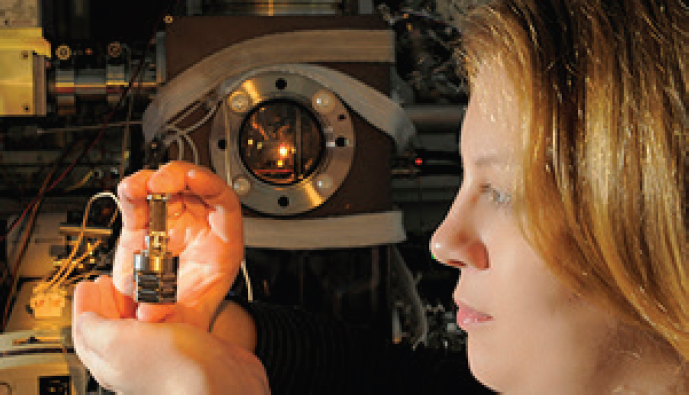
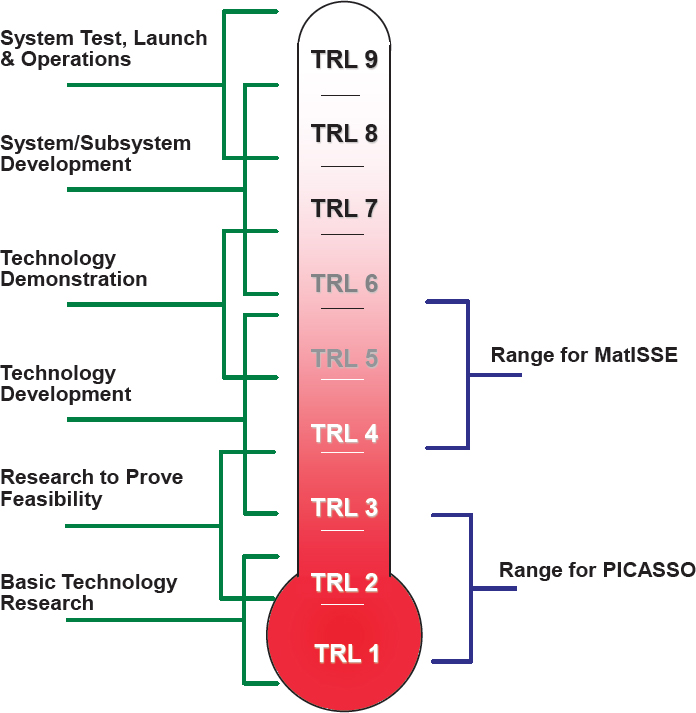
- Maturation of Instruments for Solar System Exploration (MatISSE)—The MatISSE program element supports the advanced development of spacecraft-based instruments that show promise for use in future planetary missions (Figure 1.2). The goal of the program element is to develop and demonstrate planetary and astrobiology science instruments to the point where they may be proposed in response to future announcements of flight opportunity without additional extensive technology development (i.e., to advance the technology readiness level [TRL] from three to six [Figure 1.3]20).
- Planetary Instrument Concepts for the Advancement of Solar System Observations (PICASSO)—The PICASSO program element supports the development of spacecraft-based instrument systems that show promise for use in future planetary missions. The goal of the program element is to conduct planetary and astrobiology science instrument feasibility studies, concept formation, proof of concept instruments, and advanced component technology development to the point where they may be proposed in response to the MatISSE program element (i.e., to advance the TRL from one to three).
- Planetary Major Equipment (PME)—The PME program provides funding for the purchase or development of new or upgraded non-flight analytical, computational, telescopic, and other instrumentation required by investigations in eligible planetary science research program elements.
Strategic Program Elements
The following strategic program elements, which are generally narrower in scope than the core program elements, sustain for multiple funding cycles and address current PSD strategic needs:
- Planetary Data Archiving, Restoration, and Tools (PDART)—The PDART program element solicits proposals to generate higher-order data products, archive and restore data sets or products, create or consolidate reference databases, generate new reference information, digitize data, and develop or validate software tools.
___________________
20 A technology readiness level (TRL) 6 technology is defined by NASA as having a fully functional prototype or representational model that has yet to be demonstrated in a space environment.
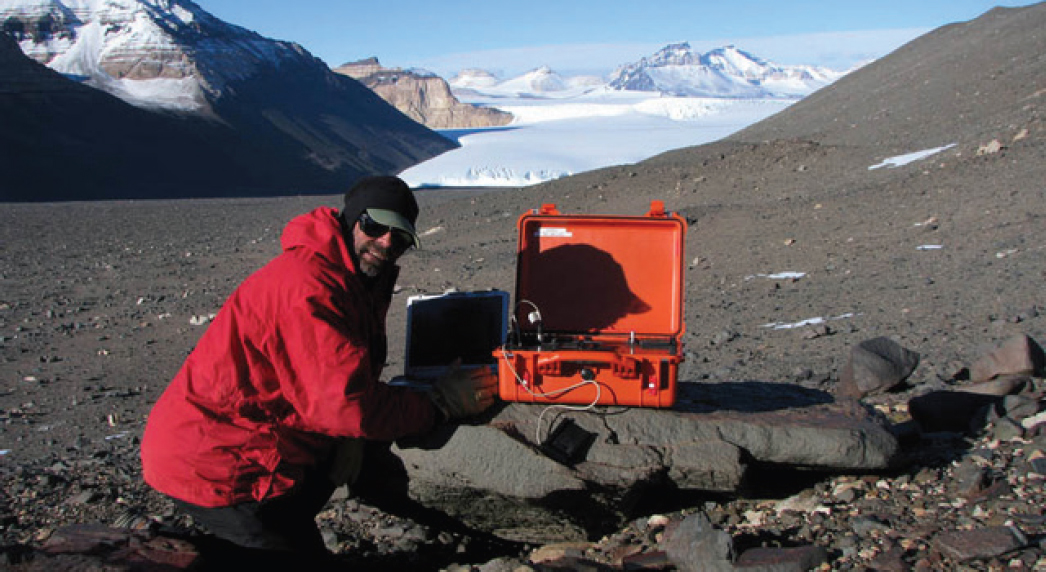
- Planetary Science and Technology from Analogue Research (PSTAR)—The PSTAR program element addresses the need for integrated interdisciplinary field experiments as an integral part of preparation for planned human and robotic missions. Furthermore, the program element solicits proposals for investigations focused on exploring the Earth’s extreme environments in order to develop a sound technical and scientific basis to conduct astrobiological research on other solar system bodies (Figure 1.4).
- Exoplanets Research (XRP; joint with Astrophysics Division)—The Exoplanets research program element solicits basic research proposals to conduct scientific investigations related to the research and analysis of extrasolar planets (exoplanets). Its broad objectives include the determination of compositions, dynamics, energetics, chemical behaviors of extrasolar planets, and the detection and characterization of other planetary systems.
- New Frontiers Data Analysis Program (NFDAP)—The objective of NFDAP is to enhance the scientific return from New Frontiers21 missions by broadening scientific participation in the analysis and interpretation of data returned by these missions.
- Discovery Data Analysis Program (DDAP)—The objective of DDAP is to enhance the scientific return of Discovery22 missions by broadening scientific participation in the analysis of data, both recent and archived, collected by these missions.
- Laboratory Analysis of Returned Samples (LARS)—The goal of the LARS program element is to maximize
___________________
21 New Frontiers missions are competed principal investigator (PI)-led missions selected from a set of candidate missions identified by the 2011 planetary science decadal survey. For the most recent competition, total mission cost is capped at $850 million (FY2015) for Phases A through D, not including the cost of the Expendable Launch Vehicle (ELV) or any foreign or other contributions.
22 Discovery missions are competed PI-led missions that are not specifically identified by the 2011 planetary science decadal survey. For the most recent competition, total mission cost was capped at a Phase A-D cost of $450 million (FY2015), excluding standard launch services.
- Mars Data Analysis Program (MDAP)—The objective of MDAP is to perform analysis of mission data sets to enhance the scientific return from missions to Mars conducted by NASA and other space agencies.
- Planetary Protection Research (PPR)—Planetary protection involves preventing biological contamination on both outbound and sample return missions to other planetary bodies. Numerous areas of research in astrobiology and exobiology are improving understanding of the potential for survival of Earth microbes in extraterrestrial environments, which is relevant to preventing contamination of other bodies by organisms carried on spacecraft. Research is required to improve NASA’s understanding of the potential for both forward and backward contamination, how to minimize it, and to set standards in these areas for spacecraft preparation and operating procedures.
the science derived from planetary sample-return missions. Activities supported by LARS fall into two categories: (1) development of laboratory instrumentation and/or advanced techniques required for the analysis of returned samples and (2) direct analysis of samples already returned to Earth.
Focused Program Elements
The following focused program elements, which are narrower in scope than the core program elements, are solicited only for a limited time usually associated with the end of a flight mission or series of missions:
- Lunar Data Analysis Program (LDAP)—The objective of this limited-term program element is to take full advantage of the wealth of lunar data from recent and ongoing missions.
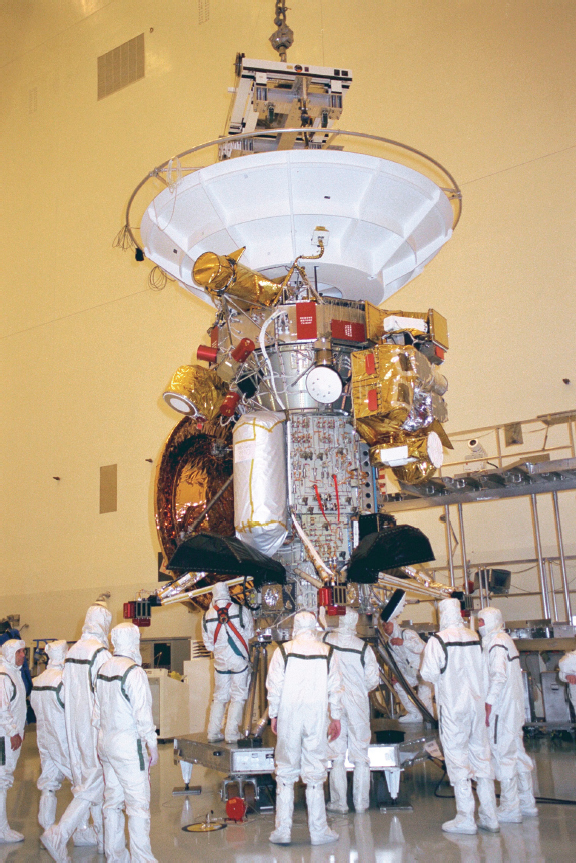
- Cassini Data Analysis Program (CDAP)—The objective of this limited-term program element is to take full advantage of the wealth of data from the Cassini mission to Saturn (Figure 1.5).
NASA PSD also establishes program elements that address topical needs or targeted technology requirements. Such program elements are often of short duration and include the following:
- New Frontiers Homesteader—This program element was released in ROSES 2015 to support the advanced development of technology, including instruments, relevant to mission concepts for the next two New Frontiers Announcements of Opportunity, the first of which will be selected in 2019.
- Concepts for Ocean Worlds Life Detection Technology (COLDTech)—This program element supports the development of spacecraft-based instruments and technology for surface and subsurface exploration of ocean worlds such as Europa, Enceladus, and Titan.
- Small Innovative Missions for Planetary Exploration (SIMPLEx)—This program element supports the formulation and development of science investigations that can be accomplished using small spacecraft.
- Planetary Science Deep Space SmallSat Studies (PSDS3)—This program element supports the study of spacecraft mission concepts that can be accomplished using small spacecraft, including CubeSats.
- Dynamic Power Converters for Radioisotope Power Systems—The goal of this program element is to investigate new dynamic power-conversion technologies for radioisotope power systems that can enable future spacecraft missions.
- Hot Operating Temperature Technology (HOTTech)—This program element supports the advanced development of technologies for the robotic exploration of high-temperature environments, such as the surfaces of Venus and Mercury, or the deep atmosphere of the gas giant planets.


