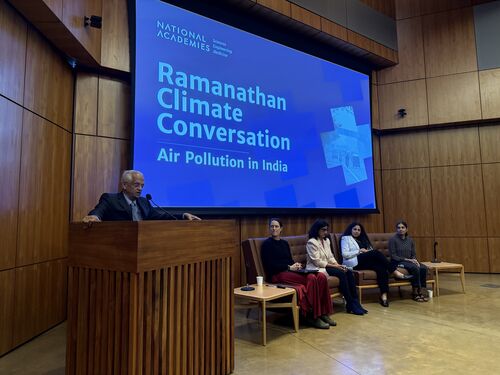
Join us for a discussion about the interactions between air pollution, climate change, and public health in India.
About this event
Poor air quality remains one of the most pressing environmental and public health challenges in India. Driven by emissions from vehicle exhaust and agricultural practices like crop residue burning, air pollution poses significant risks to human health and contributes to climate change. While certain pollutants can have localized cooling effects, greenhouse gases contribute to warming on a global scale. With Indian cities such as Delhi ranking among the most polluted in the world, gaining a deeper understanding of the complex dynamics between air pollution, human health, and climate change is critical for improving global health outcomes and addressing climate change.
Jen Burney (Stanford University) moderated a conversation between Meha Jain (University of Michigan), Meera Mahadevan (UC San Diego), and Pallavi Pant (Health Effects Institute) exploring the drivers and impacts of air pollution in India, with a special focus on agricultural practices, and actions that are being taken to address public health concerns.
The fourth annual Ramanathan Climate Conversation took place at the Scripps Institution of Oceanography, UC San Diego on September 29 as a part of RamFest 2025—a symposium dedicated to celebrate the career and retirement of Professor Veerabhadran Ramanathan. To learn more about the symposium, please visit: RamFest2025.
Ramanathan Climate Conversations are annual webinars in honor of National Academy of Sciences member Veerabhadran “Ram” Ramanathan, and are made possible through generous support provided by Sunanda Basu. Recognizing that climate change is a global challenge that requires global solutions, Ramanathan Climate Conversations focus on climate resilience in South and East Asia, aiming to identify pathways to action relevant to viewers and policymakers around the world. They are part of the Climate Conversations: Pathways to Action monthly webinar series from the National Academies of Sciences, Engineering, and Medicine, which aims to convene high-level, cross-cutting, nonpartisan conversations about issues relevant to policy action on climate change.
Participant Bios
Jennifer Burney is a Professor in Global Environmental Policy and Earth System Science in the Doerr School of Sustainability at Stanford University. Her research focuses on the coupled relationships between climate and food security – measuring air pollutant emissions and concentrations, quantifying the effects of climate and air pollution on land use and food systems, understanding how food production and consumption contribute to climate change, and designing and evaluating technologies and strategies for adaptation and mitigation among the world’s farmers. She has a PhD in Physics from Stanford University and was named a National Geographic Emerging Explorer in 2011. Prior to joining the Doerr School, she served on the faculty at UC San Diego's School of Global Policy and Strategy and Scripps Institution of Oceanography.
Meha Jain is an Associate Professor in the School for Environment and Sustainability and is also part of the Sustainable Food Systems Initiative at the University of Michigan. Jain's research examines the impacts of environmental change on agricultural production, and strategies that farmers may adopt to reduce negative impacts. To date her work has focused on the impacts of weather variability and groundwater depletion on agricultural production in smallholder systems, and whether farmers are able to adapt their cropping practices to mitigate these impacts. She has a B.A. in Ecology and Evolutionary Biology from Princeton University and a Ph.D. in Ecology, Evolution, and Environmental Biology from Columbia University.
Meera Mahadevan is an Assistant Professor at the School of Global Policy and Strategy at UC San Diego. Her research lies at the intersection of development, energy, and environmental economics, focusing on public service delivery, infrastructure, and political economy in low- and middle-income countries. She currently works on projects on electricity transitions, water markets, and governance in South Asia. Mahadevan holds a Ph.D. in economics from the University of Michigan, an M.Sc. in economics for development from the University of Oxford and a B.A. (Hon.) in economics from Delhi University.
Pallavi Pant is an air quality scientist with more than 15 years of experience working on air pollution and health, particularly in low- and middle-income countries. Her research has focused on air quality, source apportionment, and exposure assessment. She currently serves as the Head of Global Initiatives at the Health Effects Institute. She serves on editorial boards for Air Quality, Atmosphere & Health and PLOS Global Public Health, chairs the Governing Board of OpenAQ, and also advises on global air quality and health efforts for the World Health Organization and the Climate and Clean Air Coalition. Dr. Pant holds a Ph.D. in Environmental Health from the University of Birmingham, UK and a Masters in Environmental Sciences from the TERI School of Advanced Studies, India.