The Far-Reaching Impacts of Racism and Bias
Feature Story
By Sara Frueh
Last update December 3, 2020
Examining how racism affects Black Americans in science, engineering, and medicine
In 2010 a group of researchers conducted an experiment in which they pretended to be students, emailing 6,500 professors in nearly 90 academic fields at 259 universities with a request to discuss research before applying for a doctoral program. The text of the messages was identical, but the sender’s name was varied to signal race and gender, such as Brad Anderson, Latoya Brown, and Mei Chen.
The researchers found that messages sent from typical white male names were 25 percent more likely to get a response from the professor. And the highest levels of bias were found among professors in higher rated schools and higher salaried subject areas.
Such biases have harmful impacts on students of color, said Howard Ross of consulting firm Cook Ross. “Responsiveness from your professor — the ability to get communication, to get information, to get your questions answered … all of these are factors which impact students’ ability to be successful.”
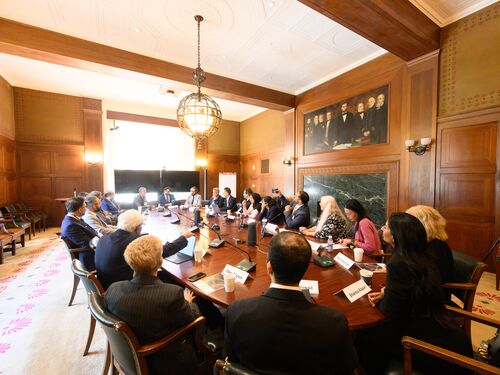
Ross described the study during a workshop held last spring — and summarized in a new publication — that explored the impacts of racism and bias on Black men and women pursuing careers in science, engineering, and medicine.
Black Americans continue to be severely underrepresented in these fields: Blacks make up 13 percent of the U.S. population, but represent less than 7 percent of medical students and less than 3 percent of practicing physicians, for example. And only 4.8 percent of employed professionals in the science and engineering disciplines are Black men and women.
The workshop was the first one held by the National Academies’ Roundtable on Black Men and Black Women in Science, Engineering, and Medicine, which focuses on barriers and opportunities encountered by Black men and women as they navigate these educational and career pathways.
Pernicious and pervasive, racism and bias in many ways serves as a backdrop to issues surrounding Black men and women in science, engineering, and medicine.
Roundtable chair Cato T. Laurencin, University Professor at the University of Connecticut, explained why racism and bias was chosen as the group’s first topic: “Pernicious and pervasive, racism and bias in many ways serves as a backdrop to issues surrounding Black men and women in science, engineering, and medicine.”
In opening the workshop, National Academy of Medicine President Victor Dzau also stressed the gravity of the problem. “Discrimination, prejudice, and unconscious and conscious bias create exclusionary environments that prevent Black men and women from entering the pipeline and pursuing careers in science, engineering, and medicine,” he said. “It is critical that we recognize that persistent structural racism and stereotyping still facing African American males and females is a significant problem.”
The ripple effects of residential segregation
Racism is a system that structures opportunity and assigns value in ways that unfairly disadvantage some groups and unfairly advantage other groups, said Camara Jones, the keynote speaker at the workshop, and past president of the American Public Health Association. Racism also saps society’s strength by wasting human resources, she said.
One way that institutionalized racism operates is through residential segregation, which in turn leads to educational segregation and lack of opportunity, she said. Public school funding in most areas is based on local property taxes, which leads poor communities to have poorly funded schools. “We as a nation are not vigorously investing in the full, excellent public education of all of our children,” said Jones, noting that the “blinders of racism” keep decision-makers from seeing that there is genius in all communities.
Richard Rothstein, a distinguished fellow of the Economic Policy Institute, elaborated on this point in a presentation. “Schools today are more segregated than at any time in the last 50 years in this country, and they are more segregated because the neighborhoods in which they are located are segregated.” This residential segregation — which is not an accident, but rather the legacy of federal, state, and local housing policies — is the major driver of the achievement gap in education, he said.
‘This is something that we have always succeeded in’
Medical writer and editor Harriet Washington offered a history of the policies and prejudices that Black men and women have faced in pursuing study and practice in medicine. For example, even after a small number of African Americans were allowed admission to U.S. medical schools in the 1800s, they were not permitted to pursue degrees, she said. After African Americans were allowed to get medical degrees, they were barred from residencies, training in specialties, and practicing in hospitals. During the civil rights movement, it took 15 years of picketing and lawsuits in order to fully integrate the American Medical Association and to allow Black physicians to practice in hospitals, Washington explained.
Despite these and other barriers, African Americans have long made significant contributions to practice and research in medicine, Washington said — from Onesimus, the first person to demonstrate variolation for smallpox, to Solomon Carter Fuller, who worked to characterize Alzheimer’s disease.
“There’s a whole pantheon of African American medical researchers who have transformed the face of American medicine,” said Washington. “It’s really important that it’s better known, and that people understand our contributions. It’s important for African American young people to understand … that far from being some exotic, unattainable goal, this is something that we have always succeeded in.”
But the belief that African Americans lack the intelligence and character to practice medicine is not confined to history, Washington said: “These attitudes unfortunately have not died.” She noted recent incidents in which an airline passenger was having a medical emergency, and the flight attendants demanded the credentials of Black female physicians who volunteered to help, but not those of white physicians.
Looking critically at environments
“Racial tension, biases, and discrimination are not only very alive but on the rise, and they are impacting our learners and faculty significantly,” said David Acosta, who leads the diversity policy and programs unit at the American Association of Medical Colleges.
Over the past 30 to 40 years, the number of Black applicants to medical schools and science and engineering graduate schools has remained relatively flat — only increasing by 1.3 percent — despite multiple attempts by many institutions to address the problem, said Acosta. Anti-affirmative action laws have impacted efforts to accelerate enrollment of students in these programs, he said. And for those who enroll, institutional environments present more challenges.
Research has revealed that medical students and residents face problems such as stereotype threat, micro- and macro-aggressions, and isolation and marginalization, among others, said Acosta. Similar problems are experienced by minority faculty in STEMM fields, who perceive their environments as being extremely stressful, exhausting, and diminishing to their sense of control, meaning, and comfort.
“We need to take a critical look at our institutional environments — the learning and workplace environments coupled together — because when we begin thinking about the toxic environments we’re exposing our students to, they’re not necessarily allowing them to thrive,” said Acosta.
Identifying levers for action
Throughout the workshop, participants offered ideas for how to address racism in science, engineering, and medicine. “We have to be willing to confront overt and conscious bias very directly,” said Ross. And in cases where people display a bias they may not be aware of, he said it can help to approach them initially with the assumption that they didn’t realize how backward their attitude was. “There are times when by speaking to people’s humanity at first, we can get them to look inward a little bit.”
In her keynote remarks, Jones stressed the importance of identifying the ways structural racism is at work. “We need to ask ‘How is racism operating here?’ … if we want to identify the levers on which we need to act,” Jones said. “We need to look at the mechanisms in our structures, policies, practices, norms, and values, which are different elements of decision-making.” She also challenged participants to continually watch for those who are not at the decision-making table, and to create space for them.
Featured Publication
Workshop
·2020
Despite the changing demographics of the nation and a growing appreciation for diversity and inclusion as drivers of excellence in science, engineering, and medicine, Black Americans are severely underrepresented in these fields. Racism and bias are significant reasons for this disparity, with detri...
View details